
The history of the calculator is not merely a chronicle of a helpful tool; it is the fundamental history of computing itself. Long before the silicon chips of Silicon Valley or the sophisticated algorithms of modern artificial intelligence, humanity struggled with the burden of complex arithmetic. The journey from manual counting to the sleek, high-speed digital interfaces we use today represents one of the most significant technological trajectories in human history. To answer the question of who invented the calculator first, we must look beyond a single name and instead examine a series of revolutionary breakthroughs that transitioned calculation from a mental labor to a mechanical certainty.

The Ancient Roots of Computation: From the Abacus to Napier’s Bones
Before the “invention” of the calculator as a standalone machine, the technological foundation was laid by ancient civilizations seeking to extend the limits of the human mind. These early devices were the “hardware” of their time, providing a physical interface for mathematical logic.
The Abacus: The First “Digital” Interface
While often dismissed as a simple toy, the abacus was the world’s first digital calculating device. Emerging in Mesopotamia around 2700–2300 BC, it utilized a system of beads on rods to represent place value. In a technological sense, the abacus was the precursor to the binary systems used in modern tech; it required a standardized set of rules (an algorithm) to manipulate physical objects to arrive at a data-driven conclusion. It remained the primary tool for commerce and engineering for millennia, proving that the need for a “calculating machine” is as old as civilization itself.
Napier’s Bones: Simplifying Logarithms
Fast forward to 1617, and we encounter John Napier, a Scottish mathematician who sought to reduce the time-consuming nature of multiplication and division. He invented “Napier’s Bones,” a manually operated device consisting of numbered rods. By placing these rods in a frame, users could perform complex calculations by simply adding or subtracting numbers based on the alignment of the rods. This was a critical step in “Tech history” because it moved calculation away from pure mental abstraction and toward a structured, modular system of data processing.
The Mechanical Pioneers: Pascal, Schickard, and the Birth of Automated Arithmetic
The true “invention” of the mechanical calculator—a device that could perform carries and borrows automatically without manual intervention—occurred during the 17th century. This era marked the transition from “tools that assist” to “machines that calculate.”
Wilhelm Schickard’s “Calculating Clock”
In 1623, German polymath Wilhelm Schickard designed what is widely considered the first mechanical calculator. Often referred to as the “Calculating Clock,” it used a system of gears and cylinders to perform addition and subtraction. Unfortunately, Schickard’s prototype was destroyed in a fire, and his designs remained buried for centuries. From a technological perspective, Schickard’s genius lay in his realization that mathematical logic could be mirrored by the physical rotation of interlocking gears—a concept that would define computing until the mid-20th century.
Blaise Pascal and the Revolutionary Pascaline
While Schickard came first, Blaise Pascal is the name most frequently associated with the first functional mechanical calculator. In 1642, at only 19 years old, Pascal invented the “Pascaline” to help his father, a tax collector, with tedious bookkeeping. The Pascaline was a marvel of 17th-century engineering; it used a series of wheels with ten teeth, each representing a digit. The breakthrough tech here was the “sautoir,” a sophisticated gravity-based carry mechanism that allowed the machine to automatically advance the next wheel when a digit surpassed nine. This was the first time a machine “thought” through a mathematical problem autonomously.
Leibniz and the Stepped Reckoner
Gottfried Wilhelm Leibniz, a titan of mathematics and philosophy, took Pascal’s work further in 1673. He designed the “Stepped Reckoner,” which introduced the “Leibniz wheel”—a cylinder with teeth of varying lengths. This allowed for not just addition and subtraction, but also multiplication and division through repeated addition. Perhaps more importantly for modern tech enthusiasts, Leibniz was a fierce advocate for the binary system. He envisioned a world where all logic could be reduced to 0s and 1s, essentially laying the philosophical and mathematical groundwork for every computer, smartphone, and server in existence today.
The Industrialization of Math: The Arithmometer and Beyond
For nearly 200 years after Pascal and Leibniz, calculators were bespoke, expensive curiosities for the elite. The shift from a laboratory experiment to a commercial tech product happened during the Industrial Revolution.
Thomas de Colmar: Bringing Calculation to the Masses
In 1820, Charles Xavier Thomas de Colmar patented the “Arithmometer.” While it utilized Leibniz’s stepped drum technology, its significance lay in its reliability and manufacturability. It was the first commercially successful mechanical calculator. For the first time, businesses, insurance companies, and government agencies could purchase a “device” to handle their data processing. This marked the birth of the “fin-tech” (financial technology) sector, as the Arithmometer became a staple in offices worldwide, remaining in production for nearly a century.
The Curta Calculator: Engineering Perfection in the Palm of Your Hand
As the 20th century approached, the race was on to shrink the technology. The pinnacle of mechanical calculation was the Curta calculator, invented by Curt Herzstark while he was a prisoner in a concentration camp during WWII. Released in 1948, the Curta was a small, cylindrical device that fit in the palm of a hand. It was an engineering masterpiece, containing thousands of tiny, precision-engineered parts. To this day, the Curta is revered by tech historians as the ultimate “handheld” device before the age of electronics, representing the absolute limit of what gear-based technology could achieve.
The Electronic Shift: The Rise of Modern Digital Calculators
The mid-20th century saw a paradigm shift that mirrored the transition from the steam engine to the internal combustion engine. The vacuum tube, the transistor, and eventually the integrated circuit replaced gears and levers, leading to the “Tech Revolution” as we know it.
The ANITA: The World’s First Electronic Desktop Calculator
In 1961, the British company Bell Punch Co. released the ANITA (A New Inspiration To Arithmetic/Accounting). This was the first all-electronic desktop calculator. It utilized vacuum tubes and cold-cathode tubes for its display. While bulky by today’s standards, it was silent and incredibly fast compared to its mechanical predecessors. The ANITA signaled the end of the mechanical era and the beginning of the electronic age, where electrons—not gears—would carry the burden of logic.
The Microchip Revolution and the Pocket Calculator
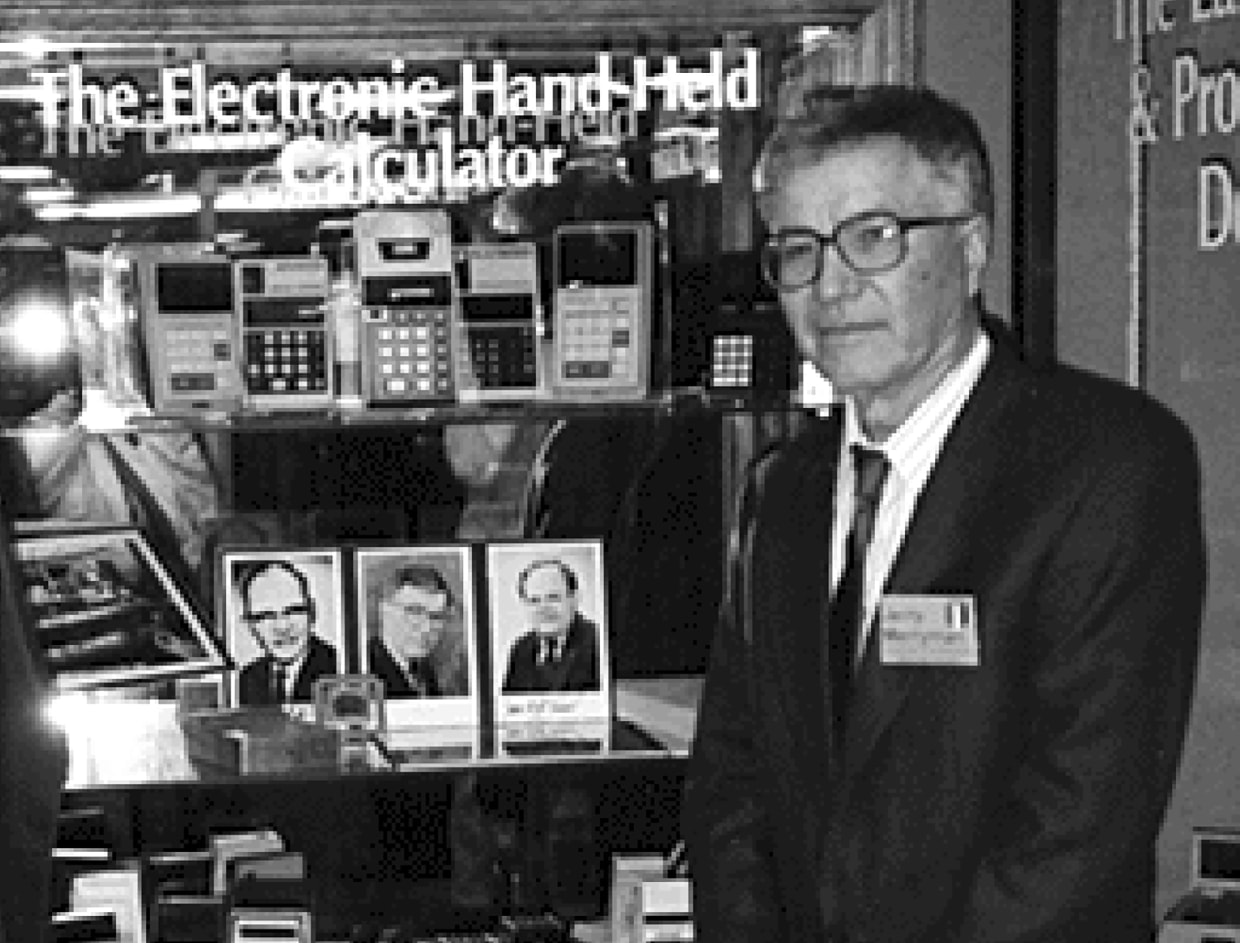
The 1970s brought the most significant disruption in the history of the calculator: the microprocessor. In a collaborative effort to create a portable calculator for the Japanese company Busicom, Intel created the 4004 chip—the world’s first microprocessor. This technological leap allowed companies like Texas Instruments, Sharp, and Casio to produce truly portable, battery-powered pocket calculators.
By the mid-70s, the “Calculator Wars” were in full swing. Prices plummeted from hundreds of dollars to under twenty, making high-level computation accessible to every student and professional. This democratization of technology was a precursor to the personal computer revolution of the 1980s.
The Future of Calculation in the Age of AI and Cloud Computing
Today, the standalone calculator has largely been absorbed into the “Swiss Army Knife” of modern technology: the smartphone. However, the technology of calculation has not stopped evolving; it has simply moved into the background of our digital lives.
Software-Based Engines and Symbolical Mathematics
Modern calculation is no longer limited to basic arithmetic. Tools like WolframAlpha and specialized graphing calculator apps use symbolic computation to solve complex calculus, linear algebra, and physics equations. These are not just “calculators” in the traditional sense; they are knowledge engines. They utilize massive cloud-based databases and sophisticated software architectures to provide answers that would have taken 17th-century mathematicians a lifetime to derive.

The Integration of Artificial Intelligence in Computational Tools
We are currently entering the era of AI-driven calculation. Large Language Models (LLMs) and specialized AI agents are now capable of interpreting natural language queries to perform multi-step mathematical reasoning. Instead of inputting “5 + 5,” a user can describe a complex engineering problem, and the AI will identify the necessary formulas, pull the required data, and execute the calculation.
The invention of the calculator did not end with the Pascaline or the pocket TI-84. It is a continuous tech journey. From the first tooth on a gear in 1642 to the first transistor in 1954 and the first neural network of the 21st century, the calculator remains the most vital tool in the human arsenal. It is the bridge between human thought and digital execution, proving that our quest to automate the “boring” parts of math is what ultimately allowed us to reach for the stars, decode the genome, and build the digital world we inhabit today.
aViewFromTheCave is a participant in the Amazon Services LLC Associates Program, an affiliate advertising program designed to provide a means for sites to earn advertising fees by advertising and linking to Amazon.com. Amazon, the Amazon logo, AmazonSupply, and the AmazonSupply logo are trademarks of Amazon.com, Inc. or its affiliates. As an Amazon Associate we earn affiliate commissions from qualifying purchases.