
Navigating the landscape of estimated tax payments is a rite of passage for entrepreneurs, freelancers, and investors. Unlike traditional employees who have taxes withheld from every paycheck, self-employed individuals and those with significant non-wage income are responsible for paying their taxes in four installments throughout the year. Knowing exactly where and how to send these payments is critical to avoiding underpayment penalties and maintaining a healthy relationship with the Internal Revenue Service (IRS).
The process of paying quarterly taxes has evolved significantly from the days of paper checks and snail mail. Today, the digital ecosystem offers a variety of streamlined, secure, and even automated ways to fulfill these obligations. Understanding the nuances of each platform ensures that your capital remains managed efficiently while your compliance status stays beyond reproach.
Understanding the Primary IRS Digital Payment Portals
The IRS has invested heavily in its digital infrastructure to make the payment process as frictionless as possible. For the vast majority of taxpayers, the “where” of quarterly taxes begins and ends with two primary official web portals.
IRS Direct Pay for Individuals
For freelancers, sole proprietors, and individual investors, IRS Direct Pay is the gold standard for quarterly submissions. This platform allows you to pay your estimated taxes directly from a checking or savings account without any processing fees.
The primary advantage of Direct Pay is that it does not require a pre-registered account. You can simply navigate to the IRS website, select “Make a Payment,” choose the “Estimated Tax” reason, and verify your identity using information from a previous year’s tax return. Once verified, you enter your bank routing and account numbers. The system provides an immediate confirmation number, which serves as a vital digital receipt for your financial records. Direct Pay is available seven days a week, though it does have brief nightly maintenance windows that users should be aware of when approaching a deadline.
The Electronic Federal Tax Payment System (EFTPS)
While Direct Pay is convenient for one-off individual payments, the Electronic Federal Tax Payment System (EFTPS) is designed for those who require more robust tracking and scheduling capabilities. This is the preferred method for many small business owners and those who manage multiple tax types (such as payroll taxes in addition to estimated income taxes).
EFTPS requires a formal registration process, which includes receiving a PIN via physical mail for security purposes. Once set up, however, it offers unparalleled control. Users can schedule payments up to 365 days in advance, allowing a business owner to set their entire year’s quarterly payments in January and forget about them. Furthermore, EFTPS maintains a 16-month history of all payments made through the system, providing a comprehensive audit trail that is invaluable during tax preparation season.
Utilizing Digital Platforms and Third-Party Gateways
While direct bank transfers are often the most cost-effective, they are not the only digital avenues available. Depending on your cash flow needs or your desire for rewards, third-party processors and mobile applications offer alternative solutions.
Paying via Debit or Credit Cards
The IRS does not collect credit card information directly; instead, it utilizes authorized third-party payment processors like PayUSAtax, Pay1040, or ACI Payments, Inc. These platforms allow you to pay your quarterly taxes using a standard credit or debit card.
The trade-off for this convenience is the processing fee. Typically, debit card payments incur a flat fee of a few dollars, while credit card payments incur a percentage-based fee (usually ranging from 1.8% to 2.2%). From a financial strategy perspective, this method is rarely optimal unless you are trying to meet a minimum spend requirement for a high-value credit card sign-up bonus or if you are facing a temporary cash flow gap and need to leverage credit to avoid IRS underpayment penalties. It is important to remember that these fees may be tax-deductible as a business expense for those who are self-employed.
The IRS2Go Mobile App
For the professional on the move, the IRS2Go app provides a mobile-optimized gateway to the same payment services found on the IRS website. Available on both iOS and Android, the app acts as a secure portal where you can access Direct Pay or card payment processors from your smartphone.
While the app doesn’t host the payment processing itself, it provides a secure environment that ensures you are navigating to legitimate IRS-sanctioned sites rather than potentially fraudulent mirrors. It also allows users to check their refund status and sign up for helpful tax tips, making it a useful tool for general financial management.
Alternative and Offline Payment Channels
Despite the push toward digital-first interactions, there are several “analog” or hybrid ways to pay quarterly taxes. These methods remain relevant for those who prefer physical documentation or who may be dealing with complex banking situations.

The Voucher Method (Form 1040-ES)
If you prefer to pay by check or money order, you must use Form 1040-ES, Estimated Tax for Individuals. This form includes four payment vouchers, one for each quarterly deadline.
When using this method, the “where” becomes a physical mailing address. It is crucial to note that the mailing address for your quarterly voucher depends on the state in which you reside. Sending your payment to the wrong processing center can lead to delays in crediting your account. Always use a trackable mailing service, such as USPS Certified Mail with a return receipt, to prove the payment was postmarked by the deadline. This provides a layer of protection in the event that the check is lost in transit or delayed by the IRS processing centers.
Cash Payments and Retail Partners
A lesser-known option is the ability to pay quarterly taxes with cash. The IRS has partnered with retail chains like 7-Eleven, CVS, and Walgreens through the “Official Payments” program. To use this method, you must first initiate the process on the IRS website to receive a “pay code.”
Once you have your code, you can visit a participating retail location and pay your taxes at the service desk. Note that there are daily limits on cash payments (often $1,000 per day) and a small processing fee. This method is primarily used by unbanked individuals or those who manage cash-heavy businesses and want to satisfy their tax obligations without first depositing the funds into a bank account.
Strategic Cash Flow Management for Quarterly Obligations
Finding out where to pay your taxes is only half the battle; the other half is ensuring the funds are available when the deadlines arrive. Strategic financial management is what separates a thriving business from one struggling with IRS debt.
High-Yield Savings Accounts for Tax Reserves
A common mistake among new freelancers is treating their entire gross income as spendable revenue. To avoid a liquidity crisis in April, June, September, or January, you should establish a dedicated tax reserve account.
By utilizing a high-yield savings account (HYSA) for this purpose, you can earn a modest return on the money while it sits waiting for the next deadline. Many modern fintech banks allow you to create “buckets” or sub-accounts. Automating a transfer of 25% to 30% of every incoming payment into a tax bucket ensures that you never “accidentally” spend the government’s portion of your earnings.
Leveraging Financial Tools for Automation
For those who want to automate the “where” and “how much,” several software tools integrate directly with your bank accounts to track income and expenses in real-time. Tools like QuickBooks Self-Employed or specialized tax-saving apps can calculate your estimated tax liability as you go.
Some of these platforms even offer an integrated “Pay Now” feature that connects to the IRS API, allowing you to fulfill your quarterly obligation without leaving the accounting software. This level of integration reduces manual data entry and minimizes the risk of human error in calculating or submitting the payment.
Compliance, Deadlines, and the Cost of Inaction
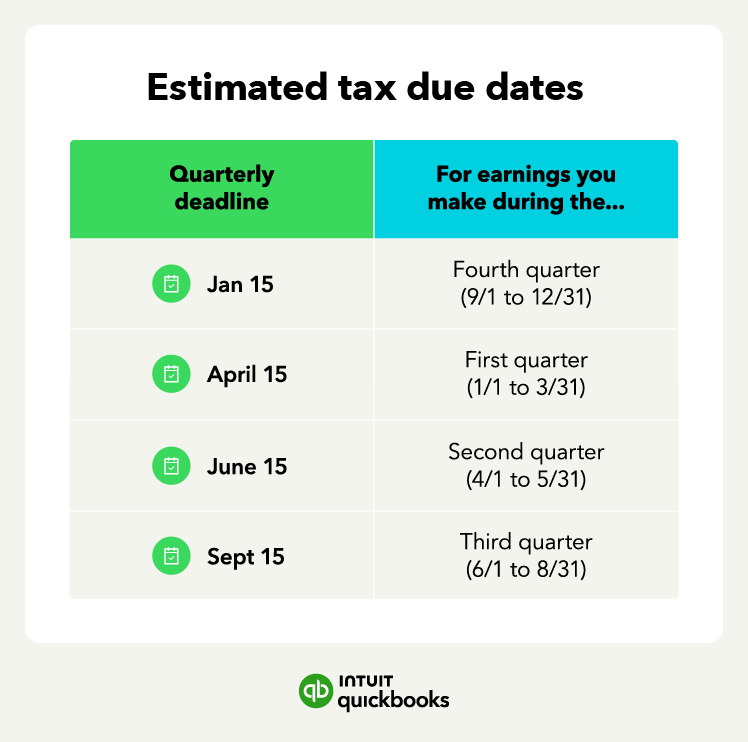
Understanding the quarterly schedule is essential to avoid the interest and penalties that the IRS levies on underpayments. The “quarters” are not traditional three-month periods, which often catches taxpayers off guard.
The Quarterly Schedule and Deadlines
The IRS quarterly deadlines generally fall on:
-
April 15 (covering income from Jan 1 – March 31)
-
June 15 (covering income from April 1 – May 31)
-
September 15 (covering income from June 1 – Aug 31)
-
January 15 of the following year (covering income from Sept 1 – Dec 31)
If these dates fall on a weekend or legal holiday, the deadline is pushed to the next business day. It is vital to remember that these are “pay-as-you-go” deadlines. If you wait until the end of the year to pay your full liability, the IRS will calculate a penalty for each quarter that you were underpaid, even if you eventually pay the full amount due on your tax return.
Avoiding Underpayment Penalties with Safe Harbor Rules
To avoid penalties, you generally must pay at least 90% of the tax for the current year or 100% of the tax shown on the return for the prior year, whichever is smaller. For high-income earners (those with an adjusted gross income over $150,000), the prior-year rule increases to 110%.
By knowing where to pay and utilizing the safe harbor rules, you can protect your business’s bottom line. Whether you choose the simplicity of IRS Direct Pay, the scheduling power of EFTPS, or the convenience of an accounting software integration, the goal remains the same: seamless compliance that allows you to focus on growing your income and building your financial future. Managing quarterly taxes is not just a legal requirement; it is a fundamental pillar of professional financial health.
aViewFromTheCave is a participant in the Amazon Services LLC Associates Program, an affiliate advertising program designed to provide a means for sites to earn advertising fees by advertising and linking to Amazon.com. Amazon, the Amazon logo, AmazonSupply, and the AmazonSupply logo are trademarks of Amazon.com, Inc. or its affiliates. As an Amazon Associate we earn affiliate commissions from qualifying purchases.