
For investors and traders alike, understanding the intricacies of market holidays and special trading hours is paramount to effective financial planning and strategy. Among the most frequently inquired-about dates is Christmas Eve, a day that, while not a full federal holiday, often brings adjusted schedules to the world’s leading stock exchanges. Navigating these changes is crucial for managing portfolios, executing trades, and ensuring liquidity. This deep dive will clarify the typical Christmas Eve market hours, explain why these schedules are in place, and offer practical insights for investors.
Navigating Holiday Trading: Understanding Christmas Eve Market Hours
The rhythm of the stock market is generally consistent: Monday through Friday, 9:30 AM to 4:00 PM Eastern Time for the major U.S. exchanges. However, holidays introduce exceptions, and Christmas Eve is a prime example of a day that often deviates from this norm, though not always. The specifics can depend on whether Christmas Eve falls on a weekday and the proximity to the actual Christmas Day holiday.

The Standard Market Calendar and Its Exceptions
The U.S. stock market calendar, primarily dictated by the New York Stock Exchange (NYSE) and NASDAQ, generally observes nine federal holidays, including New Year’s Day, Martin Luther King, Jr. Day, Presidents’ Day, Good Friday, Memorial Day, Juneteenth National Independence Day, Independence Day, Labor Day, Thanksgiving Day, and Christmas Day. On these days, the markets are fully closed.
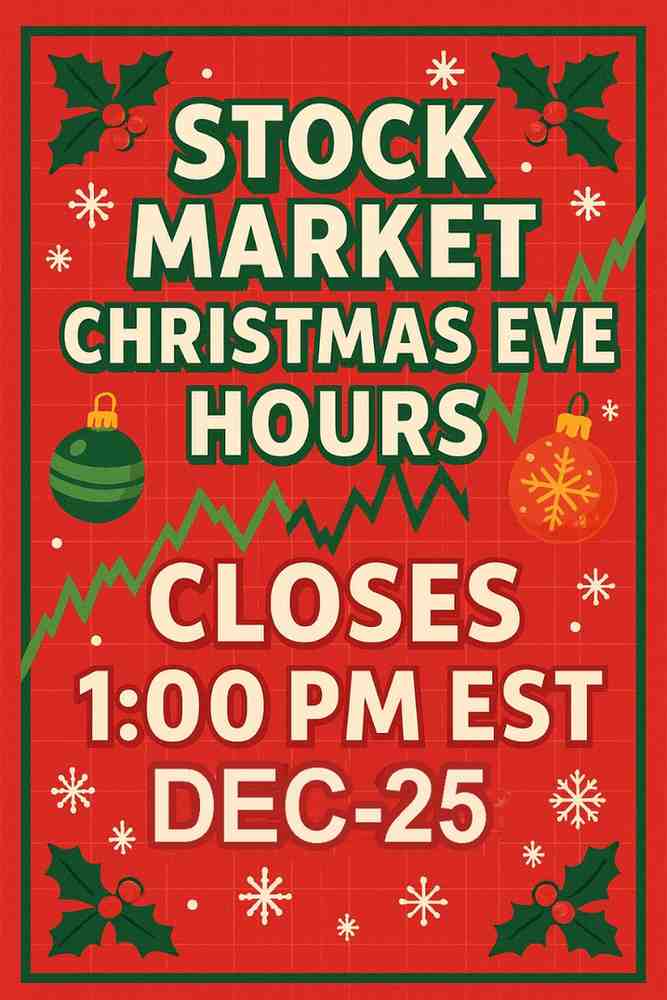
Christmas Eve, however, presents a different scenario. It is not a federal holiday, meaning government offices may be open, and banks may operate on a modified schedule. For the stock markets, the treatment of Christmas Eve has evolved over time and can vary. Historically, it was common for markets to observe an early close on Christmas Eve, typically at 1:00 PM ET. This practice stems from a combination of factors, including reduced trading activity as many market participants begin their holiday celebrations, and a long-standing tradition of accommodating employees during festive periods.
Specifics for NYSE and NASDAQ on Christmas Eve
Both the New York Stock Exchange (NYSE) and NASDAQ generally follow the same holiday schedule. For Christmas Eve, the most common scenario is an early market close. When Christmas Eve falls on a weekday, the exchanges often conclude trading at 1:00 PM Eastern Time. This applies to regular equity trading sessions. Bond markets, which operate on a different schedule, may also close early or be fully closed on Christmas Eve, often even earlier than the equity markets, typically at 2:00 PM ET or sometimes even 12:00 PM ET, depending on the year. It’s imperative for investors to consult the official calendars published by the NYSE and NASDAQ each year, as slight variations can occur based on specific directives or how the holiday weekend aligns. For example, if Christmas Eve falls on a Saturday or Sunday, and Christmas Day is observed on a Monday, the preceding Friday (Christmas Eve) might be a regular trading day or an early close, or even a full holiday if observed.
How the Day of the Week Impacts Trading Schedules
The day of the week on which Christmas Eve falls is a critical determinant of the market’s schedule.
- If Christmas Eve is a Monday-Friday: An early close at 1:00 PM ET is highly probable for equity markets. This allows market participants to prepare for Christmas Day while still providing a half-day of trading.
- If Christmas Eve is a Saturday: Since markets are closed on weekends, the market would effectively be closed, with no special adjustment needed for the preceding Friday unless Christmas Day falls on a Monday, in which case the Friday might be observed as the holiday.
- If Christmas Eve is a Sunday: Similar to Saturday, the markets would be closed. The preceding Friday would typically be a regular trading day or an early close, depending on whether the observed Christmas holiday shifts.
The key takeaway is that an early close is the most frequent occurrence when Christmas Eve is a weekday, but always verify the official exchange calendars for the most accurate and up-to-date information for the specific year.
Why Christmas Eve Hours Matter to Investors
The shortened trading hours on Christmas Eve are not just a minor inconvenience; they have tangible implications for investors and traders, affecting everything from liquidity to trading strategy and settlement times. Understanding these impacts is essential for effective capital management during the holiday season.
Impact on Liquidity and Trading Volume
One of the most immediate effects of abbreviated trading sessions is a noticeable drop in market liquidity and overall trading volume. With many institutional traders, portfolio managers, and individual investors taking time off for the holidays, fewer participants are actively buying and selling. This reduced activity can lead to:
- Wider bid-ask spreads: The difference between the highest price a buyer is willing to pay and the lowest price a seller is willing to accept can widen, making it more expensive to execute trades.
- Increased volatility for thinly traded stocks: Stocks with lower daily trading volumes may experience exaggerated price swings on fewer trades, as there’s less depth in the order book to absorb large orders.
- Difficulty in executing large orders: Large block trades might be harder to fill at desired prices without significantly impacting the market price.
For active traders, these conditions demand caution and potentially smaller position sizes.
Planning Trades Around Abbreviated Sessions
For investors with immediate trading needs or those implementing specific strategies, the early close requires meticulous planning.
- Order Placement: Market orders placed close to the early closing time might execute at unexpected prices due to reduced liquidity. Limit orders become particularly important in these scenarios.
- Intraday Strategies: Day traders must adjust their strategies to the shortened session, recognizing that the trading patterns and volume might differ significantly from a full trading day.
- News and Events: Any market-moving news released during the shortened session or, more critically, after the market closes, will have its full impact when the markets reopen, potentially leading to significant gaps at the next open. Investors must be aware of any scheduled economic data releases or corporate announcements.
Settling Transactions and Fund Availability
The standard settlement period for most stock trades (T+2, or trade date plus two business days) means that trades executed on Christmas Eve will settle two business days later. An early close does not alter the settlement period itself but impacts when you can initiate and complete these transactions. For investors who need funds available by a certain date, or who are managing margin accounts, understanding the exact settlement schedule is vital. Banking holidays around Christmas and New Year’s can further complicate fund transfers, making it prudent to plan any critical cash movements well in advance of the holiday period.
Broader Implications for Financial Planning and Strategy
Beyond the immediate trading mechanics, Christmas Eve market hours and the surrounding holiday period have broader implications for investment strategy, risk management, and even global market synchronization.
Pre-Holiday Jitters and Post-Holiday Rallies
There’s a recognized phenomenon in financial markets often dubbed the “Santa Claus Rally,” where stock prices tend to rise during the last five trading days of the year and the first two in January. While not a guaranteed event, historical data often shows a positive bias during this period. Conversely, some investors might exhibit “pre-holiday jitters,” choosing to reduce risk and lighten their positions before extended market closures, fearing unforeseen events occurring while markets are shut. This confluence of factors can lead to unique trading dynamics around Christmas Eve, with potentially lighter volumes and slightly less predictable price action leading into the Christmas Day holiday. Savvy investors often monitor these patterns, not for definitive predictions, but to understand potential shifts in market sentiment and participation.
Managing Portfolio Risk During Reduced Trading Hours
The combination of reduced liquidity, potentially increased volatility for certain stocks, and extended market closures presents unique risk management challenges.
- Overnight Risk: With the market closing early on Christmas Eve and remaining closed for Christmas Day (and potentially the weekend), investors face a longer “overnight” period during which they cannot react to breaking news or global events. Positions held over this period are exposed to heightened gap risk upon reopening.
- Options and Futures Expiration: For traders involved in derivatives, understanding how early closes affect option exercise deadlines or futures contract expirations is crucial. These instruments often have strict timing rules that must be adhered to regardless of shortened equity trading hours.
- Stop-Loss Orders: While stop-loss orders are a common risk management tool, their effectiveness can be diminished in low-liquidity or gapping markets. In extreme cases, stop-loss orders might execute at prices significantly worse than anticipated during periods of high volatility or when markets reopen after a long break.
The Role of Global Markets During U.S. Closures
While U.S. markets may be closed or operating on a reduced schedule, global markets continue to function, albeit with their own holiday adjustments. Major European and Asian markets often have varying approaches to Christmas Eve and Christmas Day. For instance, many European exchanges, like the London Stock Exchange, may also observe early closures on Christmas Eve or be fully closed. However, other markets might remain open. This means that significant economic news or geopolitical events occurring while U.S. markets are closed could influence trading in other regions, and subsequently, impact U.S. market sentiment when it reopens. Investors with diversified global portfolios or those trading international ETFs must remain cognizant of these interconnected dynamics.
Beyond the U.S.: International Market Perspectives
The global financial landscape is a tapestry of diverse customs and regulations. While the U.S. market offers its specific nuances for Christmas Eve, it’s important to recognize that international markets operate under their own sets of rules, heavily influenced by local traditions and national holidays.
European and Asian Market Approaches to Christmas Eve
In many European countries, Christmas Eve (often referred to as Heiligabend in Germany or Réveillon de Noël in France) holds significant cultural importance and is sometimes treated as a de facto half-holiday or full holiday, even if not officially designated as such.
- Europe: Major European exchanges, such as the London Stock Exchange (LSE), Euronext (which operates exchanges in Paris, Amsterdam, Brussels, Lisbon, Oslo, and Dublin), and the Frankfurt Stock Exchange (Xetra), frequently observe early closures on Christmas Eve, often concluding trading around midday (e.g., 12:30 PM GMT for the LSE). In some cases, they might even be fully closed if Christmas Eve aligns with a national holiday.
- Asia: In contrast, many Asian markets, while celebrating Christmas, do not typically observe Christmas Eve or Christmas Day as significant trading holidays unless they fall on a weekend. Countries like Japan, China, and South Korea generally maintain normal trading hours through Christmas Eve, reflecting a different cultural and religious emphasis on the holiday. However, markets in countries with larger Christian populations, such as the Philippines, might observe closures or shortened hours.
Synchronizing Global Trading Strategies
For investors with a global outlook or those involved in international currency and commodity markets that trade continuously, understanding these varied schedules is critical. A significant event unfolding in Europe while U.S. equities are closed on Christmas Eve could still impact currency pairs (e.g., EUR/USD) or commodity prices (e.g., crude oil, gold) that trade nearly 24/5. This requires a robust strategy for monitoring global news feeds and understanding how different market closures might create ripple effects. Fund managers with international mandates often employ sophisticated risk management tools to navigate these asynchronous holiday schedules, ensuring their portfolios are adequately hedged or adjusted.
The Rationale Behind Holiday Market Closures
The practice of closing or shortening market hours on holidays like Christmas Eve is not arbitrary. It’s rooted in a combination of tradition, logistical considerations, and a commitment to maintaining fair and orderly markets.
Tradition, Banking Holidays, and Investor Well-being
Historically, financial markets have observed holidays aligning with broader banking holidays and public traditions. Christmas, being a widely celebrated holiday, naturally falls into this category. The early closure on Christmas Eve often reflects a desire to:
- Accommodate market participants: Allow traders, brokers, and support staff to spend time with families during a significant cultural and religious holiday. This boosts morale and acknowledges work-life balance.
- Align with banking infrastructure: The financial ecosystem relies heavily on banks for clearing and settlement. If banks operate on a reduced schedule or are closed, it impacts the ability to process transactions efficiently. While the specifics differ, market closures generally align with bank holidays to prevent logistical bottlenecks.
- Acknowledge reduced activity: Even without an official holiday, trading volume naturally decreases significantly on Christmas Eve as many professionals take leave. Maintaining a full trading day with minimal participation can lead to inefficient pricing and increased volatility without serving a genuine market need.
Ensuring Fair and Orderly Markets
Ultimately, the primary responsibility of exchanges is to facilitate fair and orderly markets. When trading volume and liquidity are expected to be exceptionally low, keeping markets open for a full session can paradoxically undermine this objective.
- Preventing undue volatility: Low liquidity can allow smaller trades to have a disproportionately large impact on prices, potentially leading to artificial volatility that doesn’t reflect true market sentiment.
- Minimizing market manipulation: While regulatory bodies are always vigilant, thinner markets can theoretically present slightly higher risks for certain types of market manipulation, although this is generally well-controlled.
- Providing a predictable environment: Announcing holiday schedules well in advance provides predictability for all market participants, allowing them to plan their trading and investment activities without sudden surprises.
In conclusion, while Christmas Day itself brings a full market closure, Christmas Eve typically ushers in an early close for major U.S. stock exchanges like the NYSE and NASDAQ. This adjustment, influenced by tradition, banking schedules, and practical considerations of liquidity, requires investors to be vigilant, plan strategically, and always consult official exchange calendars to navigate the holiday trading landscape effectively. Understanding these nuances is a hallmark of sophisticated financial management, ensuring that one can enjoy the festive season without compromising portfolio integrity.
aViewFromTheCave is a participant in the Amazon Services LLC Associates Program, an affiliate advertising program designed to provide a means for sites to earn advertising fees by advertising and linking to Amazon.com. Amazon, the Amazon logo, AmazonSupply, and the AmazonSupply logo are trademarks of Amazon.com, Inc. or its affiliates. As an Amazon Associate we earn affiliate commissions from qualifying purchases.