
Apple Inc. (AAPL) stands as a titan in the global economy, a company whose innovative products have not only reshaped industries but whose stock performance has become a benchmark for investor success. Central to understanding the journey of AAPL as an investment is an examination of its stock splits. These corporate actions, while not altering the fundamental value of a company, profoundly impact share accessibility, market perception, and the historical performance narrative for both institutional and individual investors. This article delves into the “when” and “why” of Apple’s stock splits, exploring their financial implications and what they signify for one of the world’s most valuable companies within the Money niche of personal finance, investing, and business finance.
The Rationale Behind Stock Splits: Enhancing Accessibility and Liquidity
A stock split is a corporate action in which a company divides its existing shares into multiple new shares. While it might seem like a mere accounting adjustment, the strategic motivations behind such moves are deeply rooted in financial market dynamics and investor psychology.
Demystifying Stock Splits: What They Are and Why Companies Do Them
At its core, a stock split increases the number of outstanding shares while simultaneously decreasing the price per share proportionally. For instance, in a 2-for-1 split, a shareholder owning 100 shares at $200 each would suddenly own 200 shares at $100 each. The total value of their investment—$20,000—remains unchanged. Similarly, the company’s total market capitalization (number of shares * price per share) also remains the same.
So, if the value doesn’t change, why bother? Companies primarily initiate stock splits for two key reasons:
- Increased Accessibility: When a stock’s price becomes very high, it can become unaffordable for many retail investors, particularly those looking to invest smaller amounts or to buy whole shares rather than fractional ones (though fractional investing has become more common). By lowering the per-share price, a split makes the stock more accessible to a broader base of investors, democratizing ownership.
- Enhanced Liquidity: A lower share price can lead to higher trading volumes. More shares trading at a more ‘palatable’ price often translate into greater liquidity, meaning it’s easier for investors to buy and sell shares without significantly impacting the market price. This can also make the stock more attractive to institutional investors who might have mandates around liquidity.
Beyond these tangible benefits, there’s often a psychological component. A lower share price can make a stock feel cheaper, even though its intrinsic value hasn’t changed. This psychological effect can sometimes generate renewed interest and positive sentiment around the stock.
Apple’s Strategic Use of Splits for Market Dynamics
Apple’s journey through its various stock splits perfectly illustrates these rationales. As a growth company that has consistently delivered innovation and strong financial performance, its share price has historically climbed, making periodic adjustments through splits a strategic tool to maintain investor engagement and market appeal. Each time Apple has split its stock, it has been a testament to its significant appreciation in value, a celebratory marker of its financial success, and a forward-looking move to ensure continued widespread participation in its growth story. The splits were not arbitrary; they were calculated decisions reflecting the company’s maturity and its desire to broaden its investor base while managing its market dynamics.
A Historical Perspective: Apple’s Stock Split Timeline
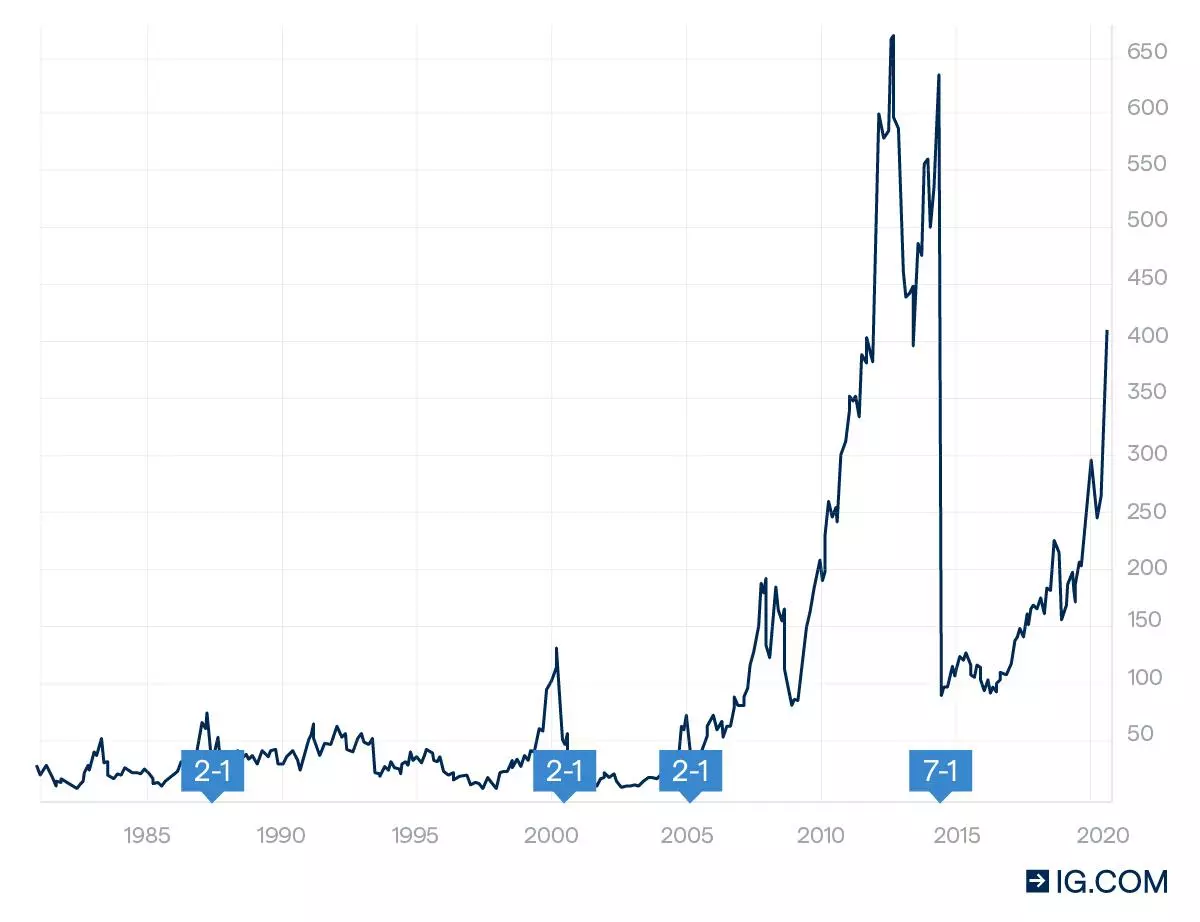
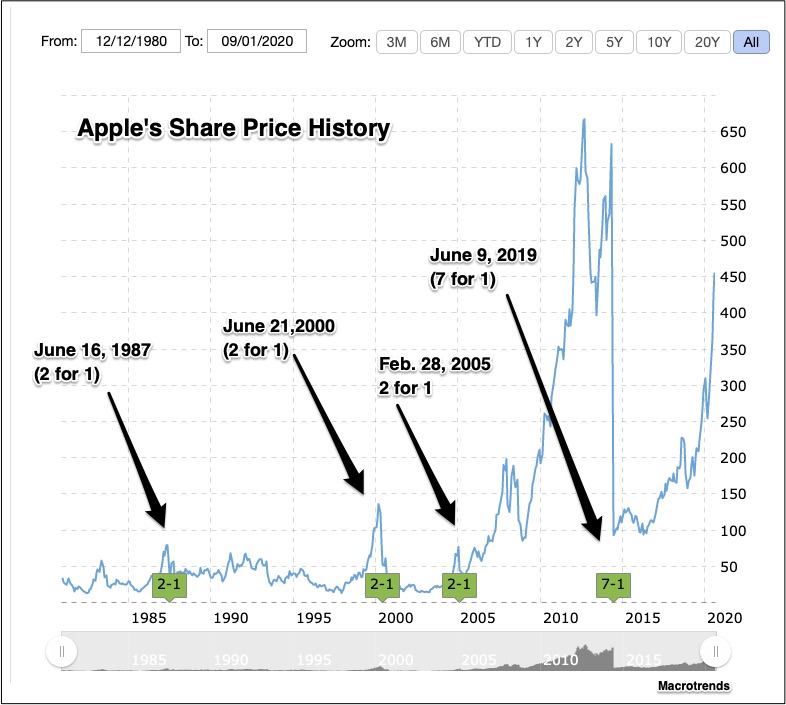
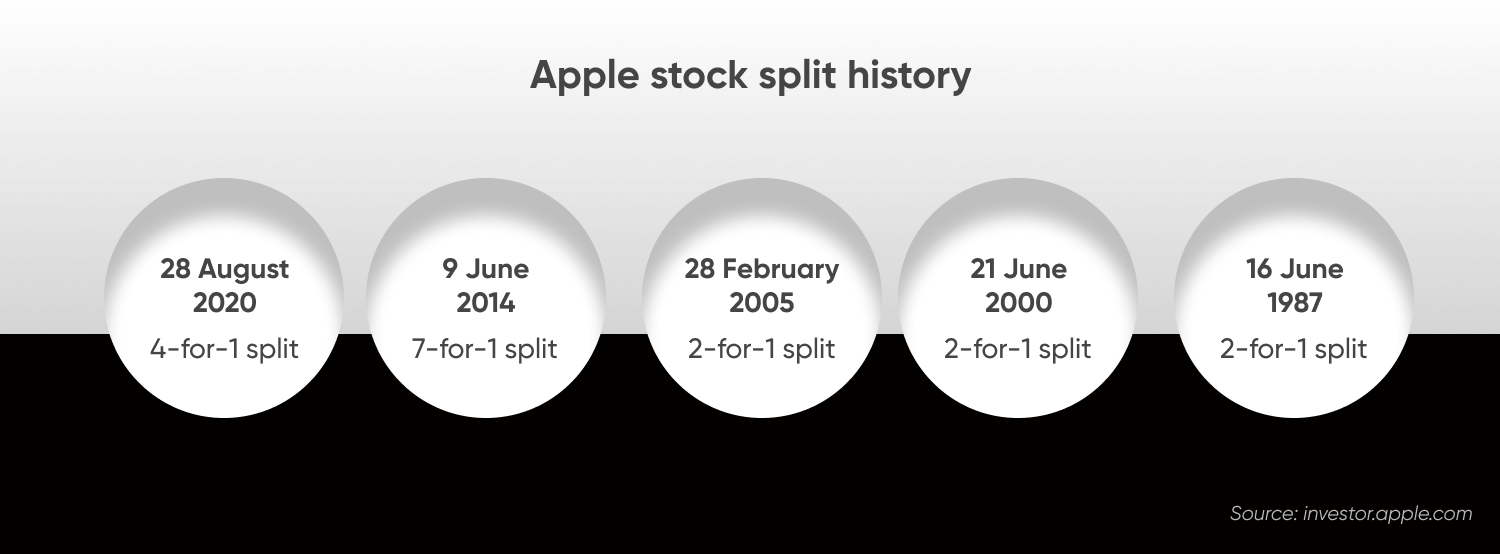
Apple has executed five stock splits throughout its history, each corresponding to periods of significant growth and market valuation increases. Understanding this timeline provides crucial insights into the company’s financial evolution and its responsiveness to market conditions.
The Early Splits: Growth and Expansion (1987, 2000, 2005)
Apple’s first three stock splits occurred during different phases of its early growth and subsequent recovery:
- June 16, 1987 (2-for-1 split): This split came during Apple’s early days of market dominance with products like the Macintosh. The company was experiencing robust growth and its stock price had risen significantly, making a split a logical step to maintain accessibility as it solidified its position in the burgeoning personal computer market. This period was characterized by Apple’s innovation in graphical user interfaces and desktop publishing, driving its initial market success.
- June 21, 2000 (2-for-1 split): Following a period of struggle in the mid-90s, Steve Jobs’ return and the introduction of the iMac had revitalized the company. The 2000 split reflected renewed confidence and market appreciation for Apple as it began its path to recovery and set the stage for future innovations. Despite the dot-com bubble burst around this time, Apple’s specific trajectory showed signs of a comeback.
- February 28, 2005 (2-for-1 split): This split occurred on the cusp of Apple’s transformation from a computer company to a consumer electronics powerhouse. The iPod was a runaway success, and the company’s ecosystem was beginning to take shape. The stock price surge warranted another split, making shares more affordable for a growing investor base eager to participate in Apple’s unfolding revolution. This period was crucial in building the foundation for the mobile computing era.
These initial splits demonstrate a consistent strategy of making Apple stock more approachable as its market value expanded in distinct phases of technological leadership.
The Post-iPhone Era Split: Catering to a Broader Investor Base (2014)
- June 9, 2014 (7-for-1 split): This was Apple’s most significant split numerically and arguably one of its most anticipated. By 2014, Apple had firmly established itself as a global technology leader, largely driven by the monumental success of the iPhone, iPad, and its growing services ecosystem. The stock price had soared to over $600 per share, making it quite expensive for individual investors. The 7-for-1 split drastically reduced the per-share price, opening the floodgates for millions of new retail investors to buy whole shares. Tim Cook, then CEO, explicitly stated that the split was aimed at making Apple stock more accessible to a wider range of investors. This split also coincided with a period of strong dividend growth and share repurchases, signaling Apple’s commitment to returning capital to shareholders and its confidence in sustained financial performance.
This split was a clear strategic move to acknowledge and capitalize on the massive success following the iPhone’s introduction, broadening its appeal to the burgeoning population of retail investors globally.
The Pandemic-Era Split: Sustaining Momentum and Inclusivity (2020)
- August 31, 2020 (4-for-1 split): The most recent split occurred amidst the unprecedented market conditions of the COVID-19 pandemic. Despite global economic uncertainty, Apple’s business remained resilient, with strong demand for its products and services as people adapted to remote work and learning. Its stock price once again surged, reaching new all-time highs above $500 per share. The 4-for-1 split aimed to maintain this momentum, further enhancing accessibility during a period when many new investors were entering the market, often through commission-free trading platforms. This split reinforced Apple’s commitment to inclusivity and ensured its stock remained attractive in a rapidly evolving investment landscape. It also made Apple more attractive for inclusion in indices that are price-weighted, although this was less of a stated reason compared to retail investor accessibility.
Each of Apple’s splits tells a story of significant value creation and a proactive approach to managing its presence in the financial markets, always with an eye toward fostering wider ownership.
The Impact of Stock Splits on Investors and Market Perception
While a stock split is often a non-event in terms of fundamental company value, its effects on investor behavior and market dynamics can be significant. It’s a classic example of how psychological factors and market structure can influence financial outcomes.
Price Psychology and Increased Retail Investor Participation
One of the most immediate and observable impacts of a stock split is the psychological effect of a lower share price. A share priced at $150 might appear more “affordable” or “cheaper” to a casual investor than a share priced at $600, even though, in a 4-for-1 split scenario, the underlying investment value is identical. This perception can lead to an increase in demand from retail investors who prefer to buy whole shares.
For a company like Apple, with its massive brand recognition and loyal customer base, lowering the entry barrier for its stock can transform customers into shareholders. This broadens the investor base, which can create a more stable and resilient demand for the stock in the long run. The increased number of outstanding shares also enhances liquidity, making it easier for buyers and sellers to find counterparts in the market, reducing bid-ask spreads and facilitating smoother trading.
The Myth of Value Creation vs. Practical Benefits
It’s crucial for investors to understand that a stock split, by itself, does not create or destroy value. The company’s earnings, assets, liabilities, and overall market capitalization remain unchanged. It’s akin to exchanging a $100 bill for two $50 bills – you still have $100. The underlying business hasn’t magically become more profitable or innovative simply because its shares are now cheaper.
However, the practical benefits extend beyond mere perception. For options traders, a lower share price can mean lower premiums for individual options contracts, making them more accessible. For companies, increased liquidity can sometimes lead to tighter spreads, reducing the cost of trading for large institutional investors. Moreover, a stock split is often seen as a signal of confidence from the company’s management, implying that they expect continued growth and future appreciation, which might drive the stock price back up over time. This forward-looking sentiment can sometimes contribute to a post-split rally, though this is not guaranteed and is more a reflection of market optimism than intrinsic value change from the split itself.
Analyzing AAPL’s Performance Pre and Post-Splits
Historically, Apple’s stock has performed exceptionally well both leading up to and following its splits. The announcement of a split often generates positive buzz, pushing the price higher as investors anticipate increased demand. Post-split, while the initial drop in price per share is mathematical, the stock has typically resumed its upward trajectory, often surpassing its pre-split equivalent price within a reasonable timeframe.
For instance, after its 2014 7-for-1 split, the effective pre-split price of AAPL shares was approximately $92 (post-split price was around $13). Within a few years, Apple’s stock had climbed well past that effective $92 mark, delivering significant returns to investors who held through the split. A similar pattern was observed after the 2020 4-for-1 split. This consistent performance underscores that while splits don’t create value, they are usually a consequence of strong underlying business performance and are often followed by continued growth, reinforcing the idea that the company’s fundamentals drive long-term returns, not just the split itself.
Beyond the Split: Understanding Apple’s Long-Term Investor Value
While stock splits offer a fascinating glimpse into market mechanics and investor psychology, they are ultimately footnotes in the larger narrative of Apple’s success. For discerning investors, the real value lies in the company’s fundamentals and its long-term strategic direction.
Fundamentals Over Form: Revenue, Innovation, and Brand Strength
The enduring appeal of Apple stock is rooted in its robust financial performance, relentless innovation, and unparalleled brand strength. Year after year, Apple consistently delivers strong revenue growth, substantial profits, and impressive cash flows, fueled by a diverse ecosystem of hardware (iPhone, Mac, iPad, Apple Watch), software (iOS, macOS), and rapidly expanding services (App Store, Apple Music, iCloud, Apple Pay).
Its commitment to innovation, from the M-series chips to advancements in augmented reality and health features, ensures a pipeline of future growth opportunities. Furthermore, Apple’s brand loyalty is legendary, commanding premium pricing and creating a significant competitive moat. These are the true drivers of its market capitalization and investor returns, far outweighing the superficial changes brought about by stock splits. Investors who focus solely on the split without understanding the underlying business risk missing the forest for the trees.
Dividends, Buybacks, and Other Shareholder Value Strategies
Beyond capital appreciation driven by growth, Apple has also become a significant player in returning value to shareholders through other means. Since reinstating its dividend in 2012, Apple has consistently increased its payout, making it an attractive stock for income-focused investors. The company also executes massive share buyback programs, reducing the number of outstanding shares and thereby boosting earnings per share (EPS), which can lead to higher stock prices. These strategies demonstrate a mature company that not only innovates but also prudently manages its capital to reward its owners. Stock splits merely adjust the packaging of these returns, not their substance.
What Future Stock Splits Could Mean for Apple and the Market
Given Apple’s history of consistent growth and market leadership, it’s not unreasonable to speculate about future stock splits. If Apple’s stock price continues its upward trajectory, reaching levels that once again deter smaller investors, management might consider another split. Each future split would likely be a reaffirmation of the company’s continued success and its commitment to broad investor accessibility.
For the broader market, Apple’s decisions regarding stock splits often set a precedent or at least influence other high-priced tech stocks. When a company as prominent as Apple splits its stock, it draws attention to the benefits of accessibility and liquidity, potentially encouraging other companies to follow suit. For investors, whether Apple splits its stock again or not, the core lesson remains: focus on the fundamentals, understand the company’s long-term vision, and recognize that financial actions like stock splits are merely mechanisms, not catalysts, for true value creation. The “when” of Apple’s stock splits marks key moments in its financial journey, but the “why” and “what next” are rooted firmly in its unparalleled business prowess.
aViewFromTheCave is a participant in the Amazon Services LLC Associates Program, an affiliate advertising program designed to provide a means for sites to earn advertising fees by advertising and linking to Amazon.com. Amazon, the Amazon logo, AmazonSupply, and the AmazonSupply logo are trademarks of Amazon.com, Inc. or its affiliates. As an Amazon Associate we earn affiliate commissions from qualifying purchases.