
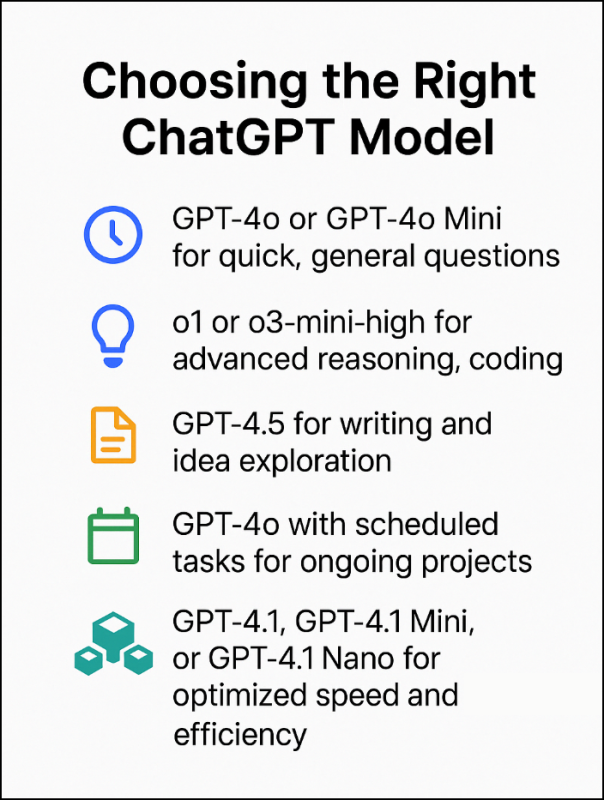
The landscape of generative artificial intelligence has evolved at a breakneck pace. For users, developers, and businesses alike, the question of which ChatGPT model to utilize is no longer as simple as picking the latest release. With OpenAI’s tiered architecture—ranging from the high-performance reasoning engines like o1 to the versatile, multimodal capabilities of GPT-4o and the lightweight efficiency of GPT-4o mini—selecting the “best” model depends entirely on the specific demands of the task at hand.
Navigating the Hierarchy of Intelligence
To understand which model fits your needs, it is essential to distinguish between the primary architectures currently available within the ChatGPT ecosystem. Each model is engineered with a different priority: raw logic, speed, or multimodal integration.
The Reasoning Powerhouse: OpenAI o1
The o1 model series represents a fundamental shift in how large language models function. Unlike its predecessors, which rely on immediate pattern prediction, o1 is designed to “think” before it speaks. By employing a chain-of-thought process, it breaks down complex prompts into logical steps, making it the undisputed champion for STEM-related tasks, advanced mathematics, and complex software engineering problems. If your objective involves debugging a legacy codebase or solving high-level physics equations, o1 is the clear leader.
The Versatile Workhorse: GPT-4o
GPT-4o (the “o” stands for “omni”) is the quintessential model for the average user. It excels because of its native multimodality; it can process audio, vision, and text in real-time with remarkably low latency. This is the model of choice for creative writing, data extraction from images, real-time voice translation, and brainstorming sessions where speed and nuance are equally important. It serves as the bridge between human-like conversation and deep analytical capability.
The Efficiency Expert: GPT-4o mini
Not every task requires the heavy lifting of a frontier reasoning model. GPT-4o mini is optimized for high-volume, low-latency tasks. It is significantly more cost-effective for developers using the API and remarkably fast for standard query-response interactions. It is the best choice for summarization, simple document classification, and answering routine questions where precision is required but complex reasoning is unnecessary.
Selecting the Right Model for Technical Workflows
For professionals working within the software and data sectors, the choice of model directly impacts project velocity and accuracy. Misaligning the model with the task can lead to “hallucinations” or wasted computational resources.
Software Engineering and Debugging
When it comes to coding, the context window and the reasoning depth are paramount. GPT-4o is excellent for generating boilerplate code, writing documentation, and simple refactoring. However, when you encounter a complex architectural bottleneck or a logic error that spans multiple interdependent files, the o1 series is superior. Its ability to iterate through potential solutions internally prevents the “looping” behavior often seen in less specialized models.
Data Analysis and Interpretation
Data science workflows often require the model to act as a bridge between unstructured text and structured insights. GPT-4o is particularly adept here due to its integration with Advanced Data Analysis (formerly Code Interpreter). It can upload CSVs, generate charts, and execute Python code to perform statistical tests. While o1 provides better insight into the “why” behind the numbers, GPT-4o provides the “how”—the visual and actionable output that stakeholders require.
Balancing Performance and Latency in Business Applications
Businesses integrating ChatGPT into their internal operations face a classic trade-off: quality versus cost and speed. Understanding the best-fit model for specific business processes can lead to significant operational efficiencies.
High-Stakes Decision Support
For executive strategy, long-form report analysis, and complex document synthesis, GPT-4o remains the gold standard. Its ability to maintain coherence across lengthy conversations makes it ideal for synthesizing disparate data points into a cohesive strategy document. It handles the nuances of tone and corporate context better than smaller, speed-focused models, which may sound overly clinical or repetitive.
Customer Support and Automated Agents
If you are deploying an AI agent for customer service, GPT-4o mini is often the superior choice. Customer inquiries are typically transactional—checking order statuses, resetting passwords, or confirming return policies. In these scenarios, the primary performance metrics are latency and cost per thousand tokens. GPT-4o mini provides a conversational experience that is indistinguishable from the larger models for basic tasks, while keeping overhead significantly lower.
The Future of Choice: When to Use Which?
The “best” model is a moving target. As OpenAI continues to update the architecture, users must adopt a modular approach to prompting.
The Hybrid Approach
The most sophisticated users are those who treat their subscription not as a monolith, but as a toolkit. Start your interaction with GPT-4o for its broad, multimodal capabilities. If the response lacks the technical depth or logical rigor required to solve a specific, difficult problem, pivot the conversation to o1. By shifting models within the same thread—or utilizing them for specific parts of a multi-stage project—you maximize the strengths of each.
Considerations for Power Users
Beyond the specific models, consider the environment in which you are working. If you are using ChatGPT through the web interface, the “Auto” setting is increasingly reliable at determining the complexity of your prompt and routing it to the appropriate engine. However, for power users who are working via the API or specific custom GPTs, manual selection is critical.
When deploying a custom GPT, you have the ability to define its persona and knowledge base. Here, the choice of model determines the “personality” of the agent. A support agent should be powered by the efficiency of GPT-4o mini to ensure instant response times, while a research assistant agent should be powered by o1 or GPT-4o to ensure the highest fidelity of information retrieval.

Summary of Strategic Selection
To summarize, the best ChatGPT model is determined by the following hierarchy:
- For logical depth, mathematics, and complex coding: Use o1. It is designed to navigate ambiguity through iteration and internal verification.
- For daily productivity, creative synthesis, and multimodal tasks: Use GPT-4o. It is the most balanced model, offering a seamless experience across voice, vision, and text.
- For high-volume, transactional, or routine tasks: Use GPT-4o mini. It provides the necessary intelligence at a fraction of the cost and time.
As we move forward, the barrier between these models will likely continue to blur. Future iterations will likely incorporate the reasoning capabilities of o1 into the multimodal fluency of GPT-4o. Until that unified model arrives, the power lies in your ability to match the architectural strength of the tool to the specific cognitive requirements of your task. Do not settle for a one-size-fits-all approach; instead, cultivate a strategic workflow that leverages the distinct advantages of the current OpenAI lineup. By doing so, you move from being a passive user of AI to a sophisticated operator, capable of extracting maximum value from the rapidly evolving landscape of digital intelligence.
aViewFromTheCave is a participant in the Amazon Services LLC Associates Program, an affiliate advertising program designed to provide a means for sites to earn advertising fees by advertising and linking to Amazon.com. Amazon, the Amazon logo, AmazonSupply, and the AmazonSupply logo are trademarks of Amazon.com, Inc. or its affiliates. As an Amazon Associate we earn affiliate commissions from qualifying purchases.