
In the vast landscape of personal finance, investing, and business operations, few concepts are as foundational and frequently encountered as percentages. The question “what percentage is 5” might seem deceptively simple, or even incomplete, at first glance. After all, “5” on its own is merely a number; it lacks the context required to transform it into a percentage. A percentage, by its very definition, expresses a number as a fraction of 100, a “part of a whole.” Therefore, to understand “what percentage is 5,” we must first establish the “whole” it relates to.
However, the essence of the question transcends a basic arithmetic problem. In the financial world, understanding how to interpret, calculate, and apply percentages is critical. Whether “5” refers to a value that needs to be expressed as a percentage, or represents a common percentage like “5%” in various financial scenarios, its implications are far-reaching. This article delves into the indispensable role of percentages in financial decision-making, exploring how “5” and similar numerical values become powerful indicators when contextualized within the realm of money.

The Ubiquitous Nature of Percentages in Financial Decision-Making
Percentages are the universal language of finance, providing a standardized way to compare different quantities, track performance, and assess risk. From interest rates on loans to investment returns, from budget allocations to tax brackets, percentages translate complex financial data into digestible, actionable insights. Without a firm grasp of percentage mechanics, navigating the modern financial landscape would be akin to sailing without a compass.
Defining the “Part-to-Whole” Relationship
At its core, a percentage (from the Latin “per centum,” meaning “by the hundred”) represents a ratio where the denominator is 100. If you have 5 apples out of a total of 100 apples, then 5 is 5% of the whole. The formula is straightforward: (Part / Whole) * 100%. This fundamental relationship underpins every financial calculation involving percentages.
For the question “what percentage is 5,” the missing piece is the “whole.” If we are asking what percentage 5 is of 100, the answer is 5%. If we are asking what percentage 5 is of 50, the answer is 10%. Conversely, if we are referring to “5%” as a given figure, it implies that we are considering 5 units out of every 100 units of a specified total. This distinction is crucial because the interpretation of “5” fundamentally shifts based on whether it’s a standalone value or a percentage already.
Why 5, and Any Number, Needs Context
The numerical value “5” gains profound significance only when placed within a specific financial context. Without this context, “5” remains an abstract digit. In finance, this context often determines whether “5” represents a minor detail or a major turning point. For instance, a “5-dollar” increase in a stock price might be negligible for a $1,000 stock but monumental for a $10 stock. Similarly, “5%” can represent a marginal difference in a budget line item or a critical threshold for investment performance.
Understanding this need for context is the first step towards financial literacy. It teaches us to ask critical questions: “5% of what?” or “What total does this ‘5’ represent a percentage of?” This analytical approach moves beyond rote calculation to genuine financial comprehension, enabling more informed decision-making across all financial categories.
Interpreting “5” as a Financial Metric: From Discounts to Returns
Once we appreciate the necessity of context, we can explore how “5” (or “5%”) manifests in various financial applications, each carrying its unique implications.
The Allure of a 5% Discount
A “5% discount” might seem modest compared to flash sales offering 50% or more. However, its impact can be significant, especially on large purchases or when aggregated over time. On a $1,000 item, a 5% discount saves you $50. While this might not feel life-changing, consistently seeking and applying 5% discounts on regular expenses or larger items can accumulate substantial savings over a year. Savvy consumers often leverage such seemingly small percentages to optimize their spending and stretch their budgets further.
Understanding a 5% Interest Rate: Loans and Savings
Perhaps one of the most common encounters with “5%” is in interest rates. A 5% interest rate on a loan means you pay an additional 5% of the principal amount annually (or over the specified period) for the privilege of borrowing. For a $10,000 loan, this translates to $500 in interest annually, excluding compounding effects. This seemingly small percentage can add up significantly over the life of a long-term loan, such as a mortgage or student loan, dramatically increasing the total cost of borrowing.
Conversely, a 5% interest rate on a savings account or certificate of deposit (CD) means your money grows by 5% annually. While finding such a high rate on traditional savings accounts is rare in typical economic climates, it illustrates the power of compound interest. Over time, that 5% growth not only applies to your initial deposit but also to the accumulated interest, allowing your wealth to expand exponentially.
What a 5% Investment Return Truly Means
In the world of investing, a “5% return” is a benchmark often used to assess performance. For a diversified portfolio, a consistent 5% annual return is considered respectable and, when compounded over decades, can lead to substantial wealth accumulation. For instance, investing $10,000 at a 5% annual return would grow to approximately $16,289 in ten years, and $26,533 in twenty years, assuming no additional contributions.
However, interpreting a 5% return also requires nuance. It must be weighed against inflation, which erodes purchasing power. If inflation is 3%, a nominal 5% return yields a real (after inflation) return of only 2%. Investors must aim for returns that outpace inflation to genuinely grow their wealth. Furthermore, the risk associated with achieving that 5% return is a critical consideration; higher returns often come with higher risk.
Budgeting and Allocation: The 5% Rule
Many personal finance experts suggest various “rules” involving percentages for budgeting, such as the 50/30/20 rule (50% for needs, 30% for wants, 20% for savings and debt repayment). Within such frameworks, a “5% allocation” might be designated for a specific category, such as entertainment, charitable giving, or a discretionary spending fund. For example, allocating 5% of your income to entertainment means that if you earn $4,000 per month, you have $200 available for leisure activities. These percentage-based rules provide a flexible yet structured approach to managing cash flow and achieving financial objectives without overly restricting individual choices.
Calculating and Applying Percentages for Financial Health
Beyond understanding what specific percentages mean, the ability to calculate and apply them is paramount for maintaining financial health.
The Fundamental Percentage Formula
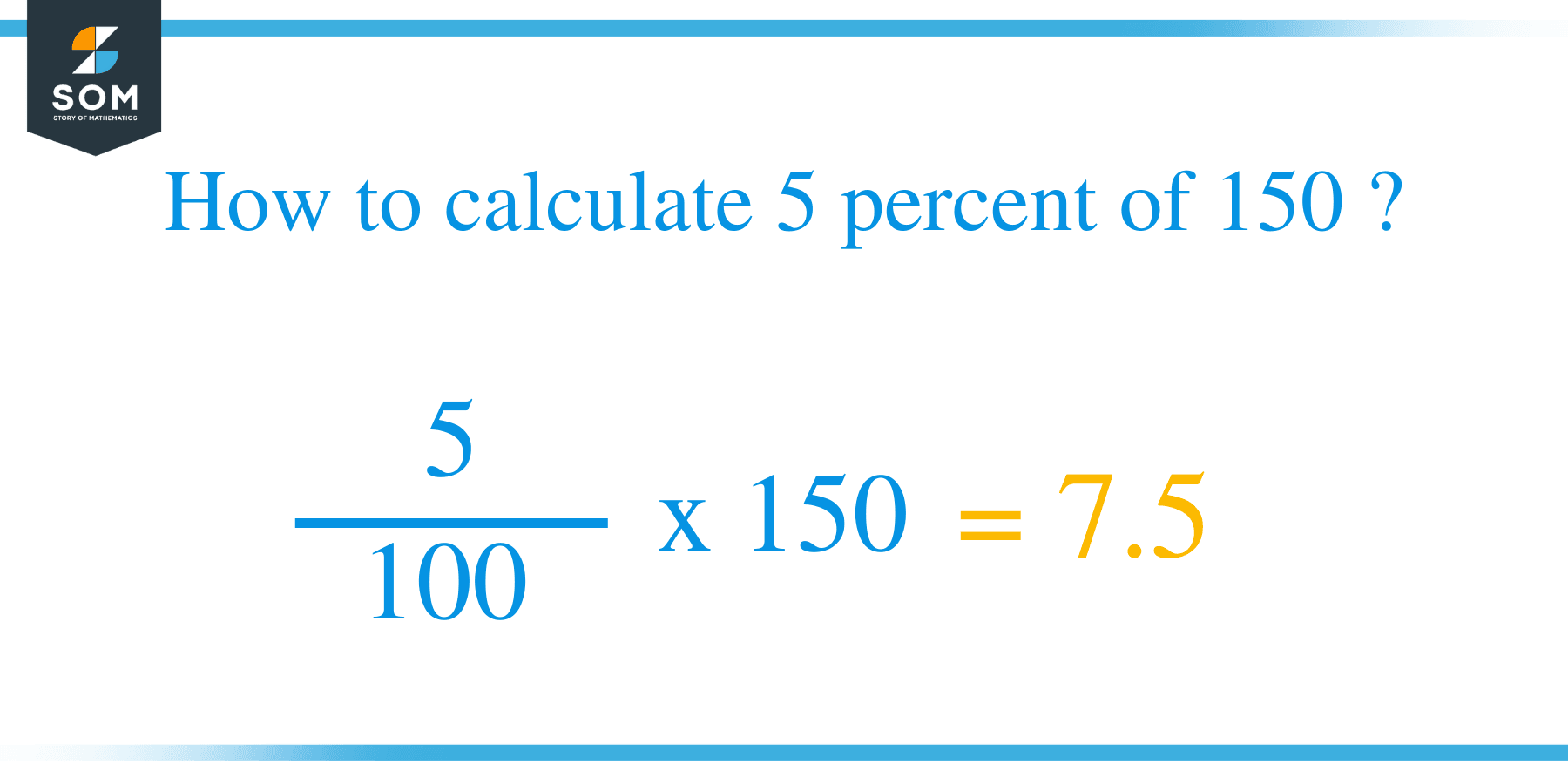
The basic formula for finding a percentage is:
Percentage = (Part / Whole) x 100
If you want to find what percentage 5 is of 200:
Percentage = (5 / 200) x 100 = 0.025 x 100 = 2.5%
Conversely, if you need to find a part when given a whole and a percentage:
Part = (Percentage / 100) x Whole
If you want to find 5% of 200:
Part = (5 / 100) x 200 = 0.05 x 200 = 10
Mastering these two variations allows you to perform almost any percentage calculation encountered in finance.
Practical Scenarios: Calculating Financial Growth and Loss
Consider a stock initially valued at $150 that increases to $157.50. To find the percentage growth:
Growth = ($157.50 – $150) = $7.50
Percentage Growth = ($7.50 / $150) x 100 = 5%
Or, if your investment portfolio started the year at $50,000 and ended at $47,500 due to market downturns:
Loss = ($50,000 – $47,500) = $2,500
Percentage Loss = ($2,500 / $50,000) x 100 = 5%
These calculations are fundamental for evaluating investment performance, understanding price changes, and assessing the impact of inflation or discounts.
Leveraging Financial Calculators and Software
While manual calculation is essential for comprehension, modern financial tools make quick work of complex percentage problems. Spreadsheet software like Excel or Google Sheets, dedicated financial calculators, and online percentage calculators can automate these computations, reducing the chance of error and saving time. Many banking and investment apps also provide built-in functionalities to display percentage changes for accounts and investments. Leveraging these tools responsibly ensures accuracy and efficiency in your financial analyses.
Avoiding Common Percentage Misconceptions
One common pitfall is misunderstanding percentage increases and decreases, especially when applied sequentially. A 10% increase followed by a 10% decrease does not result in the original amount. For example, $100 increased by 10% is $110. A 10% decrease on $110 is $11, resulting in $99, not $100. This concept, known as “percentage points” versus “percentage change,” is critical in financial reporting, particularly when discussing interest rate changes or market fluctuations.
Another pitfall is confusing an absolute difference with a percentage difference. A bond yield moving from 4% to 5% is an increase of “1 percentage point,” but it’s a 25% relative increase in the yield itself (calculated as (5-4)/4 * 100 = 25%). Understanding these nuances is vital for accurate financial interpretation.
Strategic Financial Planning Through Percentage Literacy
Ultimately, the ability to properly interpret and apply percentages transforms raw financial data into strategic insights. It empowers individuals and businesses to make better decisions, plan more effectively, and achieve their financial goals.
Setting Realistic Financial Goals
Whether saving for a down payment, retirement, or a child’s education, setting goals based on percentages makes them measurable and attainable. For instance, aiming to save “15% of every paycheck” is more concrete and trackable than just “saving more money.” Knowing what percentage of your income goes towards housing, transportation, or food allows you to benchmark against recommended guidelines and adjust spending as needed.
Assessing Risk and Reward in Investments
Percentages are at the heart of risk and reward assessment. An investor might tolerate a “5% annual volatility” in exchange for a target “8% average annual return.” Understanding the percentage of your portfolio allocated to different asset classes (e.g., 60% stocks, 40% bonds) is crucial for diversification and risk management. Performance metrics, often expressed as percentages, help evaluate if an investment is meeting expectations relative to its risk profile.
Managing Debt and Optimizing Savings
When managing debt, understanding the percentage interest rate on credit cards, personal loans, or mortgages helps prioritize repayment strategies. Tackling the debt with the highest interest percentage first (the “debt avalanche” method) can significantly reduce the total interest paid. On the savings side, knowing the percentage yield on your savings accounts or the percentage contribution to your retirement accounts enables you to project future growth and ensure you’re on track to meet your long-term objectives.

Adapting to Economic Changes and Inflation
Economic indicators like inflation rates, GDP growth, and unemployment rates are almost always expressed as percentages. A 5% inflation rate significantly impacts purchasing power, meaning your money buys 5% less than it did a year ago. Understanding these percentages allows individuals to adjust their financial strategies, from seeking higher-yielding investments to negotiating cost-of-living salary increases, to protect and grow their wealth in a dynamic economic environment.
In conclusion, while “5” itself is an inert number, its transformation into a percentage, or its interpretation as a 5% figure, unlocks a profound understanding of financial realities. Mastery of percentages is not merely an academic exercise; it is an indispensable life skill that empowers individuals to navigate the complexities of personal finance, make informed investment choices, and build a secure financial future.
aViewFromTheCave is a participant in the Amazon Services LLC Associates Program, an affiliate advertising program designed to provide a means for sites to earn advertising fees by advertising and linking to Amazon.com. Amazon, the Amazon logo, AmazonSupply, and the AmazonSupply logo are trademarks of Amazon.com, Inc. or its affiliates. As an Amazon Associate we earn affiliate commissions from qualifying purchases.