
For years, Palantir Technologies has been one of the most discussed yet least understood entities in the global technology landscape. Often shrouded in a veil of secrecy due to its deep-rooted contracts with intelligence agencies and defense departments, the company is frequently mischaracterized as a mere data collection agency or a clandestine surveillance firm. However, at its core, Palantir is a software engineering powerhouse. It does not sell data; it builds the sophisticated operating systems that allow massive, complex organizations to integrate, manage, and secure their own data.
To understand what Palantir does, one must look past the “big data” buzzwords. Palantir provides the foundational software layer that enables organizations to bridge the gap between fragmented information and actionable intelligence. Whether it is tracking a global supply chain, managing a military operation, or accelerating drug discovery, Palantir’s platforms serve as the central nervous system for modern decision-making.
Deciphering the Operating System of the Modern Enterprise
The fundamental problem Palantir solves is the “Data Paradox.” Most modern organizations are drowning in data but starving for information. Large enterprises and government agencies typically house their data in disparate “silos”—legacy databases, cloud storage, spreadsheets, and real-time sensor feeds that cannot communicate with one another. When a crisis occurs or a strategic decision needs to be made, it is often impossible to get a holistic view of the situation because the data is fragmented.
Moving Beyond Traditional Databases
Unlike traditional business intelligence tools that merely visualize data in static dashboards, Palantir’s software creates a dynamic environment where data is integrated, cleaned, and mapped to a real-world model. Traditional databases require rigid schemas; if you want to ask a new question, you often have to rebuild the data structure. Palantir’s approach is different. It allows users to layer disparate datasets on top of one another to find hidden connections. This process, often called “data fusion,” is the cornerstone of their technical advantage.
The Human-Machine Synthesis
A key philosophy driving Palantir’s tech stack is the belief that computers should not replace humans, but rather empower them. While many Silicon Valley firms focus on autonomous AI that makes decisions without human intervention, Palantir focuses on “augmented intelligence.” Their tools are designed to surface patterns and anomalies, but the final decision-making power remains with the human analyst. This is particularly critical in high-stakes environments like healthcare or national security, where the “black box” nature of pure AI can lead to catastrophic errors.
The Product Trinity: Gotham, Foundry, and Apollo
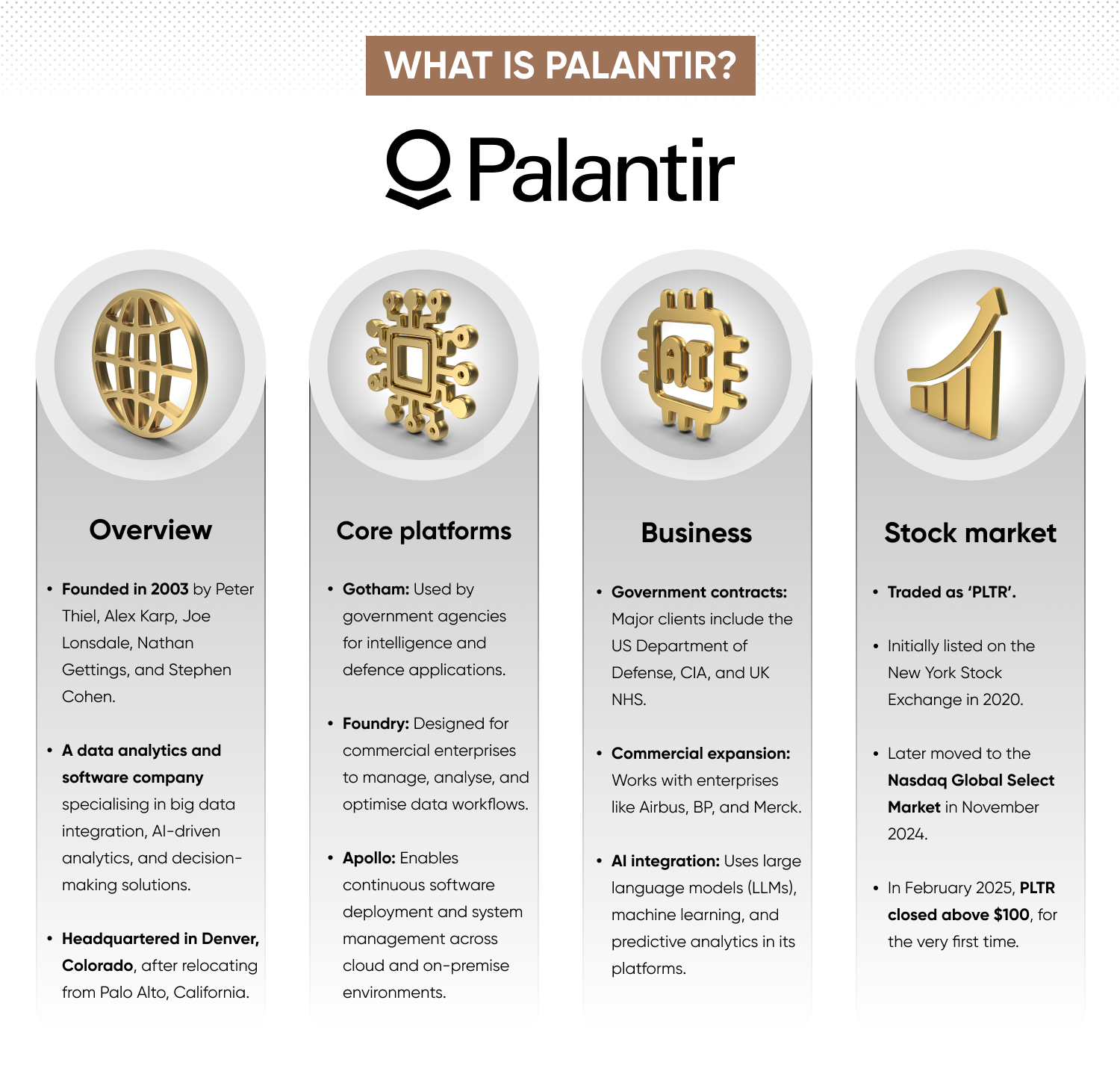
Palantir’s operations are primarily executed through three flagship platforms, each tailored to specific operational environments.
Palantir Gotham: The Intelligence Standard
Gotham was Palantir’s first product, designed specifically for the intelligence community and defense sectors. It is built to find “needles in haystacks.” In an intelligence context, Gotham might ingest signal intelligence, human reports, financial records, and satellite imagery to help analysts identify illicit networks or predict insurgent activity.
The power of Gotham lies in its ability to perform link analysis at scale. It maps entities—people, places, objects, and events—and the relationships between them. For a field commander or a counter-terrorism officer, Gotham provides a “single pane of glass” view of the battlefield or the mission area, allowing for real-time collaboration across different units that would otherwise be operating in the dark.
Palantir Foundry: The Corporate Central Nervous System
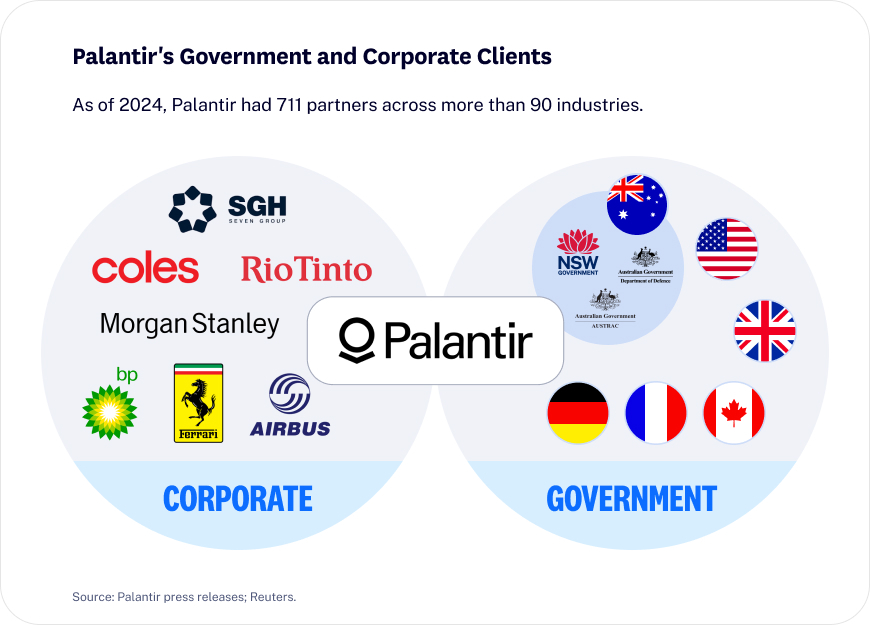
While Gotham was built for the battlefield, Foundry was built for the boardroom and the factory floor. Foundry is a data integration and operations platform used by commercial giants in sectors like aviation, energy, and finance.
For instance, an airline might use Foundry to integrate data from engine sensors, flight schedules, weather patterns, and maintenance logs. By centralizing this data, the airline can transition from reactive maintenance (fixing a part when it breaks) to predictive maintenance (replacing a part before it fails). Foundry’s success lies in its “Ontology” (a concept explored later), which allows non-technical business users to interact with complex data as if they were looking at a map of their business operations.
Palantir Apollo: The Deployment Backbone
Apollo is perhaps the most technically impressive but least discussed part of Palantir’s portfolio. It is the continuous delivery software that powers Gotham and Foundry. In the world of enterprise software, deploying updates to a secure, disconnected environment (like a submarine or a remote oil rig) is an immense challenge.
Apollo acts as an independent orchestration layer that allows Palantir to deploy software across diverse environments—public clouds, private data centers, and “at the edge” on hardware with no internet connection. It ensures that the software is always updated, secure, and functional, regardless of where the hardware resides. This capability makes Palantir one of the few software providers capable of operating in the most demanding and restricted environments on Earth.
The Architecture of the Ontology
The “Ontology” is the most critical technical innovation within Palantir’s software. To understand the Ontology is to understand how Palantir actually works.
Bridging the Gap Between Data and Decision
In most companies, data scientists speak the language of “rows and columns,” while executives speak the language of “assets and outcomes.” This disconnect is where most data projects fail. Palantir’s Ontology acts as a semantic layer that sits on top of the data. It translates raw data into digital twins of real-world objects.
Instead of looking at a SQL table named INV_001_B, a user in Foundry sees an “Aircraft Engine.” That engine has properties (temperature, flight hours) and relationships (it is attached to a specific “Plane,” which is assigned to a “Flight Path”). This allows users to ask questions in plain language and see the immediate downstream effects of their decisions.
Digital Twins and Real-World Modeling
By creating a digital twin of an entire organization, Palantir allows for “what-if” simulations. If a logistics company’s main warehouse is shut down by a strike, the Ontology allows them to simulate the ripple effects across their entire supply chain in seconds. This isn’t just data visualization; it is a live, operational model that writes back to the source systems. When a user makes a decision in Palantir, that decision can trigger actions in the company’s underlying ERP or CRM systems, closing the loop between analysis and execution.
AIP: Redefining AI for the Enterprise
With the recent explosion of generative AI and Large Language Models (LLMs), Palantir introduced the Artificial Intelligence Platform (AIP). While many companies are struggling to figure out how to use LLMs without leaking sensitive data or suffering from “hallucinations,” Palantir has integrated AI directly into its existing secure architecture.
Integrating Large Language Models Safely
AIP allows organizations to apply LLMs to their private data within the safety of the Palantir environment. The “secret sauce” here is that the AI is grounded in the Ontology. When a user asks an AI assistant to “optimize my supply chain,” the AI doesn’t just guess based on its training data. It uses the Ontology to understand the real-world constraints of the business, ensuring that its suggestions are accurate, legal, and operationally feasible.
From Analytics to Action
AIP is designed to automate workflows. It can generate code, draft reports, and even suggest tactical maneuvers in a military context, all while maintaining a strict “human-in-the-loop” requirement. Crucially, Palantir provides a full “audit trail” for every AI-driven action. In a regulated industry like banking, knowing why an AI made a certain recommendation is just as important as the recommendation itself. AIP provides the transparency necessary for enterprise-grade AI adoption.
The Future of Sovereign Tech and Data Security
As the digital world becomes more fragmented and geopolitical tensions rise, the role of software in national sovereignty has become a major theme for Palantir. They position themselves not just as a software company, but as a defender of Western democratic values through superior technology.
Security-First Engineering
Because Palantir was born in the intelligence community, security is baked into the DNA of the software. Most enterprise tools treat security as an afterthought—a layer added at the end. In Palantir, security is granular. This means that two different users looking at the same map might see different things based on their specific security clearances. This “need-to-know” access control is automated and scales across millions of data points, making it possible for different agencies or departments to collaborate without compromising sensitive sources or methods.

The Geopolitics of Software
Palantir’s leadership has been vocal about the “software-defined” nature of future conflicts. From the war in Ukraine to monitoring global health crises, Palantir’s tech is used to provide a “decision advantage.” By enabling faster processing of sensor data and more efficient allocation of resources, Palantir helps organizations stay ahead of their adversaries—whether those adversaries are hackers, rival corporations, or opposing military forces.
In summary, what Palantir does is provide the infrastructure for the intelligent age. It is a company that builds the tools required to make sense of a chaotic, data-heavy world. By focusing on data integration, the “Ontology” of business, and the secure deployment of AI, Palantir has moved from a niche intelligence tool to the essential operating system for the world’s most important institutions.
aViewFromTheCave is a participant in the Amazon Services LLC Associates Program, an affiliate advertising program designed to provide a means for sites to earn advertising fees by advertising and linking to Amazon.com. Amazon, the Amazon logo, AmazonSupply, and the AmazonSupply logo are trademarks of Amazon.com, Inc. or its affiliates. As an Amazon Associate we earn affiliate commissions from qualifying purchases.