
In the world of personal finance and long-term wealth building, few ticker symbols carry as much weight and reverence as VTSAX. Known formally as the Vanguard Total Stock Market Index Fund Admiral Shares, VTSAX has become the cornerstone of millions of retirement portfolios and a primary vehicle for the Financial Independence, Retire Early (FIRE) movement. But what exactly is this fund, and why has it earned a reputation as one of the most efficient tools for capturing the growth of the American economy?
To understand VTSAX is to understand the philosophy of passive indexing—a strategy that prioritizes broad market exposure, minimal costs, and long-term patience over the high-stakes, high-fee world of active stock picking.
What is VTSAX? Defining the Gold Standard of Passive Investing
At its core, VTSAX is a mutual fund designed to provide investors with exposure to the entire United States equity market. Instead of hiring a team of expensive analysts to guess which individual stocks will outperform others, VTSAX takes a “buy the haystack” approach.
The Mechanics of an Index Fund
An index fund is a type of mutual fund or exchange-traded fund (ETF) with a portfolio constructed to match or track the components of a financial market index. In the case of VTSAX, it tracks the CRSP US Total Market Index. This index represents nearly 100% of the investable U.S. stock market, ranging from the largest “mega-cap” companies like Apple and Microsoft to thousands of small-cap companies that are often overlooked by traditional investors.
By owning VTSAX, you are not betting on a single company; you are betting on the collective productivity and innovation of the American corporate landscape. If the U.S. economy grows over time, the value of the fund is designed to grow along with it.
Vanguard’s Role and the Legacy of John Bogle
VTSAX is managed by Vanguard, one of the world’s largest investment management companies. The firm was founded by John “Jack” Bogle, the man credited with creating the first index fund for individual investors. Bogle’s mission was radical yet simple: to lower the cost of investing so that more of the returns stay in the pockets of the investors rather than the fund managers.
Vanguard’s unique ownership structure—where the fund shareholders are the owners of the company—allows them to offer VTSAX at an incredibly low cost. This alignment of interests is a primary reason why VTSAX is often the first recommendation for those pursuing a “Bogleheads” style of investing, which emphasizes simplicity and cost-efficiency.
The Core Benefits: Why VTSAX is a Cornerstone for Portfolios
The popularity of VTSAX is not merely a result of branding; it is rooted in the mathematical advantages it provides to the average investor. By streamlining the investment process, VTSAX addresses the three biggest “wealth killers” in finance: lack of diversification, high fees, and tax inefficiency.
Unmatched Diversification Across the U.S. Economy
Diversification is often called the “only free lunch in investing.” It allows you to reduce risk without necessarily sacrificing returns. VTSAX holds over 3,700 different stocks. When you invest in this fund, your money is spread across every sector—technology, healthcare, financials, consumer discretionary, industrials, and more.
This broad exposure protects you from the failure of any single company. If a major corporation goes bankrupt, it represents only a tiny fraction of the total fund. Conversely, because the fund is market-cap weighted, the most successful companies naturally grow to become a larger part of the portfolio, ensuring you always have a stake in the market’s biggest winners.
The Power of Low Expense Ratios
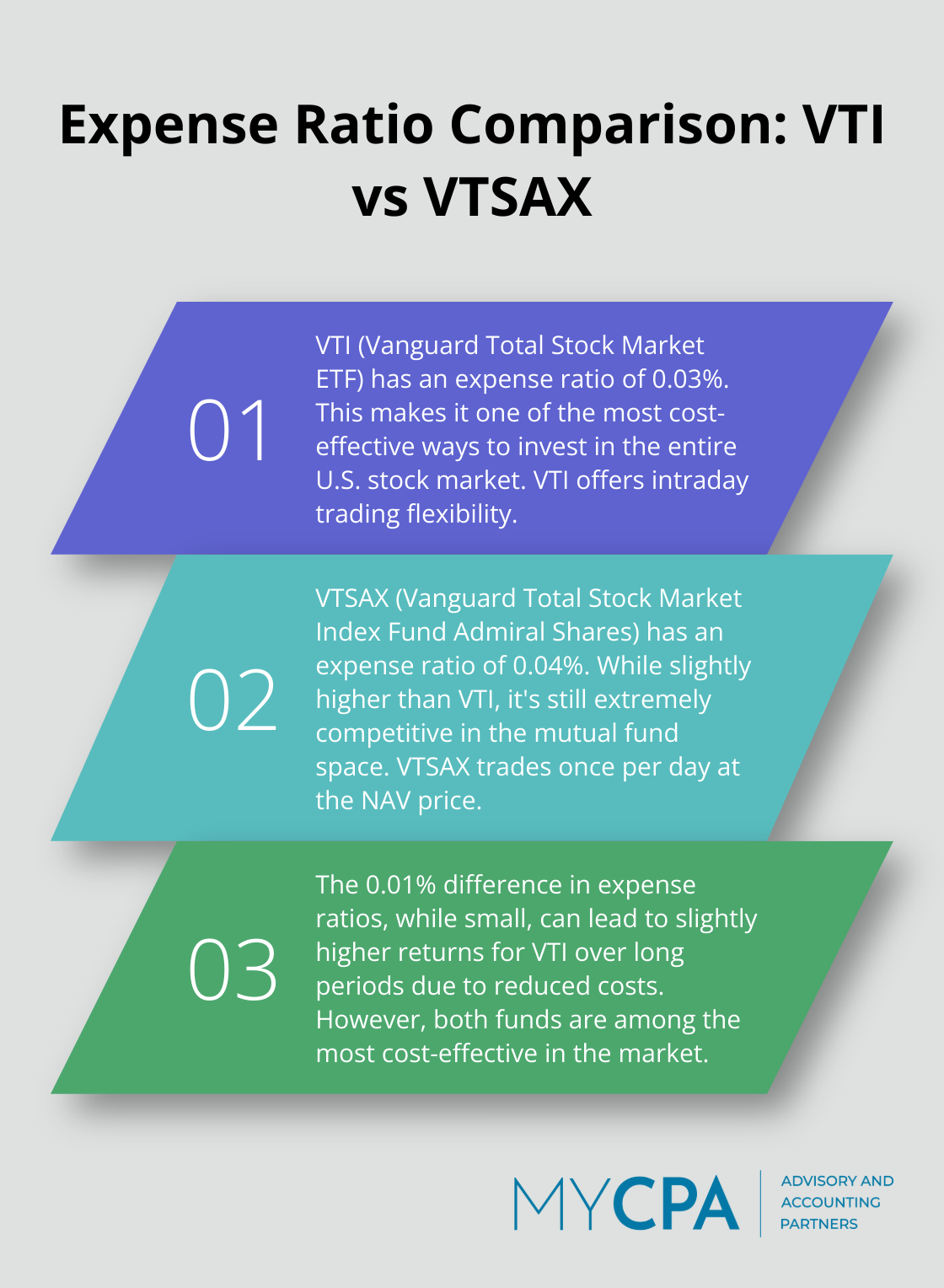
In the investment world, you usually get what you pay for—except with index funds, where the less you pay, the more you keep. VTSAX is famous for its “Admiral Shares” expense ratio, which currently stands at an ultra-low 0.04%.
To put this in perspective, if you invest $100,000, you are only paying $40 a year in management fees. Many actively managed funds charge 1.00% or more, which would cost you $1,000 a year for the same $100,000 investment. Over a 30-year investing horizon, that difference in fees can equate to hundreds of thousands of dollars in lost gains due to the erosion of compound interest. VTSAX ensures that the “magic” of compounding works for you, not your broker.
Tax Efficiency for Long-Term Holders
For investors holding funds in taxable brokerage accounts, tax efficiency is a critical consideration. VTSAX is highly tax-efficient because it has very low “turnover.” Since the fund simply tracks an index, it rarely buys or sells stocks unless the index itself changes.

Fewer trades mean fewer capital gains distributions passed on to the shareholders. This allows investors to control when they pay taxes—typically only when they decide to sell their shares in retirement—rather than being hit with annual tax bills that can drag down the portfolio’s growth.
Practical Requirements and Accessibility
While VTSAX is an ideal choice for many, there are specific practicalities regarding how to buy it and how it differs from other similar Vanguard products.
The Minimum Initial Investment Threshold
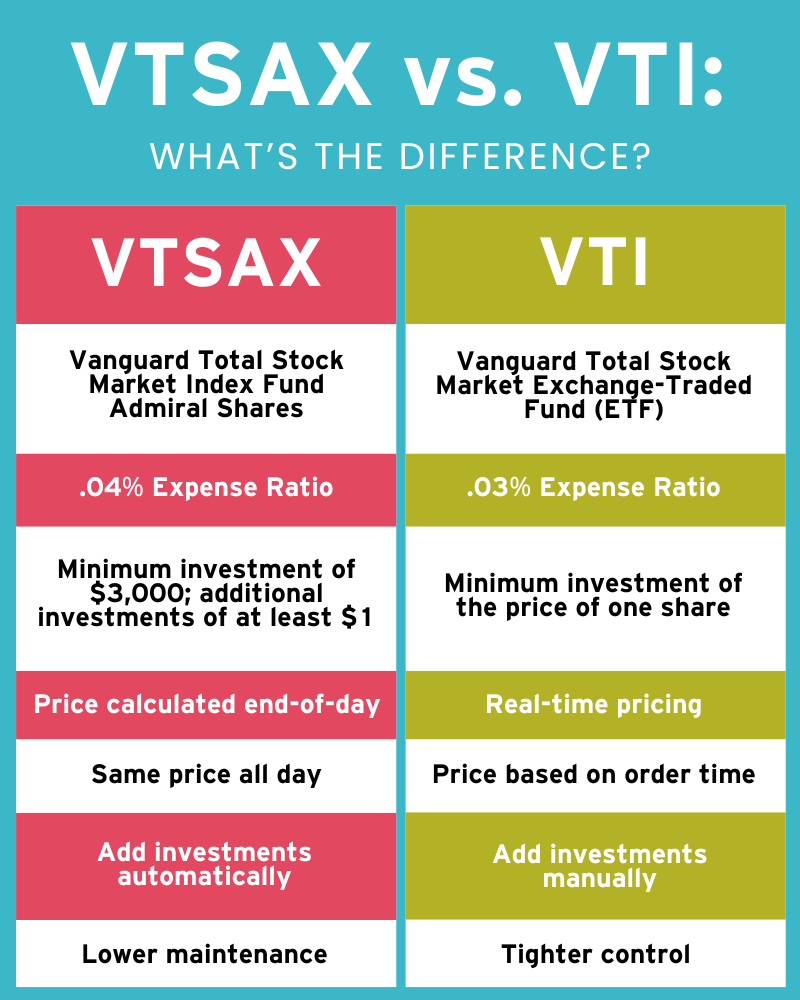
One of the few barriers to entry for VTSAX is its minimum investment requirement. To open a position in the Admiral Shares class, Vanguard requires a minimum initial investment of $3,000. For many new investors, this can be a hurdle. However, once that initial threshold is met, investors can add smaller amounts (as little as $1) at any time. This structure is designed to encourage long-term commitment and lower the administrative costs for the fund, which in turn keeps the expense ratio low for everyone.
VTSAX vs. VTI: Understanding the ETF Alternative
Investors often ask about the difference between VTSAX and VTI. VTI is the Exchange-Traded Fund (ETF) version of the Vanguard Total Stock Market Index. They hold the exact same stocks and have the same expense ratio.
The primary difference lies in how they are traded. VTSAX is a mutual fund, meaning it trades once a day after the market closes, and it allows for automated, fractional-share investing. VTI, as an ETF, trades like a stock throughout the day and does not have a $3,000 minimum (you can buy as little as one share). For most long-term investors, VTSAX is preferred for its “set it and forget it” nature, as you can schedule automatic monthly transfers from your bank account directly into the fund.
Dividend Reinvestment and Compounding
VTSAX typically pays out dividends quarterly. For those in the wealth-accumulation phase, Vanguard makes it incredibly simple to set up “DRIP” (Dividend Reinvestment Plan). By automatically using those dividends to buy more shares of VTSAX, investors can accelerate the compounding process. Over decades, the shares purchased through reinvested dividends can account for a significant portion of the total portfolio value.
Integrating VTSAX into a Broader Financial Strategy
VTSAX is powerful, but it is rarely the only asset an investor should hold. Understanding where it fits within a holistic financial plan is key to maintaining a balanced risk profile.
The Role of VTSAX in the FIRE Movement
The Financial Independence, Retire Early community has largely adopted VTSAX as its “default” investment. This is due to its simplicity. For someone aiming to live off their investments, VTSAX provides a reliable way to capture the 7–10% average annual return historically provided by the U.S. stock market. Many FIRE adherents follow the “Four Percent Rule,” and a portfolio heavily weighted in VTSAX is often used as the engine to generate the growth necessary to sustain long-term withdrawals.
Risk Management and Market Volatility
It is important to remember that VTSAX is 100% equities. This means that while it has high growth potential, it is also subject to significant market volatility. In a market crash, VTSAX will drop just as much as the overall market.
Professional financial planning often suggests that as an investor approaches retirement, they should diversify away from a 100% stock portfolio to include bonds or cash equivalents to mitigate this “sequence of returns” risk. VTSAX is the “aggressive” growth engine, but it requires a stomach for volatility during economic downturns.
Asset Allocation: When to Add International or Bond Exposure
While VTSAX covers the entire U.S. market, it does not include international stocks or fixed income (bonds). Many sophisticated investors pair VTSAX with VTIAX (Vanguard Total International Stock Index Fund) to gain exposure to markets in Europe, Asia, and emerging economies.
Additionally, adding a bond fund like VBTLX (Vanguard Total Bond Market Index Fund) can create a “Three-Fund Portfolio.” This classic strategy provides a balanced approach that covers the entire world’s stock and bond markets, with VTSAX serving as the primary driver of domestic growth.
Conclusion: The Ultimate Tool for Wealth Creation
VTSAX remains one of the most effective investment vehicles ever created for the individual investor. It embodies the democratization of finance, stripping away the complexity and high costs that once served as barriers to the stock market.
By offering a diversified, low-cost, and tax-efficient way to own the entire U.S. stock market, VTSAX allows investors to stop worrying about “beating the market” and instead focus on the things they can control: their savings rate, their expenses, and their time in the market. Whether you are just starting your financial journey with your first $3,000 or managing a multi-million dollar retirement account, VTSAX provides a professional-grade solution for long-term wealth accumulation.
aViewFromTheCave is a participant in the Amazon Services LLC Associates Program, an affiliate advertising program designed to provide a means for sites to earn advertising fees by advertising and linking to Amazon.com. Amazon, the Amazon logo, AmazonSupply, and the AmazonSupply logo are trademarks of Amazon.com, Inc. or its affiliates. As an Amazon Associate we earn affiliate commissions from qualifying purchases.