
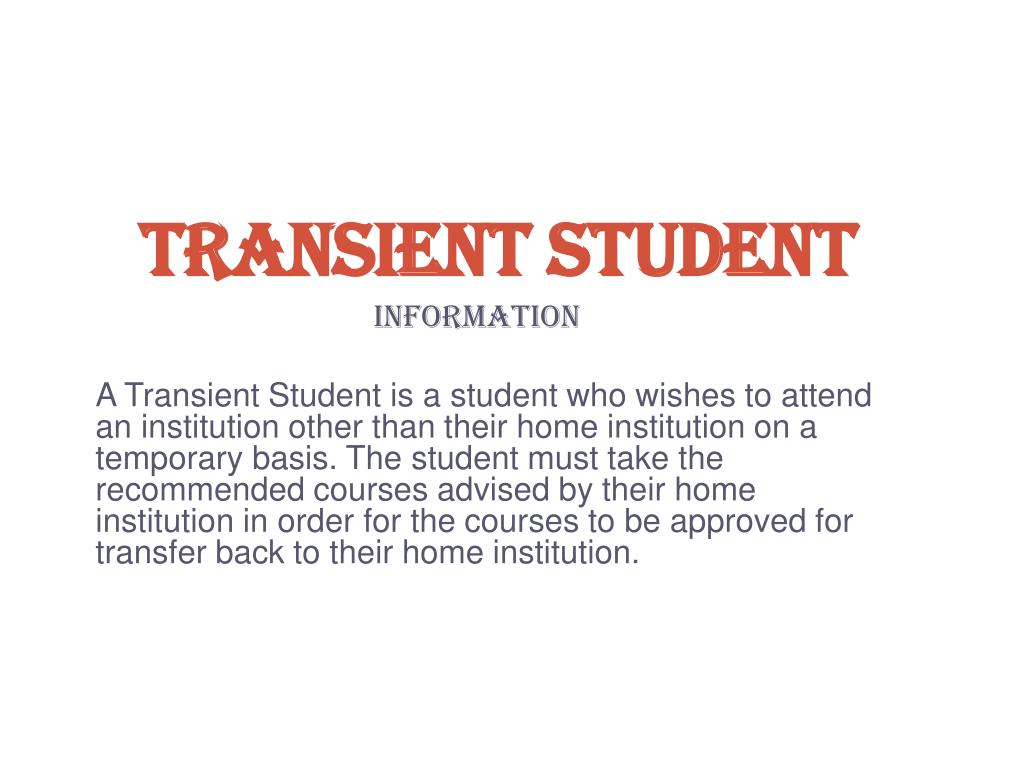
In the dynamic landscape of higher education, where tuition costs relentlessly climb and the pursuit of a degree often translates into significant financial outlay, understanding nuanced enrollment strategies can be a game-changer for personal finance. Among these strategies, the concept of a “transient student” emerges as a potent, often underutilized, financial tool for many undergraduates. A transient student, also frequently referred to as a visiting student, is an individual who temporarily enrolls in courses at a college or university with the explicit intention of transferring the earned academic credits back to their primary degree-granting institution. From a financial perspective, this academic maneuver is frequently employed as a strategic cost-saving mechanism, a method to accelerate degree completion, or a way to gain access to specific coursework without the long-term financial commitment of permanent transfer. This temporary academic pathway can significantly impact a student’s overall educational expenditures, financial aid eligibility, and eventual return on investment in their degree.
The Financial Lure of Transient Enrollment
The primary driver for many students to adopt transient status is the compelling prospect of financial savings. With the average cost of a four-year public university often exceeding $25,000 annually for in-state students and soaring past $40,000 for out-of-state attendees, and private institutions frequently charging upwards of $50,000 to $70,000 per year, seeking cost-effective alternatives for credit accumulation is not just prudent—it’s essential for responsible financial planning. Transient enrollment provides several distinct avenues for reducing the financial burden of a college education.
Cost-Saving Strategies: Leveraging Community Colleges
One of the most powerful financial advantages of transient student status lies in the ability to take courses at community colleges. Community colleges, with their significantly lower tuition rates compared to four-year universities, offer an economical pathway to fulfill general education requirements or even upper-division prerequisites. For instance, a student enrolled at a state university might pay $400-$600 per credit hour, while a local community college might charge only $100-$200 per credit hour for the exact same foundational course. By taking one or two summer courses as a transient student at a community college, a student could potentially save hundreds, if not thousands, of dollars on tuition for those specific credits. This strategy requires careful coordination with the primary institution to ensure credit transferability, but the financial arbitrage is undeniable and represents a smart budgeting decision.
Avoiding Out-of-State Tuition Penalties
For students attending out-of-state universities, the tuition differential can be staggering, often double or even triple the in-state rate. Becoming a transient student at a public institution in one’s home state during breaks, such as summer or winter, can be an astute financial move. This allows students to complete required credits at in-state tuition rates, effectively sidestepping the exorbitant out-of-state premiums their primary university would charge for the same coursework. This tactic is particularly beneficial for core curriculum subjects that are universally offered and easily transferable, making it a cornerstone of strategic personal finance in education for many families.
Strategic Use of Summer and Winter Sessions for Credit Accumulation
Beyond direct tuition savings, transient enrollment during summer or winter breaks at any accredited institution—be it a community college or another four-year university—can accelerate degree completion. By earning credits during periods when the primary institution might be less accessible, more expensive, or simply when a student desires to lighten their load during regular semesters, students can graduate earlier. Early graduation translates directly into financial benefits: fewer semesters of tuition, fees, and living expenses, and an earlier entry into the workforce, commencing income generation sooner. This strategic credit accumulation shortens the overall period of educational indebtedness and brings forward the start of wealth accumulation.
Navigating Financial Aid and Scholarship Implications
While the financial benefits of transient enrollment are compelling, students must meticulously understand how this status interacts with their existing financial aid packages and scholarship eligibility. Missteps in this area can lead to unexpected financial liabilities.
Eligibility and Disbursement Challenges
Federal financial aid, such as Pell Grants, Stafford Loans, and Plus Loans, is typically tied to enrollment at a student’s primary degree-granting institution. When a student enrolls as transient, their financial aid package from their home institution may not automatically apply to the visiting institution. Students generally cannot receive federal financial aid from two institutions concurrently for the same enrollment period. Therefore, careful planning is paramount. Students often need to arrange for a consortium agreement between their home institution and the visiting institution. This agreement allows the home institution to disburse aid based on the combined enrollment and then forward a portion to the visiting school, or to count the visiting school’s credits towards the enrollment status required for aid disbursement. Without such an agreement, students might be required to pay for their transient courses out-of-pocket and seek reimbursement or apply any excess aid towards future semesters at their home institution.
Maximizing Pell Grants and Other Federal Aid
For students eligible for Pell Grants, strategic transient enrollment can ensure continuous progress towards their degree without exhausting their Lifetime Eligibility Unit (LEU) limits prematurely on expensive courses. By taking more affordable courses at a community college, for instance, a Pell Grant recipient can stretch their federal aid dollars further, ensuring funds are available for higher-cost upper-division courses at their primary university. Understanding the specific policies regarding aid transfer and disbursement is crucial to maximizing these non-repayable funds.
Scholarship Opportunities for Visiting Students

While most scholarships are tied to enrollment at a specific institution, some smaller, local scholarships or foundation grants may be available for students taking summer courses or for those demonstrating financial need, regardless of their primary enrollment status. Moreover, by efficiently earning credits as a transient student, individuals may improve their GPA or achieve specific academic milestones faster, which could qualify them for performance-based scholarships at their home institution in subsequent semesters. Researching such opportunities and understanding their specific eligibility criteria is a valuable financial planning exercise.
Transient Status as a Smart Investment in Your Future
Viewing education as an investment, transient student status is not merely about cutting costs; it’s about optimizing the return on that investment. Strategic use of transient enrollment can enhance a student’s academic profile, accelerate career readiness, and ultimately improve long-term earning potential.
Accelerating Degree Completion and Entry into the Workforce
The most direct investment benefit of transient status is the potential for accelerated graduation. Every semester or year shaved off the total time to degree represents significant savings in tuition, fees, and living expenses, as well as an earlier start to a professional career. For a student whose post-graduation salary might be $50,000, graduating even one semester early translates to an additional $25,000 in income, plus the avoided costs of an extra semester of college. This calculation underscores the powerful financial leverage of efficient credit accumulation.
Enhancing Marketability Through Specialized Coursework
Occasionally, a student’s primary institution may not offer a specific niche course that is highly relevant to their desired career path or a valuable certification. By enrolling as a transient student at another institution renowned for a particular program or subject area, students can acquire specialized knowledge or skills that make them more attractive to employers. For example, a student pursuing a finance degree might take an intensive course in a specific financial modeling software at another university known for its robust business analytics program. This targeted acquisition of skills can lead to better job offers, higher starting salaries, and a more competitive professional profile—all contributing to a superior return on their educational investment.
Budgeting for Dual Enrollment and Academic Transfer Fees
While transient enrollment offers significant savings, it’s crucial to budget for associated costs. These can include application fees to the visiting institution, official transcript request fees from both the visiting and primary institutions, and sometimes administrative fees at the home institution for processing transferred credits. Students must also factor in potential travel, accommodation, and material costs if they are attending a distant institution. A comprehensive financial plan should account for all these minor expenditures to accurately assess the net savings and benefits of the transient strategy.
Financial Planning and Tools for Transient Students
Effective financial management is critical for transient students to maximize the benefits and avoid pitfalls. Leveraging modern financial tools and adhering to sound budgeting principles are key.
Budgeting Software and Tracking Educational Expenses
Utilizing personal finance software or budgeting apps (e.g., Mint, YNAB, Excel spreadsheets) is essential for transient students. These tools allow for meticulous tracking of all educational expenses, including tuition at both institutions, fees, books, supplies, and living costs. By categorizing expenses, students can gain a clear picture of where their money is going and identify areas for further savings. This transparency is particularly important when dealing with aid disbursement and ensuring all funds are accounted for.
Understanding Loan Deferment and Repayment Options
For students utilizing federal or private loans, understanding the implications of transient status on deferment and repayment schedules is vital. Typically, loans enter repayment six months after a student drops below half-time enrollment. If a student’s combined enrollment at both institutions (as validated by a consortium agreement) maintains their full-time or half-time status, their loans will remain in deferment. However, if there’s a gap or a failure to properly report enrollment, loans could prematurely enter repayment. Consulting with financial aid advisors at both institutions and loan servicers is crucial to navigate these complexities and ensure continuous deferment when appropriate.

Future Value of a Streamlined Education
Ultimately, the strategic use of transient student status is an exercise in optimizing the future value of one’s education. By reducing overall debt, accelerating degree completion, and potentially enhancing specialized skills, transient students are making calculated financial decisions that can lead to higher lifetime earnings and greater financial freedom. It is an investment strategy that leverages academic flexibility to achieve superior financial outcomes, underscoring that in education, as in finance, efficiency and strategic planning are paramount.
aViewFromTheCave is a participant in the Amazon Services LLC Associates Program, an affiliate advertising program designed to provide a means for sites to earn advertising fees by advertising and linking to Amazon.com. Amazon, the Amazon logo, AmazonSupply, and the AmazonSupply logo are trademarks of Amazon.com, Inc. or its affiliates. As an Amazon Associate we earn affiliate commissions from qualifying purchases.