
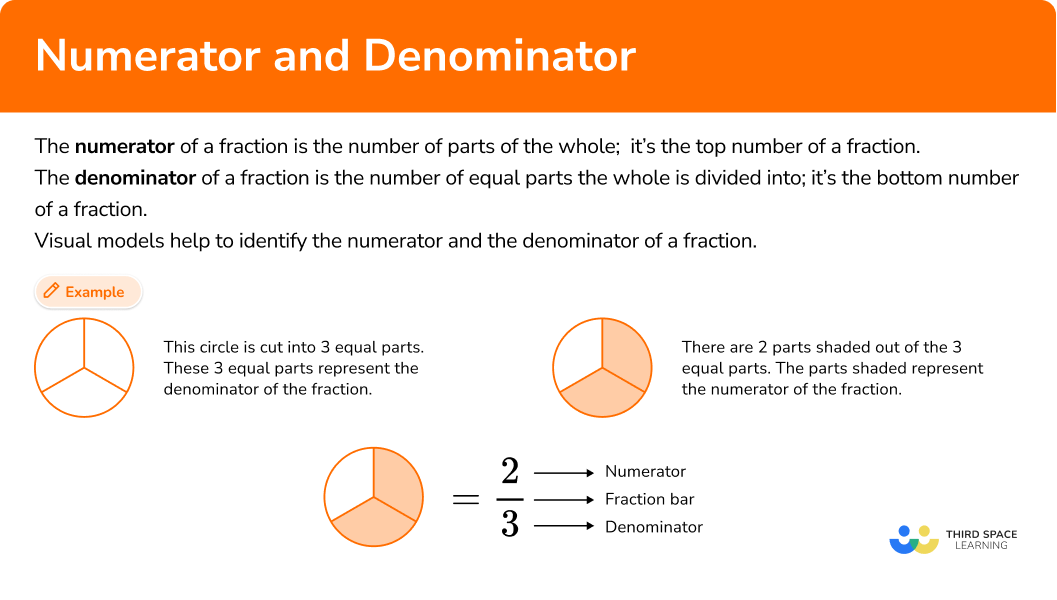
In the realm of mathematics, fractions serve as fundamental building blocks for understanding quantities and proportions. They are ubiquitous, appearing in everything from basic arithmetic to advanced calculus, and form the bedrock of many scientific and engineering disciplines. At its core, a fraction represents a part of a whole. However, to truly grasp the essence and utility of fractions, it is crucial to dissect their components. The two primary elements that constitute any fraction are the numerator and the denominator. While the denominator indicates the total number of equal parts into which a whole is divided, the numerator plays an equally vital role by signifying how many of those parts we are considering. Understanding the numerator is not merely an academic exercise; it is a prerequisite for comprehending more complex mathematical concepts, interpreting data, and even making informed financial decisions.

The Anatomy of a Fraction: Numerator and Denominator Defined
Before delving deeper into the significance of the numerator, it is essential to establish a clear understanding of the fraction’s structure. A fraction is typically written in the form of a/b, where ‘a’ and ‘b’ are integers, and ‘b’ is not equal to zero. The horizontal line separating ‘a’ and ‘b’ is known as the fraction bar or vinculum, and it signifies division.
Identifying the Numerator: The “How Many” Part
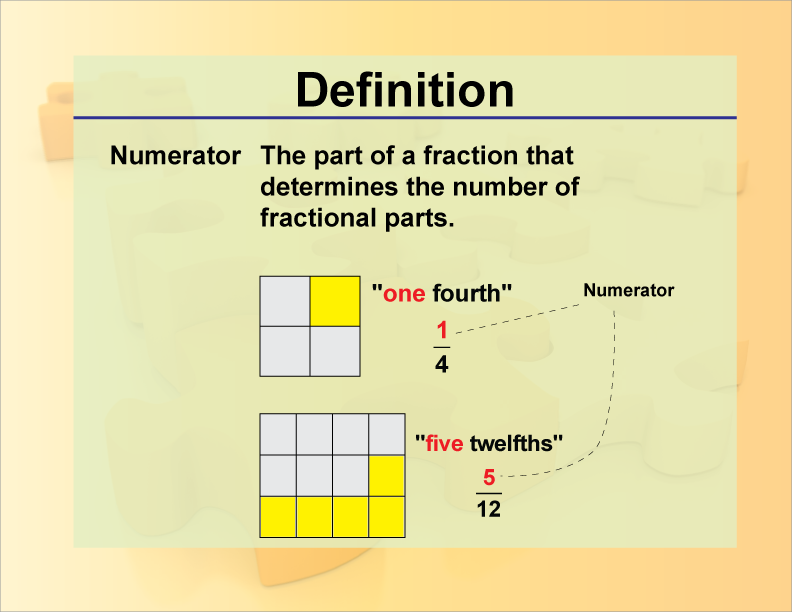
The numerator is the number positioned above the fraction bar. Its fundamental purpose is to denote the number of equal parts that are being counted or considered. Think of it as the “count” or the “amount” of the fraction. For instance, in the fraction 3/4, the number 3 is the numerator. It tells us that we are interested in 3 out of the total 4 equal parts that make up the whole.
Understanding the Denominator: The “Total Parts” Part
Conversely, the denominator is the number situated below the fraction bar. It represents the total number of equal parts into which the whole is divided. In our example of 3/4, the number 4 is the denominator. This indicates that the whole has been divided into 4 equal portions. The denominator provides the context for the numerator; the numerator’s value is only meaningful in relation to the size of the parts defined by the denominator. It is critical to remember that the denominator can never be zero, as division by zero is mathematically undefined.
The Significance of the Numerator in Mathematical Operations
The numerator is not just a static label; it actively participates in all mathematical operations involving fractions. Its value directly influences the outcome of addition, subtraction, multiplication, and division. A thorough understanding of its role is paramount for accurate calculations and for interpreting the results of these operations.
Addition and Subtraction with Common Denominators
When adding or subtracting fractions that share the same denominator, the process is straightforward. We simply add or subtract the numerators while keeping the denominator unchanged. For example, to add 2/5 and 1/5, we add the numerators (2 + 1 = 3) and retain the denominator, resulting in 3/5. The numerator’s direct influence is evident here, as it is the quantity being combined.
Addition and Subtraction with Unlike Denominators
When fractions have different denominators, a preliminary step involving finding a common denominator is necessary before addition or subtraction can occur. Once a common denominator is established, the numerators are adjusted proportionally, and then the addition or subtraction proceeds as before. The adjusted numerators, reflecting their equivalent values in relation to the common denominator, are then manipulated.
Multiplication of Fractions
Multiplying fractions involves multiplying the numerators together and multiplying the denominators together. The new numerator is the product of the original numerators. For instance, (2/3) * (1/4) = (2 * 1) / (3 * 4) = 2/12. The numerator of the resulting fraction is directly determined by the product of the initial numerators.
Division of Fractions
Dividing fractions involves inverting the second fraction (the divisor) and then multiplying it by the first fraction. This means the numerator of the second fraction becomes its denominator, and vice versa. The subsequent multiplication then follows the rules described above, with the product of the numerators forming the new numerator. For example, (3/5) ÷ (1/2) = (3/5) * (2/1) = (3 * 2) / (5 * 1) = 6/5. The interplay between the numerators of both fractions, especially the inversion of the divisor’s numerator, highlights its dynamic role in division.
The Numerator in Real-World Applications and Financial Contexts
The concept of the numerator extends far beyond the confines of the classroom, playing a crucial role in various real-world scenarios, particularly those involving finance and data analysis. Its ability to represent specific quantities within a larger whole makes it an invaluable tool for understanding proportions, calculating rates, and making informed judgments.
Understanding Proportions and Ratios
Fractions are inherently about proportions. The numerator quantifies a specific portion of the whole represented by the denominator. In finance, this is seen in calculations of ownership stakes, profit margins, or market share. For example, if a company has 10,000 shares outstanding and an individual owns 500 shares, their ownership is represented by the fraction 500/10,000. The numerator (500) clearly indicates the number of shares held by that individual out of the total.
Calculating Rates and Percentages
Percentages are simply fractions out of 100. When we talk about a 25% discount, we are referring to 25 out of every 100 units. In this context, 25 is the numerator, representing the amount of discount applied to the whole. Similarly, interest rates, growth rates, and inflation rates are all expressed using fractional concepts, where the numerator signifies the specific increase or decrease relative to a base value represented by the denominator. For instance, an annual interest rate of 5% means that for every $100 invested, the investor earns $5. This can be represented as 5/100.
Analyzing Financial Statements and Performance Metrics
Financial statements are replete with data that can be expressed and understood through fractions. Ratios used to assess a company’s performance, such as the debt-to-equity ratio or the price-to-earnings ratio, all rely on the interplay between numerators and denominators. The numerator in these ratios often represents a specific financial metric (e.g., total debt, net income), while the denominator represents another (e.g., total equity, earnings per share). Analyzing these fractions allows investors and analysts to gauge a company’s financial health, profitability, and valuation. For example, a higher profit margin (net income divided by revenue) indicates a stronger ability to generate profit from sales, with net income acting as the numerator.
Common Misconceptions and Nuances of the Numerator
Despite its fundamental nature, the concept of the numerator can sometimes lead to confusion, especially when dealing with more complex fractional forms or when comparing fractions. Addressing these common misconceptions can solidify one’s understanding.
Comparing Fractions with Different Denominators
A frequent pitfall is incorrectly assuming that a larger numerator always equates to a larger fraction. This is only true when the denominators are the same. To accurately compare fractions with unlike denominators, one must either convert them to equivalent fractions with a common denominator or convert them to decimals. For example, 3/4 is larger than 2/3. If we simply compared the numerators (3 > 2), we would be misled. However, when converted to a common denominator of 12, they become 9/12 and 8/12, respectively, clearly showing that 9/12 (and thus 3/4) is greater. The numerator’s value is always relative to its denominator.
Improper Fractions and Mixed Numbers
An improper fraction is one where the numerator is greater than or equal to the denominator (e.g., 7/4). This signifies a value greater than or equal to one whole. Improper fractions can be converted into mixed numbers, which consist of a whole number part and a proper fraction part. For instance, 7/4 can be written as 1 and 3/4. In this conversion, the original numerator is used to determine how many whole units are contained within the fraction, and the remainder becomes the new numerator of the fractional part.
The Numerator in Advanced Mathematical Concepts
The understanding of the numerator’s role extends into more advanced mathematical fields. In calculus, for instance, derivatives and integrals often involve fractions, and the numerator continues to represent the quantity or rate of change being considered. In statistics, probabilities are expressed as fractions, with the numerator denoting the number of favorable outcomes and the denominator the total number of possible outcomes. The consistent role of the numerator as a counter of specific elements within a defined set underscores its fundamental importance across the mathematical spectrum.
Conclusion
In conclusion, the numerator of a fraction is far more than just a number above a line. It is the active component that quantifies what we are counting or considering within the whole. From the simplest arithmetic problems to the intricacies of financial analysis and advanced mathematics, the numerator’s role is consistently that of the “how many.” A firm grasp of its definition, its interaction with the denominator, and its participation in various mathematical operations is essential for building a robust mathematical foundation and for navigating the quantitative aspects of our world. By understanding the numerator, we unlock a deeper comprehension of proportions, rates, and the very nature of quantities, empowering us to interpret information more effectively and make more informed decisions in both our academic and professional lives.
aViewFromTheCave is a participant in the Amazon Services LLC Associates Program, an affiliate advertising program designed to provide a means for sites to earn advertising fees by advertising and linking to Amazon.com. Amazon, the Amazon logo, AmazonSupply, and the AmazonSupply logo are trademarks of Amazon.com, Inc. or its affiliates. As an Amazon Associate we earn affiliate commissions from qualifying purchases.