
In the landscape of global finance, few metrics are as frequently cited or as profoundly influential as the market capitalization of Apple Inc. As a bellwether for the technology sector and a cornerstone of major stock indices like the S&P 500 and the Nasdaq-100, Apple’s valuation serves as more than just a number; it is a pulse check for investor sentiment, consumer spending, and the broader health of the global economy. To understand what the market capitalization of Apple represents, one must look beyond the share price and delve into the intricate financial mechanics, historical growth patterns, and strategic capital management that have solidified its position at the pinnacle of the financial world.

The Mechanics of Market Capitalization and Apple’s Valuation
Market capitalization, or “market cap,” is a straightforward yet powerful calculation used to determine the total dollar market value of a company’s outstanding shares of stock. It is calculated by multiplying the current market price of a single share by the total number of outstanding shares. For a titan like Apple, this figure is dynamic, fluctuating with every second of the trading day as global markets react to news, earnings reports, and macroeconomic shifts.
Why Market Cap Matters to Investors
For the individual and institutional investor, Apple’s market cap is a primary indicator of its size and risk profile. Apple is categorized as a “mega-cap” stock, a designation typically reserved for companies with a valuation exceeding $200 billion. The sheer scale of Apple’s market cap—which has hovered between $2.5 trillion and over $3 trillion in recent years—means it possesses a level of liquidity and stability that few other assets can match. It is often viewed as a “safe haven” within the equity markets, providing a combination of growth potential and capital preservation.
The Role of Outstanding Shares
A critical component of Apple’s market cap equation is its share count. Unlike many of its peers, Apple has been aggressive in reducing its number of outstanding shares through one of the most robust share buyback programs in corporate history. Since 2012, Apple has spent hundreds of billions of dollars repurchasing its own stock. While this reduces the denominator in the earnings-per-share (EPS) calculation—thereby boosting the stock price—it also means the market capitalization reflects a concentrated value. When we look at Apple’s valuation, we are seeing the market’s appraisal of the company’s total worth, even as the company actively shrinks the pool of equity available to the public.
The Historic Journey to the Multi-Trillion Dollar Benchmark
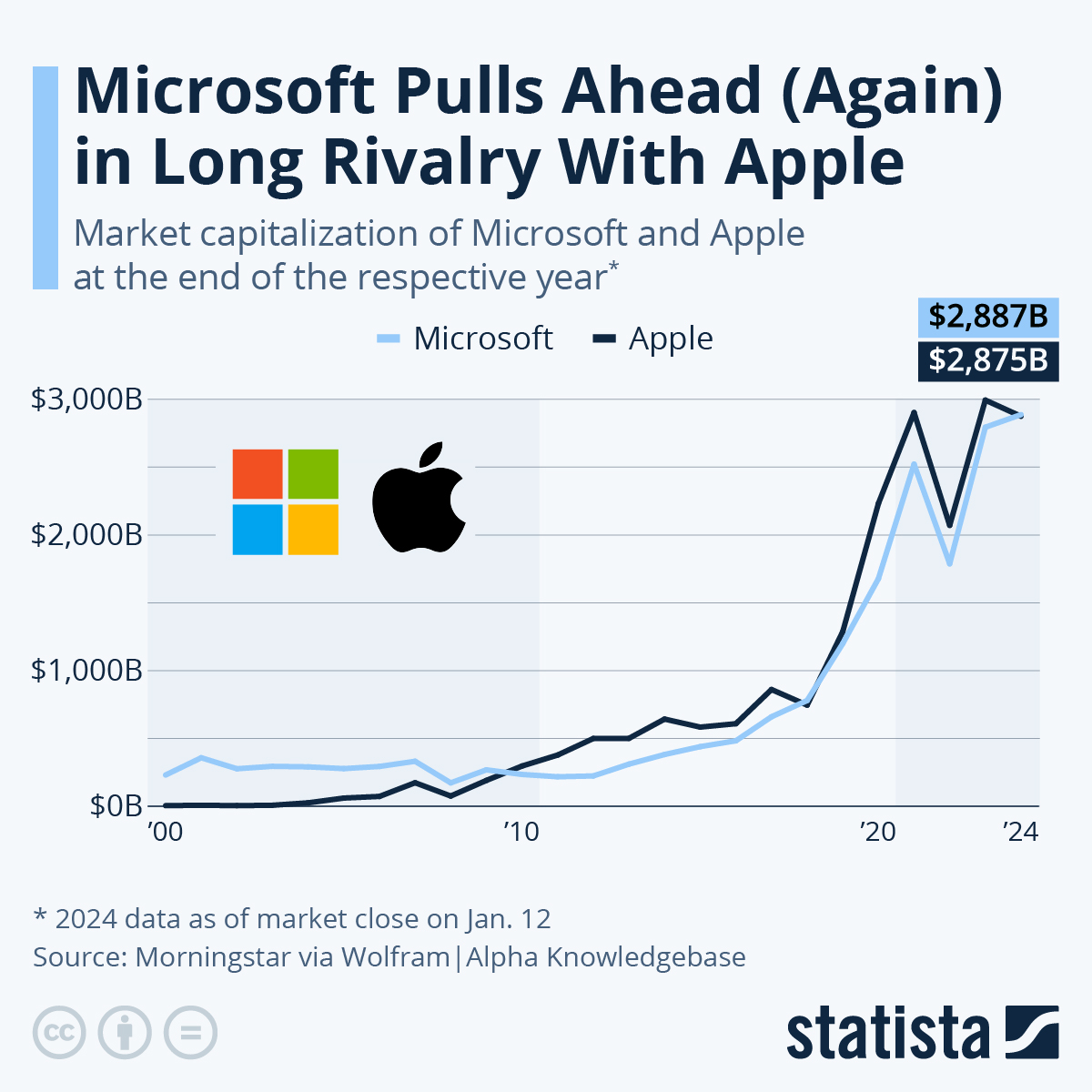
The trajectory of Apple’s market capitalization is a study in exponential growth and the compounding power of brand loyalty and ecosystem expansion. It took Apple 42 years to reach its first $1 trillion valuation in August 2018. Remarkably, it took only two more years to hit $2 trillion in August 2020, and by early 2022, it briefly touched the $3 trillion milestone. This acceleration is a testament to the market’s evolving perception of Apple from a hardware manufacturer to a high-margin services and software powerhouse.
Breaking the $1 Trillion Ceiling
The ascent to $1 trillion was driven largely by the ubiquity of the iPhone. During this era, investors focused on unit sales and the hardware refresh cycle. The market viewed Apple as a cyclical consumer electronics company. However, as the user base grew into the hundreds of millions, the narrative shifted. Investors began to realize that the value was not just in the device itself, but in the platform it provided for recurring revenue.
The Leap to $3 Trillion: The Services Multiplier
The jump from $1 trillion to over $3 trillion was fueled by a significant expansion in Apple’s price-to-earnings (P/E) multiple. Financial markets began to value Apple more like a software-as-a-service (SaaS) company rather than a traditional hardware vendor. The growth of the Services segment—which includes the App Store, iCloud, Apple Music, and Apple Pay—offered high profit margins and predictable, recurring income. This “Services Multiplier” convinced investors that Apple’s earnings were higher quality and more sustainable, justifying a much higher market capitalization even when hardware sales growth slowed.
Core Drivers of Apple’s Market Dominance and Financial Stability
Apple’s market capitalization is underpinned by several fundamental pillars that differentiate it from other large-cap technology firms. These drivers ensure that even in periods of market volatility, Apple maintains a premium valuation relative to its earnings.
The Ecosystem and Consumer “Stickiness”

From a financial perspective, Apple’s greatest asset is its ecosystem lock-in. The integration of hardware, software, and services creates a high switching cost for consumers. This translates to a predictable revenue stream that investors find incredibly attractive. When a company can guarantee a high retention rate, its future cash flows become easier to model and discount, leading to a higher present value and, consequently, a higher market cap.
Unparalleled Cash Flow and Balance Sheet Strength
Apple’s ability to generate free cash flow is almost unprecedented in the business world. This liquidity provides the company with a “fortress balance sheet,” allowing it to navigate economic downturns, invest in research and development, and return massive amounts of capital to shareholders through dividends and buybacks. For an investor, Apple’s market cap is backed by tangible financial strength, reducing the perceived risk of the investment.
Margin Expansion through Vertical Integration
Another factor supporting Apple’s valuation is its strategy of vertical integration. By designing its own silicon chips (the M-series and A-series) and controlling the entire user experience from hardware to OS, Apple has been able to maintain and even expand its profit margins. In a world where many tech companies face rising input costs, Apple’s control over its supply chain and core technology provides a significant competitive advantage that is reflected in its premium market valuation.
Comparative Valuation: Apple vs. The Global Economy
To truly grasp the scale of Apple’s market capitalization, one must compare it to other economic entities and benchmarks. At various points, Apple’s valuation has exceeded the Gross Domestic Product (GDP) of major developed nations, such as the United Kingdom, France, or Italy. This comparison highlights the immense concentrated economic power held by a single corporate entity.
Apple vs. The “Magnificent Seven”
Within the equity markets, Apple is a leading member of the “Magnificent Seven”—a group of high-performing tech stocks that includes Microsoft, Alphabet, Amazon, Nvidia, Meta, and Tesla. For much of the last decade, Apple and Microsoft have traded places as the most valuable company in the world. Investors often compare Apple’s market cap to Microsoft’s to gauge trends in enterprise versus consumer spending. While Microsoft often commands a higher valuation due to its cloud dominance (Azure), Apple’s market cap remains buoyed by its unrivaled consumer brand equity and retail footprint.
Index Weighting and Passive Investing
The sheer size of Apple’s market cap gives it a disproportionate influence over passive investment vehicles. In market-cap-weighted indices like the S&P 500, Apple often represents 6% to 7% of the entire index. This creates a feedback loop: as more capital flows into S&P 500 index funds and ETFs, a significant portion of that money is automatically used to purchase Apple shares, further supporting its market capitalization. This “passive bid” provides a layer of structural support that smaller companies do not enjoy.
Future Outlook: Maintaining a Premium Valuation in a Changing Market
As we look toward the future, the sustainability of Apple’s market capitalization depends on its ability to find the “next big thing” and successfully integrate Artificial Intelligence (AI) into its financial model. The market is no longer satisfied with incremental iPhone updates; it is looking for evidence that Apple can lead in the next era of computing.
The Role of AI and Innovation
Recent fluctuations in Apple’s market cap have been tied to investor sentiment regarding its AI strategy. As competitors like Nvidia and Microsoft took early leads in generative AI, Apple’s valuation faced pressure. However, the introduction of “Apple Intelligence” and the integration of AI across its billion-plus device install base have provided a new catalyst for growth. Investors view AI not just as a feature, but as a way to trigger a massive hardware upgrade cycle and introduce new high-margin AI-based services.
Risks to the Valuation
No discussion of Apple’s market capitalization is complete without acknowledging the risks. Regulatory scrutiny in the European Union and the United States poses a threat to the App Store’s high-margin “Apple Tax.” Furthermore, geopolitical tensions affecting supply chains in Asia could disrupt hardware production. Investors must weigh these risks against Apple’s historical resilience. A significant drop in market cap usually occurs when the market perceives a threat to the long-term terminal value of the company’s cash flows.
In conclusion, the market capitalization of Apple is a multifaceted reflection of its past successes, current financial dominance, and future potential. It represents the collective wisdom of millions of investors—ranging from retail traders to the world’s largest sovereign wealth funds—who have placed a value on Apple’s ability to innovate, monetize its user base, and manage its capital with surgical precision. Whether it sits at $2 trillion or climbs toward $4 trillion, Apple’s market cap remains the ultimate gold standard for measuring corporate success in the modern financial era.
aViewFromTheCave is a participant in the Amazon Services LLC Associates Program, an affiliate advertising program designed to provide a means for sites to earn advertising fees by advertising and linking to Amazon.com. Amazon, the Amazon logo, AmazonSupply, and the AmazonSupply logo are trademarks of Amazon.com, Inc. or its affiliates. As an Amazon Associate we earn affiliate commissions from qualifying purchases.