
In the intricate tapestry of modern technology, a few fundamental concepts serve as the bedrock upon which innovation is built. Among these, “frequency” stands out as a ubiquitous and profoundly important parameter. From the silent hum of your Wi-Fi router to the rapid processing cycles of your computer’s CPU, frequency is at play, orchestrating the unseen rhythms that define our digital world. Often expressed in Hertz (Hz), frequency quantifies how often a recurring event happens per unit of time, making it a critical metric for understanding everything from wave propagation to data transmission rates.

While the definition might seem straightforward, the applications and the various equations used to calculate and interpret frequency are diverse, reflecting its multifaceted role across different technological disciplines. This article will delve into the core equations of frequency, explore its pervasive significance in various tech sectors, discuss how it’s measured and manipulated, and glimpse into its future implications. For anyone working with or simply curious about technology, a solid understanding of frequency is not just academic; it’s a gateway to deeper comprehension and more informed innovation.
The Core Equations of Frequency: Understanding the Basics
At its heart, frequency describes periodicity. How many cycles, oscillations, or events occur within a given second? This simple question leads to several foundational equations, each tailored to different contexts but all interconnected.
Frequency from Period (T): The Most Direct Relationship
The most fundamental way to define frequency is through its inverse relationship with the “period” (T). The period is the time it takes for one complete cycle or oscillation to occur. If you know how long one cycle lasts, you can easily determine how many cycles fit into a second.
The primary equation is:
f = 1 / T
Where:
- f represents frequency, measured in Hertz (Hz). One Hertz is equivalent to one cycle per second.
- T represents the period, measured in seconds (s).
For example, if a signal completes one cycle in 0.01 seconds (T = 0.01 s), its frequency would be 1 / 0.01 = 100 Hz. This relationship is crucial in contexts like alternating current (AC) power systems, where the mains frequency (e.g., 50 Hz or 60 Hz) dictates the cycle time of the electrical waveform. Similarly, in digital circuits, clock signals operate with a specific period, directly translating to their operating frequency.
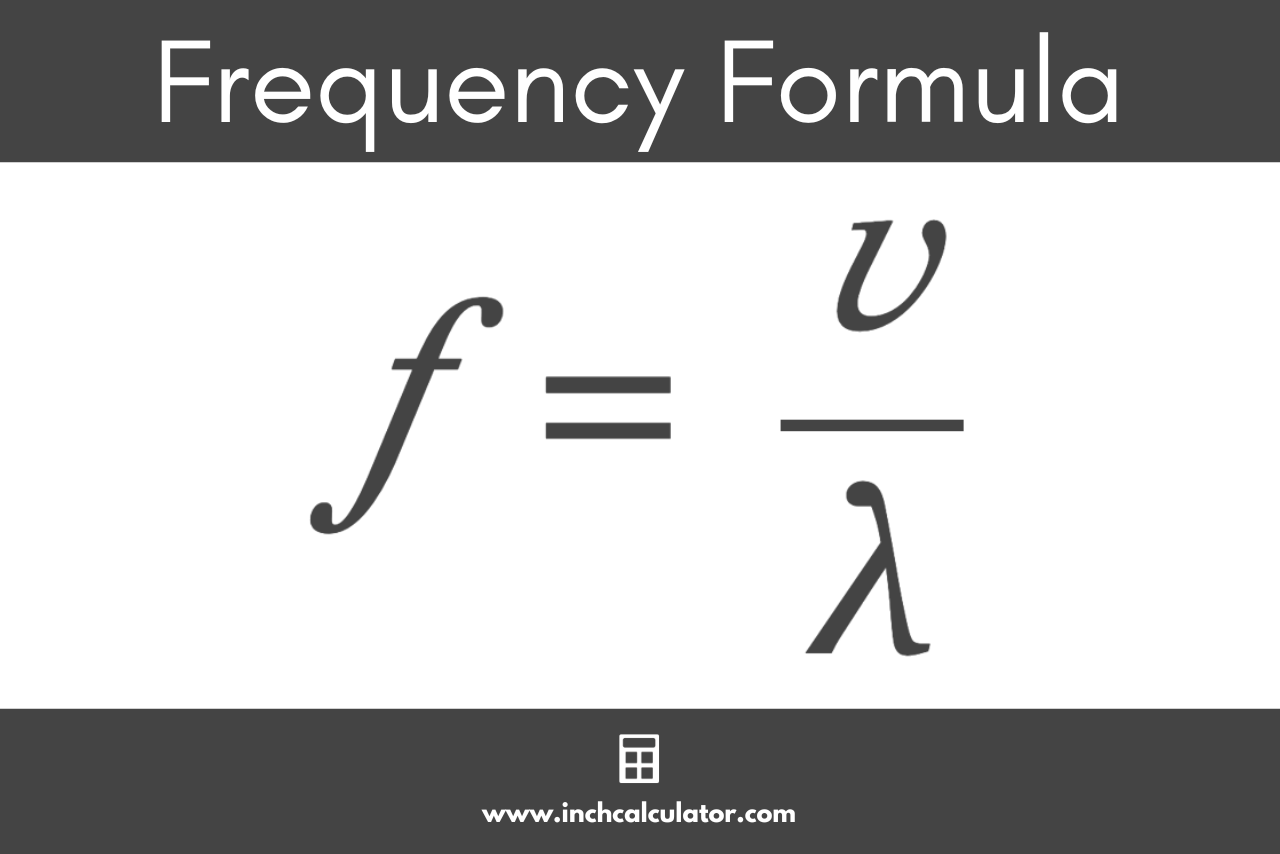
Frequency from Wavelength (λ) and Wave Speed (v): For Wave Phenomena
When dealing with waves—be it electromagnetic waves (radio, light), sound waves, or even seismic waves—frequency is inherently linked to their speed and wavelength. Wavelength (λ) is the spatial period of a wave, the distance over which the wave’s shape repeats. Wave speed (v) is how fast the wave propagates through a medium.
The equation relating these three is:
f = v / λ
Where:
- f is frequency in Hertz (Hz).
- v is the wave speed, measured in meters per second (m/s). For electromagnetic waves in a vacuum, ‘v’ is replaced by ‘c’, the speed of light (approximately 3 x 10^8 m/s).
- λ (lambda) is the wavelength, measured in meters (m).
This equation is indispensable in telecommunications. For instance, knowing the frequency of a radio signal and the speed of light allows engineers to calculate its wavelength, which is critical for antenna design. A 2.4 GHz Wi-Fi signal, for example, has a specific wavelength determined by this formula. Understanding this relationship is also key to optical fiber communication, where different frequencies (colors) of light are used to transmit data over vast distances.
Angular Frequency (ω): The Rotational Perspective
While regular frequency (f) tells us cycles per second, “angular frequency” (ω – omega) describes the rate of change of phase angle of a sinusoidal waveform, expressed in radians per second. It’s particularly useful in physics and engineering, especially when dealing with rotating systems, oscillations, and alternating current (AC) circuits where phase relationships are critical.
The relationship between angular frequency and standard frequency is:
ω = 2πf
Where:
- ω is the angular frequency, measured in radians per second (rad/s).
- π (pi) is the mathematical constant, approximately 3.14159.
- f is the standard frequency in Hertz (Hz).
This equation highlights that a full cycle (360 degrees) corresponds to 2π radians. Angular frequency simplifies many equations in circuit analysis (e.g., impedance calculations for capacitors and inductors) and describes the natural resonant frequencies of systems more elegantly. For engineers designing filters or analyzing the response of electronic components, angular frequency is often the preferred metric.
Why Frequency Matters in Technology: Diverse Applications
The implications of frequency extend far beyond mere theoretical calculations; they are the bedrock of functionality for virtually every piece of technology we interact with daily.
Telecommunications and Wireless Technology

In the realm of telecommunications, frequency is paramount. Radio waves, the carriers of all wireless communication, are defined by their frequency. Different frequency bands are allocated for distinct purposes:
- AM/FM radio broadcasting uses kilohertz (kHz) and megahertz (MHz) bands.
- Cellular networks (2G, 3G, 4G, 5G) operate across various MHz and GHz bands. 5G, particularly, is pushing into millimeter wave (mmWave) frequencies (e.g., 24 GHz to 100 GHz) for ultra-high-speed data transmission.
- Wi-Fi relies on specific bands, predominantly 2.4 GHz and 5 GHz, with newer standards exploring 6 GHz.
- Satellite communication, radar, and GPS also utilize dedicated frequency ranges.
The chosen frequency dictates propagation characteristics (how far a signal travels, how well it penetrates obstacles) and, crucially, the amount of data that can be transmitted. Higher frequencies generally allow for greater bandwidth, meaning more data can be packed into each second, leading to faster internet speeds and higher-quality multimedia streaming.
Computing and Digital Electronics
Frequency is fundamental to how computers and digital devices operate. The “clock speed” of a Central Processing Unit (CPU) is expressed in gigahertz (GHz) and represents the frequency at which the processor’s internal clock cycles. A 3 GHz CPU performs 3 billion cycles per second, each cycle executing fundamental operations. Higher clock speeds generally imply faster processing capabilities, though architecture and core count also play significant roles.
Similarly, Random Access Memory (RAM) has its own operating frequencies (e.g., DDR4-3200 operates at 1600 MHz, effectively 3200 MT/s due to double data rate), and data transfer interfaces like USB and PCIe also operate at defined frequencies to synchronize data flow. The stability and precision of these frequencies are critical for reliable and efficient computing, relying on components like crystal oscillators to generate highly accurate timing signals.
Audio and Video Engineering
In audio, frequency is synonymous with pitch. The human ear can typically perceive sounds ranging from about 20 Hz (deep bass) to 20,000 Hz (high treble). Audio engineers meticulously work with frequency responses to shape sound, using equalizers to boost or cut specific frequency bands to achieve desired tonal qualities. Sampling rates in digital audio (e.g., 44.1 kHz for CDs) define how many times per second the analog sound wave is measured and converted into digital data, directly impacting the highest frequency that can be accurately reproduced.
For video, display refresh rates are measured in Hertz (e.g., 60 Hz, 120 Hz, 144 Hz). This indicates how many times per second the screen updates its image. A higher refresh rate results in smoother motion, particularly noticeable in fast-paced gaming or video playback, reducing motion blur and tearing.
Power Systems and Electrical Engineering
In electrical engineering, especially with alternating current (AC) power systems, frequency is a defining characteristic. The electrical grids worldwide operate at either 50 Hz or 60 Hz. This frequency dictates the speed at which the current reverses direction and is crucial for the stable operation of motors, generators, and transformers. Power engineers must maintain this frequency with extreme precision, as deviations can lead to inefficiencies, equipment damage, and grid instability. Frequency analysis is also vital in designing filters to eliminate unwanted noise or selecting resonant circuits for specific applications.
Measuring and Manipulating Frequency in Tech
Given its critical role, accurately measuring and precisely generating frequency are paramount in technology. Engineers rely on specialized tools and sophisticated circuits to achieve this.
Frequency Measurement Tools
- Oscilloscopes: These are versatile instruments that display voltage waveforms over time, allowing engineers to visually inspect and measure the period of a signal, from which frequency can be derived. Modern digital oscilloscopes often have built-in functions for automatic frequency measurement.
- Spectrum Analyzers: Unlike oscilloscopes, which operate in the time domain, spectrum analyzers operate in the frequency domain. They break down a complex signal into its constituent frequencies and display their amplitudes. This is invaluable for analyzing radio frequency (RF) signals, identifying harmonics, and detecting interference.
- Frequency Counters: These are dedicated devices designed to accurately measure the frequency of a repetitive electronic signal by counting the number of cycles within a precise time interval. They offer very high precision for stable, high-frequency signals.
Frequency Generation and Control
- Oscillators: These electronic circuits generate repetitive electronic signals, typically sine waves or square waves, at a specific frequency.
- Crystal Oscillators: Extremely stable and precise, they use the piezoelectric properties of a vibrating crystal (usually quartz) to generate frequencies. They are ubiquitous in computers, microcontrollers, and wireless devices for clock signals and timing.
- LC Oscillators: Use inductors (L) and capacitors (C) to create resonant circuits that oscillate at a particular frequency. They are common in radio frequency (RF) applications.
- RC Oscillators: Use resistors (R) and capacitors (C) for feedback, often used for lower frequencies or where less precision is required.
- Frequency Synthesizers: These complex circuits generate a wide range of frequencies from a single, stable reference frequency (often from a crystal oscillator). They are essential in tunable radios, mobile phones, and signal generators, allowing devices to operate across different channels and bands.
- Phase-Locked Loops (PLLs): PLLs are control systems that generate an output signal whose phase is related to the phase of an input “reference” signal. They are widely used for frequency synthesis, modulation/demodulation, clock recovery, and frequency multiplication, ensuring precise synchronization and stability in high-frequency applications like telecommunications and data processing.
The Future of Frequency: Innovation and Challenges
The quest for higher performance, greater bandwidth, and new technological frontiers continues to push the boundaries of frequency applications.
Higher Frequencies for Greater Bandwidth
The demand for faster data transfer is driving technology towards increasingly higher frequencies.
- Millimeter Wave Technology: As mentioned, 5G utilizes mmWave bands, which offer enormous bandwidth for extremely fast local connections. However, these frequencies have poor penetration through obstacles and short range, necessitating denser networks with more base stations.
- Terahertz Gaps: The terahertz (THz) range (0.1 THz to 10 THz) is often called the “terahertz gap” because it has historically been difficult to generate and detect signals efficiently. Research is actively exploring this band for future ultra-high-speed wireless communication, advanced imaging (e.g., security screening, medical), and spectroscopy.
- Optical Frequencies: Fiber optics already uses light, which operates at hundreds of terahertz, to transmit vast amounts of data. Advancements in optical communications continue to push the limits of speed and capacity.
Frequency Optimization in Quantum Computing
In the nascent field of quantum computing, frequency plays a fundamental role. Qubits, the basic units of quantum information, are often manipulated using precisely tuned microwave or optical frequencies. Maintaining the “coherence” of qubits—their ability to retain quantum information—is highly dependent on shielding them from unwanted electromagnetic frequencies and precisely applying specific resonant frequencies for operations. The stability and accuracy of these frequencies are critical for achieving reliable quantum computations.
Spectrum Management and Regulatory Challenges
As more devices and services vie for bandwidth, managing the electromagnetic spectrum—a finite natural resource—becomes increasingly complex. Regulatory bodies worldwide allocate specific frequency bands for different uses (e.g., broadcasting, mobile, amateur radio, industrial, scientific, medical). The increasing congestion and the push into higher, less explored frequency ranges necessitate advanced spectrum sensing, dynamic spectrum sharing, and international cooperation to prevent interference and ensure efficient utilization.
Conclusion
The question “what is the equation for frequency?” opens a window into one of the most fundamental and far-reaching concepts in technology. From the simple inverse relationship with the period to its intricate connection with wavelength and wave speed, and the specialized view of angular frequency, these equations provide the mathematical framework for understanding countless phenomena. Frequency is not just a theoretical concept; it is the pulse of our digital world, orchestrating the operations of our computers, powering our communication networks, shaping our media experiences, and driving the very infrastructure that underpins modern society. As technology continues its relentless march forward, pushing into higher frequency domains and exploring new quantum frontiers, a deep appreciation for the equations and principles of frequency will remain indispensable for engineers, innovators, and anyone seeking to comprehend the intricate workings of the technological age.
aViewFromTheCave is a participant in the Amazon Services LLC Associates Program, an affiliate advertising program designed to provide a means for sites to earn advertising fees by advertising and linking to Amazon.com. Amazon, the Amazon logo, AmazonSupply, and the AmazonSupply logo are trademarks of Amazon.com, Inc. or its affiliates. As an Amazon Associate we earn affiliate commissions from qualifying purchases.