
The term “science discipline” often conjures images of sterile laboratories, complex equations, and narrowly focused experts. While these elements are undeniably part of the scientific landscape, the true essence of a science discipline is far more expansive and dynamic. In a world increasingly shaped by rapid technological advancements, sophisticated branding strategies, and evolving financial landscapes, understanding the foundational principles and interconnectedness of scientific inquiry is more crucial than ever. This article will explore what constitutes a science discipline, how it manifests across diverse fields, and why its principles are indispensable in navigating the modern world, particularly within the realms of technology, brand development, and finance.
The Pillars of Scientific Inquiry: Methodology and Objectivity
At its core, a science discipline is defined by its systematic approach to understanding the natural and social world. This systematic approach hinges on two fundamental pillars: rigorous methodology and unwavering objectivity.
The Scientific Method: A Framework for Discovery
The cornerstone of any scientific discipline is its adherence to the scientific method. This iterative process, though adaptable to various fields, generally involves:
- Observation: Noticing a phenomenon or asking a question about the world.
- Hypothesis Formation: Developing a testable explanation or prediction for the observed phenomenon.
- Experimentation/Data Collection: Designing and conducting experiments or gathering data to test the hypothesis. This phase demands precision, control, and meticulous record-keeping.
- Analysis: Interpreting the collected data to determine whether it supports or refutes the hypothesis. Statistical tools and analytical frameworks are often employed here.
- Conclusion and Theory Building: Drawing conclusions based on the analysis and, if the hypothesis is consistently supported, contributing to the development of broader scientific theories. These theories are not mere guesses but well-substantiated explanations of aspects of the natural world, subject to revision with new evidence.
- Peer Review and Replication: The process doesn’t end with a conclusion. Findings are typically submitted for peer review by other experts in the field, who scrutinize the methodology, data, and conclusions. Successful replication of results by independent researchers further validates the findings.
Objectivity: Striving for Unbiased Understanding
Objectivity is the pursuit of knowledge free from personal biases, beliefs, or emotions. In scientific disciplines, this means:
- Empirical Evidence: Relying on observable and measurable data rather than intuition or anecdotal evidence.
- Falsifiability: Scientific hypotheses and theories must be capable of being proven wrong. This is a critical distinction from dogma or belief systems.
- Reproducibility: Experiments and observations should be described in such a way that other researchers can repeat them and achieve similar results.
- Skepticism: A healthy dose of skepticism is encouraged, prompting rigorous questioning and critical evaluation of all claims, even one’s own.
While perfect objectivity is an ideal, the scientific process is designed to minimize subjective influence and maximize reliance on verifiable evidence. This commitment to empirical grounding and critical evaluation is what distinguishes scientific disciplines from other forms of knowledge acquisition.
Disciplinary Boundaries and Interdisciplinarity: From Specialization to Synthesis
Historically, the pursuit of scientific knowledge has led to the development of distinct disciplines, each focusing on specific aspects of reality. However, the modern scientific landscape is increasingly characterized by interdisciplinarity, where boundaries blur, and insights from multiple fields are synthesized to address complex challenges.
The Rise of Specialized Disciplines
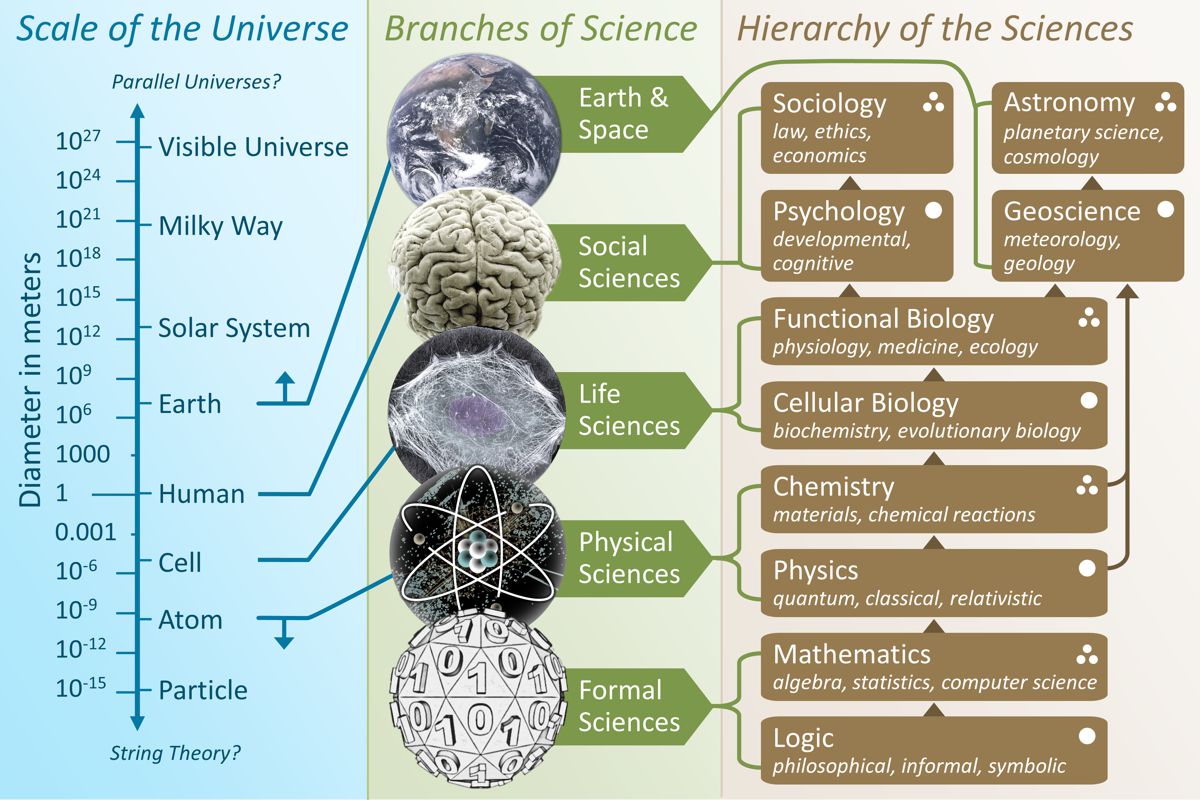
The need for depth and specialization led to the formation of traditional scientific disciplines such as physics, chemistry, biology, geology, astronomy, psychology, sociology, and economics. Each discipline has developed its own unique:
- Theoretical Frameworks: Core theories and models that explain phenomena within its domain.
- Methodologies: Specific research techniques and analytical tools best suited for its subject matter.
- Terminology and Jargon: A specialized language understood by practitioners within the field.
- Professional Societies and Journals: Organizations and publications dedicated to advancing knowledge and fostering collaboration within the discipline.
This specialization allows for in-depth exploration and mastery of intricate subjects, pushing the frontiers of human understanding in specific areas.

The Power of Interdisciplinarity in a Complex World
However, many of the most pressing challenges facing humanity today transcend the boundaries of single disciplines. The integration of knowledge from various fields is no longer a luxury but a necessity. This is where interdisciplinarity shines.
- Tech & Science Convergence: The rapid evolution of technology is a prime example of interdisciplinary science. For instance, Artificial Intelligence (AI) draws from computer science, mathematics, neuroscience, and psychology. The development of new software and gadgets often requires collaboration between electrical engineers, materials scientists, industrial designers, and even cognitive psychologists to ensure user-friendliness and functionality. Digital security is a constant battleground involving computer science, cryptography, sociology (to understand human behavior in security breaches), and even law.
- Branding and Behavioral Science: The field of brand strategy and marketing heavily relies on principles from psychology, sociology, and communication studies. Understanding consumer behavior, building corporate identity, and managing reputation requires a scientific approach to data analysis and the application of theories about perception, motivation, and group dynamics. Design itself, while often seen as artistic, is informed by principles of visual perception, ergonomics, and cognitive psychology.
- Finance and Economic Science: Personal finance, investing, and business finance are deeply rooted in economics, a social science that employs rigorous mathematical modeling and statistical analysis. The development of financial tools often involves principles from computer science and statistics. Furthermore, understanding the psychology of investment decisions, or behavioral finance, bridges the gap between economics and psychology, highlighting how irrational biases can impact financial outcomes.
Interdisciplinarity allows for a more holistic and robust approach to problem-solving. By drawing on diverse perspectives and methodologies, researchers and practitioners can uncover novel solutions, identify unforeseen consequences, and develop a more comprehensive understanding of complex systems.
The Applicability of Science Discipline in Modern Fields
The principles of scientific discipline are not confined to academic research institutions. They are the bedrock of innovation and informed decision-making across a wide spectrum of modern professional fields.
Technology: Driving Innovation Through Empirical Rigor
The Tech sector thrives on scientific inquiry. Whether it’s developing cutting-edge AI tools, creating intuitive apps, or designing innovative gadgets, a scientific approach is paramount.
- Software Development: This involves meticulous planning, hypothesis-driven problem-solving (debugging), and rigorous testing. Agile methodologies, while seemingly project management-focused, are underpinned by iterative experimentation and feedback loops, mirroring scientific principles. The pursuit of efficient and robust software is a testament to applied scientific discipline.
- AI and Machine Learning: These fields are inherently scientific, relying on vast datasets, complex algorithms, and constant experimentation to refine models. The development of AI tools for tasks ranging from content generation to predictive analytics is driven by hypothesis testing and performance evaluation.
- Digital Security: This discipline is a continuous scientific arms race. Understanding vulnerabilities, developing new encryption methods, and responding to evolving threats requires constant research, experimentation, and adaptation – all hallmarks of scientific discipline.
- Productivity Tools: The design and efficacy of productivity apps and gadgets are often informed by studies in cognitive science and human-computer interaction, applying scientific principles to optimize user experience and output.
Brand: Building Trust and Influence Through Data-Informed Strategies
In the realm of Brand, scientific discipline provides the framework for building lasting influence and trust.
- Brand Strategy and Corporate Identity: Developing a strong brand is not simply about aesthetics; it’s about understanding the target audience, market dynamics, and psychological triggers. This involves market research, data analysis of consumer behavior, and the testing of various messaging and positioning strategies, akin to scientific experimentation.
- Marketing and Reputation Management: Effective marketing campaigns are data-driven. Analyzing campaign performance, understanding audience segmentation, and refining strategies based on measurable results are all applications of scientific principles. Reputation management involves monitoring public sentiment, identifying potential crises, and developing strategic responses, often informed by social science research.
- Design and Case Studies: While design can be artistic, its most effective applications are often informed by scientific understanding of aesthetics, ergonomics, and visual communication. Case studies in branding often present a scientific narrative of problem, solution, and measurable outcome, demonstrating the application of strategic principles.
Money: Navigating Financial Landscapes with Analytical Precision
The world of Money demands a disciplined, analytical, and often scientific approach to secure financial well-being and growth.
- Personal Finance and Investing: Sound financial planning relies on understanding economic principles, risk assessment, and long-term forecasting. Investing is inherently about making calculated decisions based on available data, market analysis, and risk-reward calculations – a form of applied scientific reasoning.
- Online Income and Side Hustles: Identifying profitable opportunities online, optimizing business models, and scaling operations often involve testing different strategies, analyzing conversion rates, and adapting based on performance metrics, mirroring scientific experimentation in a commercial context.
- Business Finance and Financial Tools: Sound business finance requires rigorous accounting, forecasting, and risk management. The development and utilization of sophisticated financial tools are often born from advanced statistical modeling, mathematical finance, and algorithmic approaches, all deeply rooted in scientific discipline.

Conclusion: Embracing Scientific Discipline for a Smarter Future
In conclusion, “science discipline” is not a monolithic entity but a dynamic and ever-evolving framework for understanding the world around us. It is characterized by its commitment to rigorous methodology, objectivity, and the continuous pursuit of evidence-based knowledge. From the intricate algorithms of AI to the nuanced strategies of brand building and the calculated decisions in finance, the principles of scientific discipline are woven into the fabric of our modern lives.
By understanding and embracing these principles, individuals and organizations can navigate the complexities of our interconnected world with greater clarity, make more informed decisions, drive meaningful innovation, and ultimately, build a smarter and more prosperous future. The pursuit of scientific discipline, in its broadest sense, is the ongoing quest to unravel the mysteries of existence, to solve pressing problems, and to harness knowledge for the betterment of humanity.
aViewFromTheCave is a participant in the Amazon Services LLC Associates Program, an affiliate advertising program designed to provide a means for sites to earn advertising fees by advertising and linking to Amazon.com. Amazon, the Amazon logo, AmazonSupply, and the AmazonSupply logo are trademarks of Amazon.com, Inc. or its affiliates. As an Amazon Associate we earn affiliate commissions from qualifying purchases.