
In the intricate world of business finance, understanding the various cost components is paramount to effective management, strategic decision-making, and sustained profitability. Among the foundational metrics that businesses, particularly those involved in manufacturing or production, must master are prime costs. Often considered the bedrock of a product’s expense, prime costs represent the direct expenditures absolutely necessary to create a product or service. They are the most immediate and tangible costs, directly tied to the production process, and understanding them is crucial for setting prices, evaluating efficiency, and ultimately, ensuring a healthy bottom line.
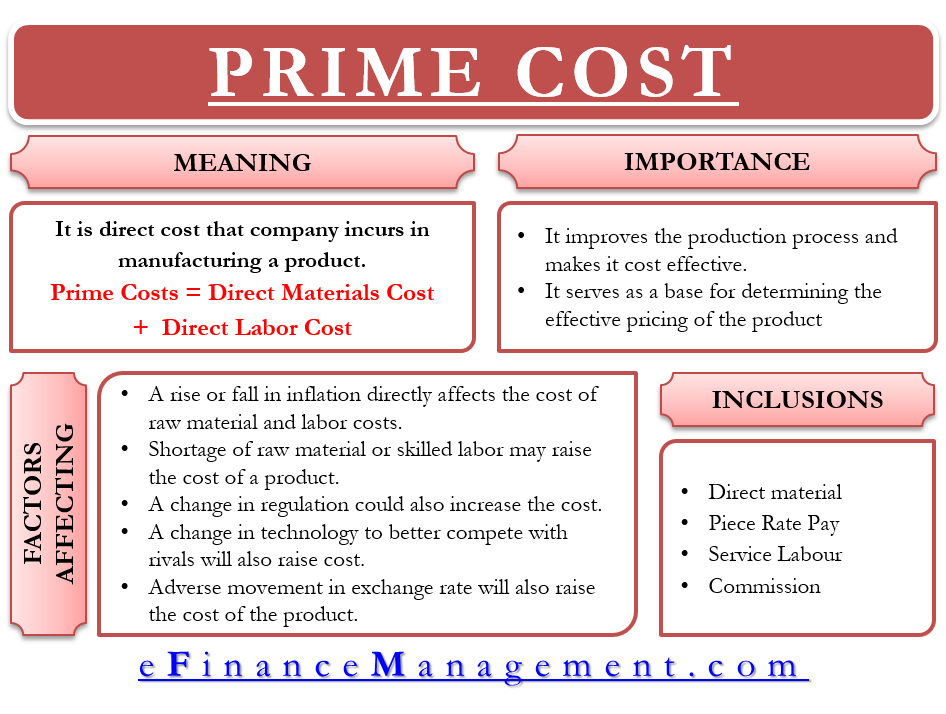
At its core, prime cost is the sum of direct materials and direct labor. These are the two inputs that can be traced unequivocally and directly to the creation of a specific unit of output. Unlike indirect costs or overheads, prime costs are not allocated or spread across various activities; they are singular, identifiable expenses incurred solely for the production of a good. For any enterprise engaged in transforming raw inputs into finished products, grasping prime costs is not merely an accounting exercise, but a strategic imperative that influences everything from pricing models to operational efficiency and long-term financial health.

This article will delve into the essence of prime costs, dissecting their components, exploring their calculation, and illuminating their profound significance in financial planning, operational strategy, and competitive positioning within the marketplace.
Deconstructing Prime Costs: The Core Components
To truly comprehend prime costs, one must first understand the two distinct yet interdependent elements that constitute them: direct materials and direct labor. These are the twin pillars upon which the concept of prime cost stands, each playing a critical role in the production process and requiring careful management.
Direct Materials
Direct materials are the raw materials and components that become an integral part of the finished product and can be directly and practically traced to specific units of production. These are the tangible inputs that undergo transformation, literally forming the physical substance of the item being manufactured. The cost of direct materials includes not only the purchase price but also any associated expenses incurred to bring these materials to the production facility and make them ready for use, such as freight-in, customs duties, and handling costs, net of any purchase discounts.
Consider a furniture manufacturer. The wood, fabric, screws, and glue that are physically incorporated into a chair are direct materials. Similarly, for a bakery, flour, sugar, eggs, and butter used to bake a cake are direct materials. The key characteristic here is the direct traceability and the fact that these materials are physically part of the final product. Accurate tracking of direct material costs is vital because even small fluctuations in their prices or usage rates can significantly impact the overall prime cost and, consequently, the profitability of a product. Companies often invest heavily in supply chain management to optimize the procurement and usage of direct materials, seeking to minimize costs without compromising quality.
Direct Labor
Direct labor refers to the wages, salaries, and benefits paid to employees who are directly involved in the manufacturing or production process and whose efforts can be directly traced to specific units of output. These are the hands-on workers who physically transform direct materials into finished goods. Their work is a direct application of skill and effort to the product itself.
Using the furniture manufacturer example, the carpenters who cut the wood, assemble the frame, and upholster the chairs represent direct labor. For the bakery, the bakers who mix ingredients, shape dough, and decorate cakes constitute direct labor. It’s crucial to distinguish direct labor from indirect labor, such as the wages of factory supervisors, maintenance staff, or security guards. While these roles are essential to the overall operation, their efforts are not directly traceable to individual units of production in the same way. The cost of direct labor includes gross wages, as well as employer-paid payroll taxes and benefits directly attributable to those workers. Managing direct labor costs involves optimizing workforce efficiency, training, and sometimes, automation to reduce manual effort.
The Exclusion of Overhead
A critical aspect of understanding prime costs is recognizing what they exclude. Prime costs explicitly omit manufacturing overheads. Manufacturing overhead includes all indirect costs associated with the production process that cannot be directly traced to specific products. This encompasses items like indirect materials (e.g., lubricants for machines, cleaning supplies), indirect labor (e.g., factory supervisors’ salaries, quality control inspectors), factory rent, utilities, depreciation of factory equipment, and insurance on the manufacturing plant.
While overheads are absolutely necessary for production to occur, they are not direct inputs to the product itself. They are “support” costs. The distinction is crucial because it allows businesses to isolate the absolute minimum variable cost associated with creating a product. This focus provides a clear picture of the core efficiency and cost-effectiveness of the direct production process, without the complexities introduced by fixed or allocated indirect costs. Understanding this exclusion also helps differentiate prime costs from other cost categories like “conversion costs,” which include direct labor and manufacturing overhead.
The Calculation and Its Significance
The calculation of prime costs is straightforward, yet its implications for business strategy are profound. By isolating these core production expenses, companies gain invaluable insights into their operational efficiency and cost structure.
The Simple Formula
The formula for prime costs is elegantly simple:
Prime Costs = Direct Materials + Direct Labor
For example, if a company uses $50,000 worth of direct materials and incurs $30,000 in direct labor costs to produce a batch of goods, the prime cost for that batch is $80,000. This simplicity allows for easy calculation and consistent application across different production runs or product lines.
Why Businesses Track Prime Costs
Tracking prime costs offers several critical advantages and serves as a fundamental analytical tool for businesses:
-
Cost Control and Reduction: By focusing on direct materials and direct labor, management can pinpoint specific areas for cost reduction. Is the cost of raw materials escalating? Are labor hours per unit too high? Identifying these trends allows for targeted interventions, such as negotiating better deals with suppliers, improving production efficiency, or investing in labor-saving technologies.
-
Accurate Pricing Strategies: Understanding the prime cost per unit is the first step in setting a competitive and profitable selling price. It provides the absolute minimum cost a company incurs to produce an item, helping to ensure that the selling price covers at least these direct expenses before even considering overheads and desired profit margins. Without knowing prime costs, a business risks underpricing its products, leading to losses despite high sales volumes.
-
Profitability Analysis: Prime costs are a key input in calculating a product’s gross profit margin. By subtracting prime costs (and subsequently overheads) from revenue, businesses can assess the profitability of individual products or product lines, guiding decisions on which products to emphasize or discontinue.
-
Efficiency Evaluation: Tracking prime costs over time or comparing them against industry benchmarks provides a direct measure of production efficiency. A reduction in prime costs per unit could indicate improved operational processes, more efficient use of materials, or higher labor productivity. Conversely, an increase might signal inefficiencies that need addressing.
-
Decision-Making (e.g., Make-or-Buy): For companies considering outsourcing components or manufacturing processes, comparing the internal prime cost of production against the external purchase price is a crucial factor in make-or-buy decisions.

Prime Costs in Action: Strategic Applications
The utility of prime costs extends far beyond simple calculation; they are a vital metric for strategic planning and operational excellence across various business functions.
Impact on Pricing Decisions
For any product-centric business, setting the right price is a delicate balance between market competitiveness and financial viability. Prime costs provide the absolute floor for pricing. A product cannot be sold below its prime cost for an extended period without incurring direct losses on each unit produced, regardless of how much overhead is covered. This understanding allows businesses to:
-
Establish a baseline: Determine the minimum viable price point.
-
Analyze competitive pricing: Understand if competitors are operating on lower prime costs, suggesting they have procurement advantages or more efficient labor.
-
Strategize discounting: Plan sales and promotions without jeopardizing the ability to cover direct costs.
-
Identify premium opportunities: For unique products, a low prime cost might allow for a higher markup and premium pricing.
Enhancing Operational Efficiency
Prime costs are a direct reflection of a company’s production efficiency. By meticulously tracking direct materials and direct labor, management can identify bottlenecks, waste, and areas for improvement:
-
Waste Reduction: Monitoring direct material usage can highlight scrap rates, spoilage, or inefficient cutting patterns, leading to initiatives to reduce waste.
-
Labor Productivity: Analyzing direct labor hours against output can reveal opportunities for process automation, better workflow design, or additional employee training to boost productivity.
-
Process Optimization: Understanding where direct costs are incurred helps in redesigning production lines, implementing lean manufacturing principles, or adopting new technologies to streamline operations and reduce the time and resources needed per unit.
Financial Planning and Budgeting
Effective financial planning relies on accurate cost forecasting. Prime costs are a foundational element of production budgets:
-
Forecasting Production Costs: By knowing the estimated prime cost per unit and projected sales volumes, businesses can accurately forecast total direct production costs, which is critical for cash flow management and working capital planning.
-
Resource Allocation: Budgets based on prime costs help in allocating financial resources efficiently, ensuring sufficient funds for raw material procurement and labor compensation.
-
Scenario Planning: Businesses can model the financial impact of changes in raw material prices or labor rates by adjusting prime cost estimates, allowing for proactive contingency planning.
Performance Measurement
Prime costs serve as a powerful tool for measuring and benchmarking performance both internally and externally:
-
Internal Benchmarking: Tracking prime costs per unit over different periods allows a company to assess its own improvement in efficiency and cost management.
-
External Benchmarking: Comparing a company’s prime costs against industry averages or best-in-class competitors can highlight areas where it lags or excels, informing strategic adjustments.
-
Variance Analysis: By comparing actual prime costs against budgeted prime costs, businesses can conduct variance analysis to understand the reasons for deviations and take corrective actions. This might reveal issues like material price variances (paying more or less than expected for materials) or labor efficiency variances (workers taking more or less time than expected).
Prime Costs vs. Other Cost Concepts
While prime costs are fundamental, they are just one piece of the larger cost accounting puzzle. Understanding their relationship and distinction from other cost concepts is crucial for a holistic financial perspective.
Prime Costs vs. Conversion Costs
This is a frequently encountered comparison. Conversion costs represent the costs incurred to convert direct materials into a finished product. They consist of:
Conversion Costs = Direct Labor + Manufacturing Overhead
The key difference lies in the inclusion of manufacturing overhead. While prime costs focus on the direct inputs (materials and labor), conversion costs focus on the costs of the transformation process itself (labor and the indirect costs supporting that transformation). Both are vital for different analytical purposes: prime costs for raw production expense, conversion costs for the efficiency of the manufacturing process beyond the materials.
Prime Costs vs. Total Production Costs
Total production costs encompass all costs incurred in the manufacturing process. They include direct materials, direct labor, and manufacturing overhead.
Total Production Costs = Direct Materials + Direct Labor + Manufacturing Overhead
Or, simply:
Total Production Costs = Prime Costs + Manufacturing Overhead
This relationship clearly shows that prime costs are a subset of total production costs. While prime costs provide insight into the variable, direct expenses, total production costs offer a complete picture of all costs involved in bringing a product to market. For external financial reporting, total production costs (often categorized as Cost of Goods Sold for products sold) are essential.
Prime Costs vs. Opportunity Costs
Opportunity cost is the value of the next best alternative that was not taken when a decision was made. For instance, the opportunity cost of investing in one project is the profit that could have been earned from another project. While prime costs are actual expenditures incurred, opportunity costs are theoretical, foregone benefits. They represent a different dimension of economic decision-making, focusing on trade-offs rather than direct out-of-pocket expenses. Though distinct, understanding prime costs helps in evaluating the direct financial implications of a chosen path, which is a component of a broader opportunity cost analysis.
Conclusion
Prime costs stand as a cornerstone of financial management for any business engaged in production. By meticulously tracking and analyzing the direct materials and direct labor that constitute these costs, companies gain unparalleled insight into their operational efficiency, pricing power, and overall profitability. They provide the fundamental financial benchmark against which all production decisions can be evaluated, from supply chain optimization and labor management to strategic pricing and capacity planning.
In an increasingly competitive global marketplace, where every dollar spent and earned can dictate success or failure, a profound understanding of prime costs is not just beneficial—it is absolutely essential. Businesses that master the identification, calculation, and strategic application of prime costs are better positioned to control expenses, optimize their operations, set profitable prices, and ultimately, build a more resilient and financially robust enterprise. For finance professionals and business leaders alike, prime costs are far more than an accounting term; they are a powerful compass guiding the journey toward sustainable financial health and strategic advantage.
aViewFromTheCave is a participant in the Amazon Services LLC Associates Program, an affiliate advertising program designed to provide a means for sites to earn advertising fees by advertising and linking to Amazon.com. Amazon, the Amazon logo, AmazonSupply, and the AmazonSupply logo are trademarks of Amazon.com, Inc. or its affiliates. As an Amazon Associate we earn affiliate commissions from qualifying purchases.