
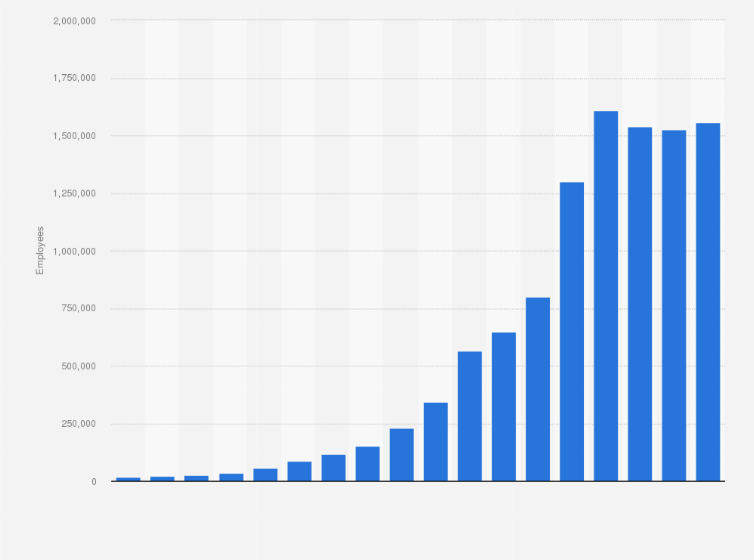
In the landscape of modern commerce, few metrics are as indicative of a company’s sheer gravity as its headcount. For Amazon, the numbers are more than just statistics; they are a testament to an unprecedented scale of operations that bridges the gap between digital convenience and physical logistics. As of the most recent fiscal reports, Amazon employs approximately 1.5 million full-time and part-time workers globally. This figure fluctuates significantly based on seasonal demand, but it consistently places Amazon as the second-largest private employer in the United States, trailing only Walmart.

From a business and financial perspective, managing a workforce of this magnitude is a Herculean task that carries immense implications for the company’s valuation, operational overhead, and long-term strategic direction. Understanding the nuances of Amazon’s employment data provides a window into how the company maintains its market dominance and how it navigates the complex waters of global labor economics.
The Current Workforce Scale: Breaking Down the Numbers
To understand the financial footprint of Amazon, one must first dissect the composition of its workforce. The 1.5 million figure is not a monolith; it is a diverse assembly of corporate professionals, software engineers, data scientists, and, most visibly, hundreds of thousands of fulfillment center associates and delivery drivers.
Seasonal Fluctuations and the Holiday Peak
Amazon’s business model is heavily cyclical, dictated by the consumer spending habits of the fourth quarter. During the “peak” season—spanning from late October through the end of December—Amazon typically hires an additional 150,000 to 250,000 seasonal workers in the U.S. alone. From an accounting standpoint, this surge represents a massive temporary increase in variable costs. These “contingent” workers allow the company to scale its capacity without the long-term liability of permanent benefits and salaries, a strategy that is vital for maintaining margins during high-volume periods.
Regional Distribution: US vs. International
While Amazon is a global entity, its human capital remains heavily concentrated in North America. Roughly 1.1 million of its employees are based in the United States. This concentration is a double-edged sword for the company’s finances. On one hand, it centralizes control in its primary market; on the other, it exposes the company to the rising costs of the U.S. labor market and localized regulatory pressures. Internationally, Amazon’s footprint is expanding rapidly in regions like India and Europe, where it seeks to replicate its domestic logistics success while navigating vastly different labor laws and wage expectations.
Labor Costs and Operational Efficiency
For an investor or a business analyst, the primary concern regarding a 1.5-million-person workforce is the cost. Human capital is Amazon’s most significant operational expense outside of its technology infrastructure. In recent years, the company has seen its shipping and fulfillment costs soar, driven largely by the need to attract and retain workers in a competitive labor environment.
The Impact of Payroll on Bottom-Line Profitability
Amazon has been a leader in pushing the minimum wage to $15 per hour (and higher in many regions), a move that forced competitors to follow suit. While this positions the company as a competitive employer, it creates a massive “burn rate” for its retail division. When you multiply even a small wage increase across 1.5 million people, the impact on quarterly earnings is measured in billions of dollars. Consequently, Amazon’s financial health is increasingly tied to its ability to squeeze greater productivity out of every labor hour.
Scaling Through Automation: The Robot vs. Human Ratio
To offset the rising costs of human labor, Amazon has invested billions into its robotics division. The introduction of systems like “Proteus”—the company’s first fully autonomous mobile robot—and “Sparrow,” which can handle millions of individual items, signals a shift in Amazon’s long-term financial strategy. The goal is not necessarily to eliminate human workers, but to change the “labor density” of its operations. By automating the most repetitive and physically taxing tasks, Amazon aims to increase its “units per hour” metric, effectively lowering the cost-per-package even as wages rise.

Economic Impact and Job Creation
Amazon’s hiring practices have a “multiplier effect” on the broader economy. The company often argues that its direct employment figures are only part of the story, pointing to its indirect impact on local economies where its fulfillment centers are located.
Amazon as an Indirect Employment Engine
Beyond its own 1.5 million employees, Amazon claims to have supported the creation of over 2 million indirect jobs. These include third-party sellers on its platform, construction workers building its massive warehouses, and independent delivery service partners (DSPs). From a macro-economic perspective, Amazon acts as a quasi-public utility for commerce. However, from a business finance perspective, these indirect roles allow Amazon to offload some of the risks and costs associated with direct employment, such as vehicle maintenance and insurance for delivery fleets, onto small business owners.
The Cost of Recruitment and Retention
One of the most significant financial hurdles Amazon faces is its high turnover rate. Reports have suggested that in some fulfillment centers, turnover can exceed 100% annually. This creates a “leaky bucket” syndrome where the cost of constantly recruiting, onboarding, and training new staff eats into the profitability of the logistics network. To combat this, Amazon has introduced various financial incentives, including pre-paid tuition programs (Career Choice) and “The Offer”—a program where the company pays employees to quit after peak seasons to ensure only the most committed staff remain. These programs are not just HR initiatives; they are strategic financial tools designed to stabilize a volatile labor pool.
Investing in Human Capital vs. Technology
As Amazon looks toward the next decade, its capital expenditure (CapEx) is increasingly split between two pillars: the expansion of its physical workforce and the advancement of its AI and robotics capabilities.
Future Projections: Will the Workforce Continue to Grow?
There is an ongoing debate among market analysts regarding whether Amazon has reached “peak human.” After the massive hiring spree during the 2020-2022 period, the company underwent its first significant rounds of corporate layoffs in 2023 and 2024, affecting roughly 27,000 employees. This shift suggests a transition from a “growth at all costs” mentality to a “lean and efficient” model. Investors are watching closely to see if Amazon can continue to grow its revenue without a corresponding linear growth in its headcount.
What Investors Need to Know About Amazon’s Labor Strategy
For those looking at Amazon through a financial lens, the employee count is a key performance indicator (KPI) of operational health. A sudden spike in hiring without a corresponding spike in AWS (Amazon Web Services) profits or retail sales can be a red flag for margin compression. Conversely, a stabilizing headcount paired with rising fulfillment speed suggests that the company’s investments in automation and AI are yielding a high return on investment (ROI).
Amazon’s labor strategy is also increasingly influenced by ESG (Environmental, Social, and Governance) factors. Institutional investors are putting pressure on the company to improve workplace safety and labor relations, as these “social” factors can have direct financial consequences in the form of legal fees, strikes, or regulatory fines.
Conclusion: The Scale of Modern Enterprise
The question of how many employees work for Amazon reveals more than just a number; it reveals the engine of a company that has redefined the global economy. At 1.5 million people, Amazon is a city-state in its own right, navigating the tensions between human labor and technological efficiency.
For the business-minded observer, Amazon represents the ultimate case study in scaling a workforce. The company’s ability to manage this massive population while simultaneously pivoting toward an automated future will determine its financial legacy. Whether Amazon continues to be a primary driver of global employment or becomes a pioneer in the “lights-out” automated warehouse model, its headcount will remain one of the most important metrics in the world of business finance. As it stands, every one of those 1.5 million roles is a cog in a machine that generates over half a trillion dollars in annual revenue, proving that in the modern market, human capital is still the most powerful asset—and the most complex liability—a brand can possess.
aViewFromTheCave is a participant in the Amazon Services LLC Associates Program, an affiliate advertising program designed to provide a means for sites to earn advertising fees by advertising and linking to Amazon.com. Amazon, the Amazon logo, AmazonSupply, and the AmazonSupply logo are trademarks of Amazon.com, Inc. or its affiliates. As an Amazon Associate we earn affiliate commissions from qualifying purchases.