
In the realm of modern civil engineering and urban development, the infrastructure we don’t see is often the most critical. Beneath our streets lies a complex web of aging utility lines—sewer, water, and gas—that are reaching the end of their operational lifespan. Traditionally, replacing these pipes required “open-cut” excavation, a disruptive and costly process involving massive trenches, traffic rerouting, and significant surface damage. However, a specialized field within construction technology known as “trenchless technology” has introduced a high-tech alternative: pipe bursting.
Pipe bursting is a sophisticated method of replacing buried pipelines without the need for continuous deep-trench excavation. By utilizing advanced hydraulic machinery and material science, this technology allows for the simultaneous destruction of an old pipe and the installation of a new one. As municipalities and private industries grapple with decaying infrastructure, understanding the technical nuances of pipe bursting is essential for anyone following the latest trends in industrial technology and smart city development.
The Mechanics of Modern Trenchless Technology
At its core, pipe bursting is a mechanical engineering feat that relies on the principles of displacement and tensile force. Unlike “cured-in-place pipe” (CIPP) lining, which adds a coating to the interior of an existing pipe, pipe bursting is a full-replacement technology. It allows for the installation of a pipe that is the same diameter—or even larger—than the original.
How the Bursting Head Operates
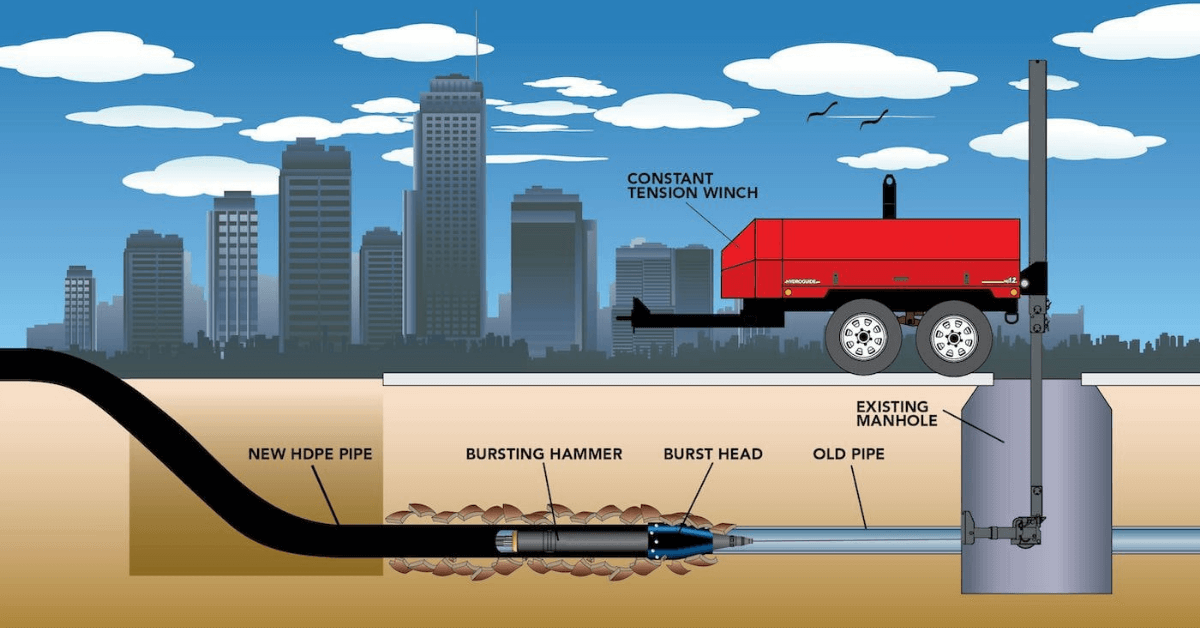
The central component of this technology is the “bursting head” or “expander tool.” This tool is typically a heavy-duty steel cone or bullet-shaped device. It is inserted into the existing pipe at an entry pit and pulled through to an exit pit. As the bursting head is pulled through the host pipe (the old, damaged line), its tapered shape creates a massive outward radial force.
This force exceeds the structural strength of the host pipe, causing it to fracture and fragment. These fragments are pushed outward into the surrounding soil, creating a void. Directly behind the bursting head, the new replacement pipe is attached and pulled into the newly created space. This “simultaneous pull” ensures that the ground remains supported throughout the process, preventing collapses.
Static vs. Pneumatic Systems
Technological iterations in this field have led to two primary methods: static and pneumatic pipe bursting.
- Static Pipe Bursting: This method uses sheer hydraulic pulling power. A high-tonnage hydraulic unit at the exit pit pulls a specialized rod or wire rope attached to the bursting head. It is the preferred method for ductile iron or steel pipes, where massive force is required to “slice” through the metal.
- Pneumatic Pipe Bursting: This involves a reciprocating, air-driven “hammer” inside the bursting head. The repeated impacts break the old pipe, similar to a jackhammer, while a constant-tension winch guides the head through the line. This is highly effective in brittle pipe materials like vitrified clay or concrete.
Digital Integration and Advanced Materials
The success of pipe bursting is not just a matter of brute force; it is a result of advancements in material science and digital monitoring. The technology has evolved from a manual labor task into a precision-engineered operation that utilizes sophisticated software and high-performance polymers.
High-Density Polyethylene (HDPE) Innovations
The “tech” in pipe bursting is largely driven by the use of High-Density Polyethylene (HDPE). HDPE is the material of choice for trenchless replacement because of its unique physical properties. It is incredibly flexible, allowing it to be fused into long, continuous strings that can navigate slight bends in the subterranean path.
From a technical standpoint, HDPE is “butt-fused” using specialized thermal equipment that melts the ends of pipe segments together. This creates a monolithic, leak-proof line with no joints—the traditional weak points where root intrusion and structural failure occur. This material transition represents a significant upgrade in utility longevity, with HDPE systems often rated for a 100-year service life.
Telemetry and Real-Time Monitoring
Modern pipe bursting rigs are increasingly equipped with digital telemetry systems. Operators use sensors to monitor “pull force” (measured in tons) in real-time. This data is critical; if the pulling force spikes, it indicates a change in soil density or an unexpected underground obstruction.
Advanced software now allows engineers to perform “pull-back calculations” before the job begins. By inputting soil type, pipe diameter, and depth, the software predicts the required force and identifies potential risks. This digital-first approach minimizes the “guesswork” traditionally associated with underground work, turning a high-risk excavation into a controlled, data-driven technical procedure.

Comparing Pipe Bursting to Traditional Excavation Tech
To understand the technological impact of pipe bursting, one must compare it to the “legacy system” of open-cut excavation. In traditional methods, the “tech” was limited to heavy earth-moving equipment—backhoes and excavators. Pipe bursting introduces a level of surgical precision that traditional digging cannot match.
Environmental Impact and Carbon Footprint Reduction
From a “Green Tech” perspective, pipe bursting is significantly more efficient. Traditional excavation requires the removal, transport, and disposal of hundreds of tons of soil and asphalt, followed by the importation of new bedding material. This process involves a heavy fleet of diesel-burning dump trucks and excavators.
Pipe bursting reduces the carbon footprint of a project by up to 60-80%. Because it requires only small entry and exit pits, the volume of soil disturbed is minimal. Furthermore, the technology preserves the “natural compaction” of the soil surrounding the pipe, which provides better structural support for the new line than backfilled soil ever could.
Precision Engineering and Geotechnical Stability
One of the most impressive technical aspects of pipe bursting is its ability to perform “upsizing.” In many urban areas, existing pipes are undersized for growing populations. Traditional tech would require digging a larger trench to accommodate a larger pipe. Pipe bursting, however, can use a larger expander head to push the surrounding soil further back, allowing a 10-inch pipe to be replaced with a 12-inch or 14-inch pipe.
This requires a deep understanding of geotechnical engineering. Technicians must calculate the “heave” (upward movement of the ground) to ensure that increasing the pipe size doesn’t damage the pavement above or interfere with adjacent utility lines (gas, electric, or fiber optics).
Future Trends in Underground Infrastructure Technology
As we look toward the future of smart cities, pipe bursting is poised to integrate with even more advanced technologies. The “digital twin” movement in urban planning relies on accurate data about underground assets, and pipe bursting provides a perfect opportunity for data collection.
Robotic Pipe Bursting and AI Diagnostics
We are currently seeing the emergence of autonomous and semi-autonomous bursting units. These machines use AI to adjust pulling speed and force based on real-time feedback from the bursting head. Before a pipe is even burst, robotic “CCTV crawlers” equipped with AI diagnostic software scan the interior of the old pipe to identify joints, lateral connections, and structural collapses. This data is fed into the bursting plan to ensure the mechanical head doesn’t encounter unexpected resistance.
The Role of Smart Cities and IoT Integration
In the near future, the HDPE pipes installed via bursting will likely be “smart pipes.” Researchers are developing HDPE lines with embedded fiber-optic sensors that can detect leaks, pressure changes, or seismic activity. By using pipe bursting to install these sensor-laden lines, cities can transition their passive infrastructure into an active, IoT-connected network.
This technological shift allows for predictive maintenance. Instead of waiting for a pipe to burst and cause a sinkhole, AI algorithms can analyze sensor data to predict where a failure is likely to occur, allowing engineers to deploy trenchless solutions before a crisis happens.
Conclusion
Pipe bursting is far more than a plumbing technique; it is a sophisticated intersection of mechanical engineering, material science, and digital monitoring. By moving away from the “brute force” of open-cut excavation and toward the precision of trenchless technology, the construction industry is mirroring the broader tech trend of doing more with less—less disruption, less waste, and less environmental impact.
As our global infrastructure continues to age, the demand for these high-tech subterranean solutions will only grow. Pipe bursting stands as a testament to how specialized technology can solve one of the oldest problems in civilization: maintaining the invisible systems that keep our modern world functioning. Whether through the use of advanced HDPE polymers, AI-driven diagnostics, or high-tonnage hydraulic systems, the future of our cities is being built—one pull at a time—from the inside out.
aViewFromTheCave is a participant in the Amazon Services LLC Associates Program, an affiliate advertising program designed to provide a means for sites to earn advertising fees by advertising and linking to Amazon.com. Amazon, the Amazon logo, AmazonSupply, and the AmazonSupply logo are trademarks of Amazon.com, Inc. or its affiliates. As an Amazon Associate we earn affiliate commissions from qualifying purchases.