
In our increasingly interconnected global landscape, understanding time zones is no longer a niche concern for travelers or international business professionals. It’s a fundamental aspect of navigating our digital lives, from coordinating online meetings and scheduling social media posts to understanding software updates and accessing digital services. The term “GMT zone” often pops up in these contexts, and while it’s a common reference point, it’s important to clarify what it means and how it relates to your actual time zone. This article will delve into the intricacies of GMT, explain how to determine your own time zone, and explore its implications across technology, branding, and even personal finance.

Understanding GMT and Time Zones
GMT, or Greenwich Mean Time, is a time standard based on the mean solar time at the Royal Observatory in Greenwich, London. It was historically the primary time standard for the world and remains a crucial reference point. However, it’s essential to understand that GMT itself is a single time zone. When people ask “what is my GMT zone,” they are often trying to figure out how their local time relates to GMT, or they might be using “GMT zone” colloquially to mean their own time zone.
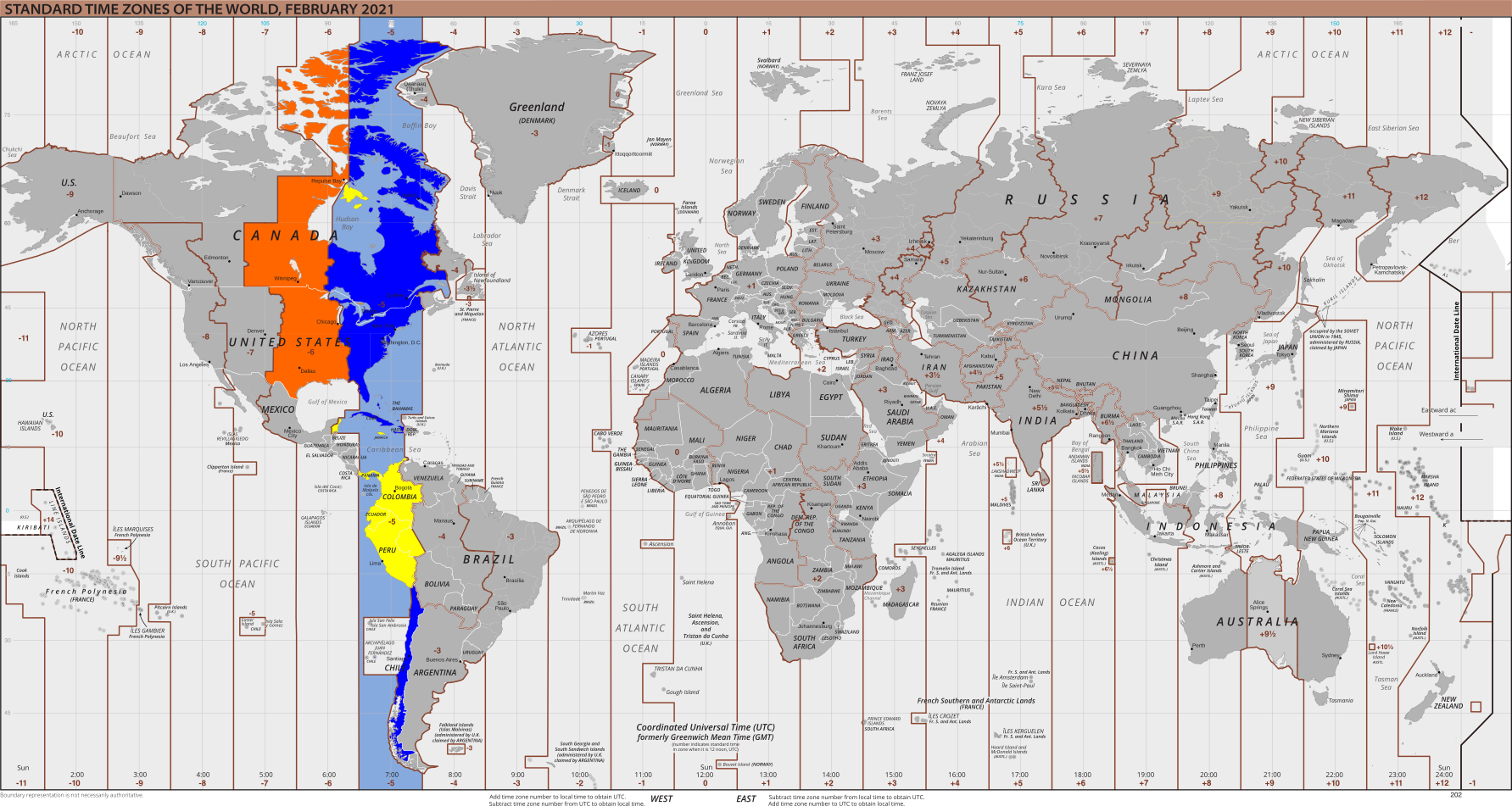
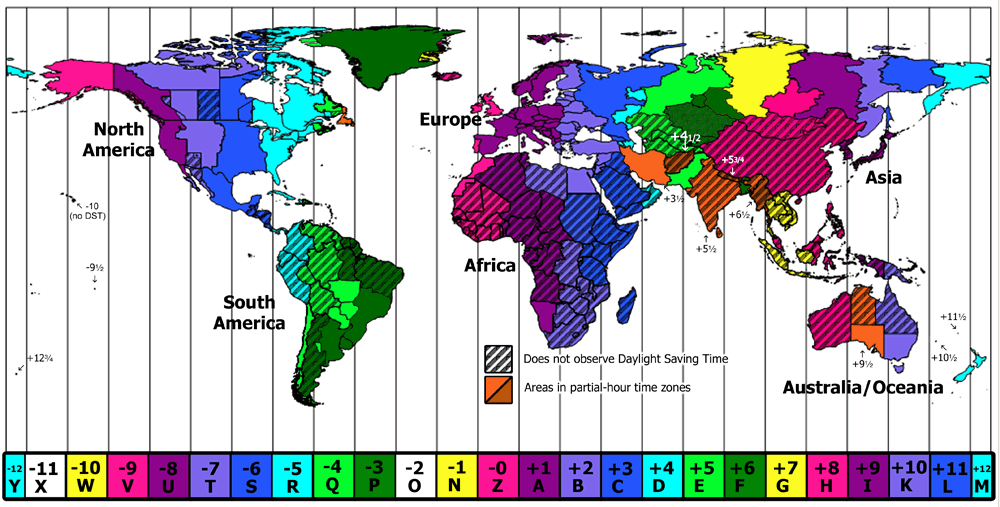
The Earth is divided into 24 time zones, each roughly 15 degrees of longitude wide. These zones are offset from GMT by whole hours, either ahead (e.g., GMT+1, GMT+5) or behind (e.g., GMT-5, GMT-8). The Universal Coordinated Time (UTC) is now the international standard for time, and for most practical purposes, UTC and GMT are considered the same. However, UTC is based on atomic clocks and is more precise, while GMT is based on astronomical observations.
The Nuances of Daylight Saving Time
A significant complicating factor in understanding time zones is Daylight Saving Time (DST). Many countries and regions observe DST, where clocks are advanced by one hour during warmer months to make better use of daylight. This means that a time zone’s offset from GMT/UTC can change throughout the year. For example, during standard time, London is on GMT (UTC+0). However, during British Summer Time, it observes BST, which is GMT+1 (UTC+1).
This dynamic nature of time zones makes it imperative to have reliable tools and methods for determining your current time zone and its offset from GMT/UTC, especially when dealing with international digital interactions.
Determining Your Local Time Zone
Fortunately, in our digital age, determining your GMT zone (or more accurately, your local time zone’s offset from GMT/UTC) is remarkably straightforward. Your operating system and web browsers are equipped with sophisticated mechanisms to automatically detect your location and set the correct time zone for you.
Automated Time Zone Detection
Most modern operating systems, whether Windows, macOS, or Linux, have a setting for automatic time zone detection. This feature typically uses your device’s IP address or location services (if enabled) to pinpoint your approximate geographical location and then applies the correct time zone and DST rules for that region.
To check or enable automatic time zone detection on your device:
- Windows: Go to Settings > Time & Language > Date & time. Ensure “Set time zone automatically” is toggled on.
- macOS: Go to System Preferences > Date & Time. Select the “Time Zone” tab and ensure “Set time zone automatically using current location” is checked.
- Linux: This varies by distribution, but generally, you’ll find time zone settings within your system settings or via the command line using commands like
timedatectl.
Web browsers also often leverage your device’s time zone settings. Many websites and web applications will then display information and times relative to your detected local time zone. This is why when you visit a website with server timestamps, they usually appear in your local time without you having to do anything.
Manual Time Zone Selection
While automatic detection is convenient, there are instances where manual selection might be necessary or preferred:
- Privacy Concerns: Some users may wish to disable location services for privacy reasons and manually set their time zone.
- Traveling and VPNs: If you are using a VPN (Virtual Private Network), your IP address might be masked, and your perceived location could be different from your actual physical location. In such cases, your device might display an incorrect time zone. Manually setting your time zone ensures accuracy.
- Specific Work Requirements: In some industries or roles, it might be crucial to explicitly set a particular time zone for operational consistency, regardless of your physical location.
To manually set your time zone:
- Windows: In the “Date & time” settings, toggle off “Set time zone automatically” and then select your desired time zone from the “Time zone” dropdown menu.
- macOS: In the “Date & Time” preferences, uncheck “Set time zone automatically using current location” and then drag your location on the world map or select it from the dropdown menu.
- Web Browsers: While browsers largely rely on the OS, some web applications allow you to set a preferred time zone within their settings, overriding the system default.
Using Online Tools and Resources
For quick checks or to understand offsets, numerous online tools are available. Websites like timeanddate.com, WorldTimeBuddy, and many others allow you to:
- Convert times: Easily see what time it is in different parts of the world.
- Find your time zone: Input your city or ZIP code to identify your exact time zone and its current offset from GMT/UTC.
- Check DST status: See if a particular region is currently observing Daylight Saving Time.
These tools are invaluable for quickly verifying your time zone or understanding the time differences when scheduling international calls or events.
Practical Implications: Tech, Branding, and Money
Understanding your GMT zone, or rather your local time’s relationship to GMT/UTC, has tangible impacts across various facets of our digital lives.
Technology and Digital Operations
In the realm of technology, precise timekeeping is paramount.
- Software Updates and Server Schedules: Software developers and IT professionals often work with server times, which are typically set to UTC to ensure consistency across geographically dispersed infrastructure. Knowing your local time’s offset from UTC is crucial for understanding when updates will be deployed, when maintenance windows will occur, or when scheduled tasks will run. For instance, if a server maintenance is scheduled for 03:00 UTC, and you are in EST (UTC-5), this translates to 10:00 PM the previous day in your local time.
- Log Files and Debugging: Analyzing log files from servers and applications is a common troubleshooting technique. These logs are almost universally timestamped in UTC. A developer debugging an issue needs to accurately correlate log entries with events happening in their local time.
- Network Synchronization (NTP): Network Time Protocol (NTP) is used to synchronize clocks across computer networks. Understanding time zones is important when configuring and troubleshooting NTP servers, ensuring that all devices on a network are operating with accurate and consistent time, crucial for distributed systems and applications.
- IoT and Connected Devices: The Internet of Things (IoT) relies on devices communicating and acting based on time-sensitive data. Whether it’s smart home devices, industrial sensors, or autonomous vehicles, their operations are often governed by synchronized time, making correct time zone configuration essential.
Brand Management and Marketing
For businesses and individuals building a brand, time zones play a strategic role.
- Global Marketing Campaigns: Launching a marketing campaign or a new product globally requires careful consideration of time zones. To maximize impact, a product launch might be timed to coincide with peak online activity in key target markets. This means understanding when your marketing message will land in different regions relative to GMT/UTC.
- Social Media Scheduling: Social media platforms allow for scheduled posts. To reach the widest audience or engage users at optimal times, brands and influencers meticulously schedule their content based on the time zones of their followers. A post scheduled for “prime time” in New York might be published at a very different hour in Tokyo.
- Customer Support and Service Level Agreements (SLAs): Providing 24/7 customer support or adhering to strict SLAs necessitates understanding when your support teams are available in relation to customer locations. This often involves mapping customer time zones to operational schedules and potentially having teams working in staggered shifts based on different regional times.
- Brand Reputation and Localized Content: Delivering timely and relevant content is key to brand perception. If a news outlet publishes an urgent update, the time it appears relative to a user’s local time can influence how quickly it’s consumed and shared. Ensuring your brand’s communications are perceived as timely and relevant across diverse geographic locations is a subtle but important aspect of reputation management.
Personal Finance and Online Income
The impact of time zones extends to our personal finances and how we earn money online.
- Online Trading and Market Hours: For those involved in stock trading, cryptocurrency, or other financial markets, understanding market opening and closing times in different global exchanges is critical. A trader in Asia needs to know when the New York Stock Exchange opens relative to their local time, and this is directly tied to GMT/UTC offsets.
- Freelancing and Gig Economy: Freelancers often work with clients from around the world. Coordinating project deadlines, client calls, and invoicing requires a clear understanding of time zone differences. Mismanaging this can lead to missed deadlines, perceived unreliability, and ultimately, lost income.
- E-commerce and Online Sales: For online businesses, understanding when potential customers are most active online in different regions can inform marketing strategies and promotional timing. Flash sales or limited-time offers need to be strategically timed to maximize reach and conversion rates across various time zones.
- Banking and Transaction Cut-off Times: While less commonly a day-to-day concern for most, banks and financial institutions often have cut-off times for transactions, especially for international transfers or certain investment activities. These cut-off times are often referenced against a primary time zone (like UTC or a specific national time) and understanding your local equivalent is important for timely financial operations.
Conclusion: Mastering Time in a Globalized World
The question “what is my GMT zone” is a gateway to understanding a fundamental aspect of our digital interconnectedness. While GMT serves as a historical and current reference point, it’s your local time zone and its dynamic relationship with GMT/UTC that truly impacts your daily digital interactions.
By leveraging the automated time zone detection features on your devices, understanding how to manually adjust settings when necessary, and utilizing readily available online tools, you can confidently navigate the complexities of time zones. This knowledge is not just about telling time; it’s about enhancing your efficiency in technology, refining your brand’s global outreach, and optimizing your personal financial strategies in our ever-shrinking, time-zone-aware world. Mastering time zones empowers you to be more effective, more connected, and more successful in every aspect of your digital life.
aViewFromTheCave is a participant in the Amazon Services LLC Associates Program, an affiliate advertising program designed to provide a means for sites to earn advertising fees by advertising and linking to Amazon.com. Amazon, the Amazon logo, AmazonSupply, and the AmazonSupply logo are trademarks of Amazon.com, Inc. or its affiliates. As an Amazon Associate we earn affiliate commissions from qualifying purchases.