
In the dynamic world of business, securing capital, attracting partners, or even simply garnering internal support for a new venture hinges significantly on the strength and clarity of your business plan. But before anyone delves into the exhaustive details of a full-fledged business proposal, they invariably encounter one crucial document: the executive summary. Far from being a mere introduction, the executive summary is a standalone, concise, and persuasive overview that encapsulates the essence of your entire business plan, particularly its financial viability and potential. For financial stakeholders – investors, lenders, or senior management – it serves as the ultimate gatekeeper, determining whether your comprehensive plan warrants further attention.
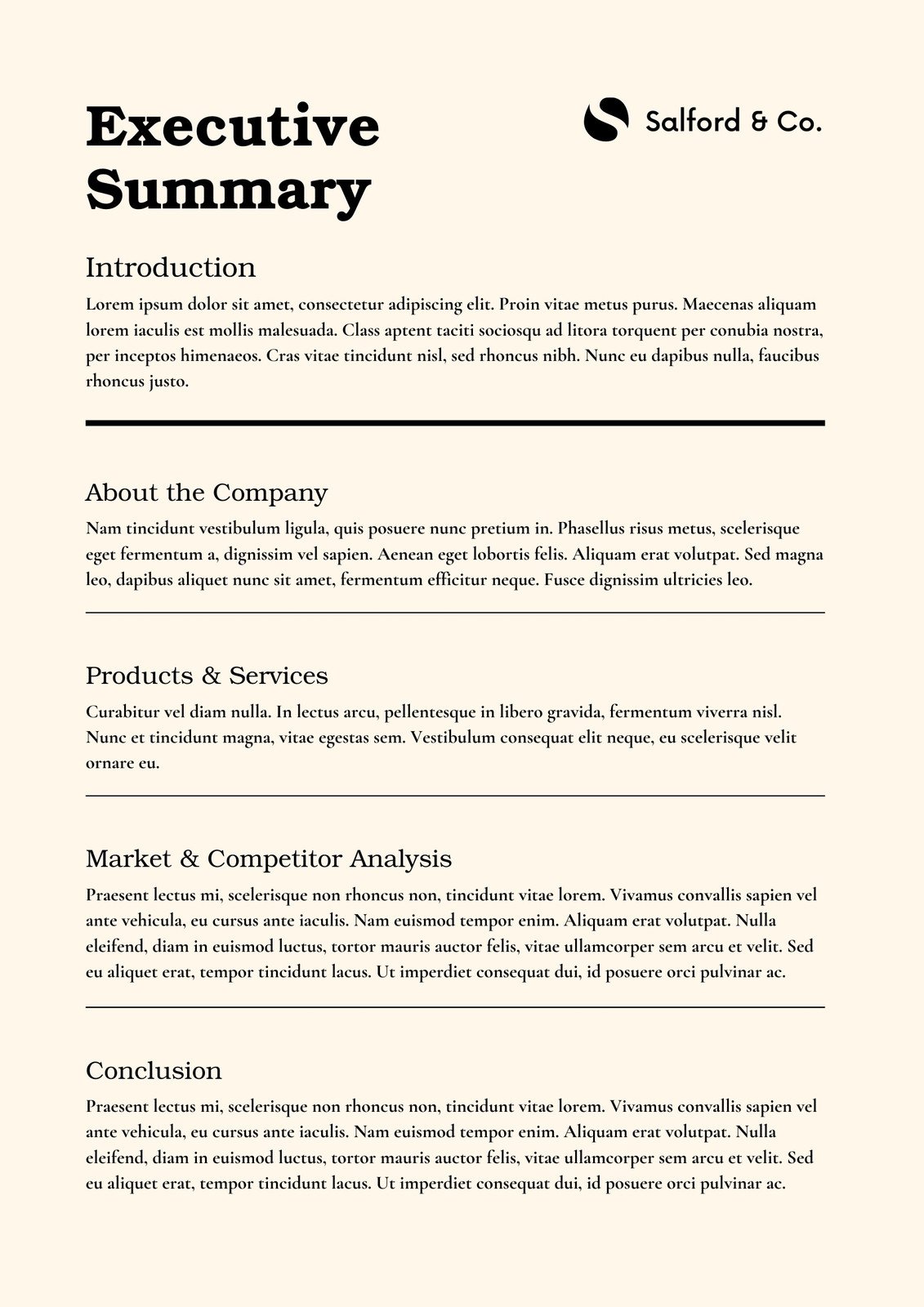
Within the “Money” category, understanding the precise components of an executive summary is paramount. It’s not just a summary of facts; it’s a strategic financial narrative designed to capture interest, convey profitability, and articulate a compelling investment opportunity. This document, often no more than one to two pages, must articulate the core value proposition, the market opportunity, the team’s capabilities, and crucially, the financial projections and funding requirements in a manner that resonates with those focused on returns and risk.
The Strategic Imperative: A Financial First Impression
The executive summary is, without exaggeration, the most critical section of any business plan when seeking financial backing. It’s the initial impression that either opens doors to further discussion or closes them decisively. For individuals focused on business finance, personal finance impacting business ventures, or investing in new enterprises, this summary is the filtered lens through which they evaluate an opportunity’s raw potential before committing valuable time to deeper analysis.
First Impressions for Financial Decision-Makers
Investors and lenders are inundated with proposals. Their time is a precious commodity, and they rapidly scan executive summaries to filter out proposals that don’t immediately align with their financial criteria or risk appetite. A well-crafted executive summary acts as a highly efficient screening tool, presenting the most compelling financial highlights upfront. It needs to convey not just what your business does, but why it will be profitable and how it will generate returns for stakeholders. This is where financial acumen in crafting the summary becomes invaluable; it’s about speaking the language of money from the very first paragraph.
Defining Your Business’s Financial Ask and Value
Beyond merely introducing the business, the executive summary must clearly articulate the specific financial request – whether it’s a loan, equity investment, or grant – and the rationale behind it. More importantly, it must immediately convey the value proposition from a financial perspective. How will this investment translate into revenue, profit, and ultimately, a significant return on investment (ROI)? For side hustles looking to scale, or online income streams seeking expansion capital, clearly defining these financial parameters in the summary is the difference between being overlooked and being taken seriously. It’s about demonstrating that your business isn’t just a good idea, but a financially sound one.
Setting the Stage for Investment Opportunity
The executive summary doesn’t just present information; it builds a narrative that sets the stage for the investment opportunity. It hints at the scale of the market, the competitive advantage, and the team’s ability to execute, all with an underlying current of financial potential. It’s the equivalent of a compelling trailer for a highly anticipated film, giving just enough tantalizing detail to make the audience eager to see the full feature – in this case, the comprehensive business plan and its detailed financial appendices.
Key Financial Components: The Heart of the Summary
While an executive summary covers all aspects of a business, its effectiveness, especially for financial stakeholders, hinges on how well it integrates and highlights the financial narrative. This section is where the raw numbers and projections are distilled into digestible, persuasive insights.
Executive Financial Snapshot: Revenue and Profitability
At the core of any investment decision is the potential for financial gain. The executive summary must provide a high-level overview of the business’s current (if applicable) and projected financial performance. This includes summary figures for anticipated revenue, gross profit, and net profit margins. It’s not about exhaustive spreadsheets, but rather about presenting key indicators that demonstrate financial health and growth potential. For instance, stating “Projected revenue of $X million in year one, growing to $Y million by year three, with a healthy Z% net profit margin” immediately captures the attention of financially-minded readers. These figures, even if aggregated, must be compelling and realistic, reflecting meticulous planning detailed in the main business plan.
Funding Requirements and Utilization
Perhaps the most direct financial element, the executive summary must clearly state the total funding required and, crucially, how those funds will be utilized. Investors want to know exactly what their money will achieve. Vague statements about “operational expenses” are insufficient. Instead, specify key areas like “investing $500,000 into R&D for product development,” or “$200,000 for aggressive market penetration in new territories.” This demonstrates foresight, responsibility, and a clear path to leveraging capital for growth and increased financial returns. It reinforces that the business has a strategic financial plan for expansion.
Projected Financial Performance and Return on Investment (ROI)
Beyond just the ask, the summary must offer a glimpse into the future financial landscape. This means including key financial projections – even if highly condensed – that demonstrate the expected financial performance over a defined period (e.g., 3-5 years). Crucially, this must tie back to the potential return on investment for the funding provider. Whether it’s through equity appreciation, interest payments, or profit sharing, the summary needs to hint at the lucrative nature of the opportunity. Highlighting key financial metrics, such as break-even points or internal rate of return (IRR), further strengthens this section, even if the detailed calculations reside in the full plan.

Exit Strategy Implications
For many investors, especially venture capitalists, the executive summary should ideally touch upon a potential exit strategy. How will they eventually realize their investment? This could involve an acquisition by a larger company, an IPO, or even a strategic buyback. While often brief, mentioning a viable exit path demonstrates a comprehensive understanding of the investment lifecycle and provides reassurance that their capital will not be indefinitely tied up, offering a clear path to their own financial gain.
Operational and Market Overview from a Financial Lens
While operations and market analysis might seem distinct from pure finance, in the executive summary, they are always viewed through a financial lens. How do these elements contribute to revenue generation, cost efficiency, and overall profitability?
Market Opportunity and Financial Potential
The executive summary needs to articulate the size and growth potential of the target market, but always framed in terms of revenue opportunity. Instead of just saying “the market is large,” quantify it: “The target market represents a $XX billion opportunity with a projected annual growth rate of YY%, indicating significant potential for revenue capture.” This demonstrates that there is a substantial financial pie from which your business can carve out a profitable slice. It convinces financial stakeholders that there’s a lucrative environment for their investment to thrive.
Competitive Advantage and Revenue Streams
What makes your business financially superior or more resilient than competitors? The executive summary must highlight your unique selling proposition (USP) or competitive advantage, and connect it directly to sustainable revenue streams and market share capture. Whether it’s proprietary technology, a superior business model, or a highly efficient operational process, the advantage must translate into a clear path to profitability and market dominance. This assures investors that your business has a defensible position to generate consistent financial returns.
Operational Efficiency and Cost Management
Briefly touching upon the operational model within the executive summary is crucial for demonstrating financial prudence. Investors look for businesses that are not only innovative but also efficient. Highlighting a lean operational structure, scalable processes, or a cost-effective supply chain reassures them that the business is designed for profitability and prudent resource allocation. It signifies that management is focused on maximizing financial output while minimizing unnecessary expenditure, directly impacting the bottom line.
Crafting a Compelling Call to Action for Investors
The executive summary is not just informative; it is a persuasive document with a clear goal: to prompt the reader to take the next step. For those in the money niche, this means an invitation to explore the full business plan, meet the team, or even initiate preliminary funding discussions.
Clearly Stating Your Funding Needs and Offering
Reiterate the specific funding amount you are seeking and, if applicable, the type of investment (e.g., equity, convertible note, debt). Be precise. This clarity ensures that interested parties immediately understand the scope of the opportunity and whether it aligns with their investment mandate. It streamlines the initial qualification process, saving time for both parties.
Demonstrating Investor Returns and Risk Mitigation
While the detailed ROI calculations are in the full plan, the executive summary should make a strong, concise argument for the potential financial returns an investor can expect. Couple this with a brief mention of how key risks are being managed or mitigated. This balanced approach acknowledges the realities of investment while powerfully advocating for the upside.

Next Steps for Engagement
Conclude with a clear and easy-to-follow call to action. Provide contact information and explicitly state what you would like the reader to do next – whether it’s to request the full business plan, schedule a meeting, or visit a specific landing page. This direct guidance helps move the interested party efficiently through the engagement funnel, transforming initial interest into tangible progress towards securing funding.
In conclusion, the executive summary of a business plan, particularly when viewed through the lens of business finance, investing, and securing capital, is far more than a simple overview. It is a strategically crafted financial narrative designed to capture attention, convey immense potential, and ultimately, open the door to vital funding and strategic partnerships. Mastering its creation is an essential skill for anyone looking to transform a business idea into a financially viable and prosperous enterprise.
aViewFromTheCave is a participant in the Amazon Services LLC Associates Program, an affiliate advertising program designed to provide a means for sites to earn advertising fees by advertising and linking to Amazon.com. Amazon, the Amazon logo, AmazonSupply, and the AmazonSupply logo are trademarks of Amazon.com, Inc. or its affiliates. As an Amazon Associate we earn affiliate commissions from qualifying purchases.