
In an era defined by digital transformation, the ability to rapidly innovate, scale operations, and manage vast amounts of data has become paramount for businesses and developers alike. At the forefront of this revolution stands cloud computing, and among its titans is Google Cloud Computing (GCP). More than just a collection of servers, Google Cloud represents a sophisticated suite of cloud computing services that runs on the same global infrastructure Google uses internally for its end-user products like Google Search, Gmail, YouTube, and Google Maps. It offers a comprehensive, secure, and highly scalable platform for enterprises to build, deploy, and operate applications and services, fundamentally reshaping how technology is consumed and delivered.

Google Cloud is designed to empower organizations of all sizes, from nascent startups to multinational corporations, by providing access to cutting-edge infrastructure, platform, and software services without the prohibitive upfront costs and complexities associated with managing on-premise data centers. It allows users to leverage Google’s global network, advanced machine learning capabilities, robust data analytics tools, and a vast ecosystem of interconnected services to drive innovation, optimize performance, and achieve strategic objectives. Understanding “what is Google Cloud Computing” means delving into its foundational principles, exploring its diverse service offerings, appreciating its unique advantages, and recognizing its profound impact on the modern technological landscape.
The Core Concept: Understanding Cloud Computing
Before dissecting Google Cloud specifically, it’s crucial to grasp the underlying paradigm of cloud computing itself. Cloud computing refers to the on-demand delivery of IT resources and applications over the internet with pay-as-you-go pricing. Instead of owning and maintaining physical data centers and servers, you can access technology services, such as computing power, storage, and databases, from a cloud provider like Google.
Beyond On-Premise Servers: The Paradigm Shift
Traditionally, organizations had to invest heavily in physical hardware, software licenses, and dedicated IT personnel to manage their own data centers. This “on-premise” approach often led to significant capital expenditures, lengthy provisioning times, underutilized resources, and complex maintenance schedules. Scaling up required purchasing and installing new hardware, a process that could take weeks or months. Scaling down was equally inefficient, as investments in hardware were already made.
Cloud computing dramatically shifts this paradigm. It virtualizes and pools vast computing resources, making them available as a utility. Businesses no longer need to predict their exact resource needs years in advance or worry about server maintenance, cooling, or power consumption. Instead, they can provision resources instantly, scale them up or down based on actual demand, and pay only for what they use. This model fosters agility, reduces operational overhead, and allows businesses to focus on their core competencies rather than infrastructure management.
Key Characteristics of Cloud Services
Cloud computing is defined by several fundamental characteristics that differentiate it from traditional IT environments:
- On-Demand Self-Service: Users can provision computing capabilities, such as server time and network storage, as needed, automatically without requiring human interaction with each service provider.
- Broad Network Access: Capabilities are available over the network and accessed through standard mechanisms that promote use by heterogeneous thin or thick client platforms (e.g., mobile phones, laptops, tablets).
- Resource Pooling: The provider’s computing resources are pooled to serve multiple consumers using a multi-tenant model, with different physical and virtual resources dynamically assigned and reassigned according to consumer demand. This includes storage, processing, memory, and network bandwidth.
- Rapid Elasticity: Capabilities can be elastically provisioned and released, in some cases automatically, to scale rapidly outward and inward commensurate with demand. To the consumer, the capabilities available for provisioning often appear to be unlimited and can be appropriated in any quantity at any time.
- Measured Service: Cloud systems automatically control and optimize resource usage by leveraging a metering capability at some level of abstraction appropriate to the type of service (e.g., storage, processing, bandwidth, and active user accounts). Resource usage can be monitored, controlled, and reported, providing transparency for both the provider and consumer.
Service Models: IaaS, PaaS, SaaS
Cloud computing services are generally categorized into three main service models:
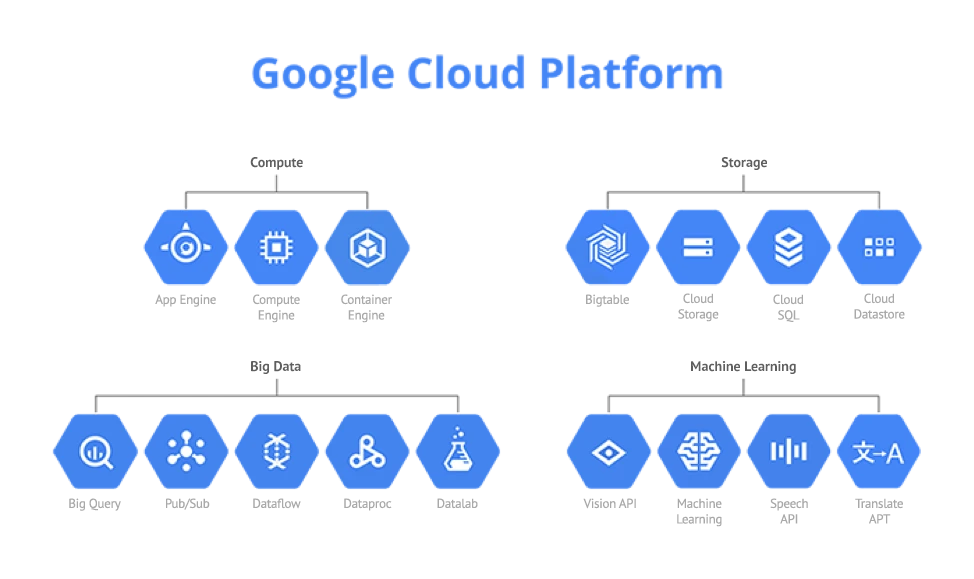
- Infrastructure as a Service (IaaS): This provides the fundamental building blocks of cloud IT, including virtualized compute (virtual machines), storage, and networking. With IaaS, you manage your operating systems, applications, and middleware, while the cloud provider manages the underlying infrastructure. Google Compute Engine and Cloud Storage are prime examples of IaaS in GCP.
- Platform as a Service (PaaS): This offers a complete development and deployment environment in the cloud, with resources that enable you to deliver everything from simple cloud-based apps to sophisticated, cloud-enabled enterprise applications. PaaS removes the need for you to manage the underlying infrastructure (hardware and operating systems). Google App Engine and Google Kubernetes Engine are key PaaS offerings.
- Software as a Service (SaaS): This provides ready-to-use applications managed by a third-party vendor over the internet. Users typically access SaaS applications via a web browser or mobile app. Examples include Gmail, Google Docs, and Salesforce, where users simply use the software without managing any infrastructure or platform components. While many GCP services are platform or infrastructure, GCP also provides foundational components for building SaaS products.
Diving Deeper into Google Cloud’s Ecosystem
Google Cloud offers an expansive portfolio of services designed to address virtually any technological requirement, from fundamental infrastructure to advanced AI and machine learning capabilities. This ecosystem is built on Google’s global network, ensuring high performance, low latency, and robust reliability.
Infrastructure Services (IaaS) – The Foundation
These services provide the essential building blocks for running applications and storing data, giving users maximum control over their computing environment.
- Compute Engine: This is GCP’s highly scalable and flexible virtual machine (VM) offering. Users can create and run VMs with custom machine types, persistent disks, and various operating systems, enabling them to host web servers, run batch processing jobs, or perform complex scientific computations. Its custom machine types allow for precise resource allocation, preventing over-provisioning and optimizing costs.
- Cloud Storage: A highly durable and available object storage service designed for storing and accessing unstructured data at any scale. It offers various storage classes (Standard, Nearline, Coldline, Archive) optimized for different access frequencies and cost points, making it suitable for backups, archives, large data lakes, and content delivery.
- Persistent Disk: Block storage that provides durable and high-performance storage for Compute Engine virtual machines. It can be attached to multiple VMs in read-only mode, providing shared data access for specific use cases, and offers various types (Standard, SSD, Balanced) to match performance needs.
- Virtual Private Cloud (VPC): Provides robust networking capabilities, allowing users to define their own virtual networks in the cloud. This includes setting up custom IP address ranges, subnets, firewalls, and routing tables, ensuring secure and isolated network environments for applications.
Platform Services (PaaS) – Accelerating Development
PaaS offerings on GCP focus on providing a managed environment that abstracts away infrastructure management, allowing developers to concentrate on writing code and building applications more rapidly.
- App Engine: A fully managed, serverless platform for developing and hosting web applications and mobile backends. It supports multiple programming languages (Python, Java, Node.js, Go, PHP, Ruby, .NET) and automatically scales applications based on traffic, eliminating infrastructure provisioning and management tasks.
- Cloud SQL: A fully managed relational database service for MySQL, PostgreSQL, and SQL Server. It handles database administration tasks like patching, backups, and replication, providing a highly available and scalable database solution without the operational burden.
- Google Kubernetes Engine (GKE): A managed environment for deploying, managing, and scaling containerized applications using Kubernetes. As the birthplace of Kubernetes, Google offers a highly optimized and integrated service that simplifies the complexities of container orchestration, providing features like auto-scaling, auto-upgrades, and high availability.
- Cloud Functions: Google’s serverless compute platform for event-driven applications. It allows developers to deploy small, single-purpose functions that respond to events (e.g., changes in Cloud Storage, messages on Pub/Sub, HTTP requests) without provisioning or managing servers.
Software & Specialized Services (SaaS & Beyond)
Beyond core IaaS and PaaS, Google Cloud excels in providing highly specialized services that leverage Google’s expertise in AI, data analytics, and global networking, often blurring the lines into SaaS-like consumption models for developers.
- BigQuery: A fully managed, petabyte-scale data warehouse that enables super-fast SQL queries using the processing power of Google’s infrastructure. It’s serverless and highly scalable, making it ideal for large-scale data analytics, business intelligence, and machine learning workloads.
- Cloud AI Platform: A comprehensive suite of services for building, deploying, and managing machine learning models. It includes AI Notebooks, custom training, prediction services, and pre-trained APIs (e.g., Vision AI, Natural Language AI, Translation AI), allowing developers to easily integrate sophisticated AI capabilities into their applications.
- IoT Core: A fully managed service that allows you to easily and securely connect, manage, and ingest data from millions of globally dispersed devices. It integrates seamlessly with other GCP services for data analytics and machine learning.
- Anthos: A modern application platform that enables consistent development and operations for hybrid and multi-cloud environments. It extends Google Cloud’s infrastructure and services to on-premises data centers and other cloud providers, offering a unified control plane for managing applications wherever they reside.
Why Choose Google Cloud? Key Advantages and Differentiators
Google Cloud’s robust ecosystem and continuous innovation offer compelling advantages that set it apart in the competitive cloud market. These benefits often translate into significant operational efficiencies, enhanced performance, and new capabilities for businesses.
Global Infrastructure and Reliability
Google boasts one of the largest and most advanced global networks in the world, with numerous regions and zones designed for high availability and low latency. This infrastructure powers not only GCP but also Google’s own massive consumer services, ensuring battle-tested reliability. GCP provides strong Service Level Agreements (SLAs) for uptime, giving businesses confidence in their applications’ continuous availability. The extensive network ensures fast data transfer and resilience against outages by distributing resources geographically.
Innovation in AI and Machine Learning
Google has been a pioneer in AI and ML for decades, and this expertise is deeply embedded in its cloud offerings. GCP provides a comprehensive suite of AI/ML services, from pre-trained APIs (Vision AI, Natural Language AI, Speech-to-Text) that can be integrated with minimal code, to a full-featured AI Platform for building, training, and deploying custom machine learning models. This democratizes access to advanced AI, allowing businesses of all sizes to infuse intelligence into their applications without needing a team of AI experts.
Data Analytics Prowess
Google Cloud is renowned for its powerful data analytics capabilities. Services like BigQuery offer unparalleled speed and scalability for analyzing massive datasets, enabling businesses to derive insights in real-time. Complementary tools like Dataflow (for stream and batch processing), Dataproc (for Spark and Hadoop workloads), and Looker (for business intelligence) create an end-to-end platform for data ingestion, processing, analysis, and visualization. This focus on data-driven decision-making is a significant differentiator.
Open-Source and Developer-Friendly Approach
Google has a strong commitment to open-source technologies, exemplified by its creation and ongoing contribution to Kubernetes, the de facto standard for container orchestration. This philosophy extends throughout GCP, with support for a wide array of open-source databases, programming languages, and tools. This fosters a developer-friendly environment, reducing vendor lock-in and allowing development teams to work with familiar technologies while leveraging cloud benefits. Its extensive API ecosystem also promotes seamless integration with existing systems and third-party services.
Scalability, Security, and Cost-Effectiveness
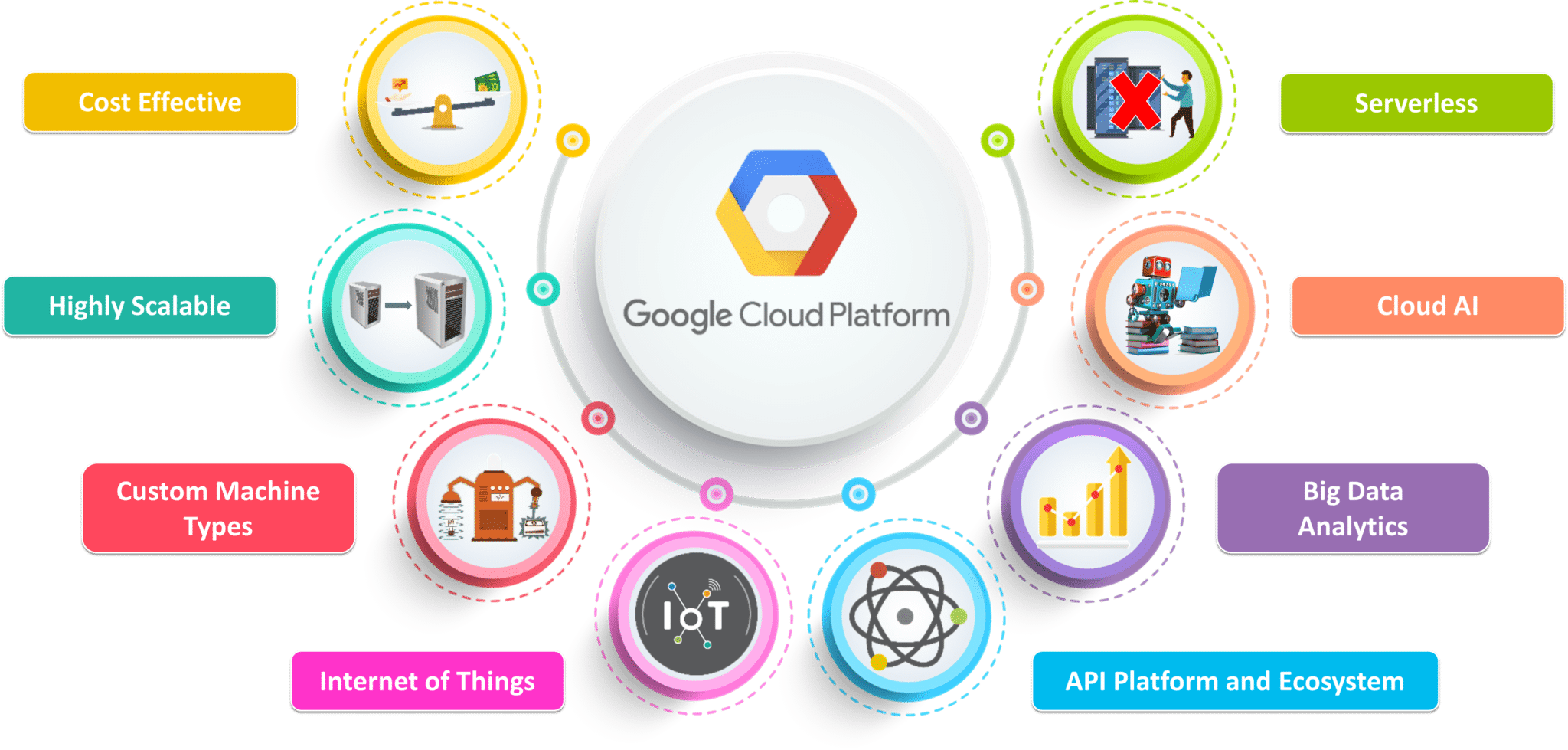
GCP services are inherently designed for massive scalability, automatically adjusting resources to meet demand, from handling sudden traffic spikes to processing petabytes of data. Security is a core tenet, inherited from Google’s stringent internal security practices, featuring multiple layers of protection, encryption at rest and in transit, and robust identity and access management. Furthermore, Google Cloud’s granular, per-second billing, sustained use discounts, and custom machine types help optimize costs, ensuring businesses pay only for the resources they genuinely consume.
Common Use Cases and Industries Leveraging GCP
The versatility and breadth of Google Cloud’s services make it suitable for a vast array of use cases across virtually every industry. Its capabilities empower businesses to innovate, optimize, and scale in unprecedented ways.
Web Hosting and Application Development
From simple static websites to complex, dynamic web applications and mobile backends, GCP provides a robust platform. App Engine and Cloud Run (serverless container platform) offer fully managed environments for rapid development and deployment, while Compute Engine provides the flexibility for custom server configurations. This enables startups to quickly launch products and large enterprises to host mission-critical applications with high availability and global reach.
Big Data Analytics and Business Intelligence
GCP is a powerhouse for handling and analyzing big data. Companies leverage BigQuery to process and query vast datasets for business intelligence, customer behavior analysis, and operational insights. Dataflow and Dataproc facilitate complex data transformations and real-time analytics, helping businesses turn raw data into actionable knowledge that drives strategic decisions and competitive advantage.
Machine Learning and AI Development
Given Google’s leadership in AI, GCP is a natural choice for building and deploying intelligent applications. Developers use Cloud AI Platform to train custom machine learning models, leveraging specialized hardware like GPUs and TPUs. Pre-trained APIs for vision, speech, and natural language processing allow businesses to quickly integrate advanced AI capabilities into their products, from facial recognition in security systems to intelligent chatbots in customer service.
Hybrid and Multi-Cloud Strategies
For organizations that cannot or do not wish to move all their workloads to a single public cloud, Anthos provides a unified platform for managing applications across on-premises data centers, Google Cloud, and even other cloud providers. This enables businesses to maintain flexibility, leverage existing investments, and ensure consistent operations regardless of where their applications reside, offering a true hybrid and multi-cloud solution.
Disaster Recovery and Business Continuity
GCP’s global infrastructure, with its multiple regions and zones, is ideal for implementing robust disaster recovery (DR) and business continuity planning (BCP) strategies. Organizations can replicate critical data and applications across geographically dispersed data centers, ensuring that operations can quickly fail over in the event of a regional outage, minimizing downtime and data loss. Services like Cloud Storage and Persistent Disk offer built-in redundancy and replication options.
Getting Started with Google Cloud
Embarking on the Google Cloud journey is designed to be accessible, with numerous resources and flexible options for individuals and organizations alike.
Free Tier and Learning Resources
Google Cloud offers a generous Free Tier, which includes a free usage limit for many services and a 90-day free trial with $300 in credits. This allows new users to explore the platform, experiment with different services, and build small applications without incurring immediate costs. Beyond the Free Tier, Google provides extensive documentation, tutorials, labs (via Qwiklabs), and certification programs to help users learn and master the platform. Online communities, developer forums, and Google Cloud Partner ecosystems further support learning and implementation.
Planning and Migration Considerations
For organizations looking to adopt GCP, careful planning is essential. This typically involves assessing existing infrastructure and applications, defining migration strategies (lift-and-shift, re-platform, re-architect), and considering data transfer mechanisms. Google Cloud offers a suite of migration tools and professional services, as well as a network of certified partners, to assist with seamless transitions to the cloud. Key considerations include cost optimization, security policy integration, and operational model adjustments.
Future Outlook: The Evolving Landscape of GCP
Google Cloud is in a constant state of evolution, driven by innovation in AI, serverless computing, and hybrid cloud solutions. Expect continued advancements in serverless technologies (e.g., Cloud Run, Cloud Functions 2nd Gen) making application development even more agile. The integration of AI/ML into more core services will deepen, offering smarter automation and insights. Sustainability is also a growing focus, with Google committed to running its operations on carbon-free energy, extending this benefit to its cloud customers. The platform will continue to empower businesses to leverage cutting-edge technology, adapt to changing market demands, and drive sustainable growth in the digital economy.
Google Cloud Computing is far more than just a set of services; it is a powerful enabler of digital transformation, providing the tools and infrastructure necessary for businesses to innovate at scale, manage vast data efficiently, and secure their digital assets with confidence. By understanding its core components, diverse offerings, and strategic advantages, organizations can effectively harness the power of Google’s global infrastructure to build the next generation of applications and solutions.
aViewFromTheCave is a participant in the Amazon Services LLC Associates Program, an affiliate advertising program designed to provide a means for sites to earn advertising fees by advertising and linking to Amazon.com. Amazon, the Amazon logo, AmazonSupply, and the AmazonSupply logo are trademarks of Amazon.com, Inc. or its affiliates. As an Amazon Associate we earn affiliate commissions from qualifying purchases.