
In the vast and rapidly evolving landscape of computing technology, few names resonate with the power, innovation, and sheer visual spectacle as prominently as GeForce. More than just a brand, GeForce represents NVIDIA’s flagship line of graphics processing units (GPUs), a critical component that has not only revolutionized the gaming industry but has also become indispensable across professional design, artificial intelligence, and scientific computing. To truly understand “what is GeForce” is to delve into the heart of modern graphics technology, exploring its origins, the intricate engineering that powers it, and its profound impact on how we interact with digital worlds.

At its core, a GeForce GPU is a specialized electronic circuit designed to rapidly manipulate and alter memory to accelerate the creation of images in a frame buffer intended for output to a display device. While traditional central processing units (CPUs) are adept at handling a wide range of tasks sequentially, GPUs are built with thousands of smaller cores, optimized for parallel processing – executing multiple calculations simultaneously. This architecture makes them exceptionally efficient at the complex mathematical operations required for rendering high-resolution graphics, applying real-time visual effects, and performing other computationally intensive tasks. From rendering the lush, hyper-realistic environments of the latest video games to accelerating machine learning algorithms that power autonomous vehicles and advanced medical imaging, GeForce GPUs are at the forefront of digital innovation, continually pushing the boundaries of what’s visually and computationally possible.
The Genesis and Evolution of GeForce Technology
The journey of GeForce began at a pivotal moment in the history of personal computing, when the promise of interactive 3D graphics was just beginning to capture the imagination of developers and consumers alike. Since its inception, the brand has been synonymous with pioneering advancements, driving the relentless pursuit of visual fidelity and computational prowess.
Early Days: Pioneering 3D Graphics
NVIDIA launched its first GeForce graphics processing unit, the GeForce 256, in 1999. Marketed as “the world’s first GPU,” it distinguished itself by integrating Transform, Clipping, and Lighting (TCL) engines into the chip itself. Prior to this, these crucial geometry calculations were performed by the CPU, creating a bottleneck that limited performance. The GeForce 256’s ability to offload these tasks to dedicated hardware marked a paradigm shift, enabling developers to create more complex and visually rich 3D environments. This initial breakthrough set the stage for a period of rapid innovation, with successive GeForce generations like the GeForce 2 and GeForce 3 introducing programmable shaders, further empowering artists and engineers to craft more dynamic and realistic scenes. The early 2000s saw GeForce solidify its reputation as the go-to choice for PC gamers seeking cutting-edge performance.
Architectural Leaps and Generational Advances
The trajectory of GeForce has been characterized by continuous architectural refinements, each generation building upon the last to deliver exponential leaps in performance, efficiency, and feature sets. Over the years, NVIDIA has introduced several groundbreaking architectures, including Fermi, Kepler, Maxwell, Pascal, Turing, Ampere, and most recently, Ada Lovelace. Each new architecture brought significant enhancements:
- Fermi (2010): Marked a deeper push into general-purpose GPU computing (GPGPU), paving the way for NVIDIA’s CUDA platform.
- Kepler (2012): Focused on efficiency and improved performance per watt.
- Maxwell (2014): Further refined power efficiency and introduced features like Multi-Frame Sampled Anti-Aliasing (MFAA).
- Pascal (2016): Brought significant performance boosts, support for High Bandwidth Memory (HBM2) in professional cards, and was crucial for early VR adoption.
- Turing (2018): This was a revolutionary architecture, introducing dedicated hardware cores for real-time ray tracing (RT Cores) and AI-accelerated super sampling (Tensor Cores for DLSS).
- Ampere (2020): Further advanced the RT and Tensor Cores, offering significant generational improvements in both traditional rasterization and ray tracing performance.
- Ada Lovelace (2022): The latest iteration, pushing the boundaries even further with third-generation RT Cores and fourth-generation Tensor Cores, alongside a new streaming multiprocessor architecture that delivers massive performance gains, particularly at higher resolutions and with advanced ray tracing effects. These architectural advancements are not merely about increasing speed; they represent fundamental redesigns that enable new levels of visual realism and computational capability.
The Rise of Real-time Ray Tracing and AI Acceleration (DLSS)
Perhaps the most significant recent development in GeForce technology came with the Turing architecture and the introduction of dedicated hardware for real-time ray tracing. Ray tracing is a rendering technique that simulates the physical behavior of light, producing incredibly realistic lighting, reflections, and shadows that were previously only achievable in offline rendering for film and animation. With its RT Cores, GeForce RTX GPUs made real-time ray tracing in games a reality, transforming the visual fidelity of digital environments.
Complementing ray tracing, NVIDIA also introduced Deep Learning Super Sampling (DLSS), powered by the dedicated Tensor Cores. DLSS is an AI-rendering technology that uses deep learning to boost frame rates while generating sharp, high-quality images. It renders frames at a lower internal resolution and then uses an AI model to upscale them to a higher target resolution, effectively giving gamers the benefit of higher performance without sacrificing image quality. These two technologies, ray tracing and DLSS, together define the modern GeForce experience, marking a profound shift in how graphics are rendered and perceived, and significantly leveraging AI to overcome performance challenges.
Decoding GeForce Technology: The Inner Workings
To appreciate the capabilities of a GeForce GPU, it’s essential to understand the intricate components and software ecosystem that work in concert to deliver its formidable performance.
Graphics Processing Units (GPUs) Explained
At the heart of every GeForce product is the GPU chip itself. Unlike a CPU, which has a few powerful cores optimized for sequential tasks, a GPU boasts hundreds to thousands of smaller, more specialized cores. These cores are designed for parallel processing, meaning they can execute many calculations simultaneously, making them exceptionally efficient for tasks that can be broken down into numerous independent operations, such as pixel shading, texture mapping, and matrix multiplications required for AI. This parallel architecture is the fundamental reason why GPUs excel at graphics rendering and other computationally intensive tasks.
Key Architectural Components
Modern GeForce GPUs, particularly those in the RTX series, integrate several specialized core types that contribute to their advanced capabilities:
- CUDA Cores: These are the traditional processing units, optimized for general-purpose parallel computation. They handle the bulk of shading, texture filtering, and other graphical tasks, as well as general-purpose computing (GPGPU) workloads like scientific simulations and cryptocurrency mining.
- RT Cores: Introduced with the Turing architecture, these are dedicated hardware accelerators specifically designed to speed up ray tracing calculations. They are responsible for performing intersection tests between rays and geometric objects, a computationally intensive part of the ray tracing process, dramatically improving the performance of real-time ray-traced effects.
- Tensor Cores: Also introduced with Turing, these specialized cores are designed for deep learning matrix operations, which are the backbone of artificial intelligence and machine learning algorithms. In GeForce GPUs, they primarily power NVIDIA’s DLSS technology, accelerating the AI models used for upscaling and image reconstruction. They also find use in AI inference workloads for various applications beyond gaming.
Memory and Bandwidth
A high-performance GPU requires equally high-performance memory to feed its multitude of processing cores with data. GeForce GPUs typically utilize GDDR (Graphics Double Data Rate) memory, which is specifically optimized for high bandwidth and low latency. Recent generations, like the RTX 30 and 40 series, leverage GDDR6 and even faster GDDR6X memory. GDDR6X, developed in partnership with Micron, features innovative PAM4 signaling technology to deliver significantly higher bandwidth than previous GDDR generations. This massive memory bandwidth is crucial for handling the immense amount of data required for high-resolution textures, complex scene geometries, and the vast frame buffers needed for 4K gaming and professional applications.
Software Ecosystem: GeForce Experience and Game Ready Drivers
While the hardware is undoubtedly powerful, a significant portion of the GeForce experience is shaped by NVIDIA’s robust software ecosystem.
- GeForce Experience: This application is designed to optimize the gaming experience. It automatically configures game settings for optimal performance and image quality based on the user’s specific GPU, updates drivers, enables ShadowPlay for instant replays and game recording, and allows streaming to Twitch and YouTube. It also facilitates NVIDIA Freestyle for custom game filters and NVIDIA Ansel for capturing stunning in-game photographs.
- Game Ready Drivers: NVIDIA releases highly optimized drivers on or before the launch of major new game titles. These drivers are meticulously tested and tuned to ensure maximum performance, stability, and compatibility for the latest games, often incorporating specific optimizations for new features or architectures. The continuous development and release of these drivers ensure that GeForce users always have access to the most up-to-date and best-performing software for their hardware.
GeForce in Action: Applications and Impact
The influence of GeForce extends far beyond the confines of a gaming rig. Its underlying technology and continuous innovation have made it a cornerstone in various demanding applications, fundamentally changing how we create, interact, and compute.
The Gaming Powerhouse
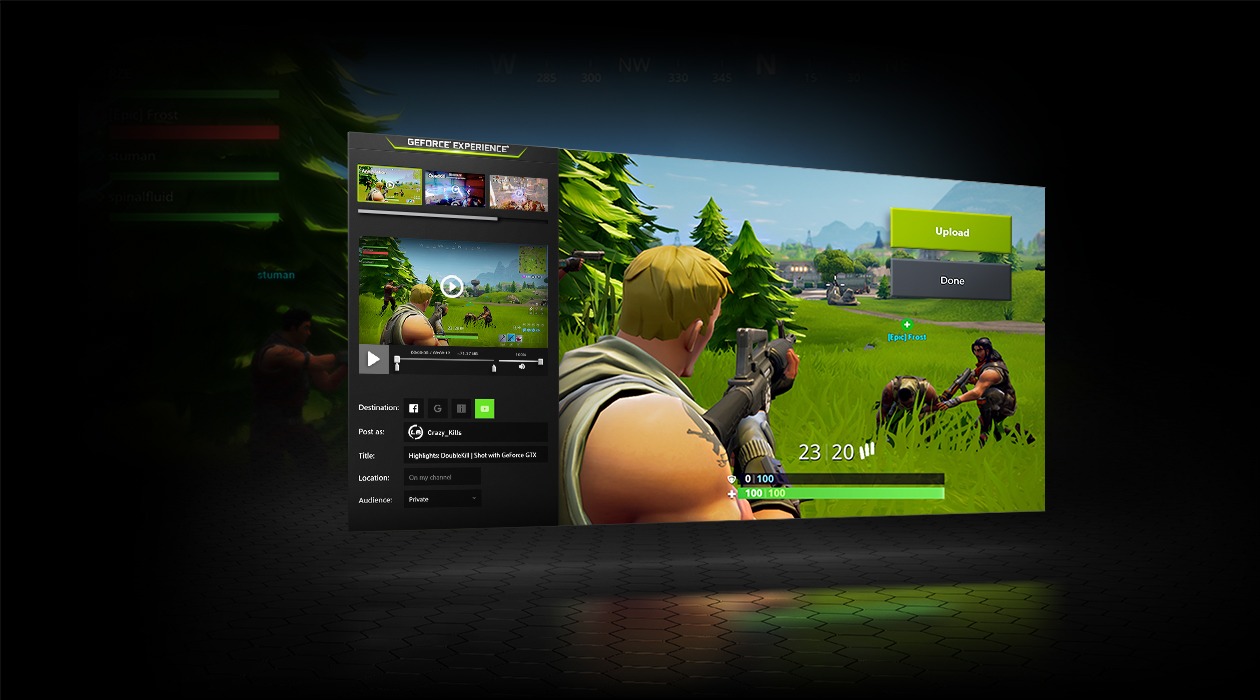
Gaming remains the primary domain where GeForce’s capabilities shine brightest. High-end GeForce RTX cards enable gamers to experience titles at ultra-high resolutions (4K and beyond), with buttery-smooth frame rates, and with all graphical settings maxed out, including complex ray-traced effects. They facilitate high-refresh-rate gaming (144Hz, 240Hz, or even higher) on competitive esports monitors, providing a critical advantage in fast-paced titles. Furthermore, GeForce GPUs are central to virtual reality (VR) experiences, providing the immense rendering power required to deliver immersive, low-latency visuals that are essential for preventing motion sickness and enhancing realism. Features like NVIDIA Reflex further optimize system latency, giving competitive gamers even more responsive gameplay.
Professional Content Creation
Beyond entertainment, GeForce GPUs have become indispensable tools for content creators. Video editors leverage GPU acceleration in applications like Adobe Premiere Pro and DaVinci Resolve to drastically speed up rendering, effects processing, and timeline playback. 3D artists use GeForce cards for real-time viewport rendering, complex simulations, and final frame rendering in software such as Blender, Autodesk Maya, and 3ds Max. Architects and designers utilize them for visualizing intricate CAD models and creating photorealistic architectural renderings. The raw computational power and specialized cores (especially Tensor Cores for AI-powered features in creative suites) significantly reduce workflow times and enable more complex projects to be realized faster.
AI, Machine Learning, and Scientific Computing
While NVIDIA’s professional-grade Quadro and Tesla/Data Center GPUs are purpose-built for large-scale AI and scientific computing, GeForce GPUs also play a significant role in these fields, particularly for researchers and developers working on personal workstations. The parallel processing architecture and Tensor Cores make them excellent for training smaller deep learning models, experimenting with neural networks, and accelerating tasks in data science, image recognition, and natural language processing. Their accessibility and performance-to-cost ratio make them a popular choice for individual researchers and startups exploring the vast potential of AI and machine learning.
Cloud Gaming: GeForce NOW
NVIDIA has also extended the GeForce experience to the cloud with GeForce NOW. This cloud gaming service allows users to stream full PC games from NVIDIA’s powerful data centers to almost any device, including low-spec PCs, Macs, Chromebooks, and mobile phones. Essentially, GeForce NOW offloads the heavy rendering work to high-performance GeForce GPUs in the cloud, then streams the video output to the user. This democratizes access to high-fidelity PC gaming, allowing millions to play demanding titles without needing to invest in expensive local hardware, thereby expanding the reach and impact of GeForce technology.
Understanding GeForce Product Lines
NVIDIA structures its GeForce offerings into distinct series and tiers to cater to a wide range of budgets, performance needs, and use cases. Understanding these distinctions is key to navigating the GeForce ecosystem.
GeForce RTX Series (High-end, Ray Tracing, DLSS)
The GeForce RTX series represents the pinnacle of NVIDIA’s consumer GPU technology. Cards in this series, such as the RTX 4090, 4080, 4070, and 4060 (and their previous generations like the RTX 30 series), are equipped with dedicated RT Cores for real-time ray tracing and Tensor Cores for AI acceleration (primarily DLSS). These GPUs are designed for enthusiasts and professionals who demand the absolute best performance, targeting high-resolution gaming (1440p, 4K) at high frame rates, immersive VR, and accelerated content creation workflows. The “RTX” designation is a clear indicator of their advanced capabilities in rendering realistic lighting and leveraging AI for performance.
GeForce GTX Series (Mainstream, Legacy)
Before the advent of dedicated RT and Tensor Cores, NVIDIA’s primary consumer lineup was the GeForce GTX series. While some GTX cards are still available and perform admirably for 1080p gaming and general computing, they lack the specialized hardware for efficient ray tracing and DLSS. GTX cards (e.g., GTX 16 series) remain a popular choice for budget-conscious gamers or those with less demanding performance requirements. They are excellent for traditional rasterization-based gaming and still provide a solid experience for many titles, but they represent an older generation of technology compared to the RTX series.
Mobile GeForce (Laptops)
NVIDIA also designs specialized GeForce GPUs for laptops, often denoted with an “M” suffix in older generations or simply integrated into the laptop model name with Max-Q or Ada Lovelace architectures. These mobile GPUs are optimized for power efficiency and thermal performance within the constrained form factor of a laptop, while still delivering impressive gaming and content creation capabilities on the go. Technologies like Max-Q design help manufacturers build thin and light laptops that can house powerful GeForce GPUs by carefully managing power limits and thermal envelopes.
Distinguishing Between Generations and Tiers
Within each series (RTX or GTX), cards are further tiered by a numerical system (e.g., RTX 4090, 4080, 4070, 4060). The higher the second digit, the more powerful the card (e.g., a 4090 is more powerful than a 4060). Sometimes a “Ti” (Titanium) or “Super” designation is added, indicating an enhanced version within that tier (e.g., RTX 4070 Ti). The first digit typically denotes the generation (e.g., 4 for the Ada Lovelace architecture, 3 for Ampere). Understanding this naming convention helps consumers and professionals identify the performance tier and architectural generation of a particular GeForce GPU, enabling them to choose the right card for their specific needs and budget.
The Future of GeForce and Graphics Technology
The journey of GeForce is one of relentless innovation, and the future promises even more exciting advancements, driven by the ever-increasing demand for visual realism and computational power.
Continued Innovation in Rendering and AI
NVIDIA is continuously investing in research and development to push the boundaries of rendering techniques. We can expect future GeForce generations to feature even more advanced RT and Tensor Cores, enabling more pervasive and realistic ray tracing effects, potentially including path tracing (a more advanced form of ray tracing) in real-time. AI is set to play an even larger role, not just in upscaling (DLSS) but also in generating game content, character behaviors, and even entire virtual worlds. AI-powered tools for content creation are also likely to become more sophisticated, further empowering artists and designers. Expect to see new paradigms in rendering that blend traditional rasterization with advanced ray tracing and neural rendering techniques.
Energy Efficiency and Performance Optimization
As GPUs become more powerful, energy consumption and thermal management become critical challenges. NVIDIA’s future architectures will undoubtedly focus on improving performance per watt, delivering more computational power with greater efficiency. This involves advancements in manufacturing processes (smaller transistor sizes), more intelligent power management algorithms, and innovative cooling solutions. Optimization will also extend to software, with drivers and APIs becoming even more sophisticated in harnessing the underlying hardware efficiently. The goal is to deliver uncompromised performance while ensuring sustainable power consumption and quieter operation.

The Competitive Landscape and NVIDIA’s Vision
The GPU market is a highly competitive arena, with AMD continually innovating with its Radeon line and Intel recently entering the discrete GPU space with its Arc series. This competition fuels innovation, benefiting consumers with diverse choices and accelerated development cycles. NVIDIA’s vision for GeForce extends beyond mere hardware; it encompasses a holistic ecosystem that includes powerful GPUs, a robust software platform (CUDA, Game Ready Drivers, GeForce Experience), and cloud services like GeForce NOW. The company aims to remain at the forefront of visual computing, enabling breakthroughs in gaming, professional visualization, and the burgeoning fields of AI and the metaverse, ensuring that GeForce continues to define the cutting edge of digital experience.
In essence, GeForce is not merely a component; it is a continuously evolving powerhouse that underpins the visual and computational fabric of our digital age. From delivering breathtaking gaming experiences to accelerating scientific discovery, GeForce GPUs are at the very heart of pushing the boundaries of what’s possible in the world of technology.
aViewFromTheCave is a participant in the Amazon Services LLC Associates Program, an affiliate advertising program designed to provide a means for sites to earn advertising fees by advertising and linking to Amazon.com. Amazon, the Amazon logo, AmazonSupply, and the AmazonSupply logo are trademarks of Amazon.com, Inc. or its affiliates. As an Amazon Associate we earn affiliate commissions from qualifying purchases.