
In the contemporary digital landscape, essay formatting is far more than a set of arbitrary rules governing margins and font sizes. It represents the structural architecture of academic and professional communication—the “user interface” of text-based information. From a technological perspective, essay formatting is the process of applying standardized metadata and visual hierarchies to a document to ensure readability, cross-platform compatibility, and algorithmic discoverability.
Whether you are utilizing advanced word processors, LaTeX editors, or AI-driven formatting assistants, understanding the technical framework of essay formatting is essential for anyone operating in the realms of software development, digital publishing, or data-driven research. This guide explores the evolution of formatting technology, the digital logic behind major style guides, and the sophisticated tools that are automating the way we structure our thoughts.
The Evolution of Formatting: From Typewriters to Markdown
The history of essay formatting is a history of technological progression. In the era of the manual typewriter, formatting was a physical constraint; “double spacing” was a mechanical adjustment of the platen, and “margins” were set by physical sliders. As we transitioned into the digital age, these physical constraints were translated into code, giving birth to the complex document processing systems we use today.
The Shift to Semantic Structure
In modern document tech, formatting is increasingly moving away from “WYSIWYG” (What You See Is What You Get) toward semantic structuring. When you apply a “Heading 1” tag in a program like Microsoft Word or Google Docs, you aren’t just making text larger and bolder; you are assigning a piece of metadata that tells screen readers, search engines, and document outlines how that piece of data fits into the hierarchy of the whole. This technological shift has made essay formatting an essential component of digital accessibility and data organization.
Markdown and Plain Text Efficiency
For many in the tech community, traditional word processors are being replaced by Markdown—a lightweight markup language with plain-text formatting syntax. Markdown allows writers to format essays using simple characters (like hashtags for headers), which can then be converted into HTML or high-quality PDFs. This represents a “tech-first” approach to formatting, where the focus is on the content’s portability and the ability to use version control systems like Git to track changes in a document.
Core Technological Frameworks: Understanding MLA, APA, and CMS
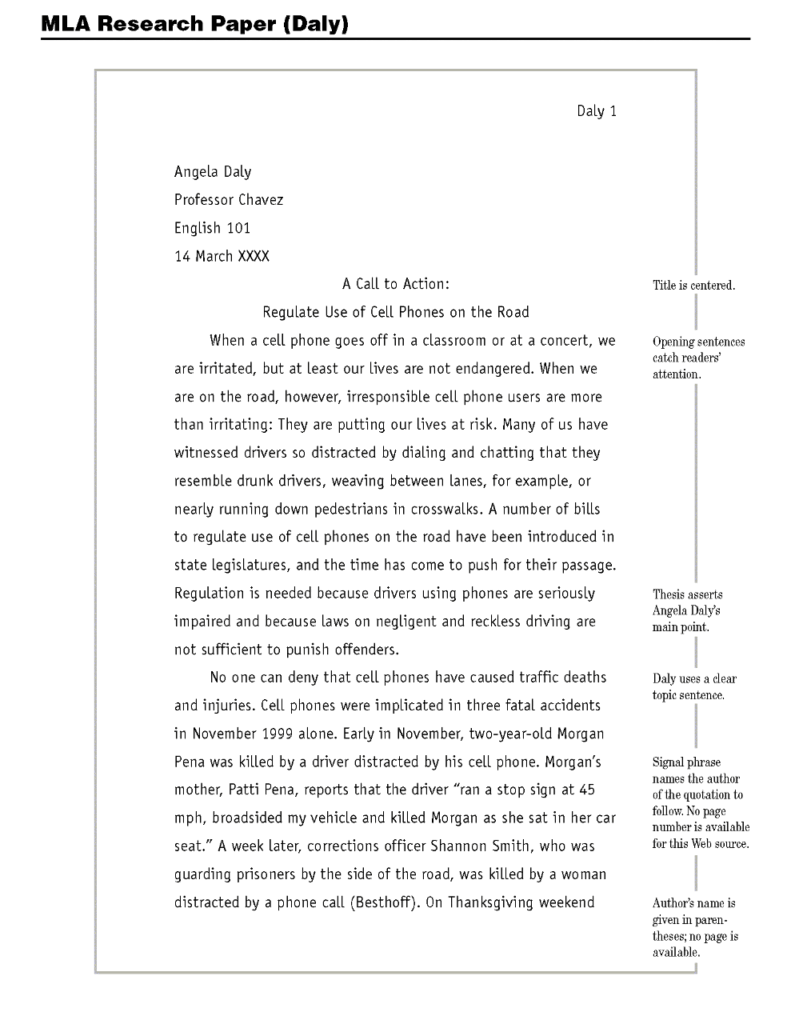
While they may seem like lists of stylistic choices, major formatting styles like the Modern Language Association (MLA), the American Psychological Association (APA), and the Chicago Manual of Style (CMS) act as standardized protocols for information exchange. Each style is optimized for a specific “industry” or field of study, functioning much like different programming languages optimized for different tasks.
APA Style: The Logic of Scientific Data
APA style is the standard for the sciences and social sciences. From a technical standpoint, APA is designed to prioritize the “recency” of data. This is why the year of publication is placed prominently in in-text citations. The formatting requirements—such as the running head and the specific structure of the abstract—are designed to facilitate rapid scanning by researchers who need to identify the methodology and results of a study without reading the entire document. It is, in essence, a data-sorting algorithm for human readers.
MLA and Chicago: Humanities and Deep Context
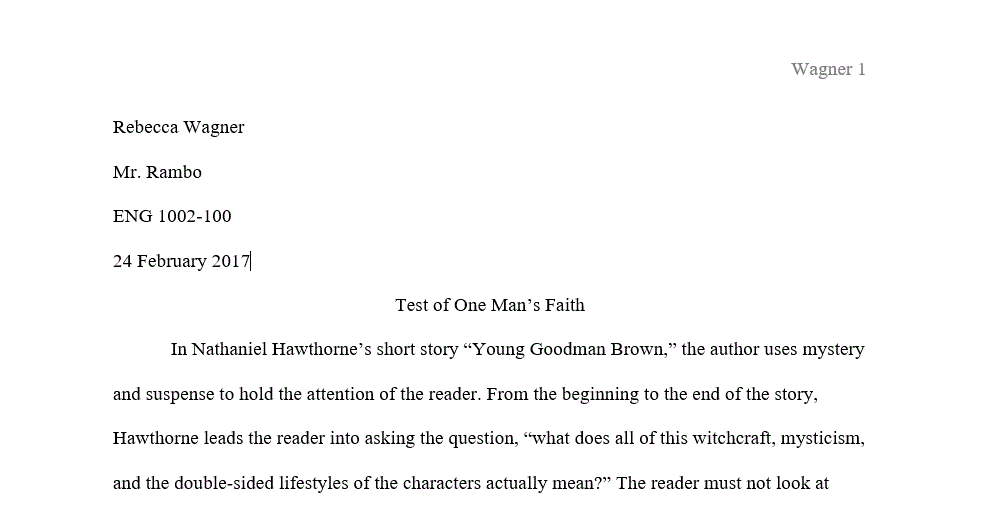
MLA style, prevalent in the humanities, focuses on the “source” rather than the “date,” reflecting a field where a text from 1920 might be just as relevant as one from 2024. Technically, MLA is designed for simplicity and ease of citation within the flow of prose. On the other hand, the Chicago Manual of Style, with its complex system of footnotes and endnotes, is the “high-bandwidth” version of formatting. It allows for a dual-track narrative: the primary argument in the body and the technical metadata/context in the footer.
Essential Software and AI Tools for Precision Formatting
The days of manually checking if a period goes before or after a parenthetical citation are largely over. A suite of sophisticated software tools has emerged to handle the “heavy lifting” of essay formatting, allowing writers to focus on the synthesis of ideas.
Reference Management Systems (RMS)
Tools like Zotero, Mendeley, and EndNote are the databases of the academic world. These programs allow users to scrape metadata from web browsers and automatically generate bibliographies in any desired format. By treating citations as a relational database, these tools eliminate human error. If you decide to switch an essay from APA to MLA at the last minute, an RMS can reformat the entire document in seconds, showcasing the power of automated document styling.
AI-Driven Style and Grammar Checkers
Artificial Intelligence has revolutionized the “polishing” phase of formatting. Tools like Grammarly and Hemingway do more than catch typos; they use Natural Language Processing (NLP) to analyze the “tone” and “readability” of a formatted essay. More advanced tools are now emerging that can scan a document against a specific style guide’s ruleset, flagging if a block quote is one line too short to be indented or if a heading level has been skipped—tasks that previously required hours of manual proofreading.
Advanced Formatting: LaTeX and Technical Documentation
For those working in mathematics, physics, or computer science, standard word processors often prove insufficient. This is where LaTeX, a high-quality typesetting system, becomes the gold standard for essay and report formatting.
The Power of Programmatic Typesetting
LaTeX is not a word processor; it is a document preparation system. Instead of clicking a “Bold” button, the writer uses commands to describe the structure of the document. The software then handles the “typesetting”—the actual placement of characters on the page—with a level of precision that Word cannot match. For essays involving complex mathematical formulas or extensive cross-referencing, LaTeX’s algorithmic approach ensures that the formatting remains perfectly consistent regardless of document length.
Integrating Data Visualizations
Modern formatting also involves the integration of dynamic data. Tech-savvy writers often use R Markdown or Jupyter Notebooks to write essays that include “live” code and visualizations. In these formats, the “essay” is a living document where the formatting includes the output of data analysis. This represents the frontier of essay formatting: the transition from static text to interactive, data-rich technical documentation.
Future Trends: The Intersection of AI and Dynamic Document Styling
As we look toward the future, the concept of “formatting” is likely to undergo another radical transformation driven by Generative AI and the semantic web. We are moving toward a world where the format of an essay is not fixed, but fluid.
Natural Language Processing in Formatting
Future AI tools will likely be able to take an unformatted stream of consciousness and, using NLP, identify the logical breaks to insert headers, generate a table of contents, and even suggest where a visual aid might improve the reader’s understanding. This “intelligent formatting” will treat the structure of an essay as a dynamic UI that can be optimized for the specific reader’s device or cognitive preferences.

From Static PDFs to Responsive Formats
The PDF has been the standard for formatted essays for decades because it “locks” the layout. However, in a mobile-first world, static layouts are becoming a hindrance. The next phase of essay formatting technology will focus on “responsive” academic documents—essays that maintain their scholarly rigors (citations, footnotes, formal structure) while adapting their visual layout for everything from a 30-inch 4K monitor to a smartphone screen.
In conclusion, essay formatting is the invisible framework that makes the exchange of complex ideas possible. In the tech world, it is the bridge between raw data and human-readable information. By mastering the tools—from LaTeX and Markdown to AI-powered reference managers—we ensure that our digital contributions are not only insightful but are also structured to meet the rigorous standards of the modern information ecosystem. Formatting is not a chore; it is the technical discipline of clarity.
aViewFromTheCave is a participant in the Amazon Services LLC Associates Program, an affiliate advertising program designed to provide a means for sites to earn advertising fees by advertising and linking to Amazon.com. Amazon, the Amazon logo, AmazonSupply, and the AmazonSupply logo are trademarks of Amazon.com, Inc. or its affiliates. As an Amazon Associate we earn affiliate commissions from qualifying purchases.