
The Anti-Lock Braking System (ABS) stands as one of the most significant technological advancements in motorcycle safety in recent decades. Far more than just a regulatory compliance feature, ABS fundamentally alters the dynamics of emergency braking, offering riders a critical margin of safety and control that was previously unattainable. Understanding its intricate operation and profound benefits is key to appreciating modern motorcycle engineering.
The Core Principle Behind ABS
At its heart, ABS is designed to prevent the wheels of a vehicle from locking up during hard braking. A locked wheel, particularly on a motorcycle, leads to a loss of traction, making the bike unstable and extremely difficult to steer, often resulting in a skid or fall. ABS intervenes precisely at this critical juncture to maintain wheel rotation and, consequently, grip.
Preventing Wheel Lock-Up
When a rider applies the brakes forcefully, especially on slippery surfaces like wet roads, gravel, or loose asphalt, there’s a high risk of the wheels ceasing to rotate while the bike is still in motion. This phenomenon, known as “wheel lock-up,” transforms a rolling wheel into a sliding one. For a motorcycle, a locked front wheel almost invariably leads to a loss of steering control and a front-wheel slide, while a locked rear wheel can cause the bike to snake violently or even high-side. ABS technology constantly monitors wheel speed and, upon detecting an impending lock-up, modulates brake pressure to allow the wheel to continue rotating at a safe speed, thus preserving traction and stability.
How Traditional Braking Differs
In a traditional braking system without ABS, the brake pressure applied directly correlates with the rider’s input at the lever or pedal. If the rider applies too much pressure, the brakes will clamp down on the rotor with full force, potentially overcoming the tire’s grip on the road surface and causing the wheel to lock. In such scenarios, the rider’s only recourse is to manually ease off the brake pressure, a skill that requires significant experience, quick reflexes, and often leads to suboptimal braking distances or a loss of control in an emergency situation. ABS removes this human limitation by intelligently and rapidly modulating brake pressure far faster and more precisely than any rider could manually achieve.
Components and Operation of a Motorcycle ABS
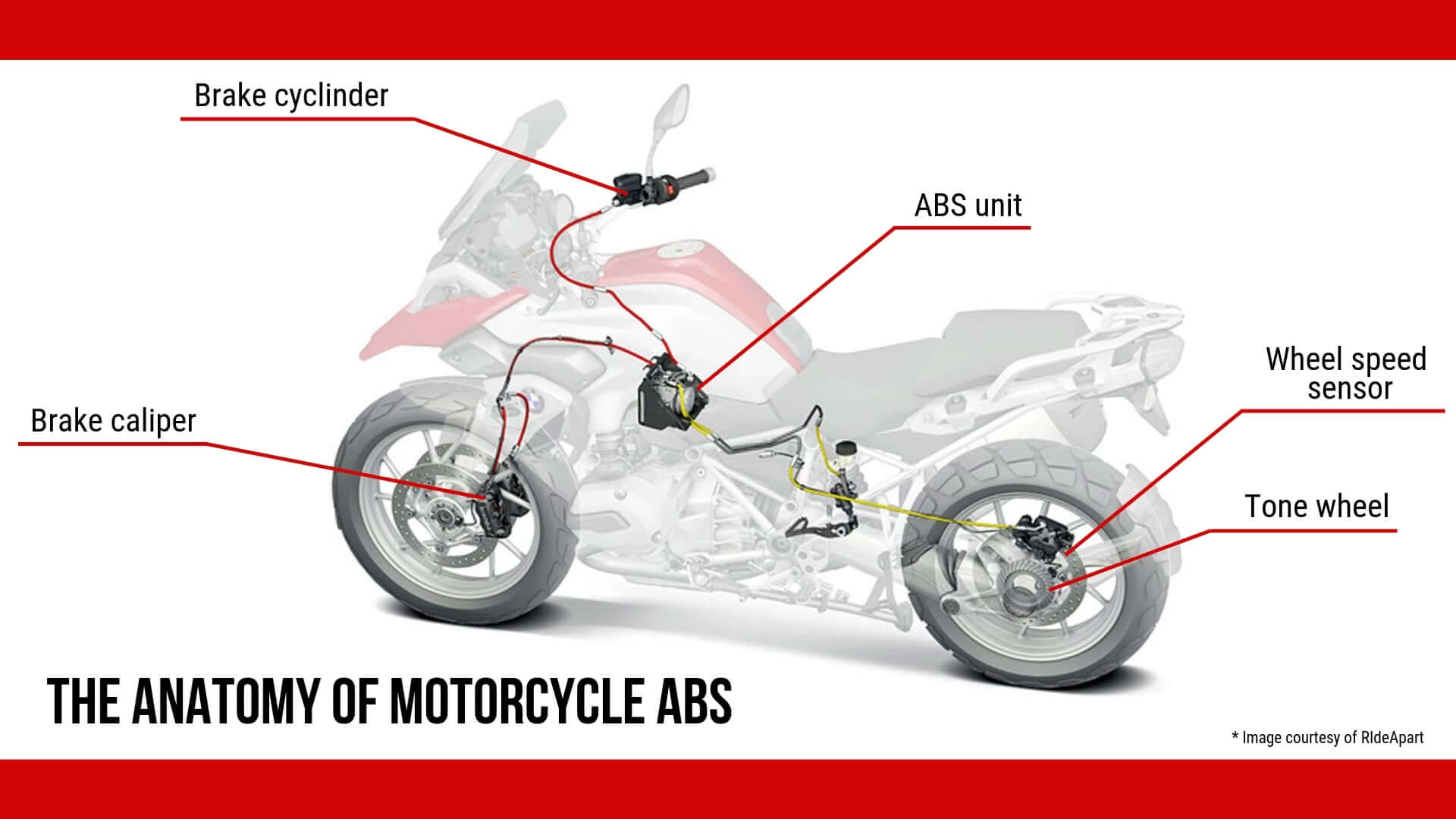
The efficacy of an ABS unit stems from a sophisticated interplay of electronic and hydraulic components that work in milliseconds to respond to changing road conditions and rider input.
Wheel Speed Sensors
Each wheel equipped with ABS features a wheel speed sensor, typically an electromagnetic sensor mounted near a toothed ring (reluctor ring) on the wheel hub. As the wheel rotates, the teeth of the reluctor ring pass by the sensor, generating a pulse. The frequency of these pulses allows the system to accurately determine the rotational speed of each wheel. Any sudden, drastic deceleration of a wheel that doesn’t match the deceleration of the other wheel or the overall speed of the motorcycle signals an impending lock-up.
The ECU (Electronic Control Unit)
The heart of the ABS system is the Electronic Control Unit (ECU). This dedicated microcomputer continuously receives data from the wheel speed sensors. It compares the rotational speed of the front and rear wheels, as well as their deceleration rates. Based on complex algorithms, the ECU analyzes this data to detect any discrepancies that indicate a wheel is about to lock up. If the ECU identifies such a condition, it immediately sends commands to the hydraulic modulator.
Hydraulic Modulator
The hydraulic modulator is the crucial component responsible for physically altering the brake pressure. It consists of a series of valves (inlet and outlet) and a pump. When the ECU detects an impending wheel lock, it signals the modulator to:
- Reduce Pressure: The inlet valve closes, and the outlet valve opens, releasing some hydraulic pressure from the brake caliper, allowing the wheel to speed up slightly.
- Hold Pressure: Both valves close, maintaining constant pressure.
- Increase Pressure: The inlet valve opens, and the outlet valve closes, allowing hydraulic pressure to build up again.
This rapid cycling of pressure reduction, holding, and increase occurs many times per second – a pulsating action that can often be felt at the brake lever or pedal by the rider. The pump within the modulator then returns the released brake fluid to the master cylinder, ensuring the system is ready for the next cycle.
The ABS Cycle in Action
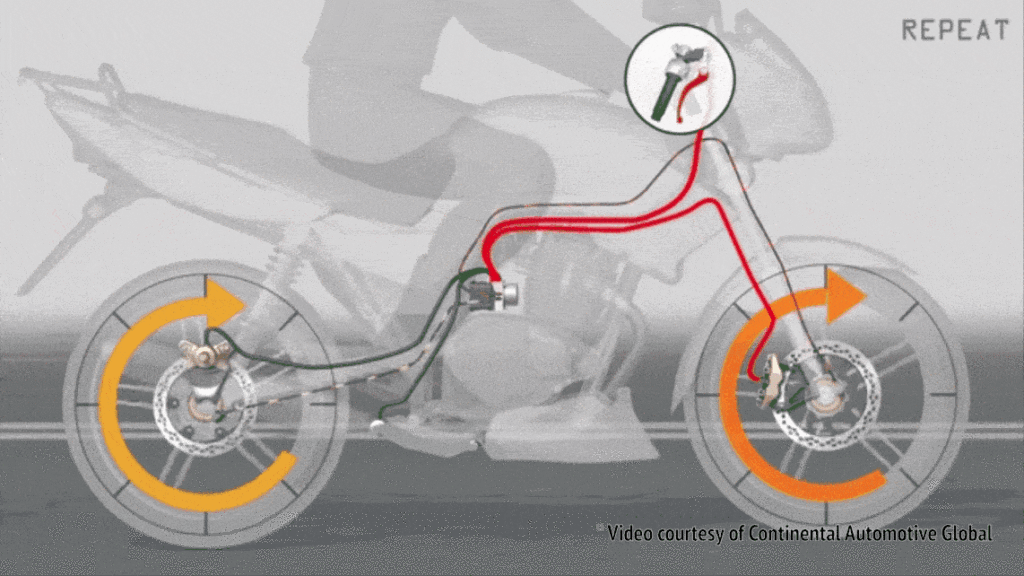
When a rider initiates hard braking, the wheel speed sensors transmit data to the ECU. If a wheel begins to slow down too quickly relative to the bike’s speed, indicating a potential lock-up, the ECU instructs the hydraulic modulator to reduce the pressure to that specific wheel’s brake caliper. As soon as the wheel regains some rotation, the pressure is reapplied. This process happens in rapid, repeated cycles, ensuring maximum braking force is applied without losing traction, thus allowing the rider to maintain steering and stability while stopping in the shortest possible distance on varied surfaces.
Why ABS is a Game-Changer for Riders
The integration of ABS has fundamentally reshaped motorcycle safety and rider experience, moving beyond mere technological novelty to a critical safety feature.
Enhanced Safety and Stability
The primary benefit of ABS is the dramatic improvement in safety. By preventing wheel lock-up, ABS allows riders to brake hard in emergency situations without fear of losing control due to skidding. This is particularly vital in unexpected scenarios such as sudden obstacles, slippery patches, or panic braking. The ability to maintain stability means the rider can steer around hazards even while applying full braking force, a crucial capability that greatly reduces the likelihood and severity of accidents. Numerous studies and real-world data have consistently demonstrated that motorcycles equipped with ABS have a significantly lower accident rate, especially those involving fatal or severe injuries.

Improved Braking Performance
While the common misconception is that ABS always stops a bike shorter, its true advantage lies in optimal braking performance under adverse conditions. On dry, clean asphalt, a skilled rider might achieve a slightly shorter stopping distance without ABS. However, on wet roads, gravel, uneven surfaces, or during panic braking where a rider might over-apply the brakes, ABS consistently delivers shorter and more controlled stopping distances by ensuring maximum grip utilization. It optimizes the braking force distribution to prevent traction loss, allowing the tires to work at their peak friction coefficients, which is paramount for effective deceleration.
Rider Confidence and Control
Beyond the objective safety metrics, ABS profoundly impacts rider confidence. Knowing that the system will intervene to prevent a dangerous skid in an emergency empowers riders to brake more assertively when necessary. This increased confidence translates into better riding habits, as riders are less likely to shy away from using their brakes effectively. The improved control offered by ABS, especially in unpredictable situations, reduces rider stress and fatigue, making for a safer and more enjoyable riding experience overall. It democratizes emergency braking, making high-level control accessible to riders of all skill levels.
Types of ABS in Motorcycles
As ABS technology has evolved, several variations have emerged, offering different levels of sophistication and control for various types of motorcycles and riding demands.
Single-Channel ABS
Single-channel ABS typically monitors and modulates brake pressure for only one wheel, usually the front wheel. The front brake is responsible for the majority of a motorcycle’s stopping power (often 70-90%), so equipping it with ABS provides a significant safety enhancement. While it prevents the front wheel from locking, the rear wheel can still lock up, potentially causing instability. This system is often found on entry-level motorcycles or scooters due to its lower cost and simpler integration.
Dual-Channel ABS
Dual-channel ABS is the most common and comprehensive type, monitoring and modulating brake pressure independently for both the front and rear wheels. This offers maximum safety and stability, as it prevents both wheels from locking up simultaneously. Each wheel has its own speed sensor and can have its brake pressure adjusted independently by the hydraulic modulator, ensuring optimal braking performance and control across varying conditions and rider inputs. This system is now standard on many mid-range and premium motorcycles.
Cornering ABS (C-ABS)
Cornering ABS represents a significant leap forward, utilizing an Inertial Measurement Unit (IMU) in addition to wheel speed sensors. The IMU measures the motorcycle’s lean angle, pitch, roll, and yaw rates. By factoring in the motorcycle’s lean angle, Cornering ABS can intelligently adjust brake pressure to prevent lock-up even when the bike is leaned over in a turn. Traditional ABS, if activated mid-corner, could cause the bike to stand up or lose traction due to the reduced available grip while leaned. C-ABS allows for safer braking while cornering, dynamically distributing braking force to maintain stability and trajectory, significantly enhancing active safety for sport and touring riders.
Combined Braking System (CBS) with ABS
Some motorcycles combine a Combined Braking System (CBS) with ABS. CBS mechanically or electronically links the front and rear brakes, so applying one brake lever or pedal partially activates the other. When integrated with ABS, this system ensures that even if a rider only applies, for instance, the rear brake, both brakes are engaged in a controlled manner, and neither wheel locks up. This setup can simplify emergency braking for some riders, distributing braking force more effectively and preventing lock-up on both wheels.
Evolution and Future of Motorcycle Braking Technology
The journey of ABS from a niche feature to a mandatory safety standard highlights a rapid evolution in motorcycle technology, continually pushing the boundaries of rider assistance and safety.
From Luxury to Standard
Initially, ABS was an expensive option found only on high-end touring and sport bikes. However, with advancements in manufacturing, miniaturization of components, and increasing awareness of its safety benefits, ABS has become more accessible. Regulatory bodies in many parts of the world, including the European Union and India, have made ABS mandatory for new motorcycles above a certain engine capacity, further cementing its status as a fundamental safety feature rather than a luxury. This standardization ensures that a broader demographic of riders benefits from this life-saving technology.
Integration with Other Rider Aids
Modern motorcycle ABS systems are no longer standalone units. They are increasingly integrated into a comprehensive suite of electronic rider aids managed by a central IMU. This allows ABS to work in conjunction with Traction Control (TC), Wheelie Control, Engine Brake Control (EBC), and even semi-active suspension systems. For example, a sophisticated ABS might receive input from TC to optimize braking when traction is already compromised, or communicate with EBC to prevent rear wheel lock-up during aggressive downshifts. This holistic approach creates a more seamless and intelligent safety net for the rider.
Predictive and Adaptive Systems
The future of motorcycle braking technology points towards even greater intelligence and foresight. Researchers and manufacturers are exploring predictive ABS systems that could potentially anticipate slippery conditions or dangerous braking scenarios before they fully develop, perhaps by using radar or lidar sensors to scan the road ahead. Adaptive ABS could also learn rider habits and dynamically adjust its intervention parameters based on the rider’s skill level, riding style, and the specific environmental context. These next-generation systems aim to not only react to impending danger but proactively mitigate risks, making motorcycling even safer and more intuitive. The continuous advancement in processing power, sensor technology, and artificial intelligence will undoubtedly unlock further innovations in anti-lock braking and overall vehicle dynamics control.
aViewFromTheCave is a participant in the Amazon Services LLC Associates Program, an affiliate advertising program designed to provide a means for sites to earn advertising fees by advertising and linking to Amazon.com. Amazon, the Amazon logo, AmazonSupply, and the AmazonSupply logo are trademarks of Amazon.com, Inc. or its affiliates. As an Amazon Associate we earn affiliate commissions from qualifying purchases.