
Imagine a simple offer: you can have $1 million today, or you can have a single penny that doubles in value every day for 30 days. Which would you choose? Most people, driven by immediate gratification and an underestimation of exponential growth, might instinctively choose the $1 million. However, a deeper understanding of the “penny doubled for 30 days” scenario reveals one of the most powerful forces in finance – a force capable of generating life-changing wealth or accumulating crushing debt. This seemingly trivial thought experiment is a profound lesson in the dynamics of compound interest, making it a cornerstone concept for personal finance, investing, and understanding economic trends.

The Astonishing Power of Exponential Growth
At its core, the penny doubling scenario is an illustration of exponential growth. Unlike linear growth, where a fixed amount is added consistently, exponential growth involves a percentage or a multiplying factor being applied repeatedly. The results, especially over time, can be astonishing, defying our intuitive understanding.
The Daily Doubling Dilemma: A Simple Calculation
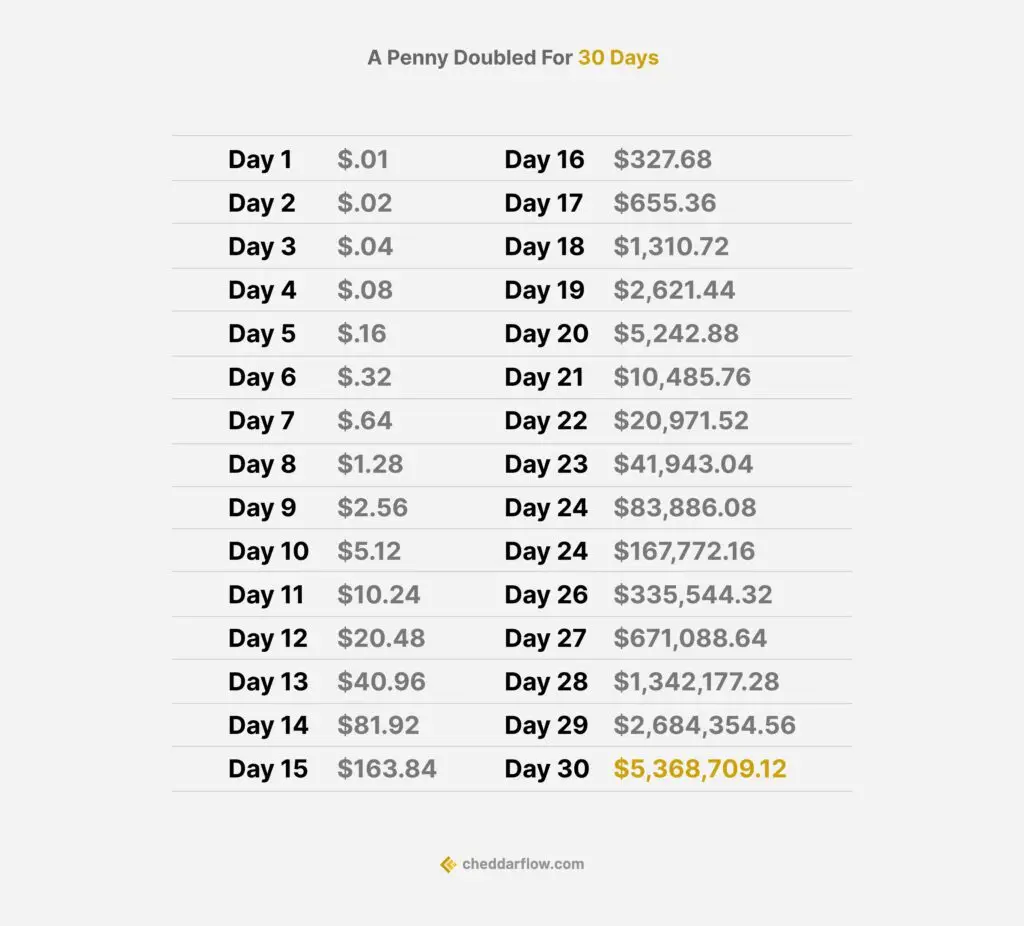
Let’s break down the penny-doubling scenario day by day:
- Day 1: $0.01 (1 cent)
- Day 2: $0.02
- Day 3: $0.04
- Day 4: $0.08
- Day 5: $0.16
- Day 10: $5.12
- Day 15: $163.84
- Day 20: $5,242.88
- Day 25: $167,772.16
For the first week or even two, the growth seems modest. Many might still feel smug about their $1 million choice, seeing only a few hundred dollars on Day 15. However, the turning point, or “hockey stick” moment, happens quickly and dramatically in the latter half of the period.
By Day 30, the penny will have grown to a staggering $5,368,709.12.
This incredible sum is calculated using the formula: Initial Amount * 2^(number of days – 1). So, $0.01 * 2^29. The penny, starting small and seemingly insignificant, surpasses the $1 million mark around Day 28, then rockets past it in the final two days. This mathematical reality underscores the non-linear nature of true financial growth.
Visualizing the Financial Snowball
The penny-doubling effect is often likened to a snowball rolling down a hill. At first, the snowball is small and grows slowly, picking up only a little snow with each rotation. But as it gains size and momentum, each rotation adds a significantly larger amount of snow, causing it to grow at an ever-accelerating pace.
Similarly, in finance, the initial stages of exponential growth can feel underwhelming. It requires patience and foresight to see beyond the small early returns. However, those who persevere and understand the underlying mechanics are ultimately rewarded when the financial “snowball” truly begins to pick up speed, often accumulating the vast majority of its value in the final stages of the compounding period. This contrasts sharply with linear growth, where you add a fixed amount (e.g., $100 every day), resulting in a predictable and less dramatic total ($3,000 after 30 days).
Beyond the Penny: Real-World Applications of Exponential Growth in Finance
While a penny doubling for 30 days is a hypothetical scenario, the principle it demonstrates — that of compounding returns — is a fundamental engine in the real world of money, affecting everything from personal savings to national economies.
Compound Interest: The Investor’s Best Friend
The most direct real-world parallel to the penny-doubling experiment is compound interest. Compound interest is “interest on interest”—the interest earned on an initial sum (principal) is added back to the principal, and then the next period’s interest is calculated on this new, larger total. This creates a virtuous cycle of accelerating growth.
- Savings Accounts & CDs: Though rates are often modest, even these accounts benefit from compounding, especially over many years.
- Retirement Accounts (401k, IRA): These are prime examples where compound interest works wonders. Early contributions have decades to compound, leading to substantially larger nest eggs than later contributions, even if the later contributions are larger in total principal.
- Stock Market Investments: When you invest in stocks, mutual funds, or ETFs, your returns (capital gains, dividends) can be reinvested, creating an even larger base for future growth. This is the bedrock of long-term wealth accumulation.
As Albert Einstein famously quipped, “Compound interest is the eighth wonder of the world. He who understands it, earns it; he who doesn’t, pays it.”
Debt: The Borrower’s Worst Enemy
Just as compound interest can be your greatest ally in building wealth, it can be your most formidable foe when it comes to debt, particularly high-interest consumer debt like credit cards.
When you carry a balance on a credit card, interest is calculated on the principal amount, plus any previously accumulated interest. If you only make minimum payments, a significant portion of that payment often goes towards interest, leaving the principal largely untouched. This allows the interest to compound on a still-large or even growing principal, trapping borrowers in a cycle that can see small debts balloon into unmanageable sums over time. Understanding this destructive compounding effect is crucial for prioritizing debt repayment and avoiding financial distress.
Inflation: The Silent Eroder of Wealth
Inflation, the rate at which the general level of prices for goods and services is rising, and consequently, the purchasing power of currency is falling, also operates on an exponential basis. Even a seemingly low annual inflation rate of 2-3% means that the cost of living effectively doubles every 23-35 years.
If your savings or investments do not grow at a rate that at least matches or ideally exceeds inflation, your purchasing power diminishes over time, even if the nominal dollar amount of your savings remains the same or grows slightly. This exponential erosion is why investing is not just about growing wealth, but also about protecting its real value against the creeping effects of inflation.
Strategies to Harness Exponential Growth for Your Wealth
Understanding the penny-doubling principle is the first step; applying it strategically to your personal finances is where the real magic happens.
Early Investment: Time is Your Greatest Asset
The most critical takeaway from the penny analogy is the power of time. The longer your money has to compound, the more dramatic the results. A person who starts investing $200 per month at age 25 for just 10 years (then stops) will likely have significantly more wealth by retirement than someone who starts investing $200 per month at age 35 and continues for 30 years. The earlier contributions have a longer runway for exponential growth, making time an irreplaceable component of financial success.
Consistent Contributions: Fueling the Fire
While time is crucial, consistently adding to your principal gives the exponential engine more fuel. Regularly contributing to your investments, even small amounts, increases the base upon which future returns are calculated. This strategy, often referred to as dollar-cost averaging, smooths out market fluctuations and ensures that you’re continually adding to your compounding base. Think of it as adding more pennies to the initial pile to be doubled.
Reinvesting Dividends and Earnings
Many investments generate dividends (from stocks) or interest (from bonds/savings). Choosing to reinvest these earnings rather than taking them out as cash allows those earnings to themselves start earning returns. This is a powerful form of compounding, as it continually increases your principal base, creating a truly exponential feedback loop. It’s the financial equivalent of doubling not just the initial penny, but also all the pennies accumulated along the way.
Common Pitfalls and Misconceptions
Despite its mathematical simplicity, the penny-doubling scenario highlights a common cognitive bias that can hinder financial well-being.
Underestimating Long-Term Impact
The human brain is generally better at understanding linear progression than exponential. We tend to underestimate the impact of small, consistent changes over long periods. This leads to procrastination (“I’ll start saving next year”), under-saving for retirement, and an overall difficulty in visualizing the future value of current decisions. The early stages of compounding often feel slow and unrewarding, making it hard to maintain discipline.
The Lure of Get-Rich-Quick Schemes
The misunderstanding of true exponential growth can also make individuals vulnerable to “get-rich-quick” schemes. These schemes often promise unrealistic, rapid returns that mimic the dramatic growth of the penny in its final days, without the crucial element of sustained time and realistic underlying assets. Genuine exponential financial growth, while powerful, typically requires patience, discipline, and a sound investment strategy over extended periods, not overnight miracles.
Practical Steps to Apply Exponential Thinking to Your Finances
Harnessing the power of compounding doesn’t require complex financial wizardry; it requires discipline, knowledge, and consistent action.
Start Saving and Investing Today
The single most important action is to begin. Even if it’s a small amount, opening a retirement account (like a 401k or IRA) or a brokerage account and setting up automatic contributions is paramount. Let your “penny” start its doubling journey as soon as possible. The power of compounding means that small consistent contributions made early will almost always outperform larger, later contributions.
Understand Your Debt and Prioritize Repayment
If you have high-interest debt, consider it an emergency. Just as compounding works for you, it works aggressively against you with debt. Prioritize paying off high-interest credit card balances first. Strategies like the “debt snowball” or “debt avalanche” can provide structured approaches to systematically eliminate debt and stop the negative compounding cycle.

Educate Yourself Continually
Financial literacy is not a one-time event; it’s a lifelong journey. Continuously educate yourself about personal finance, investing, and economic principles. Read reputable books, follow financial news from trusted sources, and consult with financial advisors. The more you understand how money works, the better equipped you’ll be to make decisions that leverage the incredible power of exponential growth in your favor.
In conclusion, the simple question, “what is a penny doubled for 30 days?”, unlocks a profound understanding of financial dynamics. It powerfully illustrates that small beginnings, combined with the relentless force of compounding over time, can lead to extraordinary outcomes. Whether you’re building a retirement nest egg, saving for a down payment, or simply managing your daily finances, embracing the principles of exponential growth is not just a theoretical exercise – it’s a blueprint for long-term financial success and security. The choice between a million dollars today and a doubling penny is a stark reminder that true wealth often belongs to those who possess both patience and foresight.
aViewFromTheCave is a participant in the Amazon Services LLC Associates Program, an affiliate advertising program designed to provide a means for sites to earn advertising fees by advertising and linking to Amazon.com. Amazon, the Amazon logo, AmazonSupply, and the AmazonSupply logo are trademarks of Amazon.com, Inc. or its affiliates. As an Amazon Associate we earn affiliate commissions from qualifying purchases.