
In an era defined by personalization and a heightened focus on individual well-being, the traditional “one-size-fits-all” approach to employee benefits is rapidly evolving. Companies are increasingly seeking innovative ways to attract, retain, and engage talent, recognizing that a diverse workforce has equally diverse needs and aspirations. Enter the Lifestyle Spending Account (LSA) – a flexible, employer-funded financial tool designed to empower employees to invest in aspects of their lives that truly matter to them, extending far beyond the conventional realms of health and retirement.
This article delves into the core mechanics, benefits, and distinctions of LSAs, positioning them as a pivotal component of modern financial wellness strategies for both individuals and organizations. We’ll explore how these accounts function, the financial advantages they offer, and how they stand apart from other familiar financial instruments, ultimately providing a comprehensive understanding of their growing significance in the financial landscape.
Unpacking the Concept of a Lifestyle Spending Account (LSA)
At its heart, a Lifestyle Spending Account is a designated fund provided by an employer to its employees, offering a high degree of flexibility for spending on a wide array of personal wellness and development expenses. Unlike more restrictive benefits, LSAs are designed to cater to the whole person, acknowledging that an individual’s financial, physical, mental, and professional well-being are interconnected.
Defining the LSA: Beyond Traditional Benefits
An LSA fundamentally represents a shift from prescriptive benefits to a more adaptable, employee-centric model. Where traditional benefits like health insurance, 401(k) plans, or even Flexible Spending Accounts (FSAs) and Health Savings Accounts (HSAs) target specific, often critical, life areas, an LSA casts a much broader net. It’s a pool of funds that employees can draw from to support various aspects of their lifestyle, as defined and allowed by their employer.
The distinguishing feature of an LSA is its inherent flexibility. While an employer sets the overarching categories of eligible expenses, these categories are typically much wider than those found in, say, an HSA. This broad eligibility allows employees to select benefits that are personally relevant, whether that’s funding a fitness membership, paying for professional development courses, or even covering pet care expenses. This personalized approach recognizes that what constitutes “wellness” or “support” varies greatly from person to person, age group to age group, and lifestyle to lifestyle.
The Philosophy Behind LSAs: Employee Well-being and Customization
The emergence and growing popularity of LSAs are rooted in a progressive philosophy that prioritizes holistic employee well-being and personalization. Employers are increasingly aware that a content, healthy, and developing workforce is a productive one. However, the ideal “benefit package” for a millennial living in a city with student loan debt is vastly different from that of a Gen X parent balancing childcare with career advancement, or a baby boomer preparing for retirement.
LSAs bridge this gap by offering a customizable solution. Instead of trying to guess what every employee might need and offering a patchwork of niche benefits, employers can provide a flexible LSA. This empowers employees to choose how they allocate their benefit dollars to best suit their individual circumstances, fostering a stronger sense of value and loyalty. This strategic investment in employee well-being translates directly into enhanced job satisfaction, reduced turnover, and a more engaged and motivated workforce, proving to be a powerful tool in a competitive labor market. From a financial perspective, it’s a direct investment in human capital that yields tangible returns through improved productivity and retention.
How Lifestyle Spending Accounts Work
Understanding the practical mechanics of Lifestyle Spending Accounts is crucial for both employers considering their implementation and employees looking to maximize their benefits. The process typically involves a clear funding structure, defined eligible expenses, and a streamlined reimbursement system.
Funding and Administration: Employer-Driven Flexibility
The core of an LSA’s operation lies in its funding model. Employers allocate a specific amount of money to each eligible employee’s LSA, often on an annual, quarterly, or monthly basis. This allocation is a direct expense for the employer, treated as part of the overall compensation package. Unlike employee-funded accounts (such as a 401(k) where the employee contributes), the LSA is entirely employer-funded, making it a distinct perk.
The administration of LSAs is often handled through third-party platforms or integrated HR software solutions. These platforms provide employees with a dedicated portal to view their balance, submit claims, and track their usage. For employers, these systems simplify the management of the program, ensuring compliance, processing reimbursements, and providing valuable anonymized data on how employees are utilizing their benefits. This outsourced administration helps companies, particularly smaller ones, offer sophisticated benefit programs without overburdening internal HR or finance departments. The funds in an LSA typically do not roll over indefinitely from one period to the next, similar to some FSAs, though this specific rule can vary greatly by employer policy.
Eligible Expenses: A Broad Spectrum of Choices
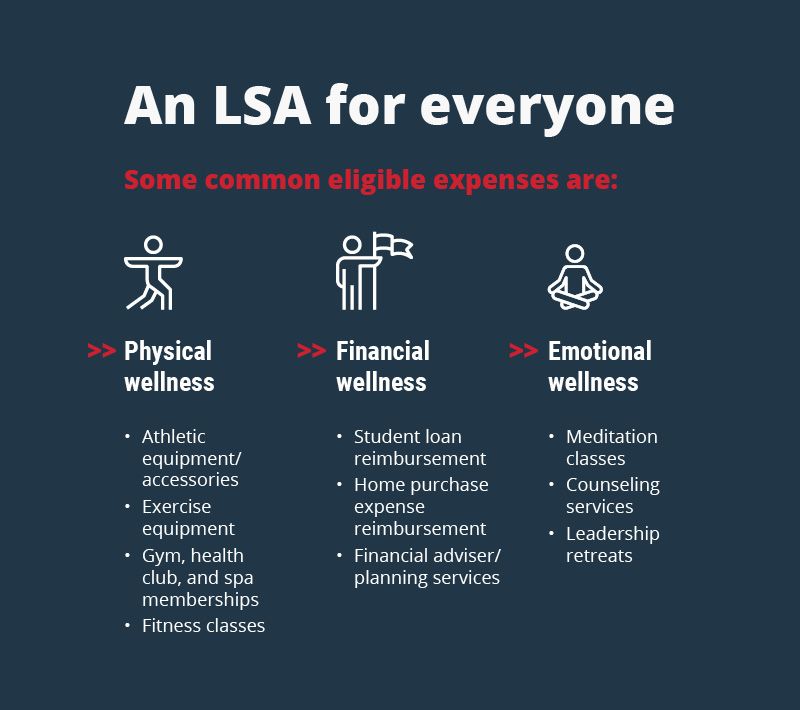
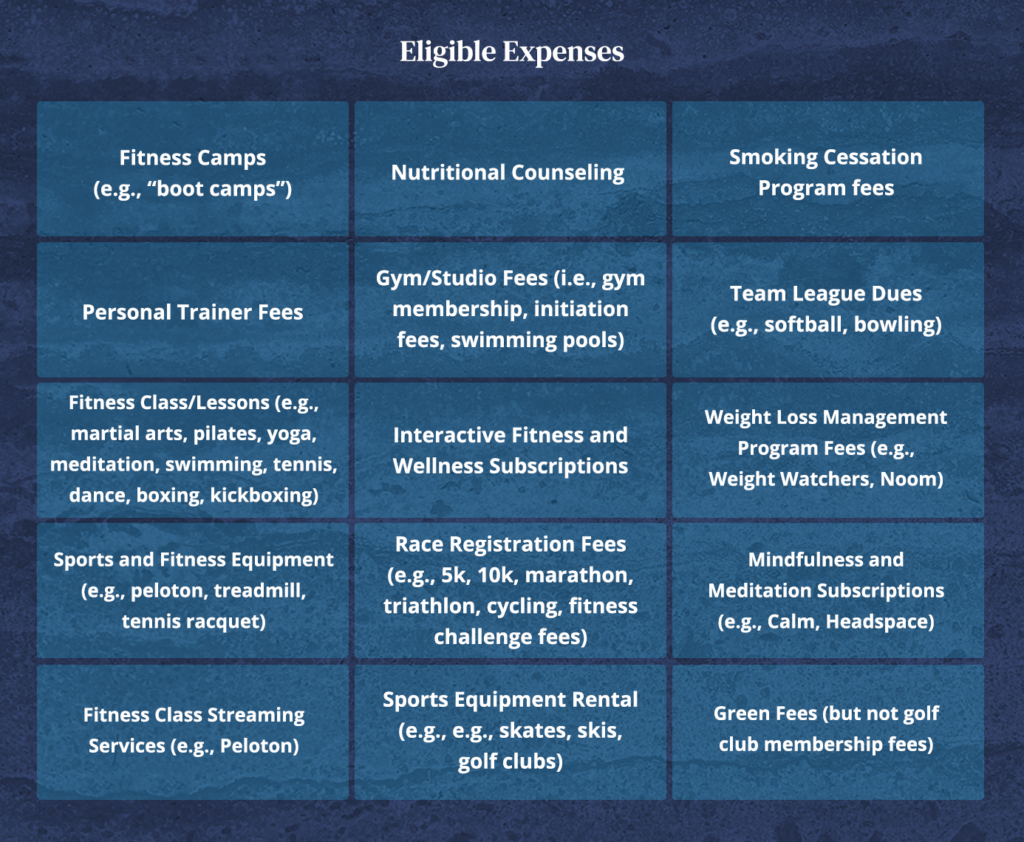
Perhaps the most compelling feature of an LSA is the breadth of expenses it can cover. While the employer ultimately defines the list of eligible expenses, these lists are characteristically broad and designed to support a holistic view of well-being. Common categories include:
- Physical Wellness: Gym memberships, fitness classes (yoga, Pilates, CrossFit), personal trainers, meditation apps, athletic gear, nutritional counseling, massages.
- Mental & Emotional Health: Therapy sessions, counseling services, mental wellness apps, mindfulness retreats.
- Professional Development: Online courses, certifications, workshops, conference fees, books related to career growth.
- Family & Dependent Care: Childcare services, elder care, pet care, tutoring.
- Financial Wellness: Student loan repayment assistance, financial planning services, budgeting tools.
- Personal Growth & Hobbies: Art classes, music lessons, educational subscriptions, travel expenses for personal development.
- Home Office & Remote Work: Ergonomic furniture, high-speed internet stipends (if not covered by other means).
It is important to note that the specific list of eligible expenses can vary significantly from one employer to another. Companies tailor their LSA programs to align with their culture, values, and the specific needs of their workforce. The key is that employees have a significant degree of choice within the defined parameters.
Reimbursement and Tracking: The Practical Mechanics
For employees, utilizing an LSA typically follows a straightforward reimbursement process. When an employee incurs an eligible expense, they pay for it upfront using their own funds. They then submit a claim through the LSA administration platform, usually accompanied by proof of purchase (a receipt or invoice). The administrator reviews the claim to ensure it meets the employer’s defined eligibility criteria. Once approved, the employee is reimbursed directly, either via direct deposit or check, from their LSA balance.
The tracking aspect is also crucial. Both employees and employers can monitor the LSA balance and spending history through the dedicated platform. This transparency allows employees to manage their funds effectively and helps employers analyze the program’s utilization and impact. Efficient tracking ensures that funds are spent appropriately and helps in refining the LSA program over time to maximize its benefit for all stakeholders.
The Financial Advantages of LSAs for Employees and Employers
Lifestyle Spending Accounts offer distinct financial benefits that extend beyond mere convenience, impacting the financial wellness and strategic positioning of both individuals and organizations.
For Employees: Financial Wellness and Personal Empowerment

For employees, LSAs translate directly into enhanced financial wellness and a profound sense of personal empowerment. By providing funds for expenses that might otherwise come out of pocket, LSAs effectively increase an employee’s disposable income. This can alleviate financial stress associated with various life expenses, from maintaining physical health to pursuing educational goals or managing family care.
Consider an employee who wants to take an online course to upskill for a promotion, but the cost is a barrier. An LSA can remove that barrier, directly investing in their career growth without dipping into their personal savings. Similarly, a parent struggling with childcare costs can find significant relief, or an individual prioritizing mental health can access therapy without additional financial strain. This reduction in out-of-pocket expenses for items that contribute to overall well-being allows employees to allocate their personal funds more strategically, potentially freeing up money for savings, investments, or other personal financial goals.
The tax treatment of LSA reimbursements is a key consideration. While it can vary based on the specific expense and how the employer structures the benefit, many LSA-eligible expenses can be designed to be non-taxable to the employee. For example, reimbursements for certain wellness programs, educational assistance (job-related), or dependent care may be excludable from an employee’s taxable income, providing an additional financial advantage. However, it’s critical for employers to consult with tax professionals to ensure compliance and proper reporting for all eligible categories.
For Employers: Strategic Investment in Human Capital
From an employer’s perspective, LSAs are not just an expense; they are a strategic investment in human capital. In today’s competitive talent landscape, robust and flexible benefits packages are powerful tools for recruitment and retention. Offering an LSA signals to prospective and current employees that the company genuinely cares about their holistic well-being, not just their work output. This perception can significantly enhance employer branding and make a company a more attractive place to work.
Beyond recruitment, LSAs contribute to a more engaged and satisfied workforce. Employees who feel supported and empowered to pursue their personal and professional goals are typically more motivated, productive, and loyal. By reducing employee stress (financial or otherwise) and fostering a culture of well-being, employers can see a decrease in absenteeism, an increase in job satisfaction, and a boost in overall morale.
Furthermore, LSAs can offer employers a more streamlined approach to benefits administration. Instead of managing dozens of niche vendor relationships for various specific benefits (e.g., separate gym membership discounts, tuition reimbursement programs, mental health apps), an LSA provides a single, flexible fund that covers a multitude of needs. This consolidates administrative effort and can often lead to cost efficiencies in the long run. Employers can also often deduct LSA contributions as a business expense, providing a tax advantage for the company. The insights gained from aggregated LSA usage data (while respecting individual privacy) can also help employers understand employee needs better and refine future benefit strategies.
Distinguishing LSAs from Other Financial Accounts
The financial landscape offers a myriad of specialized accounts, each with its own purpose and rules. To fully appreciate the unique value of Lifestyle Spending Accounts, it’s essential to understand how they differ from other commonly known financial instruments, particularly those offered through employer benefits.
LSAs vs. Flexible Spending Accounts (FSAs) & Health Savings Accounts (HSAs)
The most frequent point of comparison for LSAs is with health-related benefit accounts like Flexible Spending Accounts (FSAs) and Health Savings Accounts (HSAs). While all three can be employer-sponsored, their fundamental purposes, eligibility, and tax implications diverge significantly.
- FSAs (Flexible Spending Accounts): These accounts are primarily designed for healthcare expenses (Medical FSAs) or dependent care expenses (Dependent Care FSAs). They are funded by employee pre-tax contributions, and employer contributions are optional. A key characteristic is the “use-it-or-lose-it” rule, where funds typically expire at the end of the plan year (with some limited exceptions like grace periods or carryovers). Critically, FSAs are strictly regulated by the IRS regarding eligible expenses, which are largely confined to medical, dental, vision, or eligible dependent care services.
- HSAs (Health Savings Accounts): These are available only to individuals enrolled in a High-Deductible Health Plan (HDHP). HSAs are unique because they are triple tax-advantaged: contributions are tax-deductible, earnings grow tax-free, and qualified withdrawals for medical expenses are tax-free. Unlike FSAs, HSA funds roll over year after year and are portable, meaning the employee owns the account even if they leave their job. Like FSAs, eligible expenses are strictly medical.
How LSAs differ: LSAs stand apart because they are generally not restricted to medical or dependent care expenses. Their scope is much broader, encompassing wellness, professional development, family support, and more, as defined by the employer. LSAs are typically employer-funded only, not funded by employee pre-tax contributions. Furthermore, while some LSAs might have a “use-it-or-lose-it” clause, many offer different rollover rules or greater flexibility than FSAs. Crucially, the tax advantages of LSAs are tied to the specific type of expense being reimbursed; if it’s for a benefit that would typically be non-taxable as an employer-provided benefit (e.g., certain educational assistance or specific wellness programs), the LSA reimbursement can also be non-taxable to the employee. This nuanced tax treatment requires careful structuring by the employer in consultation with tax experts.
LSAs vs. Stipends and Bonuses
Another important distinction is between LSAs and general stipends or bonuses. While all can represent additional compensation, their intent, structure, and tax treatment differ.
- Stipends: A stipend is usually a fixed sum of money paid regularly for a specific purpose, such as a remote work stipend to cover internet and utility costs, or a travel stipend. While stipends are often intended to cover expenses, they are typically paid directly to the employee as part of their income and are taxable as regular wages. The employee is not usually required to provide receipts for specific purchases, as the stipend is seen as an allowance.
- Bonuses: Bonuses are additional payments made to employees as a reward for performance or as an incentive. They are typically discretionary, not tied to specific expenses, and are always taxable as income. Employees receive the full bonus amount and can spend it as they wish, with no requirement for reimbursement or proof of purchase.
How LSAs differ: LSAs are reimbursement-based accounts, meaning employees pay upfront for an eligible expense and then submit a claim for repayment. This contrasts sharply with stipends and bonuses, which are direct payments. The reimbursement model of an LSA ensures that the funds are used for their intended purpose—the broad category of lifestyle expenses defined by the employer. Furthermore, as discussed, depending on the expense category and IRS regulations, LSA reimbursements can potentially be non-taxable income for the employee, offering a significant financial advantage over fully taxable stipends and bonuses. This targeted, potentially tax-advantaged reimbursement mechanism is a core differentiator, making LSAs a more strategic and often more financially efficient benefit than simply providing additional taxable income.
Implementing and Optimizing a Lifestyle Spending Account Program
For employers considering or currently offering Lifestyle Spending Accounts, successful implementation and ongoing optimization are key to maximizing their value. A well-structured LSA program can yield significant returns in employee satisfaction and business performance.
Key Considerations for Employers
Implementing an LSA program requires thoughtful planning and clear execution. Employers must address several critical factors to ensure the program is effective and compliant.
- Defining Clear Eligible Expense Categories: This is perhaps the most crucial step. Employers must decide which lifestyle areas they wish to support. The categories should align with company values and employee needs. It’s vital to be specific about what is included and, equally important, what is excluded, to avoid ambiguity and frustration. For example, specifying “fitness memberships at accredited gyms” rather than just “fitness.”
- Setting Budget Limits and Frequency: Employers need to determine the monetary amount allocated per employee (e.g., $1,000 annually, $250 quarterly) and how often these funds are refreshed. This decision impacts the program’s cost and perceived value. Considerations about rollover policies (e.g., do unused funds expire, or can a percentage carry over?) also need to be clearly defined and communicated.
- Choosing an Administration Platform: Deciding between an in-house solution and a third-party vendor is essential. Third-party platforms often offer robust features for claim submission, approval workflows, reporting, and employee self-service, reducing the administrative burden on HR and finance teams.
- Communicating the Program Effectively: A comprehensive communication strategy is vital to ensure employees understand the LSA, how to use it, and its benefits. This includes clear documentation, FAQs, informational sessions, and ongoing reminders. The program’s value is only realized if employees understand and utilize it.
- Understanding Tax Implications for Both Parties: This cannot be overstressed. Employers must consult with tax professionals (e.g., CPAs, tax attorneys) to understand the tax treatment of various eligible expenses for both the employer (deductibility) and the employee (taxable vs. non-taxable income). Misclassifying expenses can lead to compliance issues and unexpected tax liabilities. Different categories of benefits have different IRS rules, and these must be meticulously followed.
Maximizing Benefits for Employees
For employees, fully leveraging an LSA means understanding its nuances and integrating it into personal financial planning.
- Understanding the Program’s Rules and Eligible Expenses: Employees should thoroughly review their employer’s specific LSA policy. Knowing precisely what is covered and any limits or exclusions will prevent wasted time and effort on ineligible claims.
- Keeping Meticulous Records for Reimbursement: Since LSAs operate on a reimbursement model, retaining receipts and proof of purchase is paramount. Digital copies are often sufficient and easier to manage through online platforms.
- Aligning Personal Financial Goals with LSA Offerings: Employees should proactively identify how the LSA can support their existing financial goals, whether it’s reducing costs for health, professional development, or family care. Integrating LSA usage into a personal budget can free up cash flow for savings or investments.
- Advocating for Desired Categories (if not included): If an employee identifies a widely beneficial lifestyle expense not currently covered by their LSA, providing constructive feedback to HR can sometimes lead to program enhancements in the future.
In conclusion, the Lifestyle Spending Account stands as a dynamic and increasingly indispensable financial tool in modern benefits packages. For employees, it offers unparalleled flexibility and direct support for personal well-being, fostering financial freedom and a sense of empowerment. For employers, it represents a strategic investment that drives recruitment, retention, engagement, and ultimately, a more productive and satisfied workforce. As the demand for personalized benefits continues to grow, LSAs are poised to become a standard rather than an exception, redefining the landscape of corporate financial wellness and employee support.
aViewFromTheCave is a participant in the Amazon Services LLC Associates Program, an affiliate advertising program designed to provide a means for sites to earn advertising fees by advertising and linking to Amazon.com. Amazon, the Amazon logo, AmazonSupply, and the AmazonSupply logo are trademarks of Amazon.com, Inc. or its affiliates. As an Amazon Associate we earn affiliate commissions from qualifying purchases.