
At first glance, the expression “8 divided by 2 times 2 plus 2” appears to be a straightforward arithmetic problem, a relic from school days designed to test basic mathematical literacy. Yet, for many, it often sparks debate and confusion, leading to different answers. Is it 10? Or is it something else? This seemingly simple equation, far from being trivial, serves as a powerful microcosm for understanding one of the most critical foundational principles in technology: the unambiguous interpretation of instructions, specifically the order of operations. In the digital realm, where every instruction must be precise, the lack of a universal, unambiguous parsing mechanism would lead to chaos, rendering software unreliable and computational results meaningless.
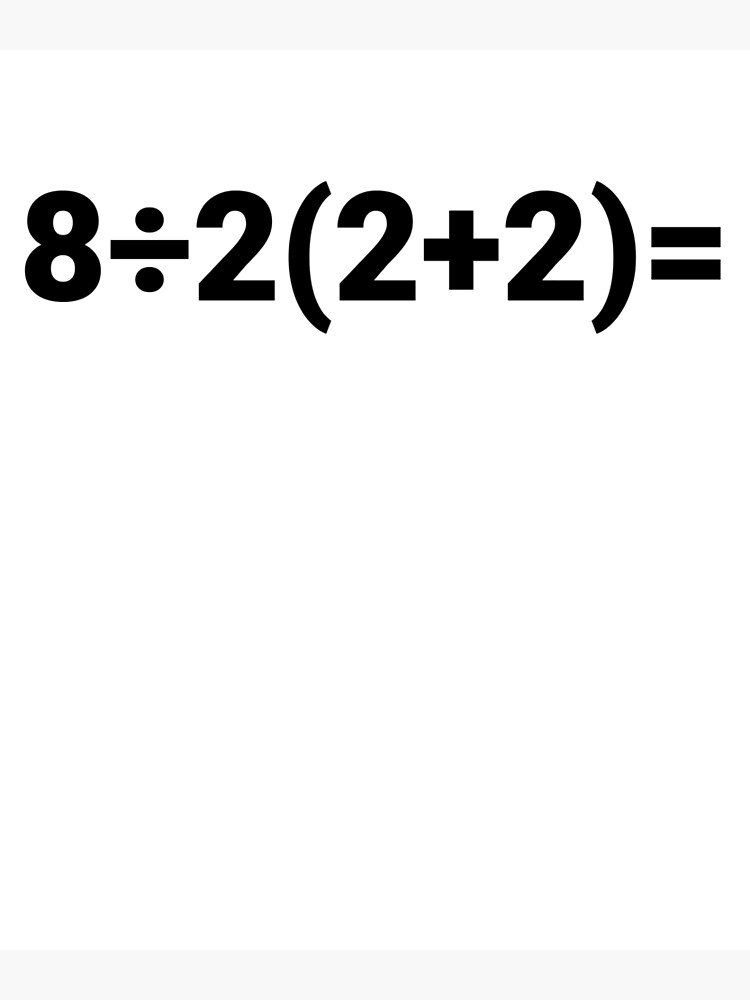
The direct answer to the problem, following the widely accepted order of operations (PEMDAS/BODMAS), is 10.
Let’s break it down:
-
Parentheses / Brackets: None
-
Exponents / Orders: None
-
Multiplication and Division (from left to right):
-
8 ÷ 2 = 4
-
4 × 2 = 8
-
-
Addition and Subtraction (from left to right):
- 8 + 2 = 10
The confusion often arises when individuals apply operations out of sequence, perhaps performing multiplication before division or addition before the other operations without proper consideration of precedence and associativity. While a human might debate the “correct” interpretation of such a phrase in natural language, a computer system, from a basic calculator to the most advanced AI, cannot afford such ambiguity. It must follow a strict, predefined set of rules to consistently arrive at the correct result. This adherence to logic is the bedrock of all technological advancement.
The Foundation of Digital Logic: Order of Operations as an Algorithm
Every piece of software, every algorithm, and every computational process relies on a rigorous interpretation of instructions. Just as a human needs a common understanding of arithmetic rules to communicate mathematical ideas, computers require a formal system to process data. The order of operations is not merely a convention; it’s a fundamental algorithm that dictates how mathematical expressions are evaluated, ensuring consistency and predictability across all digital platforms.
PEMDAS/BODMAS: A Universal Rule for Human-Machine Interface
PEMDAS (Parentheses, Exponents, Multiplication and Division, Addition and Subtraction) or BODMAS (Brackets, Orders, Division and Multiplication, Addition and Subtraction) are mnemonics designed to help humans remember the hierarchy of mathematical operations. This hierarchy isn’t arbitrary; it’s a carefully established standard that allows mathematical expressions to be written compactly without requiring excessive parentheses. Without it, expressions like 2 + 3 * 4 could be 20 or 14, depending on the reader’s interpretation.
For technology, this standard is paramount. When a user inputs an expression into a calculator app, a spreadsheet, or a programming environment, the underlying software must parse and evaluate it using these exact rules. Deviations would lead to incorrect calculations, rendering the software unusable for critical tasks, from financial modeling to scientific simulations. The “8 divided by 2 times 2 plus 2” problem perfectly illustrates this necessity; it highlights how even subtle misinterpretations of precedence can lead to dramatically different outcomes.
Ambiguity in Natural Language vs. Machine Precision
One of the fascinating aspects of the “8 divided by 2 times 2 plus 2” puzzle is how it exposes the inherent ambiguity of natural human language compared to the absolute precision required by machines. When a human reads “times 2 plus 2,” they might intuitively group the “2 plus 2” as a single thought, or interpret “times 2” as having a stronger binding than the initial division. This is because human language is rich with context, intonation, and implicit understandings that are absent in a purely textual, operational command.
Computers, however, lack intuition. They operate based on explicit instructions. For a machine to process “8 divided by 2 times 2 plus 2,” it doesn’t “think” about what a human might mean; it strictly follows its programmed parser. This parser converts the string of characters into a structured representation (like an Abstract Syntax Tree, which we’ll discuss later) where operator precedence is explicitly defined. This stark contrast between human linguistic flexibility and machine literalism underscores why careful design of programming languages and computational tools is so crucial. The ambiguity of a natural language phrase like our puzzle is precisely what programming languages aim to eliminate, enforcing a rigid, unambiguous grammar.
How Computers Interpret Mathematical Expressions
The ability of a computer to correctly solve “8 divided by 2 times 2 plus 2” goes far beyond simply knowing PEMDAS. It involves sophisticated parsing techniques, compiler design principles, and robust language specifications that define how operators are handled.
Parsing Algorithms and Abstract Syntax Trees (ASTs)
When you type an expression like 8 / 2 * 2 + 2 into a programming environment or a sophisticated calculator, the software doesn’t just execute it directly. First, it goes through a process called parsing. A parser’s job is to take a sequence of tokens (like numbers, operators, keywords) and convert them into a structured representation that reflects the grammatical rules of the language.
One common output of a parser is an Abstract Syntax Tree (AST). An AST is a tree-like representation of the source code that captures its syntactic structure and hierarchical relationships. For our problem, the expression 8 / 2 * 2 + 2 would be transformed into an AST where the + operator might be the root node, with 8 / 2 * 2 as its left child and 2 as its right child. Within the 8 / 2 * 2 subtree, the multiplication and division would be processed from left to right, reflecting their equal precedence but left-to-right associativity. This tree structure explicitly encodes the order of operations, leaving no room for ambiguity. It’s how the machine “understands” the hierarchy.
Operator Precedence and Associativity in Programming Languages
Every programming language – be it Python, Java, C++, JavaScript, or others – has a precisely defined set of rules for operator precedence and associativity. These rules are explicitly documented in the language specification and are fundamental to writing predictable code.
-
Precedence determines which operator is evaluated first when different operators are present (e.g., multiplication has higher precedence than addition).
-
Associativity determines the order of evaluation when operators of the same precedence are present (e.g., division and multiplication are typically left-associative, meaning
a / b * cis evaluated as(a / b) * c).
For 8 / 2 * 2 + 2:
-
/and*have higher precedence than+. -
/and*have the same precedence and are left-associative. So,8 / 2is evaluated first, then the result is multiplied by2. -
Finally,
+is evaluated.
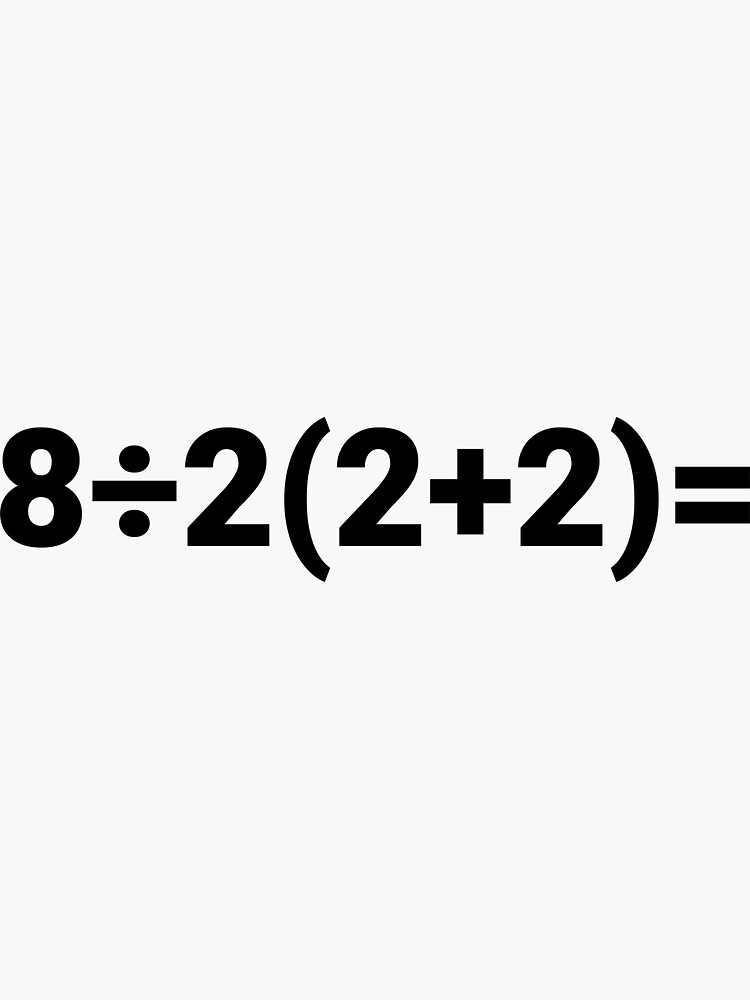
This strict adherence to defined precedence and associativity is what ensures that a program will behave consistently across different machines and environments, which is critical for software reliability and interoperability.
The Role of Compilers and Interpreters
Compilers and interpreters are the unsung heroes that bridge the gap between human-readable code and machine-executable instructions. When you write a program that includes mathematical expressions, it’s the compiler or interpreter’s job to translate that code. During this translation, they rigorously apply the language’s rules of operator precedence and associativity, often building an AST internally, to generate the correct machine code or bytecode.
For interpreted languages (like Python), the interpreter directly executes the parsed instructions. For compiled languages (like C++ or Java), the compiler translates the entire program into an executable file before it runs. In both cases, the logic for evaluating expressions like “8 divided by 2 times 2 plus 2” is hardwired into these foundational tools, ensuring that the computed outcome is always consistent with the language’s specification. Any deviation would be considered a bug in the compiler/interpreter itself, highlighting the high stakes involved in their correct implementation.
Real-World Implications: From Simple Calculators to Complex Systems
The seemingly academic discussion of operator precedence has profound practical implications across the tech landscape. The precision demanded by the “8 divided by 2 times 2 plus 2” problem scales up directly to the design and reliability of all computational systems.
Avoiding Bugs in Financial Software
Consider financial applications, where even a tiny miscalculation can have massive consequences. Imagine a spreadsheet or a banking application that calculates interest, loan payments, or investment returns. If the underlying logic for parsing and evaluating expressions doesn’t strictly adhere to mathematical order of operations, a formula like Principal * (1 + Rate / CompoundingPeriods) ^ (CompoundingPeriods * Time) could yield incorrect results. A small bug in operator precedence could lead to millions in losses, erroneous transactions, or inaccurate financial reporting. The robustness required to correctly solve “8 divided by 2 times 2 plus 2” is exactly the kind of robustness that prevents such catastrophic errors in critical financial technology.
Scientific Computing and Data Analysis Accuracy
In scientific research and data analysis, precision is non-negotiable. Whether simulating climate models, analyzing genetic sequences, or processing vast datasets, scientists rely on computational tools to perform complex calculations accurately. Errors in operator precedence could invalidate entire research findings, lead to faulty drug dosages, or misinterpret critical environmental data. Libraries like NumPy in Python or frameworks used in computational physics and chemistry are meticulously designed to handle mathematical expressions with utmost fidelity to the established rules, reinforcing the importance of correct parsing and evaluation.
The Challenge of AI in Understanding Natural Language Math
The rise of artificial intelligence, particularly large language models (LLMs), presents a new frontier for the “8 divided by 2 times 2 plus 2” type of problem. While traditional programming languages define operator precedence explicitly, training an AI to correctly interpret a mathematical expression stated in natural language – like our title – is significantly more complex.
LLMs are trained on vast amounts of text data, allowing them to understand context and generate human-like responses. However, their probabilistic nature means they might sometimes fall prey to the same ambiguities that humans do when faced with underspecified mathematical phrases. Getting an AI to reliably solve such problems requires not just pattern recognition but also the integration of symbolic reasoning and a deep understanding of mathematical rules. Bridging this gap, teaching AI to translate natural language math into a precise, parsable format, is an active area of research, highlighting that even fundamental arithmetic remains a challenge at the cutting edge of AI development.
Beyond Basic Arithmetic: The Future of Computational Accuracy
The principles highlighted by “8 divided by 2 times 2 plus 2” extend far beyond simple arithmetic. They touch upon the very essence of reliable computing and the continuous pursuit of perfect accuracy in an increasingly complex digital world.
Quantum Computing and Precision
As we venture into advanced computing paradigms like quantum computing, the need for precision and unambiguous instruction becomes even more critical. Quantum algorithms operate on probabilities and complex states, where tiny errors can cascade rapidly. While the mathematical operations in quantum computing are different from classical arithmetic, the underlying demand for a well-defined order of execution and rigorous adherence to logical rules remains paramount. Designing quantum programming languages and compilers that correctly interpret and execute complex quantum operations will draw directly from the lessons learned in ensuring classical computational accuracy.
Formal Verification and Error Prevention
In mission-critical systems, such as those in aerospace, medical devices, or autonomous vehicles, merely “correctly” implementing operator precedence isn’t enough. These systems often employ formal verification – mathematical techniques used to prove the correctness of algorithms and software against a formal specification. This involves using logic and mathematics to demonstrate, with certainty, that a program will behave exactly as intended, including how it evaluates mathematical expressions. The potential for error in a simple problem like “8 divided by 2 times 2 plus 2” underscores why such rigorous verification processes are indispensable for technologies where failure is not an option.
The Human Element in Software Development
Ultimately, while computers are excellent at following rules, those rules are designed and implemented by humans. The initial confusion around “8 divided by 2 times 2 plus 2” among people serves as a valuable reminder for software developers: clarity and explicit definition are vital. When writing code, developers must not only understand operator precedence in their chosen language but also write expressions in a way that is clear and unambiguous to other developers, using parentheses generously even when strictly unnecessary, to enhance readability and prevent potential misinterpretations. This human element, the careful crafting of clear instructions, remains fundamental to building reliable technology.

Conclusion
The seemingly trivial question, “what is 8 divided by 2 times 2 plus 2?” unravels into a deep exploration of the fundamental principles underpinning all digital technology. From the basic rules of arithmetic to the sophisticated parsing algorithms of compilers, the unwavering commitment to a precise, unambiguous order of operations is what grants technology its incredible power and reliability. It is the silent guardian against computational chaos, ensuring that every calculation, every line of code, and every digital process consistently delivers predictable and correct results. As technology continues to evolve, pushing the boundaries of what’s possible, the lessons learned from this simple puzzle—the paramount importance of clarity, precision, and logical consistency—will remain at the very heart of innovation.
aViewFromTheCave is a participant in the Amazon Services LLC Associates Program, an affiliate advertising program designed to provide a means for sites to earn advertising fees by advertising and linking to Amazon.com. Amazon, the Amazon logo, AmazonSupply, and the AmazonSupply logo are trademarks of Amazon.com, Inc. or its affiliates. As an Amazon Associate we earn affiliate commissions from qualifying purchases.