
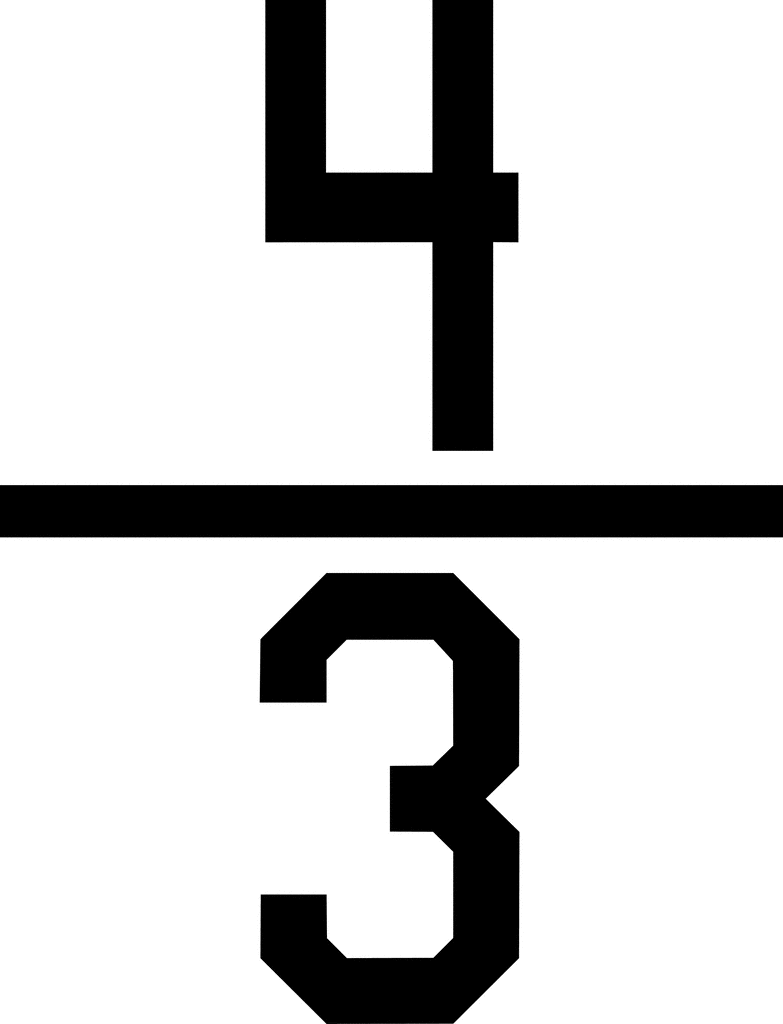
In the realm of mathematics, the fraction 4/3 is a simple improper fraction, equal to approximately 1.333 recurring. However, in the rapidly evolving landscape of technology, “4/3” represents much more than a numerical value. It is a foundational blueprint that has shaped the history of television, the architecture of digital photography, and the modern standard for professional-grade imaging sensors.
When we ask what 4/3 is equal to in a tech context, we are looking at the “Four Thirds” system—a standard that redefined how hardware and software interact to capture the world around us. From the classic “square” televisions of the 20th century to the high-performance Micro Four Thirds (MFT) mirrorless cameras used by today’s top content creators, the 4:3 aspect ratio remains a cornerstone of digital engineering.

Decoding the 4/3 Ratio in Digital Imaging
The 4:3 ratio, often referred to as 1.33:1, was the original standard for motion picture film and, subsequently, television and computer monitors. To understand what this ratio is equal to today, one must look at the mathematical harmony between the height and width of a digital frame.
The Mathematical Foundations of the Four Thirds Standard
Mathematically, a 4:3 aspect ratio means that for every 4 units of width, there are 3 units of height. In the early days of cathode-ray tube (CRT) monitors, this was the most efficient way to manufacture glass displays that could withstand vacuum pressure. In modern technology, specifically in the Four Thirds System developed by Olympus and Panasonic, the term “4/3” also refers to the size of the imaging sensor.
The sensor’s size is roughly 17.3 mm x 13.0 mm. Interestingly, the name “4/3” is derived from the outer diameter of the glass envelope of the video camera tube used in old television cameras, which was 4/3 of an inch. While the actual light-sensitive area is smaller, the tech industry retained the “4/3” nomenclature to signify a specific class of high-performance, compact imaging hardware.
Comparison with Modern Widescreen Formats (16:9)
While the world has largely shifted toward the 16:9 widescreen format for consumption (YouTube, Netflix, and modern TVs), the 4:3 ratio is equal to a “taller” canvas. In technical terms, a 4:3 sensor provides more vertical data. This is crucial for photographers who need the flexibility to crop their images for both portrait (9:16) and landscape (16:9) orientations without losing significant resolution.
For tech enthusiasts, the 4/3 ratio represents the “golden mean” of sensor design. It provides a larger surface area than the sensors found in smartphones (which are often 1/2.3″ or 1″), but remains more portable and thermally efficient than the “Full Frame” (35mm) sensors used in bulky professional DSLRs.
The Micro Four Thirds System: A Tech Revolution
In 2008, the technology sector witnessed a massive shift with the introduction of the Micro Four Thirds (MFT) system. This was the first major step toward the “mirrorless” revolution that dominates the market today. In this context, 4/3 is equal to the democratization of professional-grade video.
Sensor Size vs. Performance: The Engineering Trade-offs
One of the most frequent technical debates is whether a 4/3 sensor can compete with larger sensors. From a software and hardware engineering perspective, the 4/3 sensor is equal to a masterpiece of compromise. Because the sensor is smaller, the lenses required to cover its surface area can also be significantly smaller and lighter.
Technically, a 4/3 sensor has a “crop factor” of 2.0x. This means a 25mm lens on a 4/3 system provides the same field of view as a 50mm lens on a full-frame system. For tech-savvy users, this is an advantage in telephoto photography. You can achieve massive “reach” (zoom) with a lens that is half the size of its competitors. This efficiency in light path and glass manufacturing is what makes the 4/3 standard a favorite for drone technology and compact travel setups.
Why 4/3 Remains the Gold Standard for Professional Videography
While many assume “bigger is better,” in the world of professional video tech, 4/3 is often equal to superior performance. Cameras like the Panasonic Lumix GH series utilize the 4/3 sensor because its smaller size allows for faster data readout.
Faster readout speeds mean less “rolling shutter” (the “jello effect” seen when moving a camera quickly). Furthermore, because the sensor is smaller, it generates less heat during high-bitrate 4K or 6K recording. This allows tech manufacturers to build cameras that can record indefinitely without overheating—a feat that many larger-sensor cameras still struggle to achieve.
Software Optimization and Digital Processing in 4/3 Sensors
Hardware is only half of the story. When we define what 4/3 is equal to, we must also consider the sophisticated software and AI-driven processing that compensates for the physical size of the sensor.
Computational Photography and Sensor Cropping
In modern tech, the 4/3 ratio is often used as a “raw” capture format that software then manipulates. Because 4:3 is more square than 16:9, it allows for sophisticated “Open Gate” recording. This is a technical process where the camera records using the entire sensor area, allowing the editor to decide the final aspect ratio in post-production.
Software algorithms are now capable of “multi-aspect” recording. Some 4/3 sensors are actually “over-sized,” meaning the software can crop into the circle of light provided by the lens at different angles to maintain the same diagonal field of view whether you are shooting in 4:3, 3:2, or 16:9. This is a level of mathematical precision in software engineering that is unique to the Four Thirds ecosystem.
AI-Driven Upscaling for 4:3 Legacy Content
As we move further into the age of Artificial Intelligence, 4/3 is equal to a massive archive of legacy data. Millions of hours of historical footage and classic television exist in 4:3. Modern AI tools, such as Topaz Video AI or Adobe’s neural filters, are specifically designed to handle the “upscaling” of this 1.33:1 content.
These AI tools use deep learning to fill in the gaps of lower-resolution 4:3 footage, sharpening edges and reducing noise. In this scenario, 4/3 serves as the “input variable” for AI models that are trained to recognize the specific pixel patterns of older sensor technology and transform them into modern 4K masterpieces.
The Future of 4/3 in the Age of AI and Ultra-High Definition
Despite the push for larger sensors and wider screens, the 4/3 ratio is not a relic of the past. In fact, it is evolving to meet the needs of a multi-platform digital world.
Beyond Pixels: The Role of Aspect Ratio in AI Training Data
In the development of Generative AI, such as Midjourney or DALL-E, the 4/3 ratio is a critical standard. A significant portion of the training data used for these models consists of images in 4:3 or 3:2 ratios. For engineers building these tools, 4/3 is equal to a balanced data set that prevents “aspect ratio bias.”
When an AI generates an image, it must understand how objects occupy space. The 4:3 ratio provides a neutral verticality that helps the AI learn how to frame subjects without the extreme horizontal stretching found in 21:9 or the extreme verticality of 9:16. It remains a “reference frame” for machine vision.
Adapting 4/3 for Multi-Platform Content Distribution
Today, content is consumed on vertically held smartphones (9:16) and horizontally held tablets or TVs (16:9). What is 4/3 equal to in this environment? It is equal to the “Master Format.”
Tech-forward creators are returning to 4:3 because it is the most efficient “center-point” for multi-destination publishing. An image captured in 4:3 can be cropped into a vertical TikTok video or a horizontal YouTube thumbnail with minimal loss of the subject matter. This versatility is why the 4/3 sensor continues to be a focal point for R&D in the tech industry, particularly for companies focused on the “creator economy.”
Conclusion: The Enduring Logic of 1.33
So, what is 4/3 equal to? Mathematically, it is 1.33. But in the world of technology, it is equal to a legacy of efficiency, a standard for professional video, and a flexible canvas for the future of AI and software-driven imaging.
While consumer trends may lean toward the ultra-wide, the engineering reality is that the Four Thirds standard offers a unique balance between size, speed, and quality. From the silicon of the Micro Four Thirds sensor to the algorithms that upscale classic television, 4/3 remains a vital, breathing part of the technological ecosystem. It proves that sometimes, the most enduring innovations aren’t about being the biggest or the widest—they are about being the most calculated and versatile.
aViewFromTheCave is a participant in the Amazon Services LLC Associates Program, an affiliate advertising program designed to provide a means for sites to earn advertising fees by advertising and linking to Amazon.com. Amazon, the Amazon logo, AmazonSupply, and the AmazonSupply logo are trademarks of Amazon.com, Inc. or its affiliates. As an Amazon Associate we earn affiliate commissions from qualifying purchases.