
In the modern era of high-frequency trading, algorithmic execution, and digital currencies, we are accustomed to seeing financial figures represented in decimals. Whether it is a stock price of $150.37 or an interest rate of 4.25%, the decimal system is the undisputed language of global capital. However, to understand the foundational architecture of the financial world, one must look back at a time when the question “What is 3/8?” was not a math problem for a primary school student, but a critical data point for every trader on Wall Street.

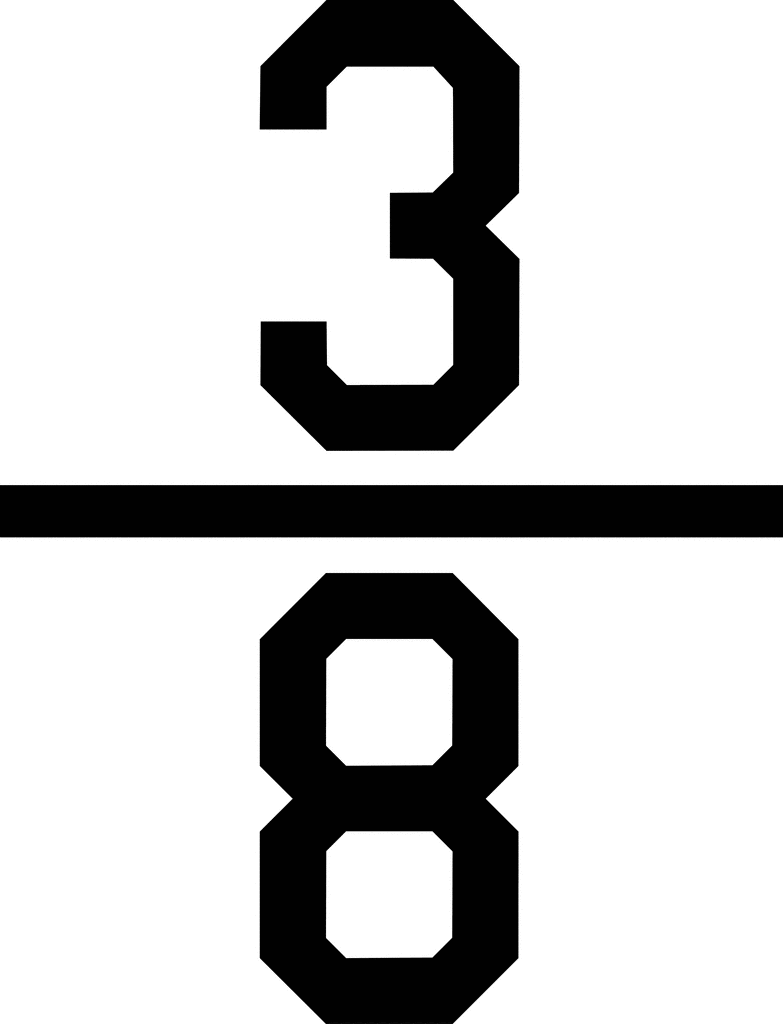
In the context of money and investing, 3/8 represents 0.375, or 37.5 cents when applied to a dollar. While this might seem like a minor increment today, for over two centuries, fractions like 3/8 were the heartbeat of the New York Stock Exchange (NYSE). Understanding the significance of 3/8 provides a window into the history of market liquidity, the evolution of trading costs, and the psychological ways we value assets.
The Historical Significance of 3/8 in Trading
To understand why 3/8 was a standard unit of measure in finance, we must look at the origin of the American financial system. Long before the digital ticker tape, the “language of the street” was dictated by physical coins and historical precedents that dated back to the 1700s.
Why Eighths? The Spanish Dollar Influence
When the NYSE was founded under the Buttonwood Agreement in 1792, the United States did not yet have a robust sovereign currency system. As a result, merchants and traders relied heavily on the Spanish Milled Dollar, also known as a “piece of eight.” This silver coin was physically designed to be chiseled into eight smaller pieces, or “reals,” to make change.
Because the currency was divided into eighths, the stock market adopted the same convention. Each “piece” was worth 12.5 cents. Consequently, stock prices did not move in pennies; they moved in “teenies” (1/16) or “eighths.” Therefore, a stock quote of 3/8 meant three pieces of a Spanish dollar, or 37.5 cents. This fractional system remained the standard for the US stock market until the dawn of the 21st century.
The 12.5-Cent Increment and the “Tick”
In the fractional era, the minimum price variation—known as the “tick size”—was typically 1/8 of a dollar. This meant that if a stock was trading at $20, the next possible price it could move to was $20 1/8 ($20.125), then $20 1/4 ($20.25), and then $20 3/8 ($20.375).
The 3/8 increment was a crucial psychological and mechanical level. It represented a significant enough move to generate profit for “scalpers” and market makers, but it also created a wide “spread” between the buying and selling price. For decades, the 3/8 mark was a common sight on the handwritten boards of brokerage houses, representing a fundamental unit of value that dictated the wealth of the nation’s wealthiest investors.
Decimalization and the Shift to Cents
The transition from fractions to decimals—a process known as decimalization—was one of the most significant structural changes in the history of the financial markets. On April 9, 2001, the US stock markets officially completed the move to quoting all stocks in decimals. The question “What is 3/8?” suddenly shifted from a market necessity to a historical relic.
The Impact on Market Liquidity
The primary driver behind the move from fractions like 3/8 to decimals was the desire to increase market efficiency and liquidity. Under the fractional system, the minimum “spread” (the difference between the bid and the ask price) was often 1/8 of a dollar, or 12.5 cents. This meant that even in a highly liquid stock, investors were effectively paying a “tax” of 12.5 cents per share to the market makers just to enter and exit a position.
By moving to decimals, the minimum spread was reduced to $0.01. This “narrowing of the spread” saved retail investors billions of dollars in execution costs. The 3/8 increment, which once felt small, was revealed to be quite expensive compared to the new one-penny standard.
Narrowing Spreads for Retail Investors
For the average personal finance enthusiast, the end of the 3/8 era was a massive win. Before 2001, if you wanted to buy a stock at $10 1/4 and sell it at $10 3/8, the price had to move significantly just for you to break even after accounting for the spread and commissions. Today, with zero-commission trading and one-cent spreads, the friction of moving money has been nearly eliminated. The “3/8” of yesteryear has been replaced by more precise, granular pricing that reflects the true supply and demand of the digital age.
3/8 in Modern Financial Calculations

While we no longer trade stocks in eighths, the fraction 3/8 (or its decimal equivalent, 0.375) still appears frequently in various niches of the financial world. From interest rate calculations to real estate, this specific ratio remains a standard benchmark.
Interest Rates and Basis Points
In the bond market and the world of corporate finance, interest rates are often expressed in increments that mirror the old fractional logic. It is common to see a loan or a bond yield quoted as “Prime plus 3/8 percent.” In this context, 3/8 of a percentage point is equal to 37.5 basis points (BPS).
Financial institutions use these increments because they provide a balance between precision and simplicity. While 0.01% (1 basis point) is the smallest unit of measurement for rates, 3/8 remains a traditional “stepping stone” in the pricing of debt instruments. When a central bank adjusts rates, or when a bank calculates the “spread” on a mortgage, the 0.375% figure often emerges as a standard margin for risk.
Real Estate and Mortgage Fractions
In the mortgage industry, you will often find interest rates like 6.375%. If you look closely at that number, you’ll realize it is 6 and 3/8 percent. Why does the mortgage industry cling to this? Much of it is legacy software and consumer psychology. For decades, mortgage tables were printed in 1/8 increments.
Even today, when an automated underwriting system calculates a borrower’s risk, the resulting interest rate is often rounded to the nearest 1/8th of a percent to keep it within the standardized “buckets” used by secondary market investors like Fannie Mae and Freddie Mac. In this niche of personal finance, 3/8 is not just a fraction; it’s a standard of reliability.
The Psychology of Fractional Value in Personal Finance
Beyond the technicalities of trading and interest rates, the concept of “3/8” offers an interesting look into behavioral finance. How we perceive fractions versus decimals can significantly impact our spending and saving habits.
Cognitive Biases in Pricing
Research in behavioral economics suggests that humans often perceive fractions and decimals differently, even when they represent the same value. A discount of “3/8 off” might feel more substantial to a consumer than “37.5% off,” despite being identical.
In personal finance, we often fall victim to “round number bias.” We tend to set goals in whole numbers—saving $10,000 or earning $100,000. However, the most successful wealth builders understand the power of the “fractional gain.” Improving your investment returns by just 3/8 of a percent per year can result in tens of thousands of dollars in extra wealth over a 30-year horizon due to the power of compounding.
Using Fractional Thinking for Budgeting
The “3/8 rule” can also be a useful heuristic for personal budgeting. For example, some financial advisors suggest that housing costs should ideally not exceed 3/8 (37.5%) of your gross income—a slightly more generous version of the traditional 30% rule that accounts for the modern cost of living in urban areas. By breaking a budget into eighths, it becomes easier to visualize a “pie chart” of spending, making the management of online income and side hustles more intuitive for the visual thinker.
Investing in the Micro-Scale: The New Fractions
As we have moved away from the 1/8 tick size of the old NYSE, we have entered a new era of “fractionalization” that is redefining how people build wealth. The spirit of 3/8 lives on, but in a much more accessible format.
The Evolution from Eighths to Fractional Shares
In the past, the 3/8 increment was the minimum move. Today, the most revolutionary change in the “Money” niche is the ability to buy fractional shares. If a single share of a high-priced tech stock costs $3,000, a retail investor can now buy 3/8 of that share for $1,125.
This technology has democratized investing. It allows individuals with limited capital to practice “dollar-cost averaging” into expensive assets. We are no longer limited by the “piece of eight” or the whole share; we can own exactly 0.375 of an asset if that is what our budget allows.
The Future of Granular Finance
As we look toward the future of digital assets and blockchain-based finance, the precision of our “fractions” will only increase. Bitcoin, for instance, is divisible to eight decimal places (the Satoshi). While the 3/8 of the 1700s was a physical piece of a silver coin, the 3/8 of the future will be a digital fraction of a decentralized asset.
In conclusion, “What is 3/8?” is a question that bridges the gap between the physical history of money and the digital future of finance. It represents a 12.5-cent piece of history, a standard for modern interest rates, and a symbol of the shift toward more efficient, accessible markets. Whether you are calculating the yield on a bond or buying 3/8 of an Amazon share, this fraction reminds us that in the world of money, every small increment counts toward the goal of long-term financial independence.
aViewFromTheCave is a participant in the Amazon Services LLC Associates Program, an affiliate advertising program designed to provide a means for sites to earn advertising fees by advertising and linking to Amazon.com. Amazon, the Amazon logo, AmazonSupply, and the AmazonSupply logo are trademarks of Amazon.com, Inc. or its affiliates. As an Amazon Associate we earn affiliate commissions from qualifying purchases.