
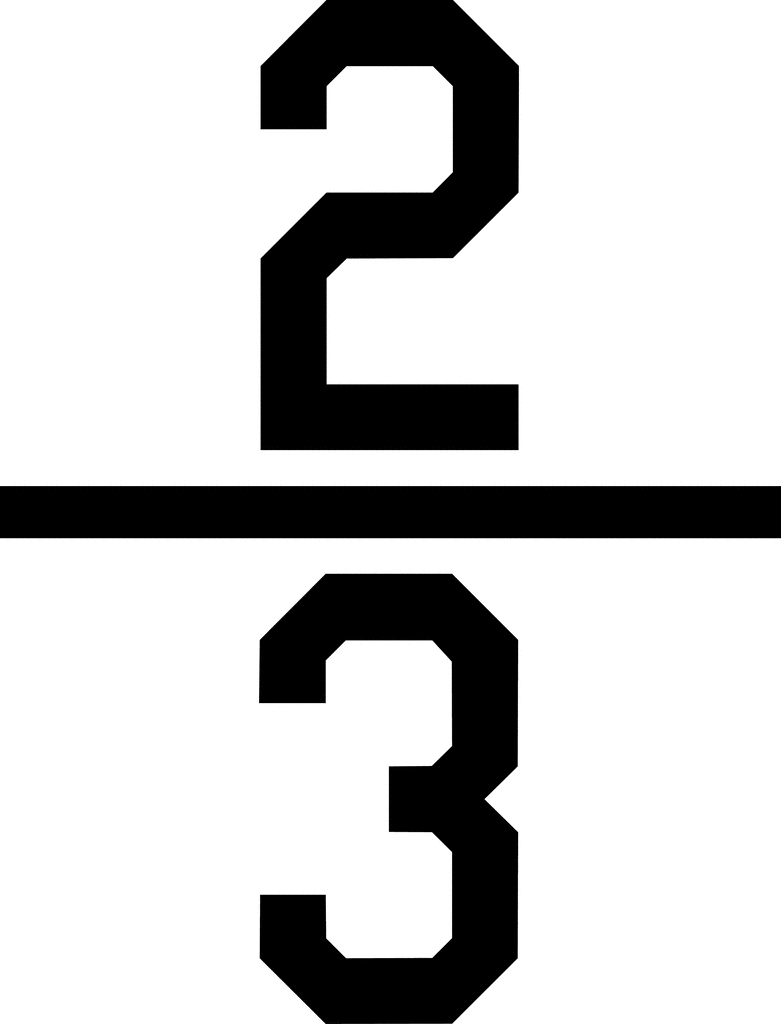
At first glance, the question “what is 2/3 as a fraction?” might seem disarmingly simple, perhaps even trivial, reserved for elementary school classrooms. After all, 2/3 is, by definition, already a fraction. It represents two parts out of a whole divided into three equal parts. In decimal form, it’s approximately 0.666…, and as a percentage, it’s about 66.67%. Yet, dismissing this seemingly basic concept would be a profound oversight, especially when navigating the intricate landscape of personal and business finance. Far from a mere arithmetic exercise, understanding 2/3 – and fractions in general – is a cornerstone of financial literacy, an indispensable tool for making informed decisions about everything from daily budgeting to complex investment strategies.
In a world increasingly driven by data, ratios, and proportions, the ability to intuitively grasp fractional relationships is not just a nice-to-have; it’s a critical skill. Whether you’re dividing profits, calculating investment returns, allocating your budget, or understanding ownership stakes, the principles embodied by “2/3” are constantly at play. This article will delve into why this fundamental fraction is so crucial for financial success, illustrating its pervasive influence across various facets of the Money domain.
The Indispensable Role of Basic Fractions in Personal Finance
Personal finance is, at its heart, about managing resources – primarily money – and allocating them effectively to meet current needs and future goals. This process is inherently fractional. Your income is a whole, and every expense, saving, or investment is a fraction of that whole. Understanding “2/3” provides a tangible framework for thinking about these allocations.
Beyond Simple Arithmetic: Why 2/3 Matters in Your Budget
Consider the practical application of 2/3 in personal budgeting. Many financial experts advocate for various budgeting rules, such as the 50/30/20 rule (50% for needs, 30% for wants, 20% for savings/debt repayment). While these use percentages, percentages are merely fractions with a denominator of 100. If you were advised to dedicate “no more than 2/3 of your income to housing and transportation combined,” this simple fraction immediately gives you a clear threshold.
Understanding 2/3 helps you:
-
Visualize Financial Commitments: If 2/3 of your take-home pay goes to fixed expenses like rent and utilities, you instantly grasp the significant portion of your income that is already spoken for. This visual clarity can be far more impactful than a raw dollar figure alone.
-
Identify Overspending: If your “needs” category consistently exceeds 2/3 of your income, it’s a red flag, prompting you to re-evaluate where your money is going and identify areas for cost reduction.
-
Set Realistic Goals: Knowing that you can only allocate 1/3 of your income to discretionary spending and savings after covering essential 2/3 helps you set achievable financial goals rather than aspirational ones disconnected from your reality.
The intuitive understanding of 2/3 provides a mental shortcut for assessing the proportionality of your financial life. It allows you to quickly evaluate if you’re living within sustainable means or if adjustments are necessary to improve your financial health.
Understanding Proportions: From Income Allocation to Debt Management
The concept of proportionality is paramount in finance. When you think about income allocation, you’re essentially dividing your total earnings into various fractional components. If you have a side hustle and its income represents 2/3 of your primary salary, you’re gaining a powerful perspective on its contribution to your overall financial picture. This isn’t just about the absolute numbers; it’s about the relative importance and impact.
In debt management, fractions play a crucial role in understanding your debt-to-income ratio (DTI) – a key metric lenders use to assess your creditworthiness. While DTI is often expressed as a percentage, its foundational concept is a fraction. If your monthly debt payments amount to 2/3 of your gross monthly income, it signals a potentially unsustainable level of debt, indicating financial strain and limiting your ability to take on new loans or secure favorable interest rates. Recognizing this fractional relationship early can empower you to:
-
Prioritize Debt Repayment: If a significant fraction of your income is consumed by debt, you might prioritize accelerating repayment to free up future cash flow.
-
Negotiate Terms: A clear understanding of how fractions impact your financial standing can help you negotiate better terms with creditors or seek credit counseling.
-
Plan for Future Borrowing: By keeping an eye on your debt burden as a fraction of your income, you can strategically plan future borrowing decisions, ensuring you don’t overextend yourself.
The ability to translate complex financial realities into simple fractional terms provides clarity and actionable insights, moving you beyond simply knowing what your numbers are to understanding what they mean for your financial stability and growth.
Investing and Wealth Building: Fractions as Your Strategic Compass
When it comes to building wealth through investing, fractions move from being simple illustrative tools to fundamental components of strategic decision-making. Investors constantly deal with fractions – whether it’s the proportion of their portfolio allocated to different asset classes, the percentage ownership in a company, or the fraction of a gain or loss on an investment.
Deciphering Investment Portfolios: Asset Allocation and Risk
Asset allocation is arguably the most critical decision an investor makes. It involves dividing your investment capital among different asset classes like stocks, bonds, real estate, and commodities. This division is inherently fractional, and the concept of “2/3” can illustrate various portfolio strategies:
-
Conservative vs. Aggressive Portfolios: A conservative investor might allocate 2/3 of their portfolio to lower-risk assets like bonds and 1/3 to stocks, while a more aggressive investor might reverse this, putting 2/3 in stocks and 1/3 in bonds. Understanding these fractional relationships helps investors match their portfolio to their risk tolerance and financial goals.
-
Diversification: Diversifying across different asset classes reduces risk. If an investor holds 2/3 of their wealth in a single company stock, they are significantly less diversified than someone whose portfolio is spread across many different companies, sectors, and asset types. The numerical value of 2/3 in this context highlights a concentration risk.
-
Rebalancing: Over time, market movements can shift your asset allocation away from your target. If your stocks suddenly grow to represent 2/3 of your portfolio, and your target was 50%, you might decide to sell a fraction of your stocks to buy more bonds, bringing your portfolio back into balance.
Without a solid grasp of fractions, making informed asset allocation decisions becomes challenging, potentially leading to suboptimal returns or excessive risk exposure.
Analyzing Business Stakes and Profit Sharing: The Power of Proportionality

In the business world, fractions are the bedrock of ownership, partnership agreements, and profit distribution. When an individual owns a “2/3 stake” in a company, it means they possess a significant majority control, holding two out of every three shares. This fractional understanding is crucial for:
-
Evaluating Control and Influence: A 2/3 ownership stake typically grants substantial control over major business decisions, often allowing the owner to pass special resolutions without unanimous consent.
-
Calculating Profit Distribution: If a business generates a certain profit, and a partner is entitled to 2/3 of those profits, the calculation is straightforward but fundamentally fractional. Misunderstanding this simple concept could lead to disputes or miscalculations in earnings.
-
Understanding Equity Dilution: When a company issues new shares, existing shareholders’ ownership becomes a smaller fraction of the total. Grasping this dilution effect requires a strong fractional understanding. If you owned 2/3 of a company, and new shares are issued that reduce your stake to 1/2, understanding the impact of that fractional change is vital for assessing your continued influence and potential future earnings.
From startups seeking seed funding to established corporations with complex shareholder structures, the concept of fractions like 2/3 defines relationships, responsibilities, and financial outcomes.
Financial Tools and Their Fractional Underpinnings
Modern financial tools, from sophisticated investment platforms to user-friendly budgeting apps, often present data in intuitive graphical formats, but their underlying calculations and logic are deeply rooted in fractional mathematics.
Budgeting Software and the Slice of Your Pie
Budgeting applications frequently use pie charts or similar visual representations to show how your income is divided among different spending categories. Each “slice” of the pie is a fraction of your total income. When an app indicates that “2/3 of your discretionary spending budget has been used,” it’s directly leveraging the fractional concept of 2/3 to provide a clear, immediate understanding of your spending status. These tools don’t just tell you the numbers; they help you visualize the fractions, making financial management more intuitive.
-
Real-time Feedback: Seeing your budget graphically updated as a fraction (e.g., 2/3 spent) provides immediate feedback on your progress and helps prevent overspending.
-
Goal Tracking: If your goal is to save 1/3 of your income, these tools can track your progress towards that fractional target.
-
Financial Planning: They allow you to model different scenarios, such as how increasing your savings fraction from 1/10 to 1/5 might impact your long-term goals.
The simplicity of “2/3” resonates deeply within these tools, making complex financial data accessible and actionable for everyday users.
Loan Interest, Returns, and the Compound Effect: A Fractional Perspective
Understanding interest rates, loan payments, and investment returns also benefits significantly from a fractional perspective. An interest rate is essentially a fraction (or percentage) of the principal amount charged for borrowing money or earned on an investment.
-
Loan Payments: A significant portion (a fraction) of your early mortgage payments might go towards interest, with only a smaller fraction reducing the principal. Understanding this fractional breakdown helps borrowers make informed decisions about extra payments or refinancing.
-
Investment Returns: A “return on investment” (ROI) is calculated as a fraction of the initial investment. If you earned $200 on a $300 investment, your return is 200/300, or 2/3. This tells you that for every dollar you invested, you got 66 cents back as profit. While typically expressed as a percentage (66.67%), the fractional root provides the clearest conceptual link.
-
Compound Interest: The magic of compound interest, where your earnings start earning interest themselves, relies on applying a fraction (the interest rate) repeatedly to an ever-growing principal. Grasping this exponential growth in fractional terms helps underscore its power in wealth accumulation over time.
These financial mechanisms, which can seem daunting, become more transparent and manageable when viewed through the lens of basic fractional relationships.
Cultivating Financial Literacy: From Basic Concepts to Strategic Decisions
Ultimately, the journey to robust financial literacy begins with mastering fundamental concepts. The seemingly simple question, “what is 2/3 as a fraction?” is a gateway to a deeper, more nuanced understanding of personal and business finance.
Empowering Yourself Through Fractional Understanding
A strong grasp of fractions empowers individuals to take control of their financial narratives. It moves you beyond passively accepting financial statements or advice to actively questioning, analyzing, and strategizing. When you can intuitively interpret that “2/3 of the company’s revenue comes from subscriptions” or “I’ve allocated 2/3 of my bonus to investments,” you are not just reciting numbers; you are demonstrating a profound understanding of proportionality and impact. This clarity builds confidence and reduces financial anxiety.
-
Critical Evaluation: It enables you to critically evaluate financial products, news, and advice, identifying potential exaggerations or misrepresentations when percentages or ratios are presented.
-
Informed Decision-Making: Whether it’s choosing a loan, diversifying an investment, or planning a budget, an understanding of fractions allows for more informed and strategic choices.
Bridging the Gap: From “What is 2/3” to “What is a 2/3 Return?”
The evolution from understanding “2/3 as a fraction” to comprehending “a 2/3 return on investment” or “a 2/3 ownership stake” is not just about vocabulary; it’s about applying a foundational mathematical principle to real-world financial scenarios. This bridge is where financial literacy truly blossoms. It transforms abstract numbers into tangible insights, enabling individuals to:
-
Negotiate Effectively: When discussing business deals or compensation, a clear understanding of fractional splits strengthens your negotiating position.
-
Plan for Retirement: Visualizing your retirement savings as a fraction of your long-term goal makes the journey more manageable and motivates consistent contributions.
-
Analyze Market Trends: Understanding how market shares or economic indicators are represented as fractions (or percentages derived from them) is key to interpreting broader economic trends.
In essence, mastering fractions is about mastering the language of money.

Conclusion
So, “what is 2/3 as a fraction?” It is, fundamentally, two parts out of three. But in the realm of money, it is far more. It is a critical building block for budgeting, an essential component for investment strategy, a vital metric for business analysis, and an empowering tool for personal financial management. The simple concept of 2/3 underpins much of the complexity in finance, offering clarity and insight where numbers alone might only cause confusion. By embracing and understanding these basic fractional relationships, individuals can unlock a deeper level of financial acumen, making smarter decisions, building greater wealth, and ultimately achieving their financial aspirations with confidence and control. The journey to financial mastery, surprisingly, often starts with understanding the smallest, most fundamental pieces of the puzzle.
aViewFromTheCave is a participant in the Amazon Services LLC Associates Program, an affiliate advertising program designed to provide a means for sites to earn advertising fees by advertising and linking to Amazon.com. Amazon, the Amazon logo, AmazonSupply, and the AmazonSupply logo are trademarks of Amazon.com, Inc. or its affiliates. As an Amazon Associate we earn affiliate commissions from qualifying purchases.