
In the world of personal finance, corporate accounting, and high-stakes investing, precision is the bedrock of success. While many people view the conversion of a fraction like 1/6 into a decimal as a simple elementary school exercise, the mathematical reality of this specific number—0.1666…—carries significant weight in the financial sector. Whether you are calculating the interest on a short-term loan, determining equity distribution in a startup, or analyzing the yield on a bond, understanding how to handle recurring decimals is essential.
This article explores the conversion of 1/6 to its decimal form and dives deep into how this value influences financial modeling, investment strategies, and the psychology of money.

The Mathematical Foundation: Converting 1/6 into a Decimal
Before we can apply this number to a financial context, we must understand its inherent structure. A fraction is simply a representation of division. In this case, 1/6 means “one divided by six.”
The Long Division Process
To convert 1/6 to a decimal manually, we perform long division. Since 6 cannot go into 1, we add a decimal point and a zero, making it 10.
- 6 goes into 10 once, leaving a remainder of 4.
- We add another zero, making it 40. 6 goes into 40 six times (6 x 6 = 36), leaving a remainder of 4.
- We add another zero, making it 40 again. Once more, 6 goes into 40 six times.
This pattern continues indefinitely. In mathematical terms, this is known as a “non-terminating, recurring decimal.”
Understanding the Recurring Decimal (0.1666…)
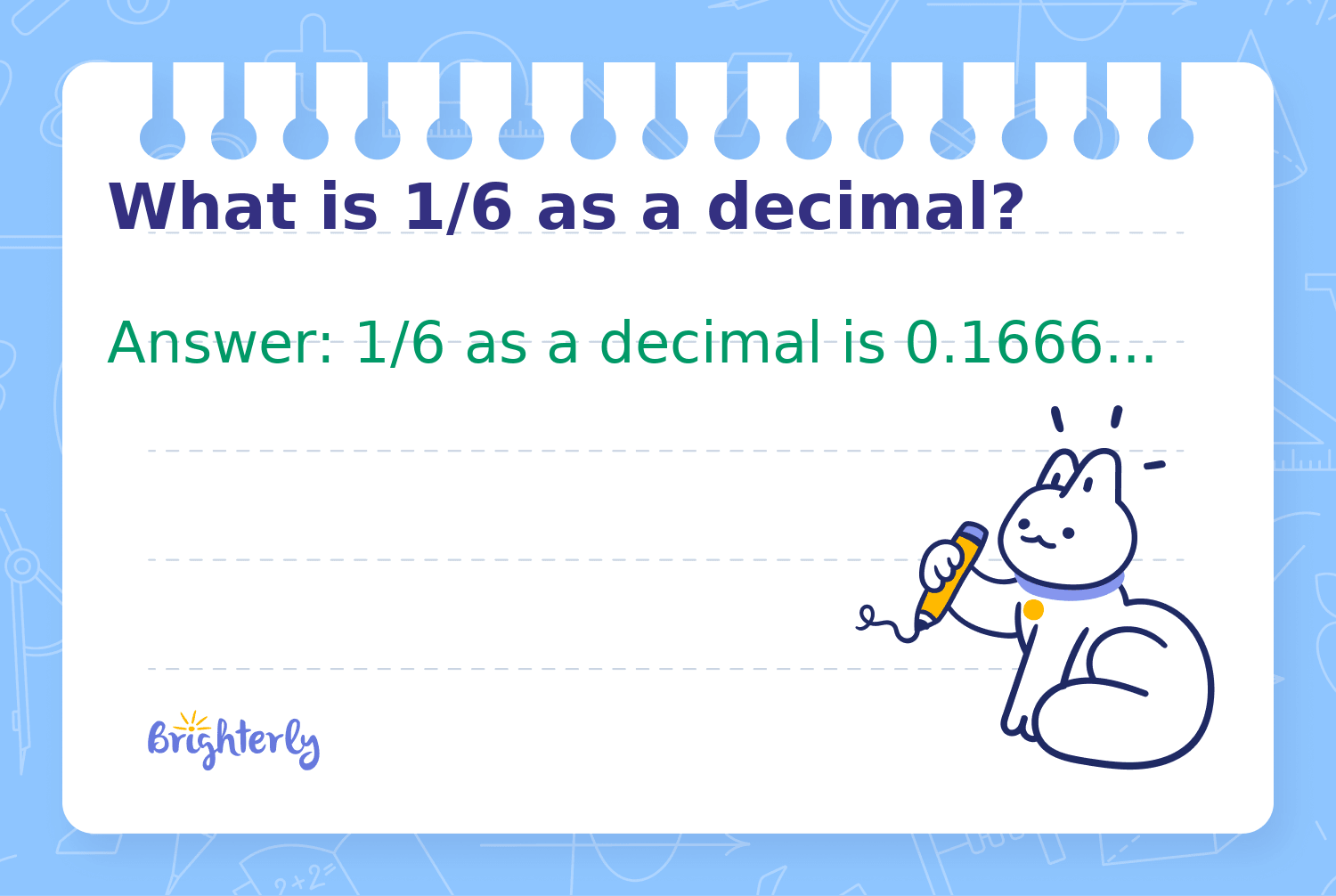
The result of 1/6 is 0.166666…, often written with a bar over the 6 (0.16bar{6}) to indicate that the digit repeats forever. In the context of “Money,” this poses an immediate challenge: currency only exists in two decimal places (cents). If you are dividing $1.00 among six stakeholders, you cannot give each person exactly 16.666… cents. You must choose between rounding down to $0.16 or rounding up to $0.17. While a fraction of a cent seems negligible, in the world of high-frequency trading or massive corporate payrolls, these discrepancies can result in thousands of dollars in “leakage.”
Why Rounding Matters in Financial Reporting
In professional accounting, rounding is governed by specific standards, such as the Generally Accepted Accounting Principles (GAAP). When 1/6 is converted for financial reports, it is typically rounded to 0.1667 or 0.167 depending on the required level of precision. Understanding the difference between 16.6% and 16.67% is vital for analysts; the latter is a more accurate representation of 1/6 and reduces the margin of error in long-term projections.
1/6 in Personal Finance: Budgeting and Debt Management
In personal finance, we often deal with “rules of thumb” that rely on fractional breakdowns of income. Understanding 1/6 as approximately 16.67% allows individuals to create more granular and effective financial plans.
The “Sixth” Rule for Savings and Tax Withholding
Many financial advisors suggest the 50/30/20 rule for budgeting, but for those in specific tax brackets or those pursuing aggressive early retirement, the “one-sixth” rule is a powerful tool. Allocating 1/6 of your gross income (roughly 16.67%) to a specific goal—such as a 401(k) contribution or an emergency fund—is a common benchmark.
For freelancers and independent contractors, setting aside 1/6 of every check for estimated taxes is a strategic move. While the actual tax rate may vary, 16.67% provides a safe baseline that accounts for various deductions while ensuring a significant portion of the liability is covered.
Debt-to-Income Ratios and Fraction Analysis
Lenders use debt-to-income (DTI) ratios to determine your creditworthiness. If your monthly debt obligations (car payments, student loans, credit cards) consume 1/6 of your monthly income, your DTI is 16.67%. In the eyes of a mortgage lender, a 16.67% DTI is considered excellent. By converting the fraction 1/6 into this percentage, a borrower can better understand how they appear to institutional lenders and whether they have the “room” to take on a mortgage.
Allocating Portfolio Diversity
Modern Portfolio Theory suggests that diversification is the only “free lunch” in finance. An investor might choose to split their portfolio into six equal “buckets”: Large-cap stocks, small-cap stocks, international equities, bonds, real estate, and commodities. In this scenario, each asset class represents 1/6 (16.67%) of the total capital. Monitoring the “drift” of these decimals is key to rebalancing. If the international equity bucket grows to 0.20 (20%), the investor knows they must sell off the excess to return to their 1/6 baseline.
Fractional Equity and Venture Capital
The conversion of 1/6 to 0.1667 becomes incredibly high-stakes when discussing corporate ownership and equity distribution. In the world of startups and venture capital, “points” of equity represent millions of dollars in potential future value.
Calculating Share Dilution
Imagine a startup with three founders who each own 1/3 of the company. If they bring on a silent partner or a lead engineer and offer them a 1/6 stake in the company, the original founders’ shares are diluted. Understanding that 1/6 equals 16.67% helps the founders visualize exactly how much of the “pie” they are giving away. In cap table management, these decimals are tracked to the eighth or ninth decimal place to ensure that every share is accounted for during an exit or IPO.
What a 16.67% Stake Means for Control
In corporate governance, owning 1/6 of the voting shares can be a strategic position. While it is not a majority (51%) or even a blocking minority (usually 25% or 33%), a 16.67% stake is often enough to secure a seat on the Board of Directors in many jurisdictions. For an activist investor, holding 1/6 of a company’s decimalized equity provides significant leverage to influence company policy, executive compensation, and merger decisions.
Valuation Multiples and Fractional Earnings
Analysts often look at the “Earnings Yield,” which is the reciprocal of the P/E ratio. If a stock has a P/E ratio of 6, its earnings yield is 1/6, or 0.1667. This tells the investor that for every dollar invested, the company is generating 16.67 cents in profit. Comparing this decimal across different companies allows investors to find “value” plays where the yield is higher than the market average.
Interest Rates and the Time Value of Money
The number 1/6 appears frequently in interest calculations, particularly when dealing with “broken periods” or bi-monthly compounding.
Monthly vs. Periodic Interest (1/6th of a Year)
Financial instruments often calculate interest based on parts of a year. A two-month period represents 1/6 of a year. If an investment offers a 12% annual return, the simple interest for two months would be calculated as 12% multiplied by 0.1666… (1/6). This results in a 2% return for that period. Errors in these calculations usually occur when people round 1/6 down to 0.16 or 0.166 too early in the process, leading to “under-crediting” the investor’s account.
The Impact of 0.16% Yield Differences
In the world of fixed income and bonds, a difference of 0.16% (often referred to as 16 basis points) is substantial. If a central bank raises interest rates by 1/6 of a percentage point—though they usually move in increments of 0.25—the ripple effect through the bond market would be massive. Professional traders use the decimal 0.1667 to price swaps and derivatives where even the fourth decimal place affects the “spread” or the profit margin of the trade.
Amortization Schedules and Recurring Precision
When you pay off a loan, the amortization schedule breaks down every penny of interest and principal. Because interest is often calculated monthly (1/12), but some fees are calculated bi-monthly (1/6), the recurring decimal 0.1666… must be handled carefully by banking software. If the software rounds incorrectly at each step of a 30-year mortgage, the final balance could be off by hundreds of dollars. This is why financial institutions use high-precision floating-point arithmetic to ensure that 1/6 remains as accurate as possible throughout the life of the loan.
Tools for High-Precision Financial Calculations
To manage the complexities of recurring decimals like 0.1666…, financial professionals rely on specific tools and methodologies.
Using Excel for Recurring Decimals
In Microsoft Excel or Google Sheets, entering “=1/6” will provide the decimal equivalent. However, the software stores the value far more precisely than it displays it. A common mistake in financial modeling is “Hard-Coding” a rounded number (like 0.167) into a cell instead of using the formula (=1/6). Hard-coding stops the recurring chain and can lead to “rounding errors” that compound over thousands of rows of data.
Financial Calculators vs. Manual Conversion
While a standard calculator might truncate 1/6 to 0.1666667, dedicated financial calculators (like the HP 12C or TI BA II Plus) allow users to set the number of decimal places. For bond traders, setting the display to 4 or 6 decimal places is standard practice to ensure that the 1/6 conversion is represented with the necessary depth for accurate pricing.
Avoiding Costly Errors in Spreadsheet Modeling
To maintain financial integrity, analysts often use the “ROUND” function in spreadsheets to force a consistent decimal length (e.g., =ROUND(1/6, 4)). This ensures that every part of the financial model is using 0.1667, preventing the “penny differences” that can stall an audit or a corporate merger.
In conclusion, while “what is 1/6 as a decimal” is a mathematical question with a simple answer—0.1666…—its application in the world of Money is anything but simple. From the way we budget our monthly paychecks to the way venture capitalists divide the ownership of the next unicorn startup, this repeating decimal is a constant presence. Mastery of this number, and the precision required to handle it, is a hallmark of financial literacy and professional competence.
aViewFromTheCave is a participant in the Amazon Services LLC Associates Program, an affiliate advertising program designed to provide a means for sites to earn advertising fees by advertising and linking to Amazon.com. Amazon, the Amazon logo, AmazonSupply, and the AmazonSupply logo are trademarks of Amazon.com, Inc. or its affiliates. As an Amazon Associate we earn affiliate commissions from qualifying purchases.