
The economic relationship between the United States and Canada is one of the most sophisticated and deeply integrated partnerships in the global financial landscape. As of 2024, the two nations exchange nearly $2.6 billion worth of goods and services every single day. For investors, business leaders, and financial analysts, understanding exactly what the United States imports from its northern neighbor is not merely an exercise in trade statistics; it is a vital component of understanding North American supply chain finance, commodity pricing, and cross-border investment strategies.
The United States relies on Canada for a diverse array of essential goods, ranging from energy and raw materials to highly complex machinery and automotive components. This trade relationship is governed by the United States-Mexico-Canada Agreement (USMCA), which provides the legal and financial framework for this massive flow of capital. This article explores the primary sectors of Canadian imports and their profound impact on the American economy and the financial markets.
The Energy Powerhouse: Fuelling the American Economy
The most significant portion of U.S. imports from Canada lies within the energy sector. Canada is the largest foreign supplier of energy to the United States, providing a sense of North American energy security that reduces reliance on more volatile regions. From a financial perspective, the energy trade represents a massive transfer of capital and a cornerstone of the Western Canadian economy.
Crude Oil and Natural Gas Financial Dynamics
Canada provides more than half of all U.S. crude oil imports. This is primarily sourced from the oil sands of Alberta and delivered via an extensive network of pipelines like the Enbridge Mainline and TC Energy systems. For investors, this creates a unique relationship between the Western Canadian Select (WCS) crude price and the West Texas Intermediate (WTI) benchmark. The “differential” or the price gap between these two benchmarks is a critical indicator for energy sector analysts and those trading in energy futures.
Furthermore, Canada is a primary supplier of natural gas to the United States. While the U.S. has increased its own production via shale, Canadian natural gas remains essential for heating and industrial use in the Northeast and Midwest. This creates a highly integrated market where price fluctuations in one country immediately impact utility costs and industrial margins in the other.
Electricity and Renewable Integration
Beyond fossil fuels, the U.S. imports significant amounts of hydroelectricity from provinces like Quebec, Ontario, and Manitoba. This trade is facilitated by massive cross-border transmission lines. As the U.S. pivots toward a greener economy, the financial value of Canadian “clean energy” imports is expected to rise. Large-scale power purchase agreements (PPAs) between Canadian utilities (such as Hydro-Québec) and American states (like Massachusetts and New York) represent multi-billion-dollar long-term financial commitments that stabilize regional energy prices and provide steady returns for institutional investors.
Integrated Manufacturing: The Automotive and Machinery Corridor
One of the most remarkable features of the U.S.-Canada trade relationship is the “circular” nature of manufacturing. It is often said that a single car part may cross the border half a dozen times before the final vehicle is sold to a consumer. This integration means that U.S. imports from Canada in the manufacturing sector are often components of a larger, continental value chain.
The Automotive Supply Chain and Capital Flow
The automotive industry is the bedrock of manufacturing trade between the two nations. The U.S. imports finished vehicles from Canadian assembly plants (such as those operated by Ford, GM, and Stellantis in Ontario) as well as a vast array of parts and assemblies.
From a business finance perspective, this sector relies heavily on “Just-in-Time” (JIT) inventory management and sophisticated supply chain financing. Disruptions at the border—whether due to policy changes or logistics hurdles—can lead to millions of dollars in lost productivity within hours. For equity investors, the health of the Canadian automotive sector is a direct bellwether for the performance of the “Big Three” American automakers and Tier 1 suppliers like Magna International.
Industrial Machinery and Aerospace
Canada is a leading exporter of specialized machinery and aerospace components to the United States. The Montreal aerospace cluster, home to companies like Bombardier and various subcontractors for Boeing and Airbus, provides high-value components that are integral to American aviation. Financial analysts monitor these imports as they reflect the health of the broader industrial sector. When U.S. companies increase their imports of Canadian industrial machinery, it is often a leading indicator of capital expenditure (CapEx) growth within the U.S. domestic economy.
Raw Materials and the Building Blocks of Infrastructure
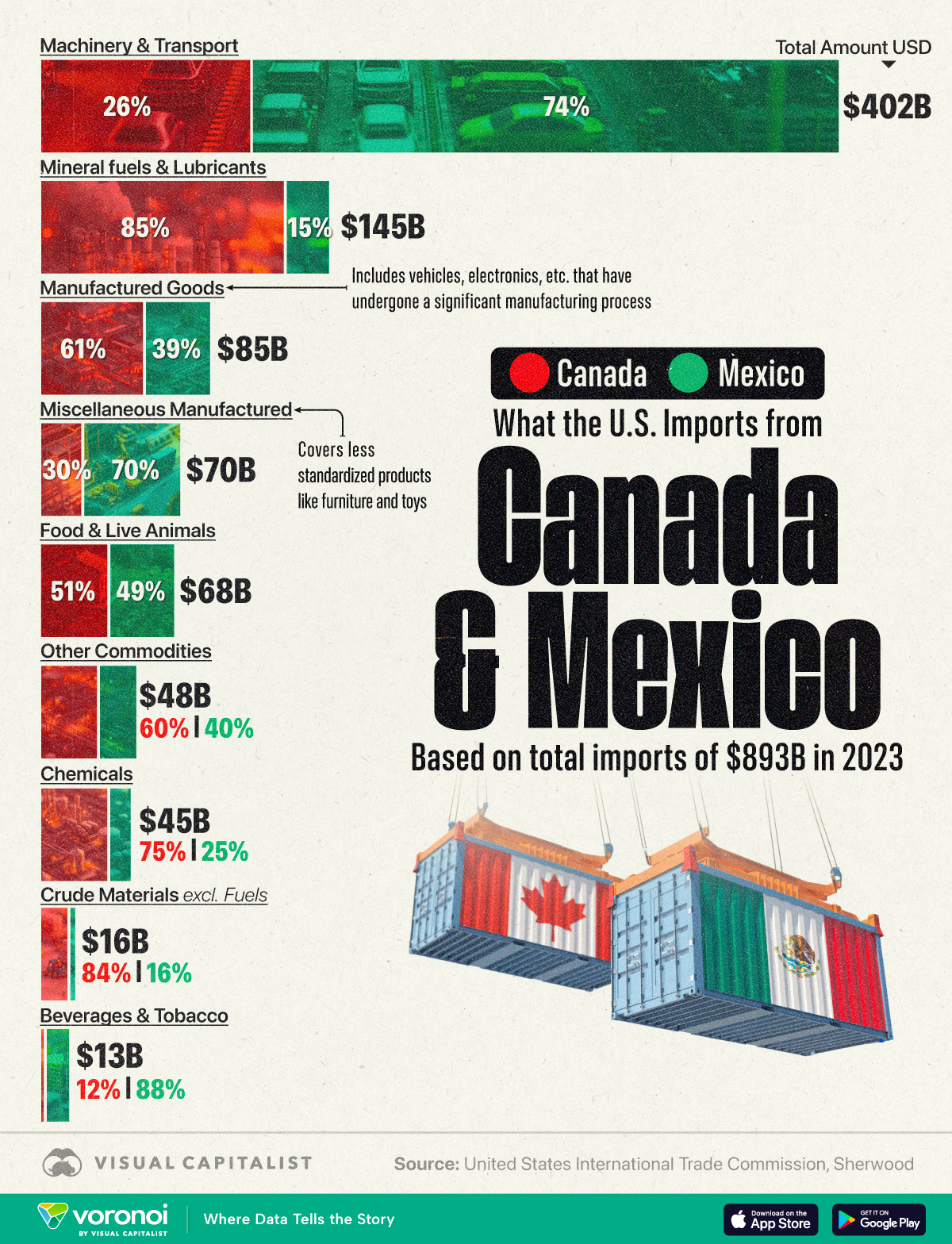
Canada’s vast geography provides the U.S. with a steady stream of raw materials essential for construction, technology, and manufacturing. These commodities are the lifeblood of the physical economy and have a direct impact on inflation and housing costs in the United States.
Softwood Lumber and the Housing Market
Perhaps no import is more frequently debated in the financial news than Canadian softwood lumber. Canada provides approximately 25% to 30% of the lumber used in U.S. home construction. For personal finance and real estate investors, the duties and trade disputes surrounding Canadian lumber are critical because they directly correlate with the cost of building a new home. When tariffs increase on Canadian lumber, the “all-in” cost of residential development in the U.S. rises, impacting mortgage affordability and the profitability of American homebuilders like D.R. Horton or Lennar.
Critical Minerals and the Tech Economy
As the global economy shifts toward electrification and advanced electronics, the U.S. has identified several “critical minerals” essential for national security and economic growth. Canada is a primary source for many of these, including nickel, lithium, cobalt, and graphite—all essential for electric vehicle (EV) batteries.
The financial implications here are twofold. First, there is a surge in venture capital and private equity moving into Canadian mining operations. Second, the U.S. government has begun providing financial incentives and grants to Canadian mining firms to ensure a secure supply chain that bypasses overseas competitors. For the savvy investor, the Canadian mining sector (often listed on the TSX or TSX-V) offers a high-growth opportunity linked directly to U.S. technological demand.
Navigating the Financial Realities of Cross-Border Trade
For businesses and investors operating within this trade corridor, the “what” of imports is only half the story. The “how”—specifically the financial mechanisms used to facilitate this trade—is equally important.
Currency Exchange and the “Loonie”
The value of the Canadian Dollar (the Loonie) relative to the U.S. Dollar is the most significant variable in cross-border trade. A weaker Canadian dollar makes Canadian exports cheaper for American buyers, which can boost the volume of imports but may squeeze the profit margins of U.S. domestic competitors.
Financial managers at cross-border firms spend significant resources on currency hedging strategies. Using forwards, options, and swaps, these businesses attempt to mitigate the risk of currency volatility. For an American investor holding Canadian stocks, the “total return” of the investment is always a combination of the asset’s performance and the movement of the USD/CAD exchange rate.
Tax Treaties and Investment Structures
The financial integration of the two countries is bolstered by a robust tax treaty designed to prevent double taxation. This allows for the efficient flow of dividends and interest across the border. Many American investors utilize Canadian Real Estate Investment Trusts (REITs) or high-yield energy stocks (often referred to as “Income Trusts” in the past) to diversify their portfolios.
Furthermore, the U.S. and Canada share a highly synchronized banking system. Large Canadian banks, such as TD Bank and RBC, have massive footprints in the United States, acting as the financial conduits for the trade described above. Their ability to provide cross-border commercial lending and liquidity is what allows the $2.6 billion daily trade volume to function smoothly.
The Future of the USMCA and Economic Forecasting
As we look toward the future, the periodic review of the USMCA will be a pivotal moment for North American finance. Trade policies regarding “rules of origin” and labor standards will dictate the cost structures of imports for the next decade. Analysts expect that the “near-shoring” trend—where U.S. companies move manufacturing away from Asia and back to North America—will continue to drive growth in Canadian imports. This shift represents a structural change in global capital flows, positioning Canada not just as a neighbor, but as a strategic financial partner in a more localized global economy.
In conclusion, the United States imports far more than just goods from Canada; it imports economic stability, energy security, and industrial efficiency. From the crude oil powering American transport to the lumber building American homes and the minerals fueling the next tech revolution, the financial ties between these two nations are unbreakable. For anyone focused on money, investing, or business finance, keeping a close eye on the northern border is not just a choice—it is a financial necessity.
aViewFromTheCave is a participant in the Amazon Services LLC Associates Program, an affiliate advertising program designed to provide a means for sites to earn advertising fees by advertising and linking to Amazon.com. Amazon, the Amazon logo, AmazonSupply, and the AmazonSupply logo are trademarks of Amazon.com, Inc. or its affiliates. As an Amazon Associate we earn affiliate commissions from qualifying purchases.