
The world of digital communication has undergone a profound transformation, moving from simple, text-only messages to rich, interactive multimedia experiences. At the heart of this evolution lies Rich Communication Services (RCS), a technology poised to redefine the standard “text message” as we know it. To understand RCS, it’s crucial to trace the journey of mobile messaging and recognize the technological gap it aims to fill.
The Evolution of Text Messaging
For decades, the humble text message, powered by SMS (Short Message Service), has been the bedrock of mobile communication. Its simplicity and universality made it indispensable, yet its limitations became increasingly apparent with the rise of smartphones and ubiquitous internet access.

From SMS to MMS: A Brief History
SMS, introduced in the early 1990s, was revolutionary. It allowed users to send short, 160-character messages between mobile phones, creating an entirely new dimension of communication. Despite its character limits and plain text nature, SMS quickly became a global phenomenon, fostering a generation of quick, concise digital exchanges. Its underlying technology, based on signaling channels within the cellular network, ensured broad compatibility across diverse devices and carriers.
As mobile technology advanced, the need for richer content became evident. MMS (Multimedia Messaging Service) emerged as the successor, enabling users to send images, audio clips, and longer text messages. While MMS expanded the capabilities of cellular messaging, it often suffered from high costs, compression issues, and inconsistent delivery across different networks and devices. The user experience remained clunky compared to the burgeoning internet-based alternatives.
The Smartphone Revolution and OTT Apps
The advent of smartphones and widespread mobile internet connectivity fundamentally shifted the messaging paradigm. Apple’s iMessage, launched in 2011, demonstrated the potential of an integrated, internet-powered messaging platform, offering features like read receipts, typing indicators, high-quality media sharing, and group chats – all seamlessly presented within the standard messaging app. It blurred the lines between traditional SMS and IP-based messaging, providing a superior user experience when communicating between Apple devices.
Concurrently, over-the-top (OTT) messaging apps like WhatsApp, Telegram, Signal, and Facebook Messenger rapidly gained prominence. These apps bypassed traditional carrier networks for messaging, leveraging internet data to offer a wealth of advanced features: end-to-end encryption, large file transfers, voice and video calls, sticker packs, and sophisticated group chat functionalities. Their cross-platform compatibility and feature richness quickly attracted billions of users, leaving traditional SMS/MMS feeling archaic and feature-poor, especially for Android users who lacked a unified, native “iMessage equivalent.” This fragmentation led to an inconsistent messaging experience, often forcing users to switch between multiple apps depending on who they were communicating with.
Understanding RCS: Rich Communication Services
RCS is the telecommunication industry’s answer to this challenge – an attempt to modernize and standardize mobile messaging to compete with the feature sets of popular OTT apps and iMessage. It represents a significant technological upgrade over SMS and MMS, aiming to bring an enhanced, app-like experience directly to the native messaging app on Android phones.
Beyond Basic Text: Key Features of RCS
RCS isn’t just an incremental update; it’s a paradigm shift in what a “text message” can be. When a message is sent via RCS, it leverages an internet data connection (Wi-Fi or mobile data), much like an OTT app, rather than the cellular signaling channels used by SMS. This enables a suite of rich features:
- High-Quality Photo and Video Sharing: Unlike MMS, RCS allows users to send media files without significant compression, preserving quality and offering larger file size limits.
- Read Receipts and Typing Indicators: Users can see when their messages have been read and when others are typing a response, fostering more dynamic and natural conversations.
- Larger Group Chats: RCS supports more robust group messaging, similar to social media platforms, with advanced management features.
- Enhanced Security (with limitations): While not universally end-to-end encrypted by default across all implementations, RCS provides a more secure and reliable platform than SMS, especially when delivered via Google Messages’ default encryption.
- Voice Messaging: The ability to send integrated voice notes.
- Location Sharing: Conveniently share your location within a conversation.
- Rich Business Messaging: A crucial aspect of RCS is its capability for businesses to interact with customers in powerful new ways, including sending boarding passes, appointment confirmations, product carousels, and engaging in chatbot conversations directly within the messaging app. This transforms customer service and transactional communication.
- Wi-Fi Messaging: Like iMessage, RCS messages can be sent over Wi-Fi, offering reliability even in areas with poor cellular signal, provided an internet connection is available.
How RCS Works: The Underlying Technology
At its core, RCS is a set of communication protocols defined by the GSMA (Global System for Mobile Communications Association), an organization representing mobile operators worldwide. It’s an IP-based messaging standard, meaning it transmits messages over the internet using data packets, rather than circuit-switched cellular connections.
When an RCS-enabled device sends a message, the native messaging application (e.g., Google Messages on Android) first attempts to connect to an RCS server, typically managed by a mobile carrier or a service provider like Google. If both the sender and recipient are using RCS-compatible devices, have an active data connection, and their carriers support RCS, the message is sent via the RCS protocol. If any of these conditions are not met – for example, if the recipient’s phone doesn’t support RCS or is offline – the message typically falls back to the legacy SMS/MMS standard, ensuring message delivery, albeit with reduced features.
The “Universal Profile” (UP), published by the GSMA, plays a critical role. It’s a global standard for RCS that aims to ensure interoperability across different networks and devices. By adhering to the UP, carriers and device manufacturers can ensure that RCS features work seamlessly, regardless of the underlying network infrastructure.
The Google Initiative: Android’s Answer to iMessage
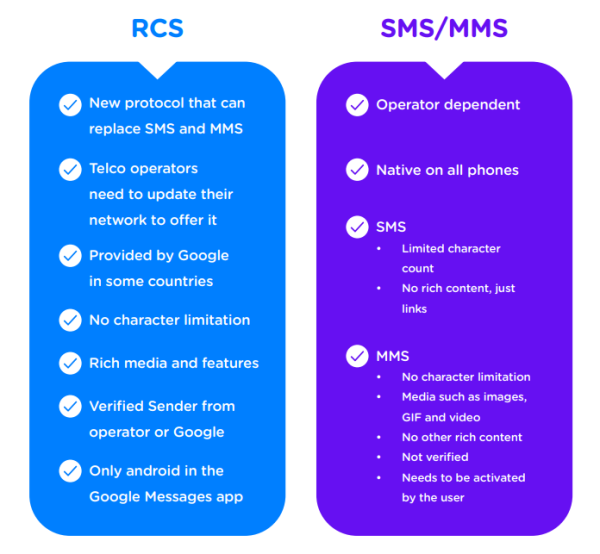
While the GSMA laid the groundwork, Google has been the primary driving force behind the global rollout and adoption of RCS, particularly for Android users. Recognizing the messaging disparity between Android and iOS, Google positioned RCS as the true successor to SMS for its ecosystem.
The Role of Carriers and Universal Profile
Initially, RCS adoption was slow due to the fragmented nature of carrier networks. Each carrier had to implement and support RCS individually, often with their own variations, leading to inconsistent experiences. This is where the Universal Profile became crucial. By defining a common set of features and technical specifications, the UP simplified implementation and ensured compatibility.
Google significantly accelerated RCS adoption by taking a proactive approach. Instead of waiting for individual carriers to enable RCS for all their subscribers, Google began deploying RCS via its Messages app, leveraging its own infrastructure. For users with Google Messages (the default messaging app on many Android devices), Google’s servers act as the RCS backbone. This “Chat” feature, powered by Google, essentially bypasses some of the traditional carrier-centric deployment hurdles, providing a unified RCS experience for most Android users globally, even if their carrier hasn’t fully rolled out its own RCS solution. This strategy has been pivotal in making RCS a reality for hundreds of millions of Android users.
Interoperability Challenges and Solutions
Despite Google’s efforts, true universal interoperability remains a work in progress. The most notable gap is the lack of direct RCS communication between Android and iOS. Apple continues to rely on iMessage for its enhanced messaging features, with messages between iPhones appearing in blue bubbles and messages to Android devices reverting to green SMS bubbles. This distinction often highlights the feature limitations when communicating cross-platform and creates a social dynamic that Google actively advocates to change, urging Apple to adopt RCS.
The technical solution for full interoperability would involve Apple integrating RCS Universal Profile support into its Messages app. This would allow iPhones to send and receive rich media, read receipts, and typing indicators when communicating with Android devices, effectively bridging the “green bubble” divide. Until then, while Android users enjoy advanced RCS features among themselves, the communication experience with iPhone users remains constrained by SMS/MMS limitations.
Advantages and Disadvantages of RCS Messaging
Like any evolving technology, RCS presents a mixed bag of benefits and challenges that influence its widespread adoption and impact on user experience.
Enhanced User Experience and Features
The advantages of RCS are primarily centered around bringing a modern, app-like messaging experience to the native phone application. For Android users, this means:
- Seamless Integration: No need to download a separate app; RCS features are built directly into the default messaging application, creating a more cohesive user experience.
- Rich Media Sharing: High-resolution photos, videos, and large files can be sent and received without the degradation or limitations of MMS.
- Interactive Group Chats: More robust group messaging capabilities, including easier management and the ability to see who has read messages.
- Reliability and Speed: Messages sent over an internet connection are generally faster and more reliable than SMS, especially over Wi-Fi in areas with poor cellular signal.
- Business Applications: The ability for businesses to engage with customers through verified profiles, interactive cards, suggested replies, and chatbots directly within the messaging app significantly enhances customer service, marketing, and transactional communications. This represents a substantial upgrade from plain SMS-based alerts.
Privacy, Security, and Adoption Concerns
While promising, RCS also faces significant hurdles, particularly concerning privacy, security, and global adoption:
- Lack of Universal End-to-End Encryption (E2EE): This is perhaps the most significant security concern. While Google Messages provides end-to-end encryption for one-to-one RCS conversations between its users, this protection does not extend universally. Messages sent via carrier-provided RCS services may not be end-to-end encrypted, leaving them potentially vulnerable to interception by carriers or service providers. This contrasts sharply with many leading OTT apps (WhatsApp, Signal, Telegram secret chats) where E2EE is a fundamental design principle.
- Data Usage: As an IP-based service, RCS messages consume mobile data, which could be a concern for users with limited data plans, although the data consumption for text and small media is typically minimal.
- Interoperability Gaps: The ongoing challenge of communicating between Android and iOS with full RCS features remains a major disadvantage. This fragmentation prevents a truly unified, rich messaging experience across the entire mobile ecosystem.
- Carrier Involvement: While Google has taken the lead, the reliance on carrier support in some regions or for certain features can still lead to inconsistent availability and performance.
- Global Adoption: Despite progress, RCS is not universally adopted across all devices, carriers, and countries, leading to a fallback to SMS/MMS when features are not supported. This inconsistency can confuse users about whether their messages are being sent via RCS or SMS.
The Future of Messaging: What’s Next for RCS?
RCS is undeniably a critical step forward for mobile messaging, particularly for the Android ecosystem. Its trajectory suggests a future where the “text message” is no longer a relic of the past but a dynamic, competitive communication platform.
Enterprise Messaging and Business Applications
One of the most promising avenues for RCS is in enterprise messaging. Businesses are increasingly leveraging RCS to deliver richer, more engaging customer interactions. Instead of generic SMS notifications, companies can send interactive messages with images, carousels, maps, and direct action buttons (e.g., “Confirm Appointment,” “Track Order,” “View Product”). This allows for branded, secure, and interactive communication, transforming everything from customer support to marketing campaigns. Think of airlines sending digital boarding passes with QR codes, banks sending secure account alerts with quick action buttons, or retailers offering personalized product recommendations directly within the native messaging app. This B2C potential is a major driver for continued RCS development and adoption.
Potential for Broader Ecosystem Integration
The long-term vision for RCS is to become the universal, default messaging standard that seamlessly bridges the gap between different mobile operating systems and device manufacturers. Achieving this will require continued collaboration and, crucially, Apple’s embrace of the RCS Universal Profile. Should Apple adopt RCS, the distinction between “blue bubbles” and “green bubbles” could largely disappear, ushering in an era of truly universal rich messaging that is interoperable by default, without requiring users to download third-party applications. This would elevate the native messaging experience for everyone, creating a more consistent, feature-rich, and modern communication standard for the entire mobile world. The industry momentum, largely driven by Google’s advocacy and the clear user benefits, suggests that such a future, while challenging, is becoming increasingly plausible.
aViewFromTheCave is a participant in the Amazon Services LLC Associates Program, an affiliate advertising program designed to provide a means for sites to earn advertising fees by advertising and linking to Amazon.com. Amazon, the Amazon logo, AmazonSupply, and the AmazonSupply logo are trademarks of Amazon.com, Inc. or its affiliates. As an Amazon Associate we earn affiliate commissions from qualifying purchases.