
When you dispute a transaction on your bank statement—perhaps due to a suspected fraudulent charge or a billing error—financial institutions are legally required to investigate. During this investigative period, the bank often grants you “provisional credit.” This is a temporary deposit of funds into your account, effectively making you whole while the bank communicates with the merchant’s bank to verify the claim.
However, seeing a “provisional credit reversal” on your statement can be jarring. It essentially means the bank has decided to take those funds back. Understanding why this happens and what it means for your personal finances is critical for navigating the dispute process effectively.
The Mechanics of Provisional Credit
To understand why a reversal occurs, one must first grasp why provisional credit exists. Under regulations such as the Electronic Fund Transfer Act (EFTA) in the United States, banks are mandated to conduct a timely investigation into reported errors.
Why Banks Issue Temporary Funds
Provisional credit serves as a bridge. If $500 disappears from your account due to an unauthorized debit, your liquidity is compromised. To ensure you aren’t penalized while the bank performs its due diligence, they “provisionally” replace the funds. This is not a final judgment on the dispute; it is a customer service measure designed to mitigate the financial stress of a potential fraud event.
The Investigative Window
Banks generally have up to 10 business days to investigate an error claim. In complex cases, they may take up to 45 or even 90 days. During this entire window, the funds remain in your account, labeled as provisional. The bank’s internal fraud department spends this time gathering evidence, checking transaction logs, IP addresses associated with digital purchases, and signature cards for physical point-of-sale transactions.
Understanding the Reversal Trigger
A provisional credit reversal is not necessarily a sign that you have done something wrong, nor does it always mean the bank has sided against you permanently. It is a procedural accounting adjustment.
The Outcome of the Investigation
If the bank’s investigation concludes that the transaction was legitimate, the provisional credit will be reversed. This happens frequently in cases where the bank discovers the charge was authorized by an authorized user on the account, or perhaps by a family member the account holder failed to consult. Once the bank verifies the charge is valid, they must reclaim the temporary credit because the original transaction stands as an official debt.
Insufficient Evidence
Sometimes, a reversal occurs because the cardholder failed to provide requested documentation. If your bank asks for a police report regarding identity theft or an affidavit of fraud and you do not supply it within their timeframe, the investigation will be closed in favor of the merchant. In this instance, the bank reverses the provisional credit because the burden of proof was not met.
The “Chargeback” Failure
The dispute process often involves a “chargeback,” where the bank attempts to claw money back from the merchant’s processor. If the merchant provides compelling evidence—such as proof of delivery, a signed receipt, or digital fingerprinting—the merchant’s bank will reject the chargeback. Your bank, having lost the battle to recover the funds from the merchant, will then execute a reversal of your provisional credit to balance their books.
What to Do If Your Credit Is Reversed
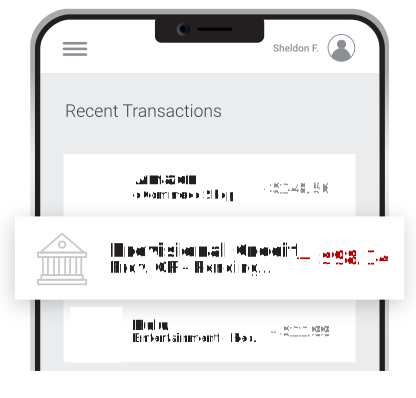
Receiving notification that a provisional credit has been reversed can be frustrating, especially if you are certain the transaction was unauthorized. However, the reversal does not always have to be the final word in the matter.
Review the Bank’s Findings
The bank is required to provide you with a written explanation of their findings. When you receive a notice of reversal, read the accompanying letter carefully. It will specify exactly why the claim was denied. Identifying whether the denial was due to a lack of evidence, a misunderstanding of the transaction, or merchant-provided data is the first step in mounting a rebuttal.
Provide Additional Evidence
If the reversal was based on insufficient evidence, you may have the opportunity to reopen the case. If you have new information—such as a copy of a police report, communication with the merchant showing they acknowledged a refund was due, or evidence that the IP address used for a purchase was located in a city where you were not present—you should submit this to the bank’s dispute department immediately.
Escalation and Consumer Protection
If you believe the bank conducted a negligent investigation, you have options. In the U.S., you can file a complaint with the Consumer Financial Protection Bureau (CFPB). The CFPB serves as a watchdog for financial services, and once a formal complaint is filed, the bank is generally required to provide a formal, documented response to the bureau regarding their investigative process. This often prompts a more thorough review of your case.
Protecting Your Account from Future Disputes
While the dispute process exists to protect you, it is an imperfect system that places significant administrative burdens on the consumer. Avoiding the need for provisional credits and subsequent reversals is the best strategy for long-term financial health.
Digital Security Habits
Many unauthorized transaction disputes arise from compromised digital accounts rather than stolen cards. Use unique, complex passwords for your banking apps and retail websites. Enable multi-factor authentication (MFA) everywhere it is offered. If a criminal cannot access your account, they cannot trigger a transaction that necessitates a dispute.
Monitor Transactions Regularly
The speed at which you notice a suspicious charge often determines the outcome of a dispute. If you wait 60 days to report a fraudulent charge, your bank may be less inclined to offer provisional credit, and your legal protections may weaken. Checking your balance and transaction history via mobile apps once every few days allows you to spot anomalies before they escalate.
Understand “Authorized User” Risks
A common source of “fake” fraud—which leads directly to provisional credit reversals—is the activity of authorized users. If a spouse or child has a card on your account and makes a purchase you have forgotten about, the bank will eventually trace that purchase to a device or location known to that authorized user. When the bank presents this evidence, your claim will be denied and your provisional credit will be reversed. Before filing a claim, always check with other members of your household to ensure a transaction wasn’t simply a misidentified purchase.
The Psychological and Financial Impact
Managing money requires a level of trust between the consumer and the financial institution. When a provisional credit is reversed, it can feel like a breach of that trust. However, it is essential to view these events through the lens of banking regulations. The bank acts as an arbiter in a dispute between you and a merchant.
Financial stability relies on liquidity. If you are dealing with a reversed credit, ensure that your account is prepared to cover the debit. If the reversal results in an overdraft fee, contact the bank’s customer service department. Often, if you have a strong relationship with the institution and a history of responsible account management, they may be willing to waive associated overdraft fees, even if they have to uphold the reversal of the original credit.
By staying proactive, keeping detailed records of all communications, and understanding the specific reasons behind the bank’s decision-making process, you can navigate the complex waters of credit reversals with confidence. Remember that the dispute process is a series of checks and balances; while the bank holds the power of the initial decision, the consumer holds the right to appeal and provide the evidence necessary to ensure a fair resolution.
aViewFromTheCave is a participant in the Amazon Services LLC Associates Program, an affiliate advertising program designed to provide a means for sites to earn advertising fees by advertising and linking to Amazon.com. Amazon, the Amazon logo, AmazonSupply, and the AmazonSupply logo are trademarks of Amazon.com, Inc. or its affiliates. As an Amazon Associate we earn affiliate commissions from qualifying purchases.