
In the intricate world of business finance and accounting, understanding the true cost of production is paramount to sustainable profitability and strategic decision-making. Among the myriad cost classifications, “prime cost” stands out as a fundamental concept, serving as the bedrock for pricing strategies, cost control, and financial analysis. Far more than just an accounting term, prime cost represents the direct, most immediate expenses tied to the creation of a product or the delivery of a service. It strips away overheads and administrative layers to reveal the core outlay required to bring a good from raw material to a semi-finished state, ready for further processing or sale. For entrepreneurs, small business owners, and seasoned financial professionals alike, a clear grasp of what constitutes prime cost, how it’s calculated, and its implications is not merely beneficial—it’s essential for navigating competitive markets and fostering long-term financial health. This article delves into the nuances of prime cost, demystifying its components, exploring its strategic importance, and illustrating its practical application in real-world business scenarios.

Understanding Prime Cost: The Foundation of Production Expenses
At its heart, prime cost is a direct measure of the expenses that can be directly attributed to the production of a particular good or service. It’s the bare minimum required to create an item, before considering any other costs associated with running a business. This clarity makes it an invaluable metric for initial cost assessments and understanding the efficiency of core production processes.
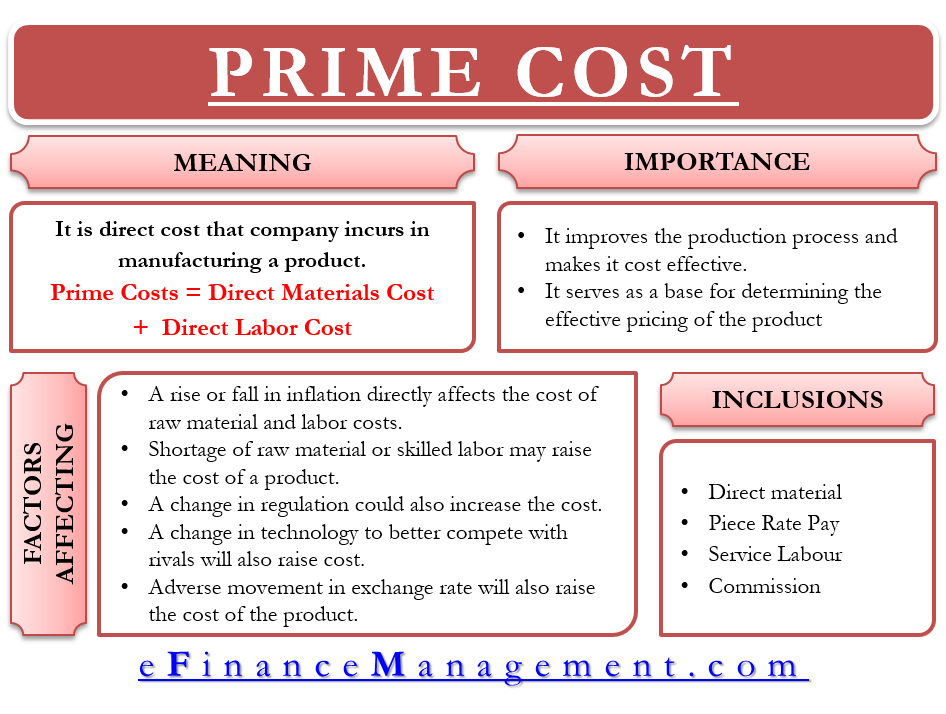
Defining Prime Cost: Direct Materials + Direct Labor
The calculation of prime cost is elegantly simple, yet profoundly impactful. It is the sum of two critical elements:
-
Direct Materials: These are the raw materials and components that become an integral part of the finished product. They are easily traceable to the product and their cost fluctuates directly with the volume of production. For instance, in manufacturing a wooden chair, the wood, screws, and upholstery fabric are direct materials.
-
Direct Labor: This refers to the wages and benefits paid to employees who are directly involved in the manufacturing or production process. Their work directly contributes to converting raw materials into the finished good. Continuing with the wooden chair example, the wages paid to the carpenters who cut, assemble, and finish the chairs constitute direct labor.
Together, these two components offer a focused view of the tangible, hands-on costs of creation, distinct from the broader operational expenses that support the production environment.
Why Separate Direct vs. Indirect Costs?
The distinction between direct and indirect costs is foundational to cost accounting, and prime cost embodies this separation perfectly. Direct costs are those that can be specifically and economically traced to a cost object (e.g., a product, service, or department). Indirect costs, on the other hand, are overheads that support multiple cost objects and cannot be directly attributed to one. Examples include factory rent, utilities, administrative salaries, and depreciation of machinery. By isolating direct costs as prime cost, businesses gain a clearer picture of the variable costs that change with each unit produced, enabling more precise pricing and production decisions. This separation prevents the true cost of an individual unit from being obscured by fixed overheads, which might distort perceptions of profitability at the unit level.
Prime Cost vs. Conversion Cost: A Key Distinction
While prime cost focuses on the “input” elements (materials and the labor to manipulate them), another important concept, conversion cost, emphasizes the “transformation” aspect of production. Conversion cost is the sum of direct labor and manufacturing overheads. It represents the costs incurred to convert raw materials into finished products. The key difference is that prime cost highlights what goes into the product directly, while conversion cost highlights what it costs to make the product from those materials (excluding the materials themselves but including other factory costs). Understanding both allows for a comprehensive analysis of different facets of production efficiency: prime cost for material and direct effort efficiency, and conversion cost for factory operational efficiency.
The Components of Prime Cost in Detail
To effectively leverage prime cost in financial analysis, a granular understanding of its constituent parts is crucial. Accurate identification and allocation of these direct costs prevent miscalculations that can cascade into flawed business strategies.
Direct Materials: Tracing Raw Inputs
Direct materials are the physical ingredients that form the finished product. Their identification requires careful attention to the manufacturing bill of materials. Not all materials used in production are direct materials; for example, glue or nails might be considered indirect materials if their cost per unit is negligible or difficult to trace precisely. The key criterion is that the material must be a significant and traceable part of the finished product. Accurate tracking of direct material costs involves managing supplier invoices, inventory valuations, and waste. Fluctuations in raw material prices directly impact prime cost, making supply chain management and hedging strategies critical for cost stability.
Direct Labor: The Human Element in Production
Direct labor encompasses the wages, benefits, and payroll taxes associated with employees whose time is directly spent on transforming raw materials into finished goods. This includes assembly line workers, machinists, and anyone else physically working on the product. It’s important to distinguish this from indirect labor, such as supervisors, quality control staff, or maintenance personnel, whose contributions support production but are not directly linked to a specific unit. The cost of direct labor is a crucial variable that can be optimized through process improvements, automation, and labor efficiency measures. Training, fair wages, and a productive work environment directly influence direct labor costs and, consequently, prime cost.
Identifying and Allocating Direct Costs Accurately
The challenge often lies in consistently and accurately identifying and allocating these direct costs. Businesses must establish robust costing systems that allow for precise tracking. For direct materials, this might involve barcode scanning for inventory usage or detailed material requisitions. For direct labor, time tracking systems (e.g., punch clocks, digital time sheets) linked to specific production orders or tasks are essential. Any ambiguity in classification can lead to inaccuracies in prime cost calculation, which in turn can lead to incorrect pricing decisions or misjudgments about production efficiency. Investment in good accounting software and clear accounting policies is vital for this precision.
The Strategic Importance of Prime Cost in Business Operations
Understanding prime cost is not merely an academic exercise; it has profound practical implications that influence a wide array of business decisions, from setting prices to evaluating performance.
Pricing Strategies and Profitability Analysis

For any business, setting the right price for its products or services is a delicate balance. Prime cost provides a critical baseline. No product should ideally be sold below its prime cost, as doing so means the business isn’t even covering the direct materials and labor needed to create it, leading to immediate losses on every unit. By knowing the prime cost, businesses can establish a minimum selling price and then add a markup to cover indirect costs (overhead) and achieve a desired profit margin. It allows for “cost-plus” pricing models and informs competitive bidding strategies, ensuring that even undercutting competitors still leaves room to cover direct expenses. Furthermore, comparing prime cost to selling price reveals the gross profit margin on direct production, offering an initial indicator of product viability.
Cost Control and Efficiency Improvement
Prime cost serves as a powerful metric for internal cost control and efficiency drives. By analyzing trends in direct material costs, businesses can identify opportunities for bulk purchasing, negotiating better supplier contracts, or exploring alternative, more cost-effective materials. Similarly, scrutiny of direct labor costs can highlight inefficiencies in the production process, suggest areas for automation, or reveal the need for better training to improve worker productivity. A rising prime cost per unit, without a corresponding increase in selling price, signals a problem that needs immediate attention, driving management to investigate the root causes of increased material waste, higher labor hours per unit, or escalating wages.
Budgeting, Forecasting, and Performance Measurement
In the realm of financial planning, prime cost is an indispensable component of budgeting and forecasting. When projecting future production volumes, businesses can use the prime cost per unit to accurately estimate future direct material and direct labor expenses. This forms a crucial part of the overall operational budget. For performance measurement, comparing actual prime costs against budgeted prime costs helps assess the efficiency of the production department. Favorable variances (actual < budgeted) indicate efficient operations, while unfavorable variances (actual > budgeted) signal potential issues in purchasing, production, or labor management. It allows for accountability and provides clear targets for continuous improvement.
Prime Cost in Action: Real-World Applications and Calculations
Moving from theory to practice, understanding how to calculate and apply prime cost in everyday business scenarios is where its true value becomes apparent.
Calculating Prime Cost: A Practical Example
Let’s consider a small bakery that produces artisanal bread.
For a batch of 100 loaves:
-
Direct Materials:
-
Flour: $50
-
Yeast: $10
-
Salt: $5
-
Water (significant enough to be traced and measured): $2
-
Total Direct Materials: $67
-
-
Direct Labor:
-
Wages for the baker directly involved in mixing, kneading, and shaping: 4 hours at $25/hour = $100
-
Total Direct Labor: $100
-
Prime Cost for 100 loaves: Direct Materials ($67) + Direct Labor ($100) = $167
-
Prime Cost per loaf: $167 / 100 loaves = $1.67
-
This $1.67 represents the fundamental cost of creating one loaf of bread, excluding oven electricity, rent, marketing, or administrative salaries. Any selling price below $1.67 would mean a direct loss on each loaf produced.
Impact on Break-Even Analysis
Prime cost plays a significant role in break-even analysis, especially when identifying the variable cost component. While variable costs in a break-even analysis typically include prime cost plus variable manufacturing overheads, understanding the prime cost portion helps in sensitivity analysis. If a business needs to lower its break-even point, identifying ways to reduce direct materials or direct labor costs can be highly effective, as these are direct variables that scale with production volume. A reduction in prime cost directly contributes to a lower variable cost per unit, which in turn reduces the number of units needed to cover fixed costs and break even.
When Prime Cost Isn’t Enough: Considering Total Costs
While prime cost is crucial, it’s vital to recognize that it’s only one piece of the financial puzzle. A business cannot operate on prime cost alone. Other significant expenses, known as manufacturing overheads, selling expenses, and administrative expenses, must also be covered. These include rent, utilities, insurance, depreciation of machinery, marketing costs, sales commissions, and executive salaries. The combination of prime cost and manufacturing overheads equals the total manufacturing cost. For overall profitability, all these costs must be recuperated through sales. Relying solely on prime cost for long-term pricing or financial health assessment would be a critical oversight, leading to unsustainable business models.
Leveraging Prime Cost for Sustainable Business Growth
In today’s dynamic business environment, informed decision-making is the cornerstone of sustainable growth. Prime cost, when properly understood and utilized, offers a powerful lens through which to view and optimize core operational efficiency.
Enhancing Decision-Making with Prime Cost Insights
By consistently tracking and analyzing prime cost, businesses can make more astute operational and strategic decisions. Should we automate a particular process to reduce direct labor? Is it more cost-effective to source materials from a new supplier, even if it means a longer lead time? What is the absolute minimum price we can offer during a sales promotion without incurring direct losses? Prime cost provides the factual basis for answering these questions. It empowers management to identify production bottlenecks, evaluate the profitability of individual product lines, and determine the economic viability of new product introductions. Furthermore, it aids in make-or-buy decisions, by comparing the internal prime cost of production against the purchase price from an external vendor.
Technology and Tools for Prime Cost Management
Modern businesses have a distinct advantage through the availability of sophisticated technology and tools that streamline cost management. Enterprise Resource Planning (ERP) systems, for example, integrate various business processes, allowing for real-time tracking of direct material consumption and direct labor hours. Accounting software packages offer robust features for categorizing expenses, generating cost reports, and performing variance analysis. Inventory management systems help optimize material procurement and reduce waste, directly impacting direct material costs. Embracing these digital tools not only enhances accuracy in prime cost calculation but also provides actionable insights more rapidly, enabling proactive adjustments rather than reactive responses.
Beyond Prime Cost: The Holistic View of Business Finance
While prime cost is undeniably a critical metric, it functions best when viewed within the broader context of a company’s entire financial structure. It is the first tier of cost analysis, laying the groundwork for understanding gross profit, operating income, and ultimately, net income. Integrating prime cost analysis with evaluations of manufacturing overheads, selling and administrative expenses, and revenue streams offers a comprehensive financial picture. Businesses that master this holistic approach—understanding not just what goes directly into a product, but every cost associated with bringing it to market and sustaining the enterprise—are those best positioned for long-term success, profitability, and resilience in a competitive landscape.
In conclusion, “what does prime cost” translates into a foundational inquiry for any entity engaged in manufacturing or service delivery. It is the transparent window into the most immediate and controllable aspects of production expenditure. By meticulously defining, calculating, and strategically utilizing prime cost, businesses can refine their pricing strategies, drive efficiency initiatives, make informed budgetary decisions, and ultimately chart a clearer course toward financial stability and growth. It’s a concept that is simple in definition but profound in its implications, guiding businesses toward smarter, more profitable operations.
aViewFromTheCave is a participant in the Amazon Services LLC Associates Program, an affiliate advertising program designed to provide a means for sites to earn advertising fees by advertising and linking to Amazon.com. Amazon, the Amazon logo, AmazonSupply, and the AmazonSupply logo are trademarks of Amazon.com, Inc. or its affiliates. As an Amazon Associate we earn affiliate commissions from qualifying purchases.