
In the intricate world of business finance, liquidity is the lifeblood that keeps operations running, fuels expansion, and ensures long-term sustainability. Among the various metrics used to assess a company’s financial health, the Accounts Receivable (AR) turnover ratio stands out as a critical indicator of operational efficiency. Often referred to as the “receivable turnover” or “debtors’ turnover” ratio, it measures how effectively a company manages the credit it extends to customers and how quickly that short-term debt is collected and converted back into cash.
When a financial analyst or a business owner observes a high accounts receivable turnover ratio, it usually signals a well-oiled machine. However, interpreting this number requires more than a superficial glance. A high ratio can indicate anything from aggressive collection policies to a conservative credit department, and in some cases, it may even point toward missed growth opportunities. To truly understand what a high ratio indicates, one must dive deep into the mechanics of cash flow, credit risk, and market positioning.
Understanding the Mechanism of Accounts Receivable Turnover
Before analyzing the implications of a high ratio, it is essential to define what the metric represents and how it is calculated. The accounts receivable turnover ratio is an efficiency ratio that quantifies how many times, on average, a company’s receivables are collected during a specific period—typically a fiscal year or quarter.
The Formula and Its Components
The formula for the AR turnover ratio is straightforward:
Accounts Receivable Turnover = Net Credit Sales / Average Accounts Receivable
- Net Credit Sales: This represents the revenue generated from sales made on credit, excluding cash sales, returns, and allowances.
- Average Accounts Receivable: This is calculated by adding the beginning accounts receivable balance and the ending balance for the period and dividing by two. Using an average helps smooth out seasonal fluctuations that might skew the data.
The Benchmark: What “High” Means in Context
A “high” ratio is relative. In some industries, like software-as-a-service (SaaS) or retail, where payment cycles are rapid, a high ratio is the standard. In heavy manufacturing or construction, where projects last months and payment terms are often net-60 or net-90, a “high” ratio might look significantly lower than in other sectors. Generally, a high ratio indicates that the company is collecting its receivables frequently throughout the year. For example, a ratio of 12 suggests that, on average, the company clears its entire accounts receivable balance once a month.
The Positive Implications of a High Ratio
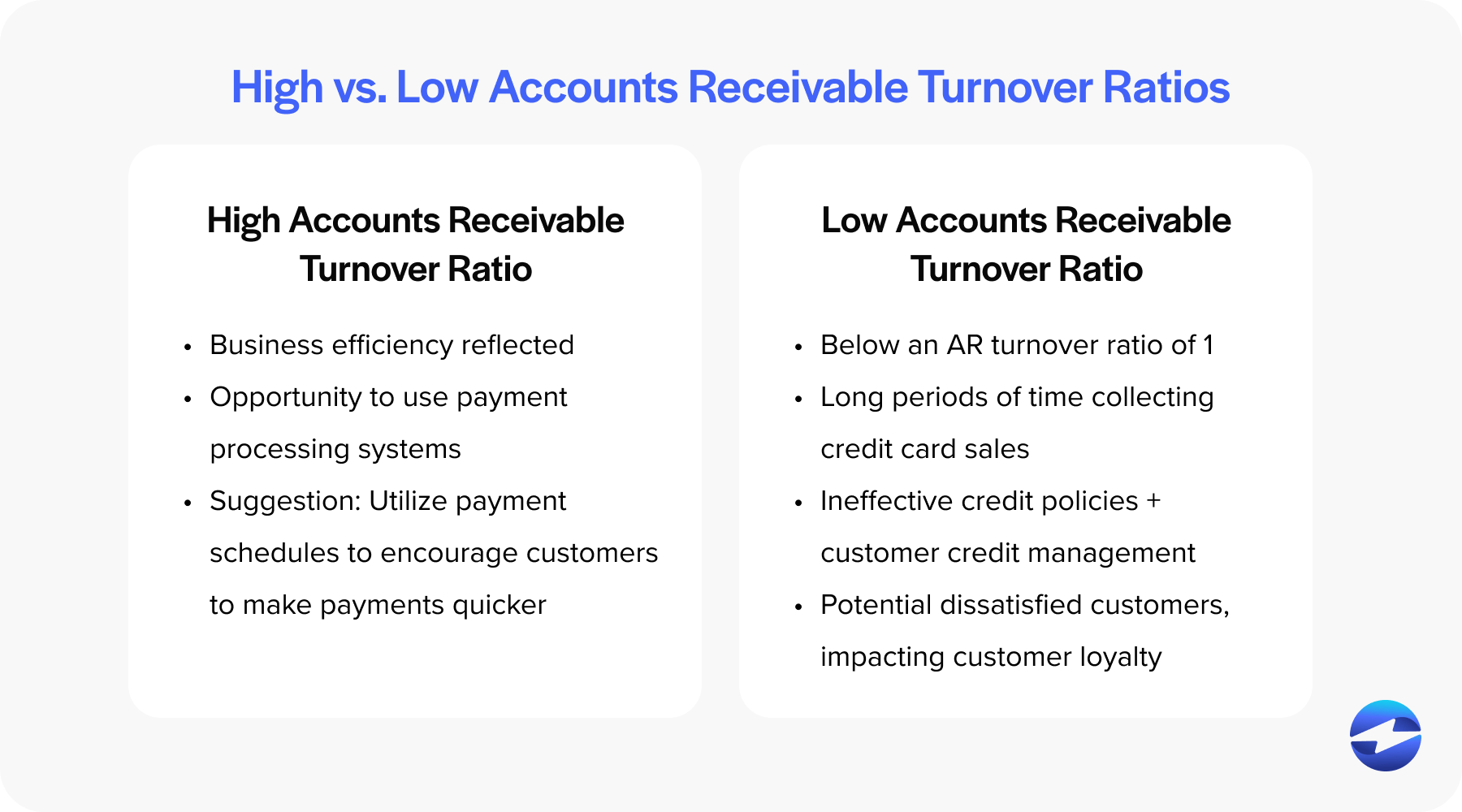
A high accounts receivable turnover ratio is generally viewed as a badge of financial honor. It suggests that the company is proficient at converting its sales into actual cash, which is the ultimate goal of any profit-seeking enterprise.
Superior Liquidity and Cash Flow Management
The most immediate takeaway from a high ratio is robust liquidity. When a company collects payments quickly, it ensures a steady stream of cash flow available to meet its own short-term obligations. This includes paying employees, settling accounts payable with suppliers to take advantage of early-payment discounts, and reinvesting in inventory.
In business finance, “cash is king.” A high turnover ratio reduces the “Cash Conversion Cycle” (CCC), which is the time it takes for a company to convert its investments in inventory and other resources into cash flows from sales. By shortening this cycle, a business reduces its reliance on external financing, such as high-interest lines of credit or bridge loans, thereby strengthening its balance sheet and reducing interest expenses.
Efficient Credit Policies and Debt Collection
A high ratio is often a direct reflection of a company’s internal discipline. It indicates that the credit department is performing rigorous due diligence before extending credit to customers. By vetting the creditworthiness of clients, the company ensures that it is selling to entities that have the capacity and intent to pay on time.
Furthermore, a high ratio highlights the effectiveness of the collections team. It suggests that the company has streamlined invoicing processes, clear communication channels with clients, and a proactive approach to following up on overdue accounts. In a high-functioning finance department, invoices are sent promptly, and reminders are automated, ensuring that the company stays at the “top of the pile” for the customer’s accounts payable department.

Minimizing Bad Debt and Financial Risk
The longer an invoice remains unpaid, the less likely it is to be collected. This is a fundamental principle of debt management. By maintaining a high AR turnover ratio, a company significantly reduces its exposure to “bad debt”—receivables that must be written off as uncollectible.
High turnover means that the “Age of Accounts Receivable” is low. When a company keeps its receivables fresh, it minimizes the risk that a customer might go bankrupt or encounter financial distress before paying their bill. This conservative approach protects the company’s earnings from being eroded by sudden write-offs, providing more predictable and stable financial reports for investors and stakeholders.
Potential Red Flags: When a High Ratio Isn’t All Good
While a high ratio is usually positive, financial analysis requires a nuanced view. There is a point where a ratio can be “too high,” indicating that the company’s credit policies may be overly restrictive or that they are missing out on potential market share.
Overly Restrictive Credit Policies
If a company’s AR turnover ratio is significantly higher than the industry average, it may be a sign that their credit policy is too “tight.” While this avoids bad debt, it might also turn away perfectly viable customers who require standard credit terms to do business. If a company demands payment upfront or offers only very short windows (e.g., net-7), they may alienate small to medium-sized enterprises (SMEs) that rely on trade credit to manage their own cash flow.
Potential Loss of Market Share to Competitors
In a competitive landscape, credit terms are often used as a marketing tool. If a competitor offers net-30 terms and your company insists on net-10, the customer may choose the competitor even if your product is slightly superior. A sky-high turnover ratio could indicate that the company is prioritizing “safe” cash over aggressive growth. In the quest for a perfect balance sheet, the firm might be surrendering market dominance to rivals who are willing to take on a managed amount of credit risk to secure larger contracts.
Missed Opportunities for Long-Term Customer Growth
Business finance is not just about the current quarter; it is about building long-term value. Sometimes, extending credit to a growing customer who is currently cash-strapped can lead to a loyal, high-value partnership in the future. If the AR turnover is too high because the company refuses to work with anyone but the most liquid clients, they might be missing out on “rising star” customers who could provide significant revenue volume over the next decade.
Strategic Optimization: Leveraging the Ratio for Business Growth
For a business to thrive, the goal shouldn’t necessarily be the highest possible AR turnover ratio, but rather an optimized one that balances liquidity with sales growth. This involves using financial tools and strategies to maintain efficiency without sacrificing opportunity.
Implementing Automated Invoicing and FinTech Solutions
Modern business finance relies heavily on technology to maintain high turnover ratios. By implementing automated invoicing systems and integrated ERP (Enterprise Resource Planning) software, companies can ensure that there is zero lag time between a sale and the issuance of an invoice. Furthermore, providing digital payment options—such as ACH transfers, credit card portals, or instant payment links—removes the friction that often delays manual check payments.
Dynamic Credit Scoring Models
Instead of a “one-size-fits-all” credit policy, sophisticated companies use dynamic credit scoring. By analyzing customer data, payment history, and external credit reports, a business can offer flexible terms to reliable customers while maintaining strict requirements for higher-risk accounts. This allows the company to maintain a healthy turnover ratio while still capturing sales from a broader range of the market.
Incentivizing Early Payments
One of the most effective ways to drive a high AR turnover ratio while maintaining good customer relations is through “cash discounts.” Terms such as “2/10, net 30” mean the customer gets a 2% discount if they pay within 10 days; otherwise, the full amount is due in 30. This is a powerful financial tool that turns the AR department into a value-driver. It encourages customers to pay early voluntarily, which boosts the turnover ratio and provides the company with immediate liquidity, often at a lower cost than the interest on a bank loan.

Conclusion: The Balance of Financial Health
In summary, a high accounts receivable turnover ratio is a strong indicator of a company’s operational efficiency, credit quality, and liquidity. It tells the story of a business that is capable of converting its efforts into tangible rewards with minimal waste and risk. It signals to investors and lenders that the company is managed with a “cash-first” mindset, making it a more attractive prospect for capital investment.
However, the savvy financial professional knows that every metric must be viewed within the context of the broader business strategy. A high ratio is an asset, but it must not come at the expense of sustainable growth or customer relationships. By leveraging modern financial tools, maintaining disciplined collection processes, and strategically offering credit, a business can achieve a high turnover ratio that fuels both immediate stability and long-term expansion. Ultimately, the goal is to ensure that the money owed to the company is working just as hard as the products and services the company sells.
aViewFromTheCave is a participant in the Amazon Services LLC Associates Program, an affiliate advertising program designed to provide a means for sites to earn advertising fees by advertising and linking to Amazon.com. Amazon, the Amazon logo, AmazonSupply, and the AmazonSupply logo are trademarks of Amazon.com, Inc. or its affiliates. As an Amazon Associate we earn affiliate commissions from qualifying purchases.