
The transition to REAL ID in Oklahoma represents more than just a change in the physical appearance of a driver’s license; it is a significant overhaul of the state’s digital identity infrastructure. As the Department of Homeland Security (DHS) moves toward full enforcement, understanding what you need for a REAL ID in Oklahoma requires a look at the intersection of government policy, data security, and technological modernization. This article explores the technical standards, the backend verification systems, and the specific documentation required to interface with Oklahoma’s upgraded identity framework.

The Technological Evolution of Identity Verification in Oklahoma
The REAL ID Act of 2005 set forth a set of national technological standards for the issuance of sources of identification. For Oklahoma, implementing these standards required a massive migration of legacy data to modern, encrypted systems capable of communicating with federal databases. This shift ensures that an identity issued in Tulsa or Oklahoma City is verifiable by the Transportation Security Administration (TSA) or at secure federal facilities nationwide.
Standardizing Data Interoperability
Before the REAL ID transition, state motor vehicle departments often operated on disparate, siloed databases. The technological backbone of the REAL ID system relies on the American Association of Motor Vehicle Administrators (AAMVA) network. This network allows for cross-state data exchange, ensuring that an individual does not hold multiple credentials in different jurisdictions. When you apply for a REAL ID in Oklahoma, the system performs a real-time check against national pointer systems to verify that your identity hasn’t been compromised or duplicated elsewhere.
Digital Image and Document Archiving
One of the core technical requirements of the REAL ID Act is the secure, digital storage of the source documents provided by the applicant. When an Oklahoman presents a birth certificate or social security card, these are not just viewed; they are scanned into a high-resolution, encrypted digital archive. This process utilizes Optical Character Recognition (OCR) technology to extract data and flag potential discrepancies or forged documents, adding a layer of automated security to the human review process.
Biometric Integration and Facial Recognition
While not always visible to the user, the photo taken at the Oklahoma Department of Public Safety (DPS) or a licensed tag agency is far more than a simple portrait. Modern Oklahoma REAL IDs utilize biometric-ready photography. These images are processed using facial recognition algorithms that map the geometry of the face—measuring distances between the eyes, nose, and chin. This data is used to prevent “one-to-many” identity fraud, ensuring that the person standing at the counter is the same person associated with the underlying data in the state’s digital repository.
The Hardware of Security: Anatomy of a REAL ID Card
A REAL ID-compliant card is a piece of high-tech hardware designed to resist tampering and counterfeiting. The Oklahoma REAL ID features several layers of physical and digital security that make it a “smart” document compared to the non-compliant versions.
Optically Variable Devices (OVDs) and Holographics
The Oklahoma REAL ID incorporates sophisticated Optically Variable Devices (OVDs). These are holographic elements that change appearance depending on the angle of light. Unlike simple stickers, these are embedded within the polycarbonate layers of the card during the manufacturing process. These devices are nearly impossible to replicate with standard printing technology, providing an immediate visual verification of authenticity for security personnel.
Laser Engraving vs. Thermal Printing
Old-fashioned ID cards often used thermal transfer printing, which sits on top of the plastic and can be scraped off. Oklahoma’s REAL ID systems utilize laser engraving. The laser reacts with carbon particles in the card’s inner layers, essentially “burning” the data and the black-and-white ghost image into the card’s core. This makes the card virtually tamper-proof, as any attempt to alter the information would require destroying the physical structure of the card itself.
The PDF417 Barcode Standard
On the reverse side of every Oklahoma REAL ID is a PDF417 barcode. This is a high-density, two-dimensional barcode capable of storing a significant amount of data in a small footprint. The tech behind this barcode allows scanners at airports and federal checkpoints to instantly pull the cardholder’s information and compare it against the printed data on the front. This ensures that the physical card and the digital data stored within it are perfectly synchronized.
The Digital Checklist: Data Inputs Required for System Compliance
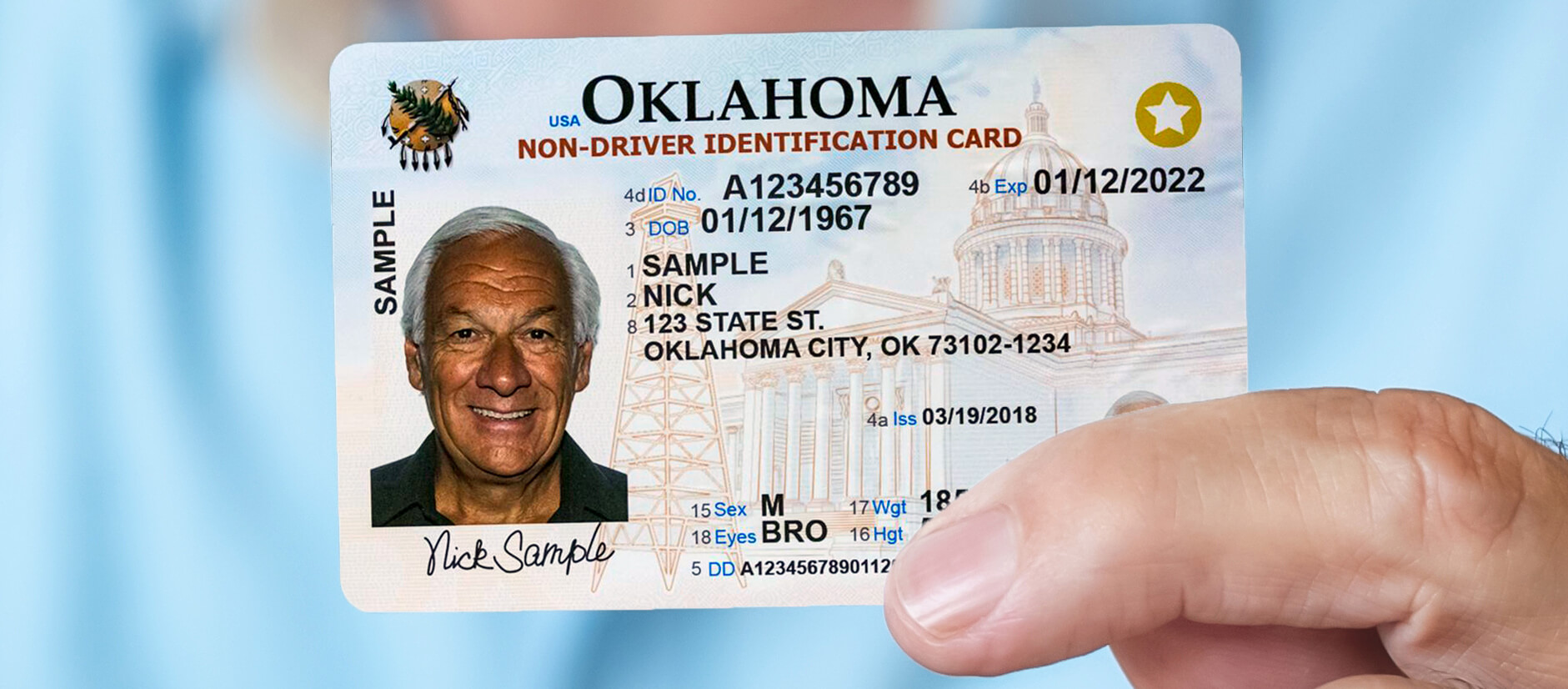
To receive a REAL ID, the applicant must provide “clean data” that the system can verify. In technical terms, the documents you bring to the Oklahoma Tag Agency serve as the “input” for the state’s identity algorithm. Without the correct inputs, the system cannot generate a compliant “output” (the ID card).
Proof of Identity (Primary Data Source)
The system requires one primary document to establish your legal presence in the United States. This serves as the foundation of your digital profile.
- Certified Birth Certificate: Must be an original or certified copy from a state office of vital statistics.
- Unexpired US Passport: A high-level federal credential that the state system can verify against State Department databases.
- Certificate of Naturalization/Citizenship: For those who have acquired citizenship, these documents provide the necessary alien registration numbers for federal verification.
Social Security Verification
Your Social Security Number (SSN) acts as a secondary verification key. Oklahoma’s REAL ID software interfaces directly with the Social Security Administration (SSA) via the Social Security Online Verification (SSOLV) system. To satisfy this, you must provide:
- An original Social Security card.
- A W-2 or 1099 form showing the full SSN.
- A pay stub containing the full SSN.
- Note: The system will flag any mismatch between the name on your identity document and the name on file with the SSA. If your name has changed due to marriage or court order, you must update the SSA database before applying for a REAL ID.
Proof of Residency (Geographic Data Verification)
The REAL ID Act requires two separate “data points” to prove your residency in Oklahoma. These documents confirm your physical location and link your identity to a specific geographic jurisdiction.
- Utility Bills: Electric, gas, or water bills are standard.
- Financial Statements: Bank statements or mortgage documents.
- Insurance Policy: Auto or homeowners insurance documents.
- Tech Tip: Digital versions of these documents are increasingly accepted, but it is often safer to bring printed copies to ensure the scanner can accurately capture the data without screen glare or resolution issues.
Cybersecurity and Data Protection in the REAL ID Framework
With the centralization of sensitive personal data comes the increased risk of cyber threats. Oklahoma has had to bolster its digital security posture to handle the influx of REAL ID data.
Encryption Standards for Personal Identifiable Information (PII)
All data collected during the REAL ID application process is encrypted both “at rest” and “in transit.” This means that as your information travels from a local tag agency to the central server in Oklahoma City, it is protected by Advanced Encryption Standard (AES) protocols. This prevents “man-in-the-middle” attacks where hackers might attempt to intercept data during the transmission phase.
Access Control and Audit Trails
The software used by Oklahoma DPS clerks and tag agents includes strict Access Control Lists (ACLs). Only authorized personnel with specific security clearances can access or modify your digital identity record. Furthermore, every time a record is accessed, the system generates an audit trail. This forensic capability allows the state to track exactly who viewed your data and why, providing a layer of accountability that was largely absent in the paper-based systems of the past.
Cloud Security and Disaster Recovery
As Oklahoma modernizes its IT infrastructure, much of the identity data is being shifted to secure government cloud environments. These environments are built to meet FedRAMP (Federal Risk and Authorization Management Program) standards. This ensures high availability and disaster recovery; even in the event of a physical catastrophe at a state data center, the digital identities of Oklahomans remain secure and recoverable in a secondary, geographically distant location.
The Future of Identity: From Physical Cards to Mobile IDs
While the current focus is on the physical REAL ID card, Oklahoma is already looking toward the next technological horizon: the Mobile Driver’s License (mDL).
The Oklahoma Mobile ID App
Oklahoma has already launched its Mobile ID application, which serves as a digital companion to the physical card. The tech behind the mDL uses ISO 18013-5 standards, which allow for “privacy-preserving” identity verification. For example, if you need to prove you are over 21, the app can generate a QR code that confirms your age without revealing your home address or exact birth date.
Blockchain and Decentralized Identity
The tech community is currently exploring the use of blockchain for decentralized identity (DID). While Oklahoma’s current system is centralized, the move toward REAL ID compliance is a necessary step toward a future where Oklahomans might control their identity data via a secure digital wallet. This would allow for “zero-knowledge proofs,” where a user can prove their identity to a service provider without actually handing over any physical or digital documents.

Conclusion
Securing a REAL ID in Oklahoma is more than a bureaucratic hurdle; it is a participation in a sophisticated national security network. By bringing the correct primary identity documents, proof of social security, and residency data, you are providing the necessary inputs for a high-security digital system. This system, backed by laser-engraved hardware and encrypted backend databases, ensures that your identity is protected, verifiable, and ready for the future of travel and secure access in the digital age.
aViewFromTheCave is a participant in the Amazon Services LLC Associates Program, an affiliate advertising program designed to provide a means for sites to earn advertising fees by advertising and linking to Amazon.com. Amazon, the Amazon logo, AmazonSupply, and the AmazonSupply logo are trademarks of Amazon.com, Inc. or its affiliates. As an Amazon Associate we earn affiliate commissions from qualifying purchases.