
In the landscape of modern culinary technology, the Santoku knife stands as a masterclass in functional design and metallurgical advancement. While the casual observer might view it simply as a kitchen tool, a technical analysis reveals a sophisticated piece of hardware engineered for specific mechanical tasks. Originating from Japan, the Santoku—translated as “three virtues”—is not merely a cultural artifact but a highly optimized instrument designed to solve the inefficiencies of traditional Western cutlery.
To understand what Santoku knives are used for, one must look past the blade and into the physics of food preparation, the material science of high-carbon alloys, and the ergonomic breakthroughs that have defined the modern “Kitchen Tech” era.
1. The Metallurgy of Performance: High-Tech Steels and Edge Retention
At the heart of a Santoku’s utility is the technology of its construction. Unlike the softer, more flexible steels used in traditional European knives, the Santoku is a product of advanced metallurgy designed for extreme hardness and precision.
Powdered Metallurgy and Carbon Content
Modern Santokus often utilize “Super Steels” such as VG-10 or SG2 (R2). These materials are products of powdered metallurgy, a process where molten metal is atomized into a fine powder and then fused under intense pressure and heat. This technological process allows for a more uniform grain structure at the molecular level. For the user, this tech translates to a “finer” edge. While a standard stainless steel knife might have a jagged edge under a microscope, a high-tech Santoku maintains a razor-like linearity, allowing it to be used for ultra-thin slicing that requires zero downward pressure.
Heat Treatment Processes and the Rockwell Scale
The utility of a Santoku is defined by its HRC (Rockwell Hardness Scale) rating. Most professional-grade Santokus are treated to a hardness of 60-62 HRC. This technical specification is achieved through cryo-quenching—submerging the blade in liquid nitrogen during the tempering process. This ensures the blade remains sharp for hundreds of hours of use. In a high-volume professional environment, this technological edge reduces downtime for sharpening and increases the efficiency of the “human-processor” (the chef).
2. Geometry and Design: The Physics of the “Three Virtues”
The “three virtues” of the Santoku—slicing, dicing, and mincing—are not just marketing terms; they are functional requirements derived from the blade’s unique geometry. The Santoku is a technical pivot from the curved “rocking” motion of the French Chef’s knife toward a more efficient “push-cut” motion.
Thin-Kerf Cutting and the Double Bevel
In engineering, the “kerf” is the width of the cut made by a tool. The Santoku is designed with a significantly thinner spine than its Western counterparts. This reduces the friction and resistance encountered when passing through dense materials. Most Santokus are ground to a 12-15 degree angle per side, compared to the 20-degree angle of standard knives. This specific geometry allows the knife to be used for “precision processing”—creating translucent slices of radish or onion where the cellular structure of the vegetable remains intact, preserving flavor and texture through mechanical efficiency.
The Aerodynamics of the Granton Edge
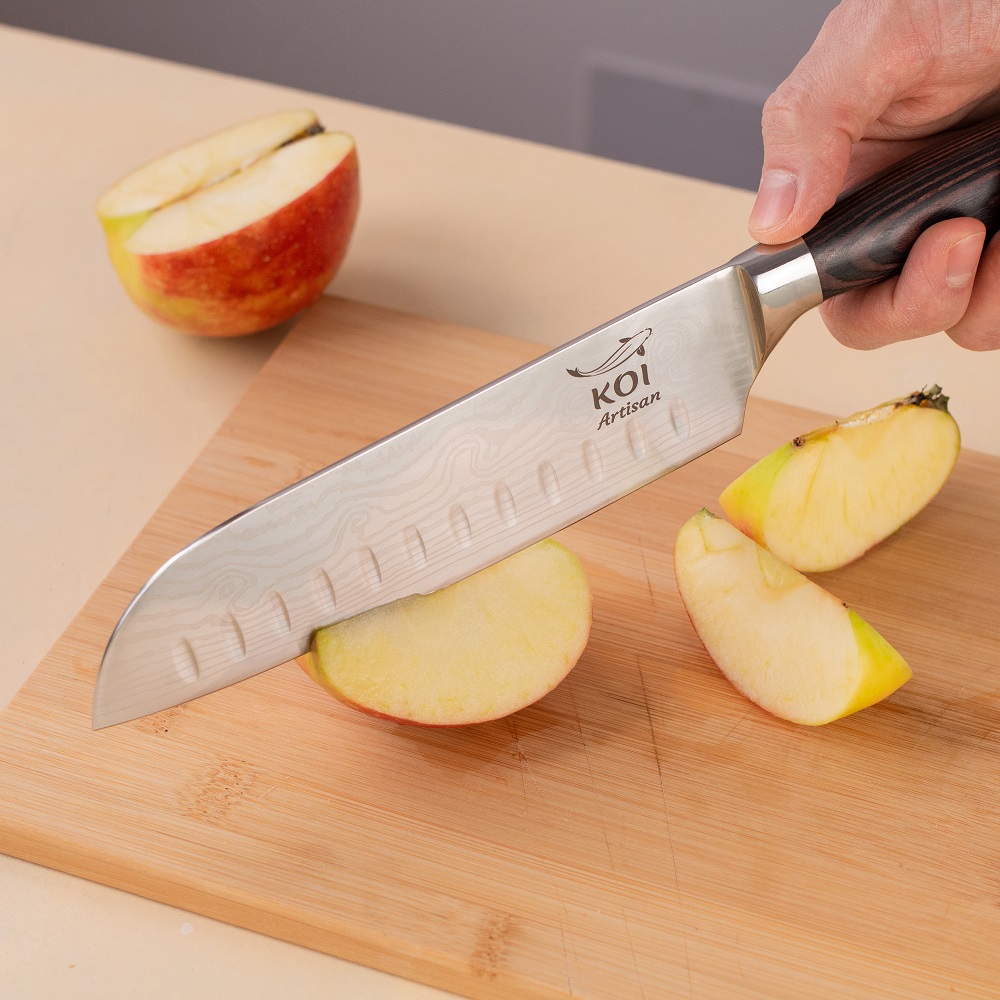
One of the most recognizable tech features of a Santoku is the “Granton edge”—the series of hollowed-out divots or scallops along the side of the blade. These are not decorative. From a physics perspective, these indentations act as air pockets that break the vacuum seal between the blade and the food. When slicing moisture-rich items like potatoes or cold proteins, these “air-cushion” pockets reduce surface tension. This allows for faster repetition rates in cutting, as the food falls away from the blade rather than sticking to it, optimizing the workflow of the kitchen station.
3. Ergonomics and the Human-Machine Interface (HMI)
The Santoku is often preferred in modern kitchens because of its superior ergonomics. In tech development, we refer to this as the Human-Machine Interface—the way a tool interacts with the physical constraints of the operator.

Weight Distribution and Geometric Balance
Traditional knives often feature a heavy “bolster” (the junction between blade and handle) which shifts the center of gravity toward the hand. The Santoku, however, is typically designed with a “blade-forward” balance. This technical shift utilizes gravity to assist in the downward “push-cut.” By optimizing the weight distribution, manufacturers reduce the strain on the user’s wrist and carpal tunnel. This is an essential design consideration for professional environments where repetitive motion injuries are a significant risk.
Computational Design in Handle Construction
Modern Santoku handles have moved beyond simple wood. Many now feature G10 (a high-pressure fiberglass laminate) or carbon fiber, materials more commonly found in aerospace or high-end tactical gear. These materials are chosen for their dimensional stability; they do not expand or contract with temperature changes in the kitchen. Using CAD (Computer-Aided Design), manufacturers can shape these handles to fit the palm’s natural contours, ensuring that the “grip-to-blade” feedback loop is as precise as possible.
4. Manufacturing Evolution: From Hand-Forged to CNC Precision
The “use case” of a Santoku is also a reflection of how it is made. The transition from traditional smithing to digital manufacturing has allowed for a level of consistency that was previously impossible.
Laser Cutting and CNC Grinding
High-end Santoku production now heavily relies on CNC (Computer Numerical Control) grinding machines. These machines can taper a blade to within microns of a specified thickness, ensuring that every knife performs exactly like the prototype. Laser-cutting technology allows for complex blade shapes that are perfectly symmetrical, which is vital for a tool that requires a straight, vertical path through the food. This consistency means that a chef can switch between two different Santokus of the same model and maintain the same “muscle memory” and cutting accuracy.
Cladding and Composite Technology
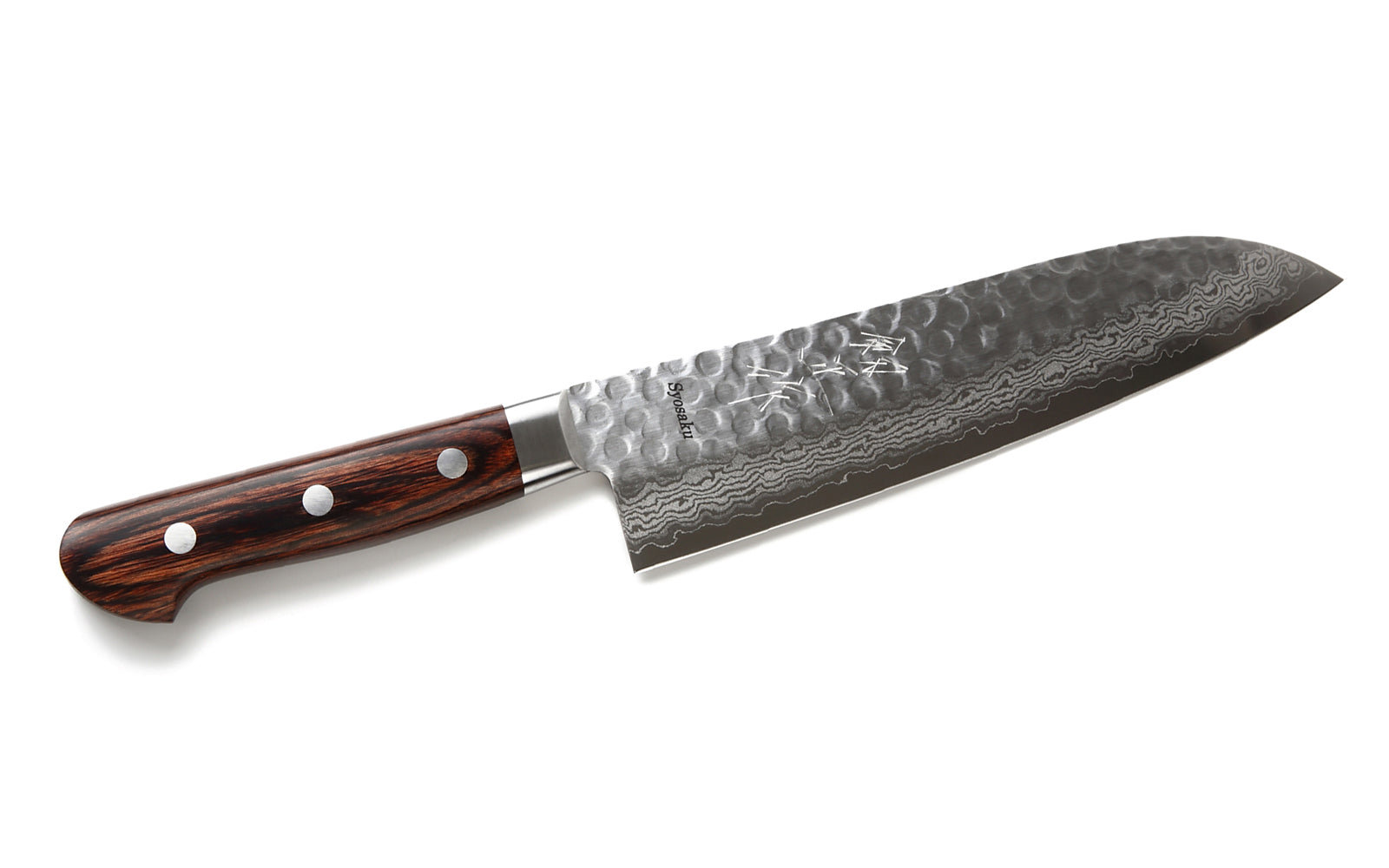
Many Santokus use “San Mai” or Damascus cladding—a tech-heavy process of layering different types of steel. Typically, a hard “core” steel (for the edge) is sandwiched between layers of softer, corrosion-resistant stainless steel. This composite construction is a brilliant engineering solution: it provides the extreme sharpness of high-carbon steel with the durability and ease of maintenance of modern alloys. It allows the knife to be used for heavy-duty tasks without the risk of the brittle core shattering.
5. The Future of Culinary Tech: Smarter Blades and New Alloys
As we look at what Santoku knives are used for today, we must also look at where the technology is heading. We are seeing the emergence of “ceramic-hybrid” Santokus and blades coated in DLC (Diamond-Like Carbon).
DLC Coatings and Friction Reduction
Diamond-Like Carbon is a nanocomposite coating that exhibits some of the unique properties of natural diamond: high hardness, low friction, and high corrosion resistance. When applied to a Santoku, it creates a surface that is nearly immune to acidic food damage and slides through proteins with almost zero resistance. This represents the next frontier in kitchen hardware—tools that use molecular engineering to outperform traditional physical limits.
The Role of AI in Blade Optimization
Leading cutlery brands are now beginning to use AI and machine learning to simulate stress points on blade designs. By inputting different cutting styles and food densities into a simulator, engineers can refine the Santoku’s profile to be even more efficient. We are reaching a point where the “virtues” of the Santoku are being mathematically perfected to ensure the maximum output with the minimum caloric expenditure from the chef.
Conclusion
A Santoku knife is far more than a simple blade; it is a sophisticated piece of technology that sits at the intersection of history and modern engineering. Its use in the kitchen—for precision slicing, efficient dicing, and effortless mincing—is the direct result of deliberate choices in metallurgy, geometry, and ergonomic design.
As technology continues to permeate every aspect of our lives, the tools we use to prepare our food are not being left behind. The Santoku remains the gold standard for those who appreciate the intersection of high-performance hardware and culinary art. Whether it is the powdered steel core, the Granton-edged physics, or the CNC-machined balance, every element of the Santoku is a testament to the power of technical optimization. For the modern professional or the tech-savvy home cook, using a Santoku is not just about cutting food—it is about operating one of the most finely tuned machines in the domestic arsenal.
aViewFromTheCave is a participant in the Amazon Services LLC Associates Program, an affiliate advertising program designed to provide a means for sites to earn advertising fees by advertising and linking to Amazon.com. Amazon, the Amazon logo, AmazonSupply, and the AmazonSupply logo are trademarks of Amazon.com, Inc. or its affiliates. As an Amazon Associate we earn affiliate commissions from qualifying purchases.