
In the landscape of computer science and digital engineering, few mathematical concepts are as foundational yet overlooked as the orthogonal matrix. While it may sound like a relic of abstract linear algebra, the orthogonal matrix is the silent workhorse behind the high-definition graphics in modern video games, the compression algorithms that make streaming video possible, and the complex neural networks that drive today’s artificial intelligence. To understand the trajectory of modern technology, one must understand the unique properties of these matrices and why they are indispensable for digital stability and computational efficiency.

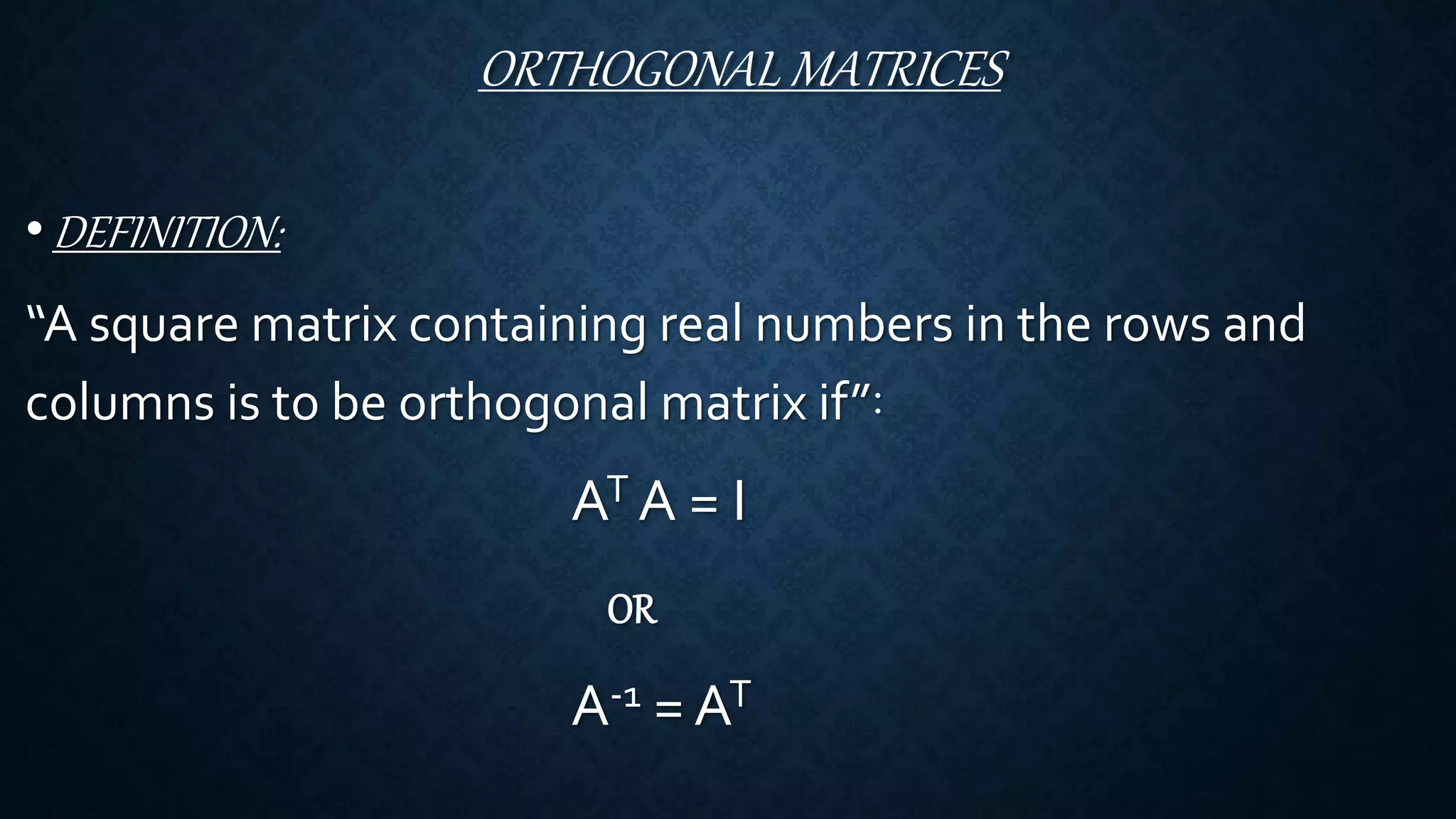
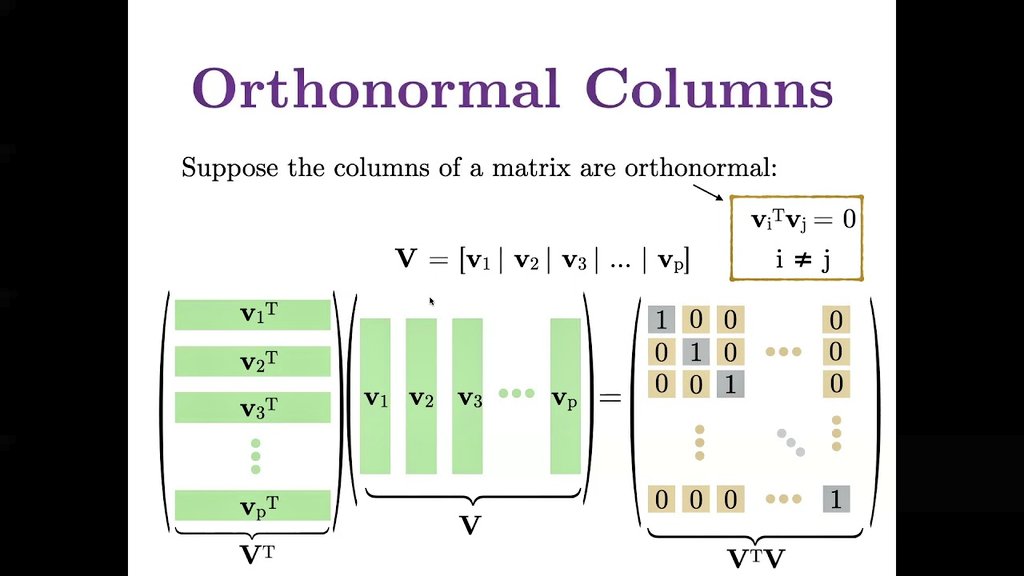
At its core, an orthogonal matrix is a square matrix whose columns and rows are orthogonal unit vectors—meaning they are perpendicular to each other and have a length of exactly one. In mathematical notation, a matrix $Q$ is orthogonal if $Q^T Q = I$, where $Q^T$ is the transpose and $I$ is the identity matrix. This simple relationship implies a profound computational advantage: the inverse of an orthogonal matrix is simply its transpose. In the world of high-performance computing, where calculating the inverse of a massive matrix is traditionally an expensive and error-prone operation, this property provides a shortcut that saves immense processing power.
The Logic of Rigidity: Why Orthogonality Matters in Data
To grasp why orthogonal matrices are so prevalent in tech, it is helpful to think of them as “rigid” transformations. When you multiply a vector by an orthogonal matrix, the vector might rotate or flip, but its length remains identical, and the angles between different vectors remain unchanged. This preservation of geometric properties is vital in any field where data integrity is paramount.
Geometric Integrity in Digital Spaces
In software engineering, specifically within 3D modeling and CAD (Computer-Aided Design) software, maintaining the proportions of an object while it moves through virtual space is critical. Whether a developer is rendering a character in a game engine like Unreal Engine 5 or simulating a bridge’s structural integrity, they rely on orthogonal matrices to ensure that a 90-degree angle stays 90 degrees and a meter-long beam remains exactly a meter long. Without the “isometry” provided by these matrices, digital objects would warp, stretch, and lose their form as they were manipulated in 3D space.
Computational Efficiency and Numerical Stability
Beyond geometry, orthogonal matrices solve a significant problem in digital security and signal processing: numerical stability. When computers perform millions of calculations in sequence, small rounding errors can accumulate, eventually leading to “floating-point drift” or catastrophic system failures. Because orthogonal matrices do not scale or distort the data—they merely reorient it—they do not amplify these tiny errors. This makes them the gold standard for algorithms that require high precision, such as those used in aerospace navigation and financial modeling software.
Transforming Visual Data: Graphics, Vision, and GPUs
One of the most visible applications of orthogonal matrices is in the realm of computer graphics and vision. Every time a user rotates a photo on their smartphone or navigates a 3D environment, the device’s GPU (Graphics Processing Unit) is executing millions of matrix multiplications per second.
The Mathematics of Rotation
In 2D and 3D graphics, rotation is represented by specific types of orthogonal matrices known as rotation matrices. These matrices allow software to calculate the new coordinates of every pixel or vertex on a screen with absolute precision. Because the inverse of a rotation is simply the reverse rotation (represented by the transpose of the matrix), GPUs can undo or change perspectives almost instantaneously. This efficiency is what allows for the high frame rates essential for immersive virtual reality (VR) and augmented reality (AR) experiences.
Computer Vision and Image Processing
In the field of computer vision, orthogonal matrices are used to align images taken from different angles—a process known as image registration. When a self-driving car’s cameras capture multiple views of a road, the system must reconcile these different perspectives into a single, cohesive 3D map. By using orthogonal transformations, the software can rotate and shift these visual inputs without introducing artifacts or distortions that could lead to misidentifying an object. This ensures that the distance to a pedestrian or a traffic light is calculated accurately, regardless of the camera’s orientation.
Powering Artificial Intelligence and Machine Learning
The explosion of artificial intelligence over the last decade has brought orthogonal matrices to the forefront of data science. In machine learning, the challenge is often to find the most important patterns within massive, noisy datasets. Orthogonal matrices provide the tools to simplify these datasets without losing critical information.
Principal Component Analysis (PCA)
One of the most common techniques in data preprocessing is Principal Component Analysis, or PCA. The goal of PCA is to reduce the dimensionality of data—for instance, taking a dataset with 500 different variables and condensing it into the five most impactful ones. This is achieved by finding the “principal components,” which are essentially a set of orthogonal vectors that represent the directions of maximum variance in the data. By projecting complex data onto an orthogonal basis, AI developers can create models that are faster, require less memory, and are less prone to “overfitting,” where the model learns noise rather than actual patterns.
Stabilizing Deep Learning Architectures
In the training of deep neural networks, engineers often face the “vanishing” or “exploding” gradient problem. As information passes through dozens of layers of a network, the numbers can become so small that the model stops learning, or so large that it crashes. To combat this, researchers have turned to “orthogonal initialization.” By initializing the weights of a neural network as orthogonal matrices, developers can ensure that the signal remains consistent as it passes through the layers. This technique has been instrumental in the development of Recurrent Neural Networks (RNNs) and Transformers, the underlying technology behind Large Language Models (LLMs).
Digital Signal Processing and Compression Algorithms
Our ability to stream high-definition video over a smartphone or store thousands of songs on a device is directly linked to the properties of orthogonal matrices. Digital Signal Processing (DSP) relies on transforming data from one “domain” to another to make it easier to manipulate.
The Discrete Cosine Transform (DCT)
The JPEG image format and the MPEG video standard (used by Netflix and YouTube) rely heavily on the Discrete Cosine Transform, which is built upon orthogonal matrices. The DCT takes a grid of pixel values and transforms them into a set of frequencies. Because the transformation is orthogonal, it is perfectly reversible and highly efficient. Once the data is in the frequency domain, the software can “discard” the high-frequency information that the human eye cannot perceive, drastically reducing the file size without a noticeable loss in quality.
Noise Reduction and Audio Engineering
In audio processing, orthogonal matrices are used to separate a desired signal from background noise. For example, the noise-cancellation technology in modern headphones uses orthogonal projections to isolate the “noise” vector and subtract it from the “audio” vector. This same logic applies to wireless communication, where orthogonal frequency-division multiplexing (OFDM) allows multiple data signals to be sent over the same radio frequency without interfering with one another. This is the backbone of 4G, 5G, and modern Wi-Fi standards.
The Future of Orthogonality: Quantum Computing and Beyond
As we move toward the next frontier of technology—quantum computing—the importance of orthogonal matrices is only set to increase. In the quantum realm, the operations performed on qubits (quantum bits) are represented by unitary matrices. A unitary matrix is essentially the complex-number version of an orthogonal matrix.
Unitary Operations and Qubits
In a quantum computer, data is not stored as 0s and 1s but as states in a complex vector space. To perform a calculation, the computer must rotate these states using unitary transformations. Just as orthogonal matrices preserve the length of vectors in real space, unitary matrices preserve the probability amplitudes in quantum space. This ensures that the total probability of all possible outcomes always adds up to 100%, maintaining the physical integrity of the quantum system.
Post-Quantum Cryptography
The tech industry is also looking toward orthogonal matrices for security. Current encryption methods, like RSA, are vulnerable to the theoretical power of future quantum computers. In response, developers are creating “lattice-based cryptography,” a form of encryption that relies on the difficulty of finding the shortest vector in a high-dimensional grid. Orthogonalization processes (such as the Gram-Schmidt process) are central to both attacking and defending these new cryptographic standards.
The Foundation of Digital Efficiency
While the term “orthogonal matrix” might remain confined to textbooks for most people, its impact is felt every time we unlock a phone with facial recognition, stream a movie, or interact with an AI assistant. These matrices provide the mathematical framework for a digital world that is fast, stable, and incredibly precise. By allowing us to rotate, transform, and compress data without losing its essence, orthogonal matrices have become the invisible scaffolding upon which the modern tech stack is built. As we push into the realms of 5G, real-time ray tracing, and quantum supremacy, this ancient piece of linear algebra will remain at the very center of the innovation curve.
aViewFromTheCave is a participant in the Amazon Services LLC Associates Program, an affiliate advertising program designed to provide a means for sites to earn advertising fees by advertising and linking to Amazon.com. Amazon, the Amazon logo, AmazonSupply, and the AmazonSupply logo are trademarks of Amazon.com, Inc. or its affiliates. As an Amazon Associate we earn affiliate commissions from qualifying purchases.