
The question “How’s the stock market?” is perennially on the minds of investors, economists, and even casual observers. It’s a query that seems simple on the surface, yet its answer is a complex tapestry woven from global economics, corporate performance, geopolitical shifts, technological innovation, and human psychology. Unlike a fixed weather report, the stock market is a dynamic, living entity, constantly reacting and adapting. Understanding its current state requires more than a glance at a headline index; it demands a deeper dive into the underlying forces at play and a nuanced interpretation of various indicators.
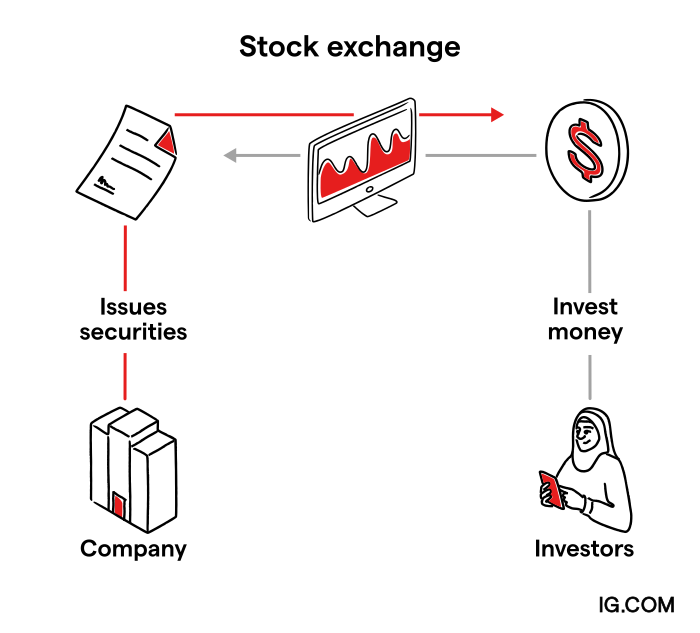
At its core, the stock market reflects collective expectations about the future profitability of businesses. When these expectations are high, prices tend to rise; when uncertainty or pessimism prevails, they often fall. However, this is a simplification. The market is also a forward-looking mechanism, attempting to discount future events before they fully materialize. This inherent complexity makes it both challenging and endlessly fascinating to analyze. To truly answer “how’s the stock market,” one must dissect its present condition, evaluate the factors shaping its trajectory, and consider the strategies best suited for navigating its inherent volatility.
Decoding Current Market Dynamics
The stock market never operates in a vacuum. Its performance is deeply intertwined with the broader economic environment, policy decisions, and global events. Understanding these foundational elements is crucial for any informed assessment.
The Tug-of-War: Inflation, Interest Rates, and Economic Growth
Perhaps the most significant drivers of market sentiment in recent periods have been inflation and the corresponding central bank responses. High inflation erodes purchasing power and corporate profit margins, making future earnings less certain. Central banks, notably the Federal Reserve in the U.S. and the European Central Bank, respond by raising interest rates to cool down the economy and bring inflation under control. While necessary, higher interest rates increase borrowing costs for businesses and consumers, potentially slowing economic growth and reducing corporate profitability, which in turn can dampen stock market enthusiasm.
The challenge lies in finding the delicate balance: taming inflation without triggering a severe recession. This “soft landing” scenario is what policymakers aim for, but achieving it is difficult. Market participants constantly gauge whether current interest rate levels are restrictive enough to slow inflation but not so high as to crush economic activity. Any data suggesting a deviation from this path – be it stubbornly high inflation or signs of a rapidly deteriorating economy – can send ripples through equity markets. This creates a constant tension, a tug-of-war between the need for price stability and the desire for robust economic expansion. The market often fluctuates as it tries to price in the probability of one outcome over the other, leading to periods of heightened volatility and uncertainty as investors adjust their expectations.
Sectoral Performance and Shifting Leadership
While broad market indices like the S&P 500 or the NASDAQ 100 offer a general snapshot, the underlying performance of various sectors can tell a more detailed story. Market leadership often rotates depending on the economic cycle and prevailing trends. For instance, during periods of rapid technological advancement and low interest rates, growth-oriented sectors like technology, software, and innovative healthcare tend to outperform. Companies in these sectors often re-invest heavily in research and development, promising future earnings growth that is more highly valued in a low-interest-rate environment.
Conversely, when inflation is high and interest rates are rising, “value” sectors such as financials, energy, and certain consumer staples might come into favor. These companies often have more stable earnings, pay higher dividends, and are less sensitive to economic slowdowns. Furthermore, the energy sector, in particular, benefits directly from higher commodity prices, which often accompany inflationary periods. This rotation highlights a crucial point: “the stock market” isn’t a monolithic entity. Different parts of it react differently to the same economic forces. Astute investors pay close attention to these sectoral shifts, identifying where capital is flowing and understanding the underlying reasons for these movements, as it provides critical insights into market sentiment and future trends.
Geopolitical Headwinds and Tailwinds
Global politics, conflicts, and trade relations exert a significant, though sometimes unpredictable, influence on financial markets. Major geopolitical events – be it a war, a trade dispute between economic superpowers, or a global pandemic – can disrupt supply chains, impact commodity prices, shift investor confidence, and even redraw the map of international commerce. For example, conflicts can lead to energy price spikes and increased defense spending, benefiting certain industries while hurting others. Trade disputes can impact corporate profitability by increasing tariffs and limiting market access.
Conversely, diplomatic breakthroughs, new trade agreements, or periods of relative stability can act as tailwinds, fostering greater investor confidence and facilitating global economic activity. The interconnectedness of today’s global economy means that an event in one corner of the world can quickly ripple across markets thousands of miles away. Investors are forced to constantly monitor these developments, as they can introduce both significant risks and unexpected opportunities. Evaluating the stock market’s health therefore requires considering the delicate balance of geopolitical stability and the potential for disruption.
Key Indicators and What They Tell Us
Beyond the broad economic narrative, specific data points and corporate reports offer tangible insights into the market’s current trajectory and future prospects. These indicators act as vital signs, providing a pulse check on the health of the corporate sector and the broader economy.
Earnings Season: The Corporate Pulse
Perhaps the most direct measure of corporate health is revealed during earnings season, when public companies report their quarterly financial results. These reports detail revenues, profits, and provide forward-looking guidance. Strong earnings and revenue growth, especially when they exceed analyst expectations, typically boost investor confidence and stock prices. Conversely, misses or a cautious outlook can lead to significant sell-offs.
Beyond the headline numbers, investors scrutinize earnings calls for insights into management’s perspective on the economic environment, supply chain issues, consumer demand, and future investment plans. The quality of earnings—whether they are driven by sustainable growth or one-off factors—is also critical. Furthermore, aggregate earnings trends across sectors can provide a clear picture of the overall health and momentum of the corporate landscape, acting as a direct barometer for the market’s underlying strength.
Consumer Confidence and Spending Habits
Consumer spending is the lifeblood of many economies, particularly in developed nations where it often accounts for a significant portion of GDP. Therefore, consumer confidence – an indicator of how optimistic consumers are about the state of the economy and their personal financial situation – is a critical determinant of market performance. When confidence is high, consumers are more likely to spend on goods and services, which drives corporate revenues and profitability. Low confidence, conversely, can lead to belt-tightening, reduced spending, and a slowdown in economic activity.
Indices like the Consumer Confidence Index or the University of Michigan Consumer Sentiment Index are closely watched. Alongside these surveys, actual retail sales data provide a concrete measure of consumer spending habits. Trends in discretionary spending versus essential spending, or shifts towards services over goods, offer further granularity. A robust and confident consumer base acts as a strong foundation for a healthy stock market, as it signals ongoing demand for corporate products and services.
Employment Figures and Wage Growth
A strong labor market is a cornerstone of economic health and a key factor influencing the stock market. Low unemployment rates, coupled with steady wage growth, indicate a robust economy where people have jobs and disposable income. This supports consumer spending and, by extension, corporate revenues. Unemployment reports, such as the monthly non-farm payrolls in the U.S., are therefore highly anticipated and can cause significant market movements.
However, rapid wage growth can also be a double-edged sword. While beneficial for workers, if it outpaces productivity gains, it can contribute to inflationary pressures. Central banks monitor wage growth closely as an input into their monetary policy decisions. A “hot” labor market, while desirable in many respects, can signal continued inflation, potentially prompting central banks to maintain or even increase interest rates, which can be a headwind for the stock market. Therefore, investors seek a balanced labor market—strong enough to support economic activity but not so tight as to fuel runaway inflation.
Navigating Market Volatility and Risk
Volatility is an inherent characteristic of stock markets. While it can be unnerving, understanding its drivers and adopting sound investment principles are essential for long-term success.
The Psychological Impact of Market Swings
Market swings are not just numerical fluctuations; they have a profound psychological impact on investors. Periods of rapid ascent can fuel “fear of missing out” (FOMO), leading to speculative behavior and asset bubbles. Conversely, sharp declines can trigger panic selling, where investors offload assets at depressed prices, often locking in losses. This emotional rollercoaster is one of the biggest challenges for individual investors.
Recognizing these psychological biases is the first step in mitigating their negative effects. A professional, insightful approach involves cultivating emotional discipline, focusing on long-term goals rather than short-term noise, and avoiding knee-jerk reactions to daily market headlines. Understanding that volatility is normal and an inevitable part of investing helps in maintaining a rational perspective during turbulent times.

Diversification: Your Best Defense
Diversification is arguably the most fundamental principle of prudent investing, especially in a volatile market. It involves spreading investments across various asset classes (stocks, bonds, real estate, commodities), different sectors (technology, healthcare, finance, energy), various geographies, and even different company sizes. The goal is to reduce overall portfolio risk by ensuring that a poor performance in one area is offset by better performance in another.
A well-diversified portfolio helps cushion the impact of downturns in specific market segments. For instance, if the technology sector is underperforming, a diversified investor might find their losses mitigated by stronger performance in defensive sectors or bonds. Diversification doesn’t eliminate risk, but it manages it effectively, providing a smoother ride over the long term and protecting capital from severe localized shocks. It ensures that an investor isn’t putting “all their eggs in one basket,” which is a recipe for potential financial disaster.
Rebalancing and Risk Assessment
Even a well-diversified portfolio requires ongoing attention. Market movements can cause an investor’s initial asset allocation to drift significantly over time. For example, a strong bull market in stocks might lead equities to represent a much larger portion of a portfolio than originally intended, thereby increasing its overall risk profile. This is where rebalancing comes in.
Rebalancing involves periodically adjusting the portfolio back to its target asset allocation. This typically means selling some assets that have performed well (and are now overweight) and buying more of those that have underperformed (and are now underweight). This systematic approach forces investors to “buy low and sell high” to a certain extent, while also ensuring that the portfolio’s risk level remains consistent with their comfort zone and financial goals. Regular risk assessment, evaluating one’s personal financial situation, time horizon, and capacity for loss, is crucial alongside rebalancing to ensure the investment strategy remains aligned with individual circumstances.
A Look Ahead: Trends Shaping the Future
The stock market is not just about the present; it’s constantly looking forward, anticipating future trends and innovations that will reshape industries and investment opportunities.
The Persistent Influence of Technology and Innovation
While technology companies themselves are a sector, the overarching influence of technological advancement permeates all aspects of the stock market and the economy. Innovations in artificial intelligence, automation, biotechnology, renewable energy, and digital infrastructure are not just creating new industries; they are transforming existing ones. Companies that successfully adopt and leverage these technologies tend to be more efficient, competitive, and profitable, making them attractive investments.
Investors must consider how technological trends will impact various sectors. For instance, AI could revolutionize healthcare diagnostics, manufacturing processes, and financial services. Green technologies are driving massive investment in renewable energy and sustainable solutions. Staying abreast of these overarching technological shifts is crucial for identifying long-term growth opportunities, even in traditional industries, and understanding which companies are best positioned for future success.
ESG Investing: Values Meeting Valuations
Environmental, Social, and Governance (ESG) factors have rapidly moved from a niche concern to a mainstream consideration in investment decisions. Investors are increasingly looking beyond traditional financial metrics to assess a company’s impact on the planet, its treatment of employees and communities, and the integrity of its leadership. Companies with strong ESG practices are often seen as more sustainable, resilient, and better positioned for long-term growth, as they may face fewer regulatory risks, attract top talent, and appeal to a growing segment of socially conscious consumers.
The growth of ESG investing signifies a shift in how value is perceived in the market. It suggests that non-financial factors can have a material impact on a company’s financial performance and reputation. Many institutional investors now incorporate ESG criteria into their investment processes, and the availability of ESG-focused funds and indices is rapidly expanding. This trend indicates a growing recognition that responsible business practices are not just good for society but also contribute to robust, long-term shareholder value.
Global Economic Interconnectedness
The concept of a truly isolated national economy is largely a relic of the past. Today’s global economy is profoundly interconnected, meaning that events in one major region can quickly reverberate across financial markets worldwide. A slowdown in China can impact demand for goods produced in Europe or raw materials from Latin America. Interest rate decisions by the U.S. Federal Reserve can influence currency values and capital flows in emerging markets.
This interconnectedness means that investors need a global perspective. Diversifying internationally, understanding macroeconomic trends across different continents, and monitoring global trade relations and currency fluctuations are all becoming increasingly important. While this adds a layer of complexity, it also opens up a broader universe of investment opportunities and allows for greater diversification, helping investors to capture growth wherever it may occur and mitigate region-specific risks.
Strategies for the Prudent Investor
Navigating the stock market, particularly during periods of uncertainty, requires more than just understanding the current landscape; it demands a clear, disciplined strategy.
Adopting a Long-Term Perspective
One of the most powerful strategies for success in the stock market is adopting a long-term perspective. Historically, equity markets have demonstrated a remarkable ability to recover from downturns and generate positive returns over extended periods. Short-term market fluctuations, while emotionally taxing, often represent noise rather than fundamental shifts. Investors who focus on long-term growth—thinking in terms of decades rather than months or years—are less likely to be swayed by daily headlines or temporary dips.
This perspective encourages investors to remain invested through market cycles, allowing the power of compounding to work its magic. It emphasizes “time in the market” over “timing the market,” acknowledging that consistently guessing market bottoms and tops is an impossible feat for even the most seasoned professionals. For most investors, patience and perseverance are far more valuable than attempting to outsmart short-term volatility.
The Power of Dollar-Cost Averaging
Dollar-cost averaging (DCA) is a simple yet effective strategy for mitigating the impact of market volatility. It involves investing a fixed amount of money at regular intervals, regardless of the market’s current price. For example, investing $500 every month into an index fund. When prices are high, your fixed investment buys fewer shares; when prices are low, it buys more shares.
Over time, this strategy averages out the purchase price of your investments, reducing the risk of making a large investment at an unfavorable peak. It removes emotion from the investment decision and fosters consistent saving habits. DCA is particularly beneficial for long-term investors building their portfolios, as it systematically capitalizes on market dips without requiring any market-timing expertise.

Seeking Professional Guidance
While self-directed investing has become increasingly accessible, the complexity of financial markets, the array of investment products, and the ever-changing economic landscape can be overwhelming. For many, seeking guidance from a qualified financial advisor is a prudent strategy. A good advisor can help assess an individual’s financial goals, risk tolerance, and time horizon, and then construct a personalized investment plan.
They can provide objective advice, help rebalance portfolios, educate on different investment vehicles, and—perhaps most importantly—help clients avoid emotional investment decisions during volatile periods. While there are costs associated with financial advice, the value derived from a well-structured plan, disciplined execution, and the peace of mind it offers often outweighs these expenses, particularly for those looking to build substantial wealth over the long term.
To answer the question “How’s the stock market?”, one must conclude that it is perpetually in flux—a complex system constantly recalibrating based on a multitude of variables. It is influenced by the push and pull of economic forces like inflation and interest rates, shaped by geopolitical events, and driven by the fundamental performance of corporations. While challenges and volatility are inevitable, the market also continually presents opportunities born from innovation and adaptation. For the prudent investor, understanding these dynamics, focusing on long-term principles, diversifying wisely, and managing emotional responses are the bedrock of navigating its intricate dance and ultimately achieving financial goals. The market’s health isn’t a single data point, but a nuanced narrative that demands continuous, informed engagement.
aViewFromTheCave is a participant in the Amazon Services LLC Associates Program, an affiliate advertising program designed to provide a means for sites to earn advertising fees by advertising and linking to Amazon.com. Amazon, the Amazon logo, AmazonSupply, and the AmazonSupply logo are trademarks of Amazon.com, Inc. or its affiliates. As an Amazon Associate we earn affiliate commissions from qualifying purchases.