
In the intricate world of personal finance, business transactions, and everyday consumerism, understanding how to calculate discounts is not just a useful skill—it’s an essential one. From sales events and coupon redemptions to negotiating bulk purchases or simply verifying a reduced price, the ability to quickly and accurately determine a percentage off a price empowers individuals to make informed financial decisions. This guide will demystify the process, offering clear, actionable steps, and insights into the broader financial implications of discounts.
Understanding the Fundamentals of Percentage Discounts
Before diving into the mechanics of calculation, it’s crucial to grasp the foundational concepts that underpin percentage-based reductions. A solid understanding here will not only make the calculations easier but also highlight the financial significance of these figures.

What is a Percentage?
At its core, a percentage is simply a way of expressing a number as a fraction of 100. The word “percentage” itself comes from “per cent,” meaning “per one hundred.” So, 25% means 25 out of 100, or 25/100, which is equivalent to 0.25 in decimal form. This conversion to a decimal is often the key to simplifying percentage calculations. For instance, if you want to find 25% of a number, you multiply that number by 0.25. If you’re taking 25% off a number, you’re essentially looking for 75% of that number, which is 100% – 25%.
Why Discounts Matter (for Consumers and Businesses)
For consumers, discounts represent direct savings, allowing them to stretch their budgets further, acquire desired goods and services at a lower cost, or even afford items they might otherwise deem too expensive. A shrewd shopper understands that a 20% discount on a major purchase can translate into hundreds or even thousands of dollars saved, which can then be allocated to other financial goals like savings, investments, or debt repayment.
From a business perspective, offering discounts is a powerful marketing and sales strategy. It can drive traffic, clear excess inventory, attract new customers, reward loyal patrons, or stimulate sales during slow periods. While a discount reduces the per-unit revenue, the increased sales volume and customer engagement can often outweigh this reduction, leading to higher overall profits and market share. Businesses must carefully balance the allure of a discount with the need to maintain profitability.
Common Scenarios for Percentage Discounts
Percentage discounts are ubiquitous across various financial and commercial landscapes. You’ll encounter them in:
-
Retail Sales: “20% off all marked prices,” “Buy One Get One 50% Off.”
-
Service Industries: “First month 15% off,” “Senior discount 10%.”
-
Online Shopping: Coupon codes offering “30% off your entire order.”
-
Financial Products: “Reduced interest rate by 0.5%,” “Waived fee for 2%.”
-
Negotiations: Discussions about reducing the cost of a service or product by a certain percentage.
-
Real Estate: Price reductions on properties, often expressed as a percentage of the original listing price.
Understanding these contexts helps in recognizing when and where to apply your percentage calculation skills, making you a more financially astute participant in the economy.
Step-by-Step Guide to Calculating Percentage Reductions
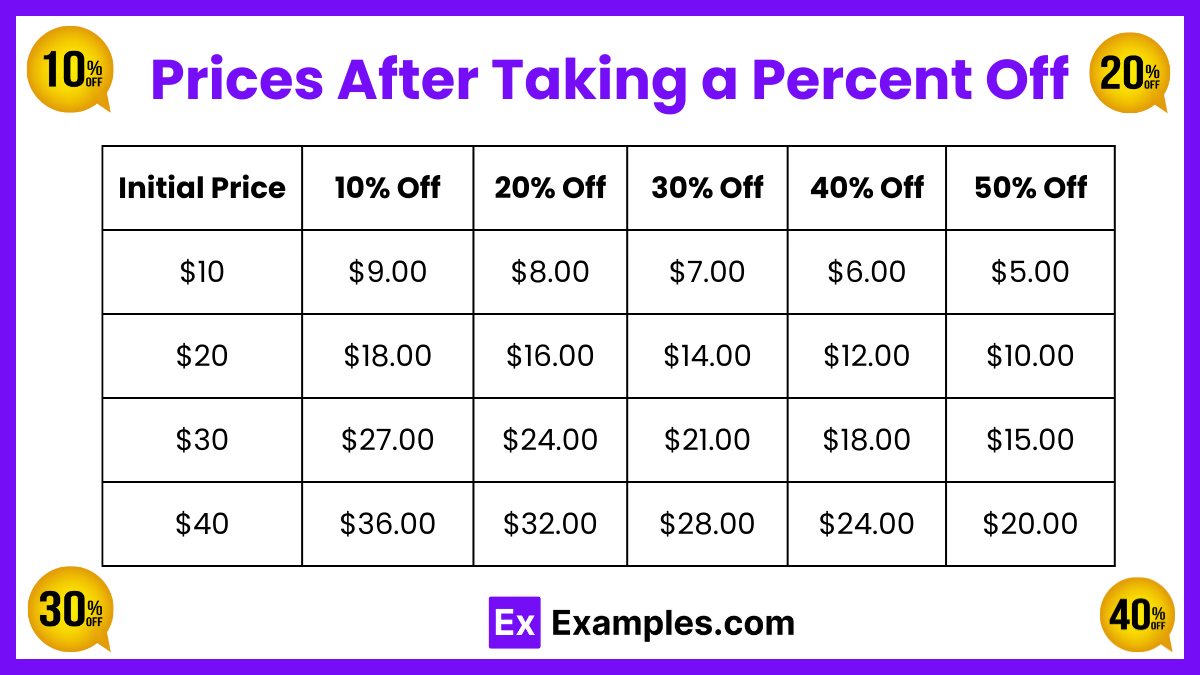
Mastering the calculation of percentage discounts involves a few straightforward methods. Both approaches yield the same correct answer, but one might feel more intuitive or efficient depending on the situation and what information you primarily seek (the discount amount or the final price).
Method 1: Calculating the Discount Amount First
This method breaks the process into two distinct steps: first finding out how much money the discount saves you, and then subtracting that amount from the original price.
-
Convert the percentage to a decimal: Divide the percentage by 100.
-
Example: 25% becomes 0.25 (25 ÷ 100).
-
Example: 10% becomes 0.10 (10 ÷ 100).
-
-
Multiply the decimal by the original price: This gives you the monetary value of the discount.
-
Example: If an item costs $80 and has a 25% discount, multiply $80 by 0.25.
$80 times 0.25 = $20. (The discount amount is $20).
-
-
Subtract the discount amount from the original price: This reveals the final price you will pay.
- Example: $80 (original price) – $20 (discount) = $60. (The final price is $60).
This method is particularly useful if you want to explicitly know how much money you are saving.
Method 2: Calculating the Final Price Directly
This approach is often more efficient as it combines the steps, directly yielding the final discounted price. It relies on the understanding that if you’re taking a percentage off a price, you’re paying the remaining percentage of that price.
-
Determine the percentage you will pay: Subtract the discount percentage from 100%.
-
Example: For a 25% discount, you will pay 100% – 25% = 75% of the original price.
-
Example: For a 10% discount, you will pay 100% – 10% = 90% of the original price.
-
-
Convert this “payment percentage” to a decimal: Divide it by 100.
-
Example: 75% becomes 0.75 (75 ÷ 100).
-
Example: 90% becomes 0.90 (90 ÷ 100).
-
-
Multiply the decimal by the original price: This gives you the final discounted price.
-
Example: If an item costs $80 and has a 25% discount, you will pay 75% of $80.
$80 times 0.75 = $60. (The final price is $60).
-
This method streamlines the process, especially when your primary goal is to find the final price quickly.
Practical Examples
Let’s apply these methods to a few common scenarios:
-
Scenario 1: 15% off a $120 item.
-
Method 1:
-
Discount amount: $120 times 0.15 = $18
-
Final price: $120 – $18 = $102
-
-
Method 2:
-
Payment percentage: 100% – 15% = 85%
-
Final price: $120 times 0.85 = $102
-
-
-
Scenario 2: 40% off a $500 item.
-
Method 1:
-
Discount amount: $500 times 0.40 = $200
-
Final price: $500 – $200 = $300
-
-
Method 2:
-
Payment percentage: 100% – 40% = 60%
-
Final price: $500 times 0.60 = $300
-
-
-
Scenario 3: 75% off a $2,000 item.
-
Method 1:
-
Discount amount: $2,000 times 0.75 = $1,500
-
Final price: $2,000 – $1,500 = $500
-
-
Method 2:
-
Payment percentage: 100% – 75% = 25%
-
Final price: $2,000 times 0.25 = $500
-
-
These examples illustrate the versatility and reliability of both methods. Choose the one that best fits your immediate needs and comfort level.
Tools and Strategies for Efficient Discount Calculations
While mental math is a valuable skill, various tools and strategies can make discount calculations even faster and more accurate, especially for complex figures or large purchases.
Leveraging Calculators and Spreadsheets
The most obvious tool is a simple calculator, whether it’s a dedicated device, one built into your computer’s operating system, or a smartphone app. For quick, on-the-spot calculations, a basic calculator is indispensable.
For more involved financial planning, or if you’re dealing with multiple discounts and items (e.g., managing inventory or a complex shopping list), a spreadsheet program like Microsoft Excel or Google Sheets is incredibly powerful. You can set up formulas that automatically calculate discounts, total prices, and even sales tax.

-
Example in Excel:
-
If original price is in cell A1 and discount percentage (as a decimal) is in cell B1, the discount amount would be
=A1*B1. -
The final price would be
=A1-(A1*B1)or more efficiently,=A1*(1-B1). This allows for dynamic calculations where you can change the price or discount and see the result instantly.
-
Smartphone Apps for Financial Calculations
Beyond the basic calculator app, many specialized apps are designed to assist with shopping and financial calculations. These apps can often:
-
Handle multiple items: Calculate total discounts across an entire shopping cart.
-
Incorporate sales tax: Automatically add local sales tax after discounts have been applied.
-
Compare deals: Help determine which discount (e.g., “20% off” vs. “$50 off”) provides greater savings.
-
Unit pricing: Help you compare prices per unit, especially useful in grocery shopping.
Searching your app store for “discount calculator” or “shopping calculator” will reveal a plethora of options tailored to various needs.
Mental Math Shortcuts for Quick Estimates
While precision is key for actual transactions, being able to quickly estimate a discount mentally is a powerful skill for budgeting and on-the-fly decision-making.
-
Finding 10%: This is the easiest. Just move the decimal point one place to the left.
-
10% of $50 is $5.
-
10% of $120 is $12.
-
-
Using 10% as a base:
-
For 20%: Calculate 10% and multiply by 2. (20% of $50 = $5 x 2 = $10).
-
For 5%: Calculate 10% and divide by 2. (5% of $50 = $5 / 2 = $2.50).
-
For 15%: Calculate 10% and add 5%. (15% of $50 = $5 + $2.50 = $7.50).
-
-
Estimating for percentages near common fractions:
-
25% is 1/4. (25% off $80 is 1/4 of $80 = $20).
-
33.3% is 1/3. (Approx. 33% off $90 is 1/3 of $90 = $30).
-
50% is 1/2. (50% off $100 is 1/2 of $100 = $50).
-
These mental shortcuts allow you to quickly assess the value of a deal without needing a physical calculator, making you a more agile and informed shopper.
Beyond the Basics: Advanced Applications and Considerations
The world of discounts isn’t always straightforward. Sometimes, there are layers of complexity that require a deeper understanding of percentage calculations.
Understanding Stackable Discounts and Exclusions
Not all discounts are created equal, especially when multiple offers are present.
-
Stackable Discounts: These are discounts that can be applied one after another. If an item is 20% off, and you have an additional 10% off coupon, the order of application matters. Generally, the second discount is applied to the already discounted price, not the original price.
-
Original price: $100
-
First discount (20%): $100 – ($100 * 0.20) = $80
-
Second discount (10% off the new price): $80 – ($80 * 0.10) = $72
-
This is different from a straight 30% off, which would be $70.
-
-
Non-Stackable Discounts/Exclusions: Many promotions explicitly state “cannot be combined with other offers” or list specific exclusions (e.g., “discount not valid on electronics” or “certain brands excluded”). Always read the fine print to avoid disappointment and accurately calculate your final cost.
Calculating Sales Tax After Discounts
Sales tax is typically applied to the final discounted price, not the original price. This is another area where understanding the order of operations is crucial for accurate financial planning.
-
Example: An item costs $60, with a 25% discount, and a 5% sales tax.
-
Calculate the discounted price: $60 – ($60 * 0.25) = $60 – $15 = $45
-
Calculate sales tax on the discounted price: $45 * 0.05 = $2.25
-
Total final price: $45 + $2.25 = $47.25
-
Mistakenly applying sales tax to the original price would lead to an overpayment.
Reverse Percentage Problems (Finding Original Price)
Sometimes you know the discounted price and the percentage off, but you want to find the original price. This is a common challenge for businesses verifying supplier invoices or consumers trying to understand the true value of a deal without the original tag.
-
Example: An item is now $75 after a 25% discount. What was the original price?
-
Understand what percentage of the original price you paid: If it was 25% off, you paid 100% – 25% = 75% of the original price.
-
Set up an equation: Let ‘X’ be the original price. You know that 75% of X is $75.
- $0.75 * X = $75
-
Solve for X: Divide the discounted price by the decimal equivalent of the “payment percentage.”
-
$X = $75 / 0.75$
-
$X = $100
-
- The original price was $100.
-
This “reverse” calculation is a testament to the versatility of percentage understanding in financial analysis.
The Financial Savvy Behind Discount Shopping
Beyond the arithmetic, there’s a broader financial intelligence at play when dealing with discounts. It involves more than just finding the lowest price; it’s about making financially sound decisions.
Budgeting with Discounts in Mind
Smart budgeters don’t just allocate funds; they actively seek opportunities to optimize spending. Incorporating discounts into your budgeting strategy means:
-
Planning purchases around sales: If you know you’ll need a new appliance, waiting for seasonal sales (Black Friday, Prime Day, end-of-season clearances) can yield significant savings.
-
Utilizing loyalty programs and coupons: Many stores offer exclusive discounts to loyal customers. Integrating these into your routine spending can lead to consistent, albeit smaller, savings.
-
Allocating saved funds wisely: When you save money through discounts, consciously decide where that money goes. Does it contribute to an emergency fund, a retirement account, or debt reduction?
Recognizing True Value vs. Perceived Savings
A “deal” isn’t always a good financial decision. True value lies in acquiring something you genuinely need or want at a price that fits your budget, regardless of the original markup.
-
Avoid impulse purchases: A large percentage off a product you don’t need or won’t use is still 100% waste of your money.
-
Compare prices across retailers: A discount at one store might still be more expensive than the regular price at another. Always do your research.
-
Consider the long-term cost: Sometimes, a slightly more expensive, higher-quality item on discount might offer better long-term value than a heavily discounted, lower-quality alternative that will need frequent replacement.
The Psychology of Price Perception and Discounts
Businesses are adept at using discounts to influence consumer behavior. Understanding these psychological tactics can help you make more rational financial choices:
-
The Power of “9”: Prices ending in .99 or .95 often make items appear cheaper than they are.
-
Anchoring: Presenting a high original price alongside a discounted price can make the deal seem more attractive, even if the discounted price is still high.
-
Scarcity and Urgency: “Limited time offer” or “only 3 left!” can create a fear of missing out, prompting hasty purchases.
-
The “Rule of 100”: For items under $100, a percentage discount feels more significant (e.g., 20% off $50 feels like a big saving). For items over $100, a dollar amount discount feels larger (e.g., “$200 off” rather than “10% off $2000”).
Being aware of these psychological tricks allows you to approach discounts with a critical eye, ensuring your decisions are driven by financial logic rather than emotional appeal.
In conclusion, the ability to confidently take a percentage off a price is a fundamental financial literacy skill. Whether you’re a consumer seeking to maximize savings, a business owner pricing products, or an investor analyzing market movements, mastering these calculations and understanding their broader implications will undoubtedly contribute to more astute financial management and decision-making.
aViewFromTheCave is a participant in the Amazon Services LLC Associates Program, an affiliate advertising program designed to provide a means for sites to earn advertising fees by advertising and linking to Amazon.com. Amazon, the Amazon logo, AmazonSupply, and the AmazonSupply logo are trademarks of Amazon.com, Inc. or its affiliates. As an Amazon Associate we earn affiliate commissions from qualifying purchases.