
Navigating the complexities of personal finance often brings us face-to-face with our tax obligations. For many, the Internal Revenue Service (IRS) can seem like a looming presence, and the question, “Do I owe the IRS money?” can cause significant anxiety. Whether you’re a seasoned taxpayer or new to managing your finances, understanding your tax status is not just about compliance; it’s a cornerstone of sound financial health. Proactively checking your tax account can prevent penalties, interest accrual, and unnecessary stress, allowing you to manage your money with greater confidence and control. This comprehensive guide will walk you through the various official and unofficial methods to determine if you have an outstanding balance with the IRS and what steps to take if you do.
Understanding Your Tax Obligation Landscape
Before diving into how to check your balance, it’s crucial to understand why you might owe the IRS money in the first place and the potential ramifications of not addressing those obligations. This foundational knowledge empowers you to approach your tax situation with a clear perspective.
Why You Might Owe Taxes
Several common scenarios can lead to a tax liability. Being aware of these can help you identify potential red flags in your financial planning:
-
Under-withholding from Paychecks: If you don’t withhold enough federal income tax from your salary throughout the year, as determined by your Form W-4, you could end up owing money at tax time. This is especially common if you’ve had multiple jobs, significant income increases, or haven’t updated your W-4 after major life events (like marriage or having children).
-
Self-Employment Income: Individuals who are self-employed, freelancers, or independent contractors often pay estimated taxes quarterly. If these estimated payments are insufficient, or if you miss payments, you’ll likely owe money when you file your annual return.
-
Investment Gains: Selling investments (stocks, bonds, real estate) for a profit can result in capital gains taxes. If these gains are substantial and not accounted for through estimated payments or other means, they can create a tax liability.
-
Insufficient Estimated Tax Payments: Beyond self-employment, income from various sources like rental properties, significant interest, dividends, or other taxable income not subject to withholding might require you to make estimated tax payments. Failing to make these or underpaying can lead to a balance due.
-
Changes in Income or Deductions: A sudden increase in income, a decrease in eligible deductions, or changes in tax laws can all impact your final tax liability, potentially leading to an unexpected bill.
-
Previous Tax Years’ Adjustments: Sometimes, the IRS may audit a past tax return or make adjustments, leading to a revised tax bill for a prior year.
The Consequences of Unpaid Taxes
Ignoring an outstanding tax balance is never advisable. The IRS has significant power to collect unpaid taxes, and the consequences can be severe:
-
Penalties: The IRS assesses penalties for various infractions, including failure to file on time, failure to pay on time, and failure to pay estimated taxes. These penalties can significantly increase the total amount you owe.
-
Interest Accrual: In addition to penalties, the IRS charges interest on underpayments, and this interest compounds daily. The longer you wait to pay, the more costly it becomes.
-
Liens and Levies: For substantial and persistent unpaid taxes, the IRS can place a federal tax lien on your property (like real estate or vehicles), making it difficult to sell or refinance. They can also issue a levy, which allows them to seize assets (like bank accounts, wages, or retirement funds) to satisfy the debt.
-
Impact on Credit: While the IRS doesn’t directly report tax debts to credit bureaus, a federal tax lien can be reported and negatively affect your credit score. Furthermore, the financial strain of large tax debts can indirectly impact your ability to manage other financial obligations, potentially harming your credit.
-
Stress and Financial Instability: Beyond the tangible financial repercussions, the psychological burden of owing the IRS can be immense, leading to stress and anxiety that spill over into other areas of your life.
Official IRS Resources for Checking Your Balance
The most reliable way to determine if you owe the IRS money is to go directly to the source. The IRS provides several official channels designed to help taxpayers check their account status securely and accurately.
Checking Your Account Online with the IRS
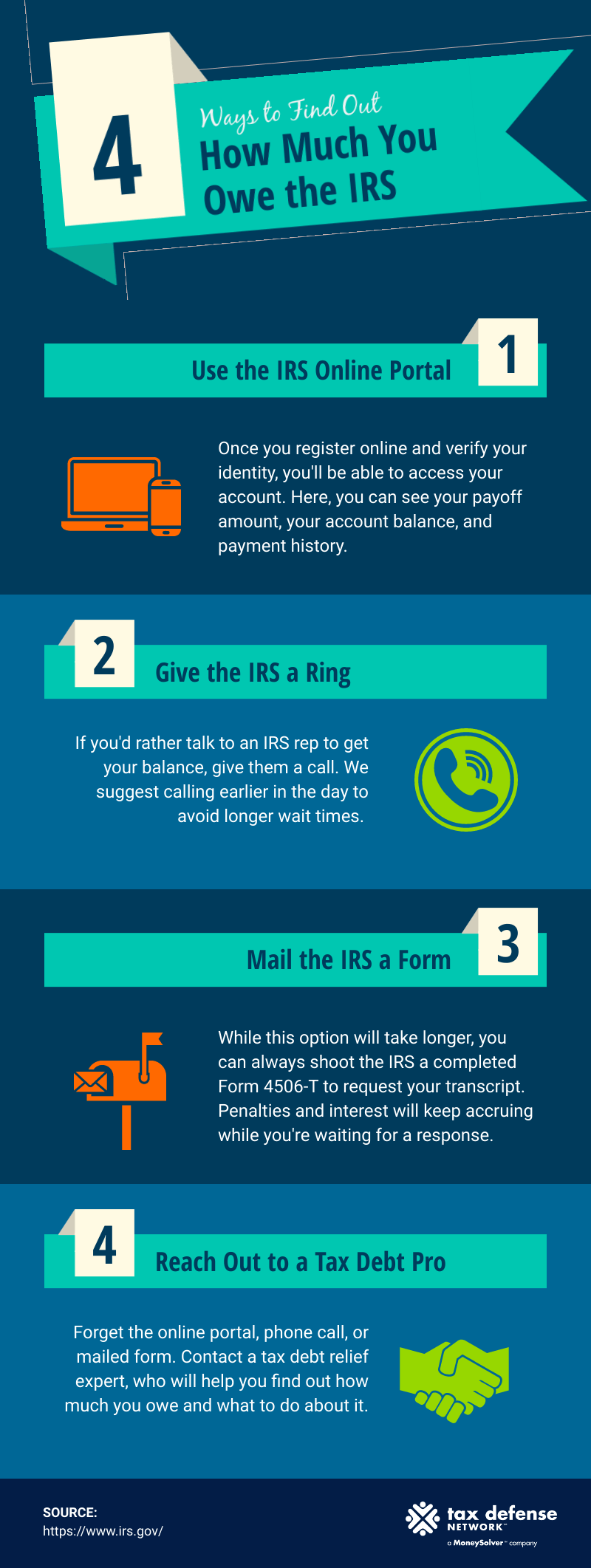
The IRS’s “View Your Account Information” tool on IRS.gov is an invaluable resource for taxpayers. This secure online portal allows you to access a wealth of information about your federal tax account.
-
What Information You Can Find There: By using this tool, you can see your current tax balance, payment history, tax return transcripts, and key information from your most recent tax return. It can show you if you have any unfiled returns the IRS is aware of, any tax adjustments, or upcoming payments due.
-
Steps to Access and Required Information: To access your account, you’ll need to verify your identity. This typically involves providing your Social Security Number (SSN) or Individual Taxpayer Identification Number (ITIN), date of birth, filing status, and an account number from a financial product (like a credit card, mortgage, or auto loan) linked to your name. You’ll also need a mobile phone number associated with your name to receive a one-time verification code.
-
Security Measures: The IRS employs robust security measures to protect your sensitive tax information. The identity verification process is thorough precisely to prevent unauthorized access. It’s crucial to ensure you are on the official IRS.gov website to avoid phishing scams.
Requesting a Tax Transcript
A tax transcript is a summary of information from your tax return, as filed, or from your tax account. It’s an excellent way to review your tax history and can often reveal outstanding balances or discrepancies.
-
What a Tax Transcript Is: Unlike a copy of your tax return, a transcript typically provides key line items and other account information, often sufficient for verifying income or identifying issues.
-
How to Get One: You can request a tax transcript online (through the “Get Transcript Online” tool on IRS.gov, which requires similar identity verification as “View Your Account”), by mail using Form 4506-T or Form 4506T-EZ, or by phone.
-
Types of Transcripts:
-
Account Transcript: Shows basic data like marital status, type of return filed, adjusted gross income (AGI), and information about payments, penalties, and adjustments for a particular tax period. This is often the best choice for checking balances.
-
Record of Account Transcript: Combines the information from the return transcript and the account transcript.
-
Return Transcript: Shows most of the line items from your filed tax return (Form 1040, 1040-SR, 1040-NR), including any attached schedules. It doesn’t show changes made after the return was filed.
-
Wage and Income Transcript: Shows data from information returns like Forms W-2, 1099, 1098, and Form 5498, which are reported to the IRS.
-
-
How It Can Help Identify Discrepancies: By reviewing your account transcript, you can see if the IRS’s records of your payments and balance match your own. Any discrepancies could indicate an outstanding balance or an error that needs to be resolved.
Contacting the IRS Directly
Sometimes, a direct conversation with an IRS representative is the most effective way to clarify your tax status, especially if you have complex questions or can’t find the information online.
-
Phone Numbers for Individuals and Businesses: The IRS provides specific phone lines for different types of inquiries. For individual taxpayers, the general toll-free number is usually the best starting point. You can find the most current numbers on the “Contact Your Local IRS Office” page on IRS.gov.
-
What to Have Ready Before Calling: To expedite the process, have your Social Security Number (SSN) or Individual Taxpayer Identification Number (ITIN), the tax year(s) in question, copies of any relevant tax returns or IRS notices, and a valid form of identification readily available. The IRS agent will need to verify your identity before discussing sensitive account details.
-
Visiting a Taxpayer Assistance Center (TAC): For issues that require in-person help, such as identity theft concerns, preparing an Offer in Compromise, or needing help with a tax lien/levy, you can visit a Taxpayer Assistance Center. It’s highly recommended to make an appointment in advance, as walk-in services are limited.
Other Methods for Confirming Your Tax Status

While official IRS channels are paramount, there are other complementary methods you can use to piece together your tax picture and proactively monitor for potential liabilities.
Reviewing Prior Year Tax Returns
Your own meticulously kept records are a powerful tool in managing your tax obligations.
-
Looking for Balance Due on Form 1040 (or equivalent): When you file your tax return, the balance due (or refund amount) is clearly indicated on Form 1040. If you filed a return that showed a balance due, and you haven’t paid it, then you still owe. Check your copy of the return for line 37 (for 2023 Form 1040), which indicates “Amount you owe.”
-
Checking for Payment Confirmation or Installment Agreements: If your return showed an amount due, did you make the payment? Look for bank statements, canceled checks, or payment confirmations from IRS Direct Pay or other payment processors. If you entered into an installment agreement, ensure you are up-to-date on those payments.
-
Importance of Keeping Good Records: Maintaining organized records of all filed returns, W-2s, 1099s, payment receipts, and IRS correspondence is crucial. This not only helps you verify your tax status but also provides essential documentation in case of an IRS inquiry or audit.
Analyzing IRS Notices and Letters
The IRS primarily communicates with taxpayers through physical mail. It’s imperative to open and understand any correspondence you receive from them.
-
Understanding Common IRS Notices: The IRS sends a variety of notices, often identified by a “CP” or “LT” code.
-
CP14: Typically informs you that you owe money, usually for an underpayment or unpaid balance from a previously filed return.
-
CP2000: An Underreporter Inquiry, indicating a discrepancy between income reported on your tax return and income reported to the IRS by third parties (e.g., employers, banks). This can often lead to an additional tax assessment.
-
Letters: Other letters might address proposed changes to your return, audit notifications, or notices of intent to levy or lien.
-
-
What They Signify: These notices are not to be ignored. They contain critical information about your tax account, proposed changes, deadlines, and often, an outstanding balance.
-
Importance of Not Ignoring IRS Correspondence: Failing to respond to an IRS notice can escalate your tax issue, leading to further penalties, interest, and more aggressive collection actions.
-
Identifying Legitimate IRS Communication vs. Scams: Be vigilant. The IRS generally initiates contact via mail. They typically will not first contact you by phone, email, or social media to demand immediate payment or sensitive information. If you receive suspicious communication, verify its legitimacy through official IRS channels before taking any action.
Utilizing Tax Software or Professional Advice
Modern financial tools and expert advice can also play a role in monitoring your tax situation.
-
How Tax Preparation Software Can Track Estimated Payments and Potential Balances: Many popular tax preparation software programs allow you to input estimated tax payments throughout the year. As you prepare your annual return, the software calculates your total tax liability, factoring in payments made, to show you if you have a balance due or are due a refund.
-
The Role of Tax Professionals (CPAs, Enrolled Agents): A qualified tax professional (such as a Certified Public Accountant (CPA) or an Enrolled Agent (EA)) can be an invaluable asset. They have secure access to IRS e-services and can often pull your account transcripts, communicate with the IRS on your behalf, and help you understand your liabilities.
-
When to Seek Professional Help: If your tax situation is complex, if you’ve received a notice you don’t understand, if you believe there’s an error on your account, or if you’re struggling to pay an outstanding balance, a tax professional can provide expert guidance and representation.
What to Do If You Owe the IRS Money
Discovering you owe the IRS money can be unsettling, but it’s crucial to act promptly and strategically. The IRS offers several payment options and relief programs.
Understanding Your Payment Options
The IRS provides various pathways to resolve your tax debt, depending on your financial situation:
-
Paying in Full: The simplest solution, if affordable, is to pay your balance in full by the due date to avoid penalties and interest. You can do this through IRS Direct Pay (from your checking or savings account), debit/credit card payments (via third-party processors), electronic funds withdrawal when e-filing, or by check/money order through the mail.
-
Short-Term Payment Plan: If you can pay your full tax liability within 180 days but need a little extra time, you can request a short-term payment plan. Interest and penalties still apply.
-
Installment Agreement: If you can’t pay your full balance within 180 days, you might qualify for a monthly installment agreement, allowing you up to 72 months to pay off your debt. This can be set up online, by phone, or by mail. Interest and penalties continue to accrue, but at a reduced rate if an installment agreement is in place.
-
Offer in Compromise (OIC): An OIC allows certain taxpayers to resolve their tax liability with the IRS for a lower amount than what they originally owe. This is typically an option when you are facing significant financial hardship and genuinely cannot pay your full tax liability. The IRS will consider your ability to pay, income, expenses, and asset equity.
-
Penalty Abatement: In certain situations, you may be able to request relief from penalties. The IRS may remove or reduce penalties if you show reasonable cause (e.g., illness, natural disaster) or if you qualify for first-time penalty abatement. Interest, however, generally cannot be abated.
Importance of Proactive Communication
One of the most critical pieces of advice regarding tax debt is to be proactive.
-
Don’t Wait for the IRS to Contact You: If you know you owe, or suspect you might, reach out to the IRS or a tax professional before they contact you. This demonstrates good faith and can often lead to more favorable resolutions.
-
Respond to Notices Promptly: As discussed, ignoring IRS notices only exacerbates the problem. Respond within the timeframe indicated on the notice, even if it’s just to acknowledge receipt and request more time or clarification.
-
Consequences of Inaction Are Severe: Allowing tax debt to linger without communication can lead to enforced collection actions like liens, levies, and referrals to private debt collectors.

Adjusting Future Withholding or Estimated Payments
To prevent future tax debts, take steps to adjust your withholding or estimated payments.
-
Using Form W-4 for Employees: If you’re an employee, review your Form W-4 annually or whenever you have a significant life change. Use the IRS Tax Withholding Estimator tool on IRS.gov to determine the correct amount of tax to have withheld from your pay.
-
Adjusting Estimated Tax Payments (Form 1040-ES) for Self-Employed or Others with Significant Income: If you’re self-employed or have other income not subject to withholding, regularly re-evaluate your estimated tax payments using Form 1040-ES. Make adjustments as your income or deductions change throughout the year to avoid underpayment penalties.
-
Performing a “Paycheck Checkup”: Make it a habit to perform a “paycheck checkup” annually. This involves comparing your year-to-date income and withholding with your projected annual tax liability to ensure you’re on track.
Knowing whether you owe the IRS money is a fundamental aspect of financial literacy and responsible money management. By leveraging the official resources provided by the IRS, maintaining diligent records, and understanding the implications of tax debt, you empower yourself to take control of your financial future. Should you discover an outstanding balance, remember that the IRS offers various solutions, and proactive communication is always your best strategy. By staying informed and addressing tax obligations promptly, you build a foundation for greater financial security and peace of mind.
aViewFromTheCave is a participant in the Amazon Services LLC Associates Program, an affiliate advertising program designed to provide a means for sites to earn advertising fees by advertising and linking to Amazon.com. Amazon, the Amazon logo, AmazonSupply, and the AmazonSupply logo are trademarks of Amazon.com, Inc. or its affiliates. As an Amazon Associate we earn affiliate commissions from qualifying purchases.