
In the intricate world of personal finance, business operations, and investment strategies, numbers reign supreme. Among these, percentages hold a uniquely powerful position, serving as the universal language for comparing values, tracking growth, measuring change, and assessing risk. From calculating a discount on a new purchase to understanding the interest rate on a loan, or evaluating the return on an investment, mastering “how to find the percentage of” isn’t merely a mathematical exercise; it’s an indispensable skill for informed decision-making and achieving financial literacy.
This comprehensive guide will demystify the concept of percentages, provide a clear framework for calculating them, and demonstrate their ubiquitous application across various financial scenarios. By the end, you’ll not only understand the mechanics but also appreciate the strategic importance of this fundamental tool in managing and growing your wealth.
Understanding the Essence of Percentages in Finance
At its core, a percentage is a way of expressing a number as a fraction of 100. The word “percent” itself is derived from the Latin “per centum,” meaning “by the hundred.” It’s a relative measure that allows us to standardize comparisons, making disparate figures relatable and understandable. In finance, this standardization is crucial for evaluating performance, gauging proportions, and forecasting trends.
What is a Percentage? The Core Concept
Imagine you have a pie. If you cut it into 100 slices, and you eat 10 slices, you’ve eaten 10 percent of the pie. It’s that simple. Mathematically, 10 percent (or 10%) is equivalent to the fraction 10/100, or the decimal 0.10. This interchangeability between percentages, fractions, and decimals is key to performing calculations efficiently.
The beauty of percentages lies in their ability to contextualize numbers. A raw number like “$500” might not tell you much in isolation. But if you know that “$500 is 10% of your monthly income,” or “500 basis points is 5%,” suddenly it gains significant meaning, informing your budgeting or investment decisions. Percentages provide a common denominator, allowing for apples-to-apples comparisons regardless of the absolute scale of the numbers involved.
Why Percentages Matter in Your Financial Life
The relevance of percentages permeates every facet of financial management. Without a solid grasp of percentage calculations, individuals and businesses alike would struggle to:
- Budget Effectively: Understanding what percentage of your income goes to housing, food, or entertainment is fundamental to creating a sustainable budget and identifying areas for savings.
- Evaluate Investments: Investment returns (ROI), dividend yields, expense ratios of funds, and portfolio allocations are almost universally expressed as percentages. Knowing how to calculate these helps assess profitability and risk.
- Manage Debt: Interest rates on loans, credit cards, and mortgages are percentages. Calculating the percentage of your principal paid off or the effective annual rate helps you understand the true cost of borrowing.
- Spot Deals and Discounts: Sales and promotions often use percentages (“20% off,” “buy one, get 50% off”). Quickly calculating the final price ensures you’re getting the best deal.
- Understand Economic Indicators: Inflation rates, unemployment rates, GDP growth, and interest rate changes by central banks are all presented as percentages, impacting purchasing power and investment decisions.
- Analyze Business Performance: Companies use percentages to track profit margins, sales growth, market share, and operational efficiency, all critical for strategic planning.
In essence, percentages provide the lens through which we interpret financial data, allowing us to quantify relationships, project outcomes, and make more intelligent choices with our money.
The Universal Formula: Breaking Down “Percentage Of”
The core of finding a percentage is surprisingly straightforward, relying on a simple formula that can be adapted to a multitude of financial scenarios. Once you grasp this foundational equation, you’ll unlock the ability to tackle almost any percentage-related problem.
The Basic Calculation: Part Over Whole
The universal formula for finding “what percentage X is of Y” or “how to find percentage of” a total is:
Percentage = (Part / Whole) × 100
Let’s break down the components:
- Part: This is the specific amount or quantity you are interested in, the portion of the whole.
- Whole: This is the total amount, the base, or the reference quantity against which the part is being compared.
- × 100: Multiplying by 100 converts the decimal result of the division into a percentage.
Alternatively, if you know the percentage and the whole, and you want to find the part, the formula can be rearranged:
Part = (Percentage / 100) × Whole
Understanding which value represents the “part” and which represents the “whole” is often the trickiest step. Always ask yourself: “What am I comparing to what total?”
Step-by-Step Examples: From Discounts to Investment Gains
Let’s illustrate with practical financial examples:
Example 1: Calculating a Discount
You want to buy a new laptop priced at $1,200, and it’s on sale for 25% off. How much is the discount in dollars?
- Whole: $1,200 (original price)
- Percentage: 25% (discount rate)
- Part: The discount amount (what we need to find)
Using the rearranged formula:
Discount Amount = (25 / 100) × $1,200
Discount Amount = 0.25 × $1,200
Discount Amount = $300
So, the laptop is $300 off. The final price would be $1,200 – $300 = $900.
Example 2: Determining Your Housing Expense Percentage
Your monthly take-home income is $4,000, and your rent is $1,200. What percentage of your income goes to housing?
- Part: $1,200 (rent)
- Whole: $4,000 (total income)
- Percentage: What we need to find
Using the basic formula:
Percentage = ($1,200 / $4,000) × 100
Percentage = 0.30 × 100
Percentage = 30%
You are spending 30% of your income on housing. This helps you compare it against budgeting rules (like the 30% rule for housing).
Example 3: Calculating Investment Return (ROI)
You invested $5,000 in a stock, and it grew to $5,750. What is your percentage return on investment?
First, find the profit (the “part” of the growth):
Profit = $5,750 (final value) – $5,000 (initial investment) = $750
Now, calculate the percentage return:
- Part: $750 (profit)
- Whole: $5,000 (initial investment – this is the base you’re comparing the profit to)
- Percentage: What we need to find
Using the basic formula:
Percentage Return = ($750 / $5,000) × 100
Percentage Return = 0.15 × 100
Percentage Return = 15%
Your investment yielded a 15% return.
These examples highlight how the same fundamental formula is applied across diverse financial contexts, making it a cornerstone of financial literacy.
Practical Applications: Where Percentages Shape Financial Decisions

Beyond basic calculations, percentages are interwoven into the fabric of daily financial life, influencing how we save, spend, invest, and borrow. Understanding these applications is crucial for making informed and strategic financial decisions.
Personal Budgeting and Expense Tracking
Effective personal finance begins with a budget, and percentages are its backbone. They help you visualize how your income is distributed and identify potential areas for optimization.
- The 50/30/20 Rule: A popular budgeting guideline suggests allocating 50% of your after-tax income to needs (housing, utilities, groceries), 30% to wants (dining out, entertainment), and 20% to savings and debt repayment. To apply this, you need to calculate what percentage each expense category is of your total income.
- Tracking Spending Habits: “What percentage of my discretionary income did I spend on dining out last month?” Answering this helps you identify spending leaks and make conscious choices about your consumption patterns.
- Savings Goals: If you want to save a certain amount, calculating “what percentage of my income do I need to save each month?” provides a clear target for your contributions.
Investing: Calculating Returns, Yields, and Portfolio Allocation
In the investment world, percentages are the lingua franca. They quantify performance, risk, and diversification.
- Return on Investment (ROI): As shown in the example, ROI is almost always expressed as a percentage, allowing you to compare the profitability of different investments regardless of their initial cost.
- Dividend Yield: For income-generating investments like stocks or mutual funds, dividend yield (annual dividends per share / price per share) is a key metric, indicating the percentage return in the form of dividends.
- Portfolio Allocation: Investors strategically divide their capital among different asset classes (stocks, bonds, real estate) to manage risk. This is done by allocating a specific percentage to each, e.g., “60% stocks, 40% bonds.” Regularly calculating the actual percentage allocation helps ensure your portfolio remains aligned with your risk tolerance and goals.
- Expense Ratios: Mutual funds and ETFs charge an expense ratio, which is the percentage of your investment that goes to cover the fund’s operating costs. A seemingly small percentage can have a significant impact on long-term returns.
Debt Management: Interest Rates, Repayment Progress
Debt is a significant part of many financial landscapes, and percentages are critical for understanding its cost and managing its repayment.
- Interest Rates: Whether it’s a mortgage, car loan, student loan, or credit card, the annual percentage rate (APR) is the most critical factor. Understanding how to calculate the interest paid as a percentage of the principal helps you grasp the true cost of borrowing.
- Loan Repayment Progress: “What percentage of my original loan principal have I paid off?” Tracking this visually and numerically can be a great motivator and helps you assess how much further you have to go.
- Debt-to-Income Ratio: Lenders often assess your creditworthiness based on your debt-to-income (DTI) ratio, which is the percentage of your gross monthly income that goes towards debt payments. Knowing your DTI is essential for applying for new credit.
Discounts, Markups, and Sales Tax
Everyday transactions frequently involve percentages.
- Sales and Promotions: “30% off!” “Buy one, get 25% off the second!” Being able to quickly calculate the final price after a percentage discount ensures you can compare deals effectively.
- Sales Tax: Sales tax is a percentage added to the price of goods and services. Calculating it helps you budget accurately for purchases.
- Markups: For business owners, understanding markups (the percentage added to the cost of a product to determine its selling price) is fundamental for profitability.
These real-world scenarios underscore that “how to find percentage of” is not just an academic exercise but a dynamic skill that directly impacts your financial well-being.
Tools and Techniques for Effortless Percentage Calculations
While the basic formula is simple, performing percentage calculations quickly and accurately can be enhanced through various tools and techniques. From traditional calculators to sophisticated spreadsheets, leveraging the right resources can save time and reduce errors.
Leveraging Calculators and Spreadsheets (Excel/Google Sheets)
For complex calculations or when dealing with large datasets, digital tools are invaluable.
- Basic Calculators: Most standard calculators have a ‘%’ button, which can simplify certain operations. For instance, to find 25% of 1200, you can often type
1200 * 25 % =. However, understanding the manual(Part / Whole) * 100method is always more reliable as not all ‘%’ functions work identically. - Spreadsheets (Excel/Google Sheets): Spreadsheets are incredibly powerful for financial calculations involving percentages.
- Direct Calculation: To find what percentage A2 is of B2, you’d type
= (A2/B2)*100. - Percentage Formatting: You can also simply type
=A2/B2and then format the cell as a percentage (e.g., right-click cell > Format Cells > Percentage). This automatically multiplies by 100 and adds the ‘%’ symbol. - Financial Functions: Spreadsheets offer functions like
RATE,PV,FV,PMTthat inherently deal with interest rates and percentage growth, making complex financial modeling much easier.
- Direct Calculation: To find what percentage A2 is of B2, you’d type
Mental Math Shortcuts for Quick Estimates
While precision is crucial in finance, sometimes a quick mental estimate is all you need to gauge a situation or verify a calculation.
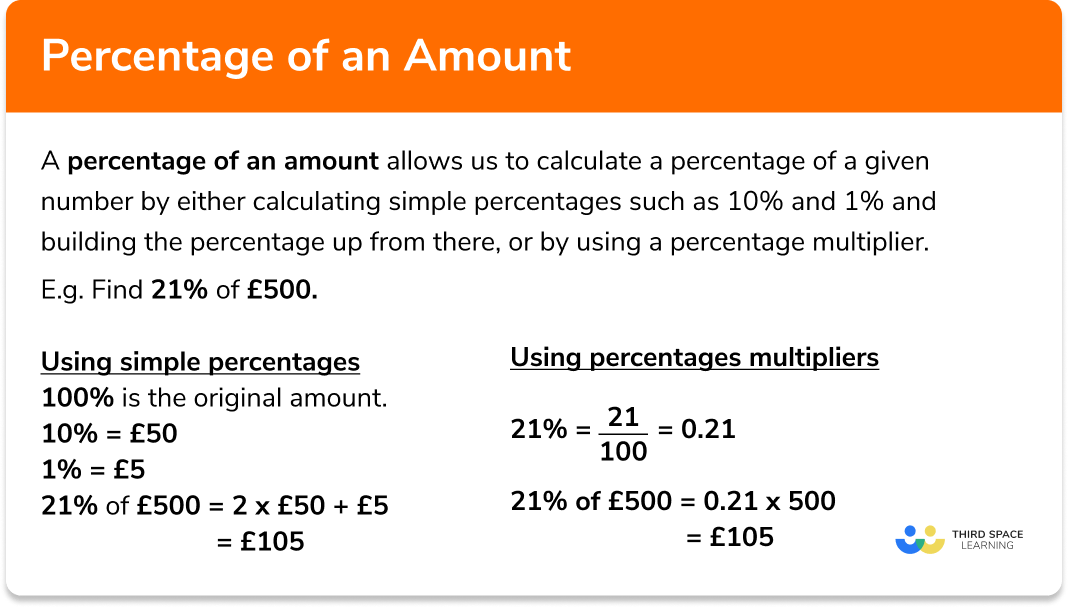
- Finding 10%: To find 10% of any number, just move the decimal point one place to the left. (e.g., 10% of $500 is $50).
- Finding 1%: Move the decimal point two places to the left. (e.g., 1% of $500 is $5).
- Using 10% and 1% for Other Percentages:
- 20%: Calculate 10% and multiply by 2 (10% of $500 = $50; 20% = $100).
- 5%: Calculate 10% and divide by 2 (10% of $500 = $50; 5% = $25).
- Combine for complex percentages: To find 17% of $500: (10% = $50) + (5% = $25) + (2% = $10) = $85. (2% is 2 times 1%, which is $5).
These mental shortcuts are particularly useful for on-the-spot budget checks, comparing discounts in stores, or quickly estimating investment returns.
Online Tools and Financial Apps
The digital age provides a plethora of online calculators and mobile apps designed to simplify financial percentage calculations.
- Online Percentage Calculators: Many websites offer free tools specifically for finding percentages, percentage change, and more. A quick search for “online percentage calculator” will yield numerous options.
- Budgeting Apps: Apps like Mint, YNAB (You Need A Budget), or Personal Capital automatically categorize your spending and often display expenses as percentages of your income, providing instant insights.
- Investment Platforms: Brokerage accounts and investment apps typically show your portfolio’s performance, individual stock gains/losses, and dividend yields as percentages, often in real-time.
By combining a strong understanding of the underlying formula with the appropriate tools and mental shortcuts, you can master percentage calculations and apply them effortlessly to all your financial endeavors.
Common Pitfalls and Advanced Considerations
While the basic percentage calculation is straightforward, its application in finance can sometimes lead to misinterpretations or require a deeper understanding of related concepts. Being aware of these nuances is crucial for truly advanced financial literacy.
Avoiding Misinterpretations: Basis Points vs. Percentage Points
In financial markets, particularly when discussing interest rates, bond yields, or investment fees, you’ll often hear terms like “basis points” and “percentage points.” It’s vital not to confuse them with a simple percentage change.
- Percentage Points: This refers to the absolute difference between two percentages. If an interest rate goes from 4% to 5%, that’s an increase of 1 percentage point (5% – 4% = 1%). It’s not a 1% increase in the rate itself (which would be 4% * 0.01 = 0.04%).
- Basis Points (bps): One basis point is equal to one-hundredth of a percentage point (0.01%). Therefore, 100 basis points equal 1 percentage point. An interest rate increase from 4% to 5% is an increase of 100 basis points. Financial professionals use basis points to avoid ambiguity when discussing small changes in percentages. For example, saying “the Federal Reserve raised rates by 25 basis points” is clearer than “raised rates by 0.25 percentage points,” and certainly more precise than “raised rates by 0.25%”.
Understanding this distinction is critical for interpreting financial news and professional reports accurately.
The Impact of Compounding (Interest on Interest)
When discussing growth or returns over time, especially in investments or loans, percentages interact powerfully with the concept of compounding. Compounding refers to earning interest not only on the initial principal but also on the accumulated interest from previous periods.
- Investment Growth: A modest annual percentage return, when compounded over many years, can lead to exponential growth. For example, 7% annual return on $10,000 for 30 years means your initial $10,000 would grow to over $76,000, thanks to the power of “interest on interest.”
- Debt Growth: Conversely, high interest rates on debt, especially credit cards, compounded monthly can quickly lead to spiraling debt burdens, as you pay interest on the original balance and on the unpaid interest.
While the calculation for percentage change remains the same, understanding compounding adds a critical dimension to interpreting the long-term impact of those percentages.
Understanding Inflation and Real Returns
Inflation is the rate at which the general level of prices for goods and services is rising, and consequently, the purchasing power of currency is falling. It is always expressed as a percentage.
- Nominal vs. Real Returns: When your investments yield a certain percentage return, that’s the nominal return. To understand the true increase in your purchasing power, you need to consider inflation. The real return is roughly the nominal return minus the inflation rate. If your investment grows by 7% but inflation is 3%, your real return is only about 4%.
- Eroding Savings: High inflation percentages erode the value of your savings over time. Keeping cash in a low-interest savings account might yield a 1% nominal return, but if inflation is 5%, you’re losing 4% of your purchasing power each year.
Grasping how inflation percentages impact your money is vital for long-term financial planning and ensuring your investments are truly growing your wealth.
In conclusion, “how to find percentage of” is far more than a simple arithmetic problem; it’s a fundamental mathematical concept with profound implications across the entire financial spectrum. From managing daily expenses and optimizing savings to navigating complex investment landscapes and understanding economic trends, a solid command of percentages empowers individuals to make more intelligent, informed, and strategic financial decisions. By mastering this essential skill, you unlock a deeper understanding of your financial world and pave the way towards greater economic security and prosperity.
aViewFromTheCave is a participant in the Amazon Services LLC Associates Program, an affiliate advertising program designed to provide a means for sites to earn advertising fees by advertising and linking to Amazon.com. Amazon, the Amazon logo, AmazonSupply, and the AmazonSupply logo are trademarks of Amazon.com, Inc. or its affiliates. As an Amazon Associate we earn affiliate commissions from qualifying purchases.