
The Foundational Role of Percentages in Financial Acumen
Understanding percentages is not merely an academic exercise; it is a critical skill for navigating the complexities of modern finance. From personal budgeting to intricate investment analysis, the ability to calculate and interpret percentages empowers individuals and businesses to make informed, strategic decisions. Without this fundamental grasp, financial data often appears abstract, hindering effective planning and evaluation.
Understanding the Basics: What a Percentage Truly Represents
At its core, a percentage is a way of expressing a number as a fraction of 100. The term “percent” literally means “per hundred” or “out of 100.” It acts as a standardized unit of comparison, allowing us to evaluate portions of different wholes on an equal footing. For instance, knowing that 25% of your income goes to housing expenses provides a clearer picture of your financial allocation than merely stating a dollar amount, especially when comparing it to someone with a different income level. Percentages transform raw numbers into relative values, making them incredibly useful for comparisons, trend analysis, and expressing proportions. They bridge the gap between absolute figures and their comparative significance, whether you’re looking at a discount on a product, the interest rate on a loan, or the return on an investment.
Why This Calculation Is Indispensable in Finance
The application of percentage calculations pervades nearly every aspect of finance. In personal finance, they are essential for creating and adhering to budgets (e.g., what percentage of your income should be saved?). They help in understanding the true cost of borrowing through interest rates (Annual Percentage Rate, or APR) on credit cards, mortgages, and loans. When shopping, discounts are almost universally expressed as percentages, requiring quick mental math or a calculator to determine actual savings.
For investors, percentages are the language of performance. Return on Investment (ROI), portfolio allocation (e.g., 60% stocks, 40% bonds), and expense ratios of funds are all percentage-based metrics vital for assessing growth and risk. Businesses rely on percentages to analyze profit margins, calculate commissions for sales staff, understand market share, and project growth rates. Tax rates, whether income, sales, or capital gains, are also percentage-based, directly impacting financial planning. Mastering these calculations isn’t just about getting the right number; it’s about gaining an insightful perspective that drives better financial decisions and helps you understand the “why” behind the numbers.
Mastering the Core Calculation: Number as a Percentage of Another
The ability to accurately determine what one number is as a percentage of another forms the bedrock of financial literacy. This core skill unlocks countless applications across personal and business finance.
The Fundamental Formula
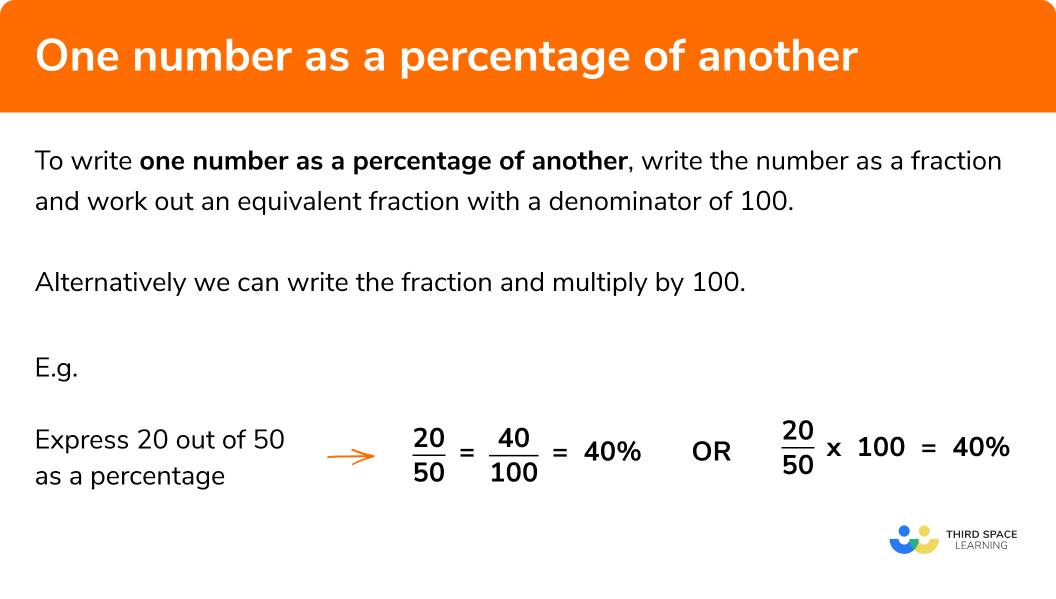
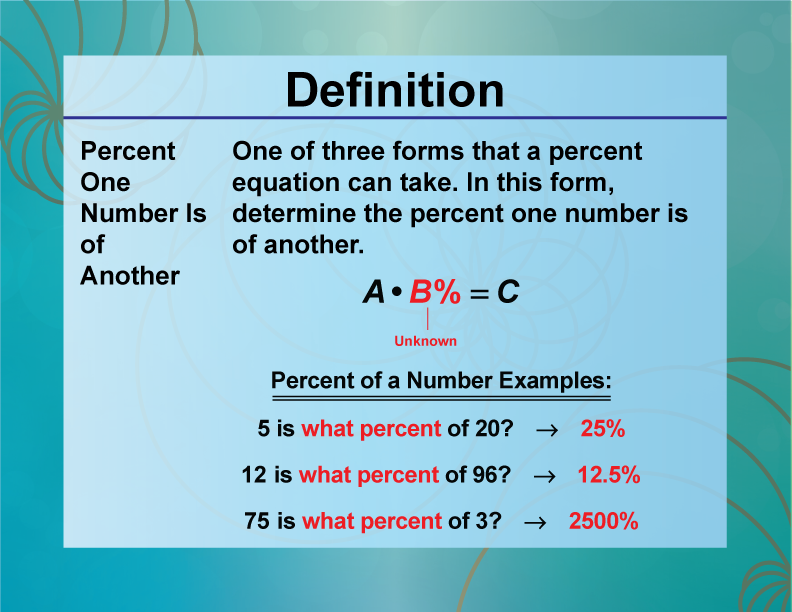
The most straightforward way to calculate what number is a percentage of another involves a simple two-step process: division followed by multiplication. The formula is:
Percentage = (Part / Whole) * 100
Here’s what each component represents:
-
Part: This is the specific number or amount you want to express as a percentage. It represents a portion of the larger total.
-
Whole: This is the total, the larger number, or the base amount against which the “part” is being compared.
-
100: Multiplying by 100 converts the decimal result of the division into a percentage format.
For instance, if you spent $300 on groceries from a $2,000 monthly income, the “part” is $300, and the “whole” is $2,000. Applying the formula would tell you what percentage of your income goes to groceries.
Step-by-Step Application with Financial Examples
Let’s walk through practical financial scenarios to illustrate this core calculation.
Example 1: Budgeting for Expenses
Scenario: Your monthly take-home income is $4,500. You spent $1,200 on rent this month. You want to know what percentage of your income goes to rent.
-
Identify the Part: Rent expense = $1,200
-
Identify the Whole: Monthly income = $4,500
Calculation:
-
Divide the part by the whole: $1,200 / $4,500 = 0.2666…
-
Multiply by 100 to get the percentage: 0.2666… * 100 = 26.67% (rounded)
Result: 26.67% of your monthly income goes towards rent. This insight helps you evaluate if your housing costs align with common budgeting guidelines (e.g., the 30% rule) and adjust your spending or savings goals accordingly.
Example 2: Analyzing Discounts and Savings
Scenario: A jacket originally costs $150. It’s on sale for $120. You want to determine the discount percentage.
-
First, find the discount amount (the Part): Original price – Sale price = $150 – $120 = $30
-
Identify the Whole (the original price): Original price = $150
Calculation:
-
Divide the discount amount by the original price: $30 / $150 = 0.2
-
Multiply by 100: 0.2 * 100 = 20%
Result: The jacket is discounted by 20%. This calculation is crucial for quickly assessing the value of sales and comparing deals across different retailers.
Example 3: Evaluating Investment Performance
Scenario: You invested $10,000 in a stock, and after one year, your investment grew to $11,500. What is your percentage return on investment?
-
First, find the profit (the Part): Current value – Initial investment = $11,500 – $10,000 = $1,500
-
Identify the Whole (the initial investment): Initial investment = $10,000
Calculation:
-
Divide the profit by the initial investment: $1,500 / $10,000 = 0.15
-
Multiply by 100: 0.15 * 100 = 15%
Result: Your investment yielded a 15% return. This metric is fundamental for comparing the performance of different investments and understanding the growth of your capital over time.
Advanced Applications and Variations in Financial Contexts
While the core formula is essential, financial situations often require variations of percentage calculations to answer more complex questions or to derive specific financial figures.
Calculating Percentage Change (Increase or Decrease)
Percentage change is critical for evaluating growth, decline, and volatility in financial metrics like revenue, stock prices, or inflation. It measures the relative change between an old value and a new value.
Formula: ((New Value – Old Value) / Old Value) * 100
-
A positive result indicates a percentage increase.
-
A negative result indicates a percentage decrease.
Example: Measuring Business Growth or Decline
Scenario: A company’s revenue was $500,000 last year and $580,000 this year. What is the percentage growth?
-
New Value: $580,000
-
Old Value: $500,000
Calculation:
-
Subtract the old value from the new value: $580,000 – $500,000 = $80,000
-
Divide by the old value: $80,000 / $500,000 = 0.16
-
Multiply by 100: 0.16 * 100 = 16%
Result: The company experienced a 16% revenue growth. This allows businesses to track performance against targets and competitors.
Example: Stock Price Fluctuations
Scenario: A stock price dropped from $75 to $60 in a week. What was the percentage decrease?
-
New Value: $60
-
Old Value: $75
Calculation:
-
Subtract the old value from the new value: $60 – $75 = -$15
-
Divide by the old value: -$15 / $75 = -0.20
-
Multiply by 100: -0.20 * 100 = -20%
Result: The stock price decreased by 20%. Investors use this to understand market volatility and assess risk.
Determining the Whole When You Have a Part and a Percentage
Sometimes you know a portion of a total and its percentage representation, and you need to find the total (the “whole”). This is common in financial planning and business forecasting.
Formula: Whole = Part / (Percentage / 100)
Example: Finding the Original Price Before a Discount
Scenario: You bought an item for $80 after a 20% discount. What was the original price?
-
Part: The discounted price ($80) represents the remaining portion after the discount. If it’s a 20% discount, you paid 100% – 20% = 80% of the original price. So, the part is $80, and the percentage is 80.
-
Percentage (of the original price): 80%
Calculation:
-
Convert the percentage to a decimal: 80 / 100 = 0.80
-
Divide the part by the decimal: $80 / 0.80 = $100
Result: The original price of the item was $100. This calculation is invaluable for verifying savings or understanding pre-discount costs.
Calculating a Specific Number Based on a Percentage (Finding the Part)
Often, you know the total amount and a specific percentage, and you need to find the corresponding numerical “part.”
Formula: Part = Whole * (Percentage / 100)
Example: Estimating Sales Commissions
Scenario: A salesperson earns a 5% commission on total sales. If their total sales for the month were $25,000, how much commission did they earn?
-
Whole: Total sales = $25,000
-
Percentage: Commission rate = 5%
Calculation:
-
Convert the percentage to a decimal: 5 / 100 = 0.05
-
Multiply the whole by the decimal: $25,000 * 0.05 = $1,250
Result: The salesperson earned $1,250 in commission. This is essential for payroll, budgeting, and performance incentives.
Example: Allocating Budget Funds
Scenario: Your company has a marketing budget of $150,000. You decide to allocate 30% of it to digital advertising. How much money is allocated to digital advertising?
-
Whole: Total marketing budget = $150,000
-
Percentage: Allocation to digital advertising = 30%
Calculation:
-
Convert the percentage to a decimal: 30 / 100 = 0.30
-
Multiply the whole by the decimal: $150,000 * 0.30 = $45,000
Result: $45,000 is allocated to digital advertising. This allows for precise budget management and resource allocation.
Leveraging Financial Tools for Percentage Calculations
While understanding the underlying formulas is crucial, modern financial tools can significantly streamline and automate percentage calculations, enhancing efficiency and reducing the potential for error.
Everyday Calculators and Spreadsheets
The most accessible tools for percentage calculations are often right at your fingertips. Basic calculators typically have a “%” button, which can perform direct percentage operations (e.g., 200 + 10% will give 220). However, for more complex financial modeling and tracking, spreadsheet programs like Microsoft Excel or Google Sheets are indispensable.
Spreadsheets allow users to input formulas directly, making them incredibly powerful for financial analysis. For instance, you can set up a column for “Part,” a column for “Whole,” and then a third column that automatically calculates the percentage using the formula =(A2/B2)*100. Furthermore, you can format cells to display numbers directly as percentages, eliminating the need to manually multiply by 100 in the formula. This feature is particularly useful for tracking budget allocations, investment returns over time, or comparing expense ratios across multiple funds, as the percentages update automatically with changes in raw data.
Specialized Financial Software and Online Calculators
Beyond general-purpose tools, a vast array of specialized financial software and online calculators exists to simplify specific percentage-based tasks. Budgeting apps often automatically categorize your spending and display it as a percentage of your income, helping you visualize adherence to financial goals. Investment platforms provide dashboards showing portfolio allocation percentages and calculate historical percentage returns. Loan calculators automatically compute interest payments, total interest paid, and effective APRs based on loan amounts, terms, and interest rates.
These tools are designed to abstract away the repetitive calculations, allowing users to focus on interpreting the results and making strategic decisions. While they offer convenience and often sophisticated visualizations, it’s vital for users to still understand the fundamental mathematics. This underlying comprehension enables critical evaluation of the results provided by the software and prevents blindly trusting figures that might be based on incorrect inputs or assumptions. Leveraging these tools effectively requires both technological fluency and foundational financial literacy.
The Strategic Impact: Making Informed Financial Decisions
The mastery of percentage calculations transcends mere arithmetic; it is a gateway to profound financial insight and strategic decision-making. By understanding how to derive and interpret these relative values, individuals and businesses can gain a competitive edge and secure their financial futures.
Personal Finance Empowerment
For individuals, a solid grasp of percentages transforms complex financial data into actionable intelligence. Budgeting becomes more dynamic and effective when you view expenses as percentages of your income, enabling swift adjustments to spending habits to meet savings or debt reduction goals. Understanding the APR on loans and credit cards allows for savvy debt management, choosing options with lower borrowing costs and appreciating the long-term impact of interest. When planning for retirement or saving for major purchases, calculating percentage contributions and projected returns provides a clear roadmap towards financial independence. It allows for a realistic assessment of financial products, ensuring you can discern genuinely beneficial offers from those with hidden costs.
Business and Investment Acumen
In the business world, percentage calculations are integral to almost every facet of operation and strategic planning. Businesses analyze profit margins (gross profit percentage, net profit percentage) to gauge operational efficiency and pricing strategies. Market share percentages inform competitive positioning and growth aspirations. Understanding year-over-year percentage growth rates in revenue or customer acquisition allows for accurate forecasting and resource allocation. Investors rely heavily on percentages to assess the performance, risk, and diversification of their portfolios. Metrics like dividend yield percentage, expense ratios of funds, and percentage asset allocation are crucial for constructing a balanced and goal-oriented investment strategy. For example, a business negotiating bulk discounts must understand the percentage impact on its cost of goods sold to ensure profitability.

Avoiding Common Pitfalls
A strong foundation in percentage calculations also helps in avoiding common financial misinterpretations. One frequent pitfall is confusing “percentage points” with “percentage change.” For instance, an interest rate increasing from 5% to 6% is a 1 percentage point increase, but it’s a 20% percentage change (calculated as (6-5)/5 * 100 = 20%). Misinterpreting this can lead to significant financial errors. Another pitfall is failing to understand the “base number” or “whole” upon which a percentage is calculated, which can drastically alter the perceived significance of a number. Always clarifying what the percentage is of is paramount.
In essence, the ability to calculate what number is a percentage of another is more than just a calculation; it’s a fundamental skill that underpins financial literacy, critical thinking, and empowers better decision-making in an increasingly data-driven world.
aViewFromTheCave is a participant in the Amazon Services LLC Associates Program, an affiliate advertising program designed to provide a means for sites to earn advertising fees by advertising and linking to Amazon.com. Amazon, the Amazon logo, AmazonSupply, and the AmazonSupply logo are trademarks of Amazon.com, Inc. or its affiliates. As an Amazon Associate we earn affiliate commissions from qualifying purchases.