
Understanding how to calculate monthly payments is a fundamental skill in personal finance, empowering individuals to make informed decisions, manage debt effectively, and plan for a secure financial future. Whether you’re considering a mortgage, an auto loan, a personal loan, or student financing, the ability to accurately project your monthly financial obligations is paramount. This knowledge transforms abstract loan terms into concrete, budgetable figures, moving you from speculation to strategic financial planning. Without this insight, borrowers risk overextending themselves, jeopardizing their financial stability and long-term goals.
This guide delves into the mechanics of monthly payment calculations, demystifying the formulas and offering practical applications. We’ll explore the key components that influence your payments, highlight the tools available to simplify this process, and discuss strategies to optimize your loan structure. By the end of this article, you will not only understand how to calculate your monthly payments but also appreciate why this skill is an indispensable asset in your financial toolkit.
The Indispensable Role of Monthly Payment Calculations in Personal Finance
Accurately calculating monthly payments extends far beyond simple arithmetic; it’s a cornerstone of sound financial management. For many, major life purchases like a home or a car necessitate borrowing, and the monthly payment often represents a significant portion of their recurring expenses. Without a clear understanding of these obligations, budgeting becomes guesswork, leading to potential financial strain and missed opportunities.
Understanding Loan Mechanics: Principal, Interest, and Term
At the heart of every loan payment are three critical components that dictate its size and duration:
- Principal (P): This is the initial amount of money borrowed. It’s the base sum upon which interest is calculated and which you are contractually obligated to repay. A higher principal naturally leads to higher monthly payments, assuming other factors remain constant.
- Interest (i): This is the cost of borrowing money, expressed as a percentage of the principal. Lenders charge interest as compensation for the risk they take and the opportunity cost of lending their capital. Interest rates can be fixed (remaining constant throughout the loan term) or variable (fluctuating with market conditions). Even a small difference in the interest rate can significantly impact the total cost of a loan and, consequently, the monthly payment.
- Loan Term (n): This refers to the duration over which the loan is to be repaid, typically expressed in months. A longer loan term generally results in lower monthly payments because the principal and interest are spread out over a greater number of installments. However, a longer term also means paying more in total interest over the life of the loan. Conversely, a shorter term leads to higher monthly payments but a lower overall interest cost.
Grasping the interplay between these three elements is crucial. Adjusting one component inevitably affects the others and, ultimately, your monthly outflow.
Why Accurate Calculations are Crucial for Financial Planning
Accurate monthly payment calculations are not merely an academic exercise; they are a vital tool for:
- Budgeting and Cash Flow Management: Knowing your precise monthly obligations allows you to construct a realistic budget, ensuring you have enough disposable income for other expenses, savings, and investments. It prevents unexpected financial shortfalls and helps maintain a healthy cash flow.
- Debt Management: For those managing multiple debts, understanding each loan’s payment structure is key to developing an effective debt repayment strategy, whether it’s the snowball or avalanche method. It helps in prioritizing payments and monitoring progress towards debt freedom.
- Making Informed Borrowing Decisions: Before committing to a loan, accurate calculations enable you to assess affordability. You can compare different loan offers, adjust loan terms, or even decide if borrowing is the right path, preventing financial distress down the line. It allows you to model various scenarios and choose the option that best aligns with your financial capacity and goals.
- Evaluating Refinancing Opportunities: When interest rates drop or your financial situation improves, calculating new potential payments for a refinanced loan helps determine if it’s a financially advantageous move, saving you money over the long term.
Demystifying the Monthly Payment Formula
While numerous online calculators automate the process, understanding the underlying formula for calculating monthly payments provides a deeper insight into how loans are structured and repaid. This formula, often referred to as the amortization formula, is a cornerstone of financial mathematics.
Breaking Down the Standard Amortization Formula
The most common formula for calculating a fixed monthly loan payment (M) is:
$M = P [ i(1 + i)^n ] / [ (1 + i)^n – 1 ]$
Where:
- M = Monthly Payment
- P = Principal Loan Amount (the initial amount borrowed)
- i = Monthly Interest Rate (annual interest rate divided by 12)
- n = Total Number of Payments (loan term in years multiplied by 12)
This formula looks complex, but it systematically accounts for both the principal repayment and the interest accumulated each month over the life of the loan, ensuring that the loan is fully repaid by the end of its term. It demonstrates the amortization process, where early payments are heavily skewed towards interest, and later payments contribute more significantly to reducing the principal.
Components Explained: P, i, n, and M
Let’s clarify each variable:
- P (Principal Loan Amount): If you borrow $100,000 for a mortgage, P = $100,000.
- i (Monthly Interest Rate): If the annual interest rate is 6%, then $i = 0.06 / 12 = 0.005$. It’s crucial to convert the annual rate to a monthly rate and express it as a decimal.
- n (Total Number of Payments): For a 30-year mortgage, $n = 30 times 12 = 360$ payments. For a 5-year auto loan, $n = 5 times 12 = 60$ payments.
The formula essentially calculates how much you need to pay each month so that by the very last payment, the entire principal has been repaid, along with all the accumulated interest.
Practical Application: A Step-by-Step Guide
Let’s walk through an example:
Suppose you take out a loan of $20,000 for a new car at an annual interest rate of 5% for a term of 5 years.
- Identify P: $P = $20,000$
- Calculate i: Annual interest rate is 5%, so $i = 0.05 / 12 = 0.00416667$
- Calculate n: Loan term is 5 years, so $n = 5 times 12 = 60$ months
- Plug into the formula:
$M = 20,000 [ 0.00416667(1 + 0.00416667)^{60} ] / [ (1 + 0.00416667)^{60} – 1 ]$
$M = 20,000 [ 0.00416667(1.00416667)^{60} ] / [ (1.00416667)^{60} – 1 ]$
$M = 20,000 [ 0.00416667 times 1.283359 ] / [ 1.283359 – 1 ]$
$M = 20,000 [ 0.00534735 ] / [ 0.283359 ]$
$M = 106.947 / 0.283359$
$M approx $377.42$
So, your estimated monthly payment for this car loan would be approximately $377.42. This manual calculation, though tedious, reveals the precision behind every loan repayment schedule.
Leveraging Tools and Technology for Seamless Calculations
While understanding the formula is valuable, in practice, most people rely on modern tools to perform these calculations quickly and accurately. These tools eliminate human error and allow for rapid scenario analysis.
The Convenience of Online Loan Calculators
The internet is replete with free online loan calculators provided by financial institutions, independent websites, and regulatory bodies. These tools are incredibly user-friendly: you simply input the principal amount, interest rate, and loan term, and the calculator instantly provides the estimated monthly payment. Many also offer amortization schedules, detailing how much principal and interest are paid each month over the loan’s lifetime.
The benefits of online calculators include:
- Speed and Accuracy: Instant results free from manual calculation errors.
- Scenario Planning: Easily adjust variables (e.g., extend the term, reduce the principal, find a better interest rate) to see how they impact your payment.
- Accessibility: Available 24/7 from any device with internet access.
When using online calculators, always ensure you’re using a reputable source to guarantee the accuracy of the results.
Spreadsheet Functions: Empowering Advanced Analysis

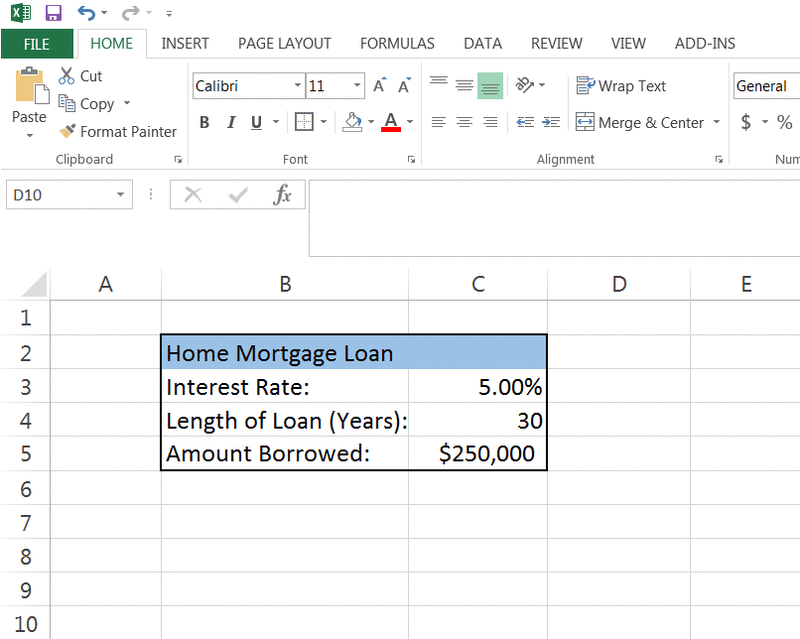
For those comfortable with Microsoft Excel, Google Sheets, or similar spreadsheet programs, the PMT function offers robust capabilities for calculating loan payments. The PMT function uses the same parameters as the amortization formula and is structured as:
PMT(rate, nper, pv, [fv], [type])
Where:
- rate: The interest rate per period (i.e., annual rate / 12).
- nper: The total number of payments for the loan (i.e., years * 12).
- pv: The present value, or the total amount that a series of future payments is worth now (i.e., the principal loan amount).
- fv (optional): The future value, or a cash balance you want to attain after the last payment is made. If omitted, it’s assumed to be 0 (meaning the loan is fully paid off).
- type (optional): Indicates when payments are due (0 for end of period, 1 for beginning of period). If omitted, it’s assumed to be 0.
Using a spreadsheet allows for greater control, integration with other financial data, and the creation of personalized financial models. You can build comprehensive budget templates that automatically update loan payment figures as your financial situation or loan terms change.
The Role of Financial Advisors
While self-service tools are powerful, a qualified financial advisor can provide personalized guidance, especially for complex financial situations or large loans. They can help you:
- Understand loan implications: Beyond the monthly payment, they can explain the total cost of interest, early repayment penalties, and other fine print.
- Optimize loan structures: Advise on the best loan term, interest rate negotiation strategies, or whether a fixed vs. variable rate loan suits your risk profile.
- Integrate loans into a holistic financial plan: Ensure that your borrowing decisions align with your broader investment, retirement, and savings goals.
Their expertise can add an invaluable layer of insight, helping you avoid common pitfalls and make truly optimal financial choices.
Factors Influencing Your Monthly Payment and Strategies for Optimization
Beyond the core components of principal, interest, and term, several other factors can subtly or significantly impact your monthly payments. Being aware of these and understanding strategies for optimization can lead to substantial savings and better financial control.
Interest Rates: A Primary Driver
Interest rates are arguably the most influential factor after the principal amount. A seemingly small percentage difference can lead to thousands of dollars in total interest paid and a noticeable change in your monthly payment. For example, a 30-year, $300,000 mortgage at 4% interest has a monthly payment of approximately $1,432. At 5% interest, that jumps to about $1,610 – nearly $180 more per month and tens of thousands more over the loan’s life.
Optimization Strategy:
- Improve Credit Score: Lenders offer the best rates to borrowers with excellent credit scores, reflecting lower risk. Focus on timely payments, reducing credit utilization, and correcting errors on your credit report.
- Shop Around: Don’t settle for the first offer. Compare rates from multiple lenders for the same loan type.
- Negotiate: Especially for personal loans or auto loans, there might be room for negotiation on the interest rate, particularly if you have a strong credit profile.
Loan Term vs. Payment Amount: The Trade-Off
The relationship between loan term and monthly payment is inverse: a longer term means lower monthly payments, but a higher total interest cost. A shorter term means higher monthly payments but less total interest paid.
Optimization Strategy:
- Balance Affordability and Cost: Choose the shortest loan term you can comfortably afford. While a longer term offers lower monthly payments, it costs more in the long run. If your budget allows, opting for a 15-year mortgage instead of a 30-year one, for example, can save a tremendous amount of interest.
- Consider Early Repayment: Even if you choose a longer term for lower payments, consider making extra principal payments whenever possible. This can significantly reduce the effective loan term and total interest paid without committing to a higher fixed monthly payment.
Principal Amount: The Foundation
The amount you borrow directly dictates the core of your payment. Less borrowed means less to repay, both in principal and interest.
Optimization Strategy:
- Make a Larger Down Payment: For secured loans like mortgages and auto loans, a larger down payment reduces the principal you need to borrow, immediately lowering your monthly payments and total interest.
- Minimize Borrowing: Before taking out a loan, thoroughly evaluate your needs. Can you make do with a less expensive car? Or save a bit more before buying a home to reduce the mortgage amount?
Other Considerations: Fees and Insurance
Some loans, especially mortgages, come with additional costs that can be rolled into your monthly payment or paid upfront. These can include:
- Loan Origination Fees: A fee charged by the lender for processing the loan.
- Private Mortgage Insurance (PMI): If your down payment is less than 20% on a conventional mortgage, PMI protects the lender.
- Property Taxes and Homeowner’s Insurance: For mortgages, these are often collected by the lender and held in an escrow account, then paid on your behalf, effectively becoming part of your “monthly payment” even though they are not part of the loan’s principal and interest.
Optimization Strategy:
- Factor in All Costs: When comparing loan offers, look beyond just the interest rate and principal. Understand all associated fees and whether they will be capitalized into the loan or require upfront payment.
- Avoid PMI: If possible, save enough for a 20% down payment on a mortgage to avoid PMI, which is an additional cost that doesn’t build equity.
Beyond the Numbers: The Broader Impact of Informed Payment Management
Understanding how to calculate monthly payments is more than just a mathematical exercise; it’s a gateway to financial empowerment. It fosters a proactive approach to personal finance, transforming you from a passive borrower into an informed decision-maker.
Budgeting and Cash Flow Management
The most immediate benefit of accurate payment calculation is its impact on your budget. By knowing precisely what your obligations are, you can:
- Create Realistic Budgets: Allocate funds appropriately, ensuring you meet all financial commitments without sacrificing savings or discretionary spending.
- Prevent Overspending: Avoid the trap of borrowing more than you can comfortably afford, which can lead to late fees, damaged credit, and financial stress.
- Optimize Cash Flow: Strategically managing your loans can free up cash flow for other critical financial goals, such as building an emergency fund, investing, or saving for retirement.
Debt Management and Financial Freedom
For many, debt is a significant obstacle to financial freedom. Effective debt management starts with a clear understanding of each loan’s payment structure and its overall impact on your finances.
- Strategic Repayment: Use your understanding of payments to prioritize high-interest debts, accelerate repayment, and minimize the total interest paid over time.
- Avoiding Debt Traps: By calculating and comparing different loan scenarios, you can avoid loans with unmanageable payments or exorbitant interest rates that can lead to a cycle of debt.
- Path to Freedom: Each calculated and successfully made payment brings you closer to reducing your debt burden, freeing up capital, and achieving true financial independence.

Making Informed Borrowing Decisions
Ultimately, the power to calculate monthly payments equips you to make superior borrowing decisions. It allows you to:
- Evaluate Loan Offers Critically: Rather than blindly accepting a lender’s proposed payment, you can verify its accuracy and compare it against other offers.
- Negotiate from a Position of Strength: Armed with knowledge, you can engage with lenders to negotiate better terms, whether it’s a lower interest rate, a shorter term, or reduced fees.
- Align Borrowing with Goals: Ensure that any debt you take on serves your long-term financial objectives, rather than hindering them. This includes assessing if the asset being acquired (e.g., home, education) provides sufficient value to justify the cost of borrowing.
In conclusion, the skill of calculating monthly payments is far more than a technicality; it’s a cornerstone of financial literacy. It empowers you to navigate the complex world of loans with confidence, make prudent decisions, and pave your way towards a secure and prosperous financial future. By mastering this fundamental concept, you gain control over your money, one payment at a time.
aViewFromTheCave is a participant in the Amazon Services LLC Associates Program, an affiliate advertising program designed to provide a means for sites to earn advertising fees by advertising and linking to Amazon.com. Amazon, the Amazon logo, AmazonSupply, and the AmazonSupply logo are trademarks of Amazon.com, Inc. or its affiliates. As an Amazon Associate we earn affiliate commissions from qualifying purchases.