
Understanding the Power of Compounding
Compound interest is often hailed as the “eighth wonder of the world” by financial experts, and for good reason. It’s the engine that drives significant wealth accumulation over time, allowing your money to earn money on itself. While many are familiar with the general concept, understanding the mechanics of daily compounding offers a powerful advantage in personal finance and investing.
What is Compound Interest?
At its core, compound interest is the interest you earn not only on your initial principal but also on the accumulated interest from previous periods. Unlike simple interest, which is calculated solely on the original principal amount, compound interest creates a snowball effect. The longer your money compounds, and the more frequently it compounds, the faster your wealth can grow. This principle applies across various financial instruments, from savings accounts and certificates of deposit (CDs) to investment portfolios and retirement funds.

The Advantage of Daily Compounding
The frequency with which interest is compounded plays a crucial role in its overall impact. While interest can compound annually, semi-annually, quarterly, or monthly, daily compounding is the most frequent interval typically encountered in financial products. When interest is compounded daily, it means that at the end of each day, the interest earned for that day is added to your principal, and the next day’s interest is calculated on this new, slightly larger principal. This continuous growth accelerates the accumulation process, leading to a higher overall return compared to less frequent compounding intervals over the same period and interest rate. Even seemingly small daily increments can add up substantially over months and years, significantly enhancing your financial outcomes.
Key Variables in Compound Interest
To calculate compound interest effectively, particularly on a daily basis, you need to understand four core variables:
- Principal (P): This is the initial amount of money deposited or invested. It’s the foundation upon which all interest is earned.
- Annual Interest Rate (r): This is the stated percentage rate at which interest is earned on your money per year. For calculations, it must always be converted to a decimal (e.g., 5% becomes 0.05).
- Number of Compounding Periods per Year (n): This specifies how many times the interest is calculated and added to the principal within a year. For daily compounding,
nwill always be 365 (or 360 in some specific financial contexts, but 365 is standard for general daily calculations). - Time (t): This is the total number of years your money is invested or saved. The longer the time horizon, the more pronounced the effect of compounding.
The Daily Compound Interest Formula Explained
To precisely calculate the future value of an investment with daily compounding, we use a specific mathematical formula. While it may look complex at first glance, breaking it down makes it straightforward to apply.
Deconstructing the Formula
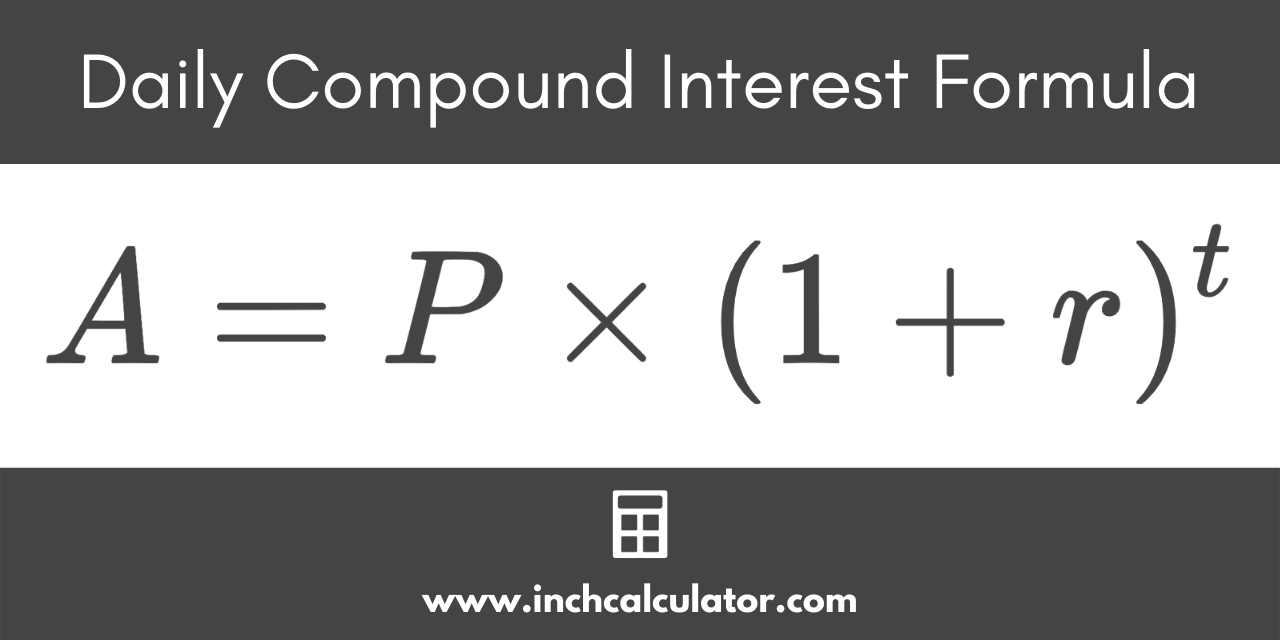
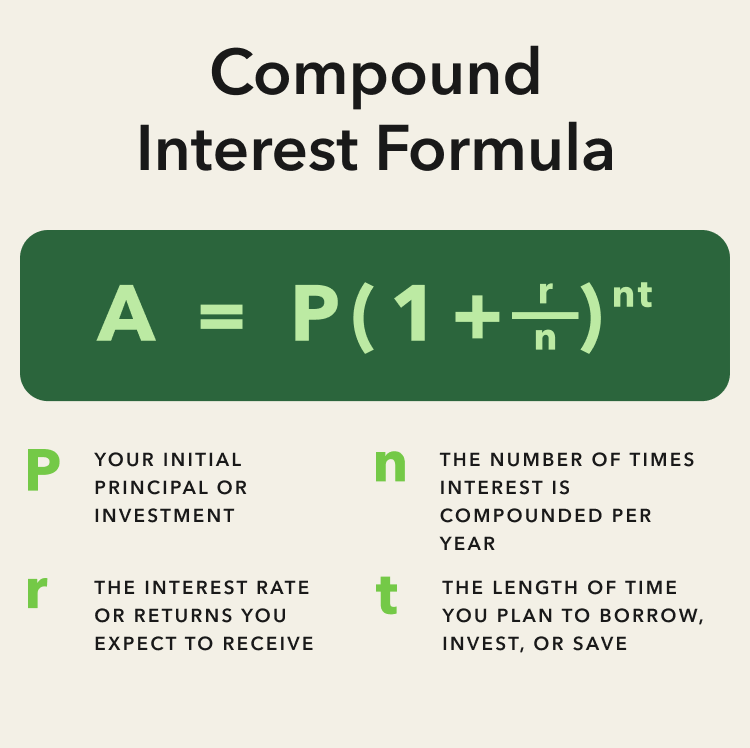
The standard formula for compound interest is:
A = P(1 + r/n)^(nt)
Let’s break down each component in the context of daily compounding:
- A = Future Value: This is the total amount of money you will have after the specified time period, including both your initial principal and all accumulated compound interest.
- P = Principal Investment: As mentioned, this is your initial lump sum.
- r = Annual Interest Rate: The stated annual rate, expressed as a decimal. If the annual rate is 4%,
rwould be 0.04. - n = Number of Compounding Periods Per Year: For daily compounding,
nis 365. - t = Time in Years: The total duration for which the money is invested.
Step-by-Step Calculation Guide
Let’s walk through an example to illustrate how to calculate daily compound interest. Suppose you invest $10,000 at an annual interest rate of 5%, compounded daily, for 3 years.
Step 1: Identify Your Variables
- P (Principal) = $10,000
- r (Annual Interest Rate) = 5% = 0.05
- n (Compounding Periods Per Year) = 365 (for daily)
- t (Time in Years) = 3
Step 2: Calculate the Daily Interest Rate (r/n)
- Divide the annual interest rate by the number of compounding periods per year:
- 0.05 / 365 = 0.0001369863 (approximately)
Step 3: Calculate the Total Number of Compounding Periods (nt)
- Multiply the number of compounding periods per year by the number of years:
- 365 * 3 = 1095 periods
Step 4: Plug the Values into the Formula
A = 10000 * (1 + 0.05/365)^(365*3)A = 10000 * (1 + 0.0001369863)^(1095)A = 10000 * (1.0001369863)^(1095)
Step 5: Compute the Future Value
- First, calculate the exponential part:
(1.0001369863)^(1095)≈ 1.1618335 - Then, multiply by the principal:
10000 * 1.1618335≈ $11,618.34
After 3 years, your initial $10,000 investment, compounded daily at 5% annually, would grow to approximately $11,618.34. To find the total interest earned, subtract the principal from the future value: $11,618.34 – $10,000 = $1,618.34.
For comparison, if this were simple interest (calculated only on the principal), the interest would be $10,000 * 0.05 * 3 = $1,500. The extra $118.34 is the power of daily compounding at work.
Practical Applications and Real-World Scenarios
Understanding daily compound interest isn’t just an academic exercise; it has tangible implications for various financial products and strategies.
Savings Accounts and High-Yield Accounts
Most traditional savings accounts compound interest daily or monthly, though interest is often paid out monthly or quarterly. High-yield savings accounts (HYSAs), offered by online banks, typically boast higher annual percentage yields (APYs) and often compound interest daily. This daily compounding maximizes the growth of your emergency fund or short-term savings, making sure every dollar works as hard as possible. When comparing savings accounts, always look for the APY, as it reflects the effective annual return after compounding, making it a better metric than just the stated annual interest rate.
Investment Portfolios
For long-term investors, daily compounding is a critical driver of wealth. While stocks don’t directly “compound” in the same way a savings account does, the principle applies when dividends are reinvested. If you own dividend-paying stocks or exchange-traded funds (ETFs) and choose to automatically reinvest those dividends, you are essentially buying more shares with your earnings. These new shares then generate their own dividends, creating a compounding effect. Over decades, this reinvestment strategy, akin to daily compounding, can significantly amplify your portfolio’s returns. Similarly, mutual funds and bond interest can be set to reinvest, continuously growing your principal and accelerating future gains.
Debt Management
Compounding works in both directions. While beneficial for savings and investments, it can be detrimental when applied to debt. Credit cards, for instance, often compound interest daily. If you carry a balance, the interest accrues daily and is added to your principal balance, meaning the next day’s interest is calculated on an even higher amount. This is why credit card debt can spiral out of control so quickly. Understanding daily compounding in this context emphasizes the urgency of paying off high-interest debts as rapidly as possible to stop the negative compounding cycle. Personal loans and mortgages also utilize compounding, though typically on a monthly basis, where unpaid interest can be added to the principal (e.g., in cases of deferred payments).
Retirement Planning
Perhaps the most significant beneficiary of daily compounding is long-term retirement planning. Contributions to 401(k)s, IRAs, and other retirement vehicles grow exponentially over decades due to compounding. The earlier you start investing, the more time your money has to compound daily, monthly, or quarterly. Even small, consistent contributions made early in one’s career can amass substantial wealth by retirement, thanks to the uninterrupted growth facilitated by compounding over an extended period. This underscores the importance of not just saving, but also understanding how those savings grow.
Leveraging Tools for Daily Compounding Calculations
While manual calculation provides clarity, various financial tools can simplify the process, especially for complex scenarios or quick estimations.
Online Calculators
Numerous websites offer free compound interest calculators. These tools are incredibly user-friendly: you simply input your principal, interest rate, compounding frequency (select “daily”), and time horizon, and they instantly provide the future value and total interest earned. Many calculators also allow for additional contributions over time, which further enhances the compounding effect and provides a more realistic projection for consistent savers. These are excellent for quick checks and understanding different scenarios without needing to manually apply the formula.
Spreadsheet Software
For those who prefer a more hands-on approach or need to integrate compounding calculations into broader financial models, spreadsheet software like Microsoft Excel or Google Sheets is invaluable.
Excel’s FV (Future Value) function is specifically designed for this purpose:
FV(rate, nper, pmt, [pv], [type])
Where:
rate: The interest rate per period (e.g.,annual_rate/365for daily compounding).nper: The total number of payment periods in an annuity (e.g.,years * 365for daily compounding).pmt: The payment made each period (e.g., additional daily contributions). For simple lump-sum compounding, this is 0.pv: The present value or the lump-sum amount of a series of future payments (your initial principal, entered as a negative value).type: Optional, specifies when payments are due (0 for end of period, 1 for beginning).
For example, to calculate the future value of our $10,000 investment at 5% daily for 3 years, the formula would be:=FV(0.05/365, 3*365, 0, -10000). Spreadsheets allow for dynamic adjustments, letting you see the impact of changing variables instantly.
Financial Apps
Many personal finance and investment apps integrate basic compound interest calculations, often as part of their projection tools. These apps can help you visualize the growth of your savings or investments over time, factoring in various compounding frequencies. While they might not explicitly show the daily calculation, their growth projections are built on these underlying principles. Some budgeting apps also help track progress towards financial goals, where understanding the daily growth rate can reinforce positive saving habits.
Strategies to Maximize Daily Compounding
Armed with the knowledge of how daily compound interest works, you can employ several strategies to maximize its benefit for your financial future.
Start Early and Be Consistent
Time is arguably the most critical factor in compounding. The longer your money has to grow, the more significantly daily compounding will impact your overall returns. Starting to save and invest early, even with modest amounts, gives your money decades to compound, leading to far greater wealth than starting later with larger contributions. Consistency in contributions further amplifies this effect. Regularly adding to your principal ensures that each new contribution also benefits from the compounding snowball.
Increase Your Principal
The more money you initially invest or consistently contribute, the larger the base upon which interest is earned. A higher principal will naturally generate more interest per period, which in turn leads to even more interest in the subsequent periods, accelerating the compounding process. Look for opportunities to increase your savings rate or direct unexpected windfalls (bonuses, tax refunds) into your investment accounts to boost your principal.
Seek Higher Interest Rates
While daily compounding is powerful, a higher annual interest rate (APY) will always accelerate your returns. Compare different savings accounts, CDs, or investment vehicles to find the best available rates. Even a seemingly small difference of 0.5% or 1% can translate into thousands of dollars over many years, especially when compounded daily. However, balance higher rates with appropriate risk levels for your financial goals.
Minimize Withdrawals and Fees
Every withdrawal from a compounding account reduces your principal, thereby shrinking the base for future interest calculations. Similarly, excessive fees, whether from investment platforms or bank accounts, erode your returns. Strive to leave your investments undisturbed for as long as possible and be mindful of any fees associated with your accounts. Opt for low-cost index funds, ETFs, and bank accounts with minimal or no maintenance fees to maximize the amount of money working for you.
Reinvest Earnings
Ensure that any interest earned on savings or dividends from investments are automatically reinvested back into the original principal. This is the essence of compounding. By immediately adding your earnings back into the pool, you ensure that future interest is calculated on an ever-growing sum, continuously accelerating your wealth accumulation without requiring new out-of-pocket contributions.
By understanding how to calculate daily compound interest and implementing these strategies, you can harness its remarkable power to achieve your personal finance and investment goals more effectively and build substantial wealth over time.
aViewFromTheCave is a participant in the Amazon Services LLC Associates Program, an affiliate advertising program designed to provide a means for sites to earn advertising fees by advertising and linking to Amazon.com. Amazon, the Amazon logo, AmazonSupply, and the AmazonSupply logo are trademarks of Amazon.com, Inc. or its affiliates. As an Amazon Associate we earn affiliate commissions from qualifying purchases.