
Purchasing a new or used vehicle often represents one of the largest financial commitments an individual makes, second only to a home mortgage. For most, this significant investment is facilitated through a car loan, transforming a large upfront cost into manageable monthly payments. However, merely looking at the advertised monthly payment can be misleading. A thorough understanding of how car loan calculations work is paramount to making informed financial decisions, ensuring you secure a deal that aligns with your budget and long-term financial goals. This article will demystify the process, guiding you through the essential components, calculation methods, and strategic considerations for financing your next vehicle.

Understanding the Fundamentals of a Car Loan
Before diving into the numbers, it’s crucial to grasp the core elements that constitute any car loan. These variables interact to determine your monthly payment, the total interest you’ll pay, and ultimately, the true cost of your vehicle over time.
Key Components of a Car Loan
- Principal Amount (Loan Amount): This is the actual sum of money you borrow to purchase the car. It’s the negotiated price of the vehicle minus any down payment, trade-in value, or rebates. The higher the principal, generally, the higher your monthly payments and total interest.
- Interest Rate (APR): Expressed as an Annual Percentage Rate (APR), this is the cost of borrowing money from the lender. It’s typically presented as a percentage and can vary significantly based on your creditworthiness, the loan term, the lender, and prevailing market rates. A lower APR means less interest paid over the life of the loan.
- Loan Term (Repayment Period): This refers to the duration, usually in months, over which you agree to repay the loan. Common terms range from 36 to 84 months. A shorter term generally results in higher monthly payments but less total interest paid, while a longer term lowers monthly payments but increases the overall interest cost.
- Down Payment: An upfront cash payment you make towards the purchase price of the vehicle. A larger down payment reduces the principal amount you need to borrow, thereby lowering your monthly payments and the total interest you’ll pay. It also signals financial stability to lenders, potentially securing a better interest rate.
- Trade-in Value: If you’re trading in your current vehicle, its agreed-upon value will be deducted from the purchase price of your new car, effectively reducing the principal amount of your new loan, similar to a down payment.
Why Calculation Matters
Understanding how these components interact is not just an academic exercise; it’s a critical step in prudent financial planning. Without calculating your loan, you risk agreeing to terms that stretch your budget thin, lead to negative equity (owing more than the car is worth), or result in paying thousands more in interest than necessary. Calculating your loan allows you to:
- Determine affordability: Know your exact monthly payment and assess if it fits comfortably within your budget.
- Compare offers: Accurately evaluate different loan offers from various lenders (banks, credit unions, dealership financing).
- Optimize terms: Play with different down payment amounts, loan terms, and interest rates to find the optimal balance between monthly payment and total cost.
- Avoid surprises: Understand the full financial commitment upfront, including total interest and potential additional fees.
Manual Calculation Methods for Your Car Loan
While online calculators offer instant gratification, understanding the underlying formulas provides a deeper appreciation for how your loan works. Even a basic grasp of the mathematics can empower you to scrutinize loan offers more effectively.
The Basic Interest Calculation (Simple Interest)
For very basic scenarios, especially short-term loans or for calculating a single period’s interest, the simple interest formula is useful:
Interest = Principal (P) × Rate (R) × Time (T)
- P: The principal loan amount.
- R: The annual interest rate (expressed as a decimal, e.g., 5% becomes 0.05).
- T: The time the money is borrowed for, in years.
Example: If you borrow $10,000 at a 5% simple annual interest rate for one year, the interest would be $10,000 × 0.05 × 1 = $500.
However, car loans typically use amortization, where interest is calculated on the remaining principal balance, and a portion of each payment goes towards both interest and principal. The simple interest formula, while foundational, is inadequate for determining complex monthly payments over many years.
Amortization Schedule: The Detailed Approach
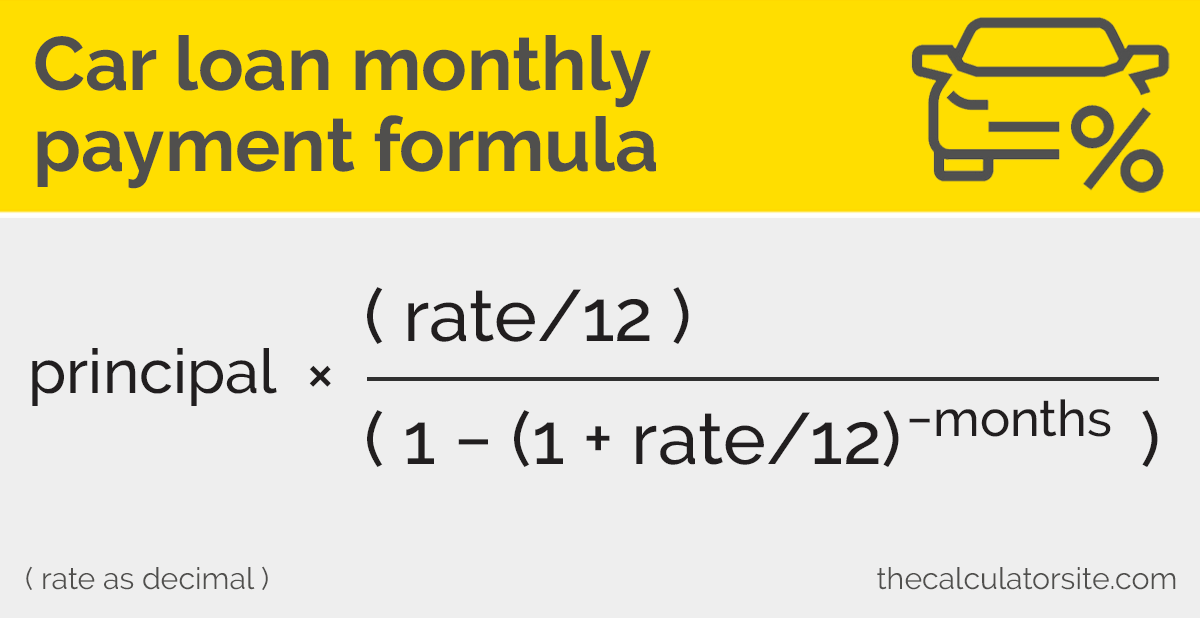
Most car loans are amortizing loans, meaning each payment consists of both principal and interest, with the interest portion decreasing over time as the principal balance is paid down. The standard formula for calculating the fixed monthly payment (M) on an amortizing loan is:
M = P [ i(1 + i)^n ] / [ (1 + i)^n – 1]
Let’s break down each variable:
- M: Your monthly loan payment. This is what you’re trying to find.
- P: The principal loan amount. This is the total amount you are borrowing after your down payment and trade-in.
- i: Your monthly interest rate. To get this, you divide your annual interest rate (APR) by 12. For example, if your APR is 6%, then i = 0.06 / 12 = 0.005.
- n: The total number of payments. This is your loan term in years multiplied by 12. For example, a 5-year loan would have n = 5 × 12 = 60 payments.
Step-by-Step Example Using a Simplified Scenario:
Let’s assume you want to borrow $25,000 for a car, with an APR of 5% over a 60-month (5-year) term.
-
Identify P, i, and n:
- P = $25,000
- i = 0.05 / 12 = 0.004166667 (It’s crucial to use as many decimal places as possible for accuracy)
- n = 60
-
Calculate (1 + i)^n:
- (1 + 0.004166667)^60 = (1.004166667)^60 ≈ 1.283359
-
Calculate the numerator: i(1 + i)^n:
- 0.004166667 × 1.283359 ≈ 0.0053473
-
Calculate the denominator: (1 + i)^n – 1:
- 1.283359 – 1 = 0.283359
-
Calculate M:
- M = P × (numerator / denominator)
- M = $25,000 × (0.0053473 / 0.283359)
- M = $25,000 × 0.018871
- M ≈ $471.78
So, your estimated monthly payment would be approximately $471.78. From this, you can then calculate the total amount paid ($471.78 × 60 = $28,306.80) and the total interest paid ($28,306.80 – $25,000 = $3,306.80).
While this manual calculation provides precision, it can be cumbersome. This is where online tools become invaluable.
Leveraging Online Car Loan Calculators and Tools
In the digital age, a plethora of online car loan calculators are available, making the complex mathematics of loan amortization accessible to everyone. These tools are designed to provide quick, accurate, and customizable results with minimal effort.
Benefits of Online Calculators
- Speed and Accuracy: Online calculators instantly perform complex computations, eliminating human error and providing precise monthly payment estimates in seconds.
- Scenario Planning: They allow you to easily adjust variables such as down payment, trade-in value, interest rate, and loan term. This flexibility enables you to run multiple “what-if” scenarios to find the payment structure that best fits your financial situation.
- Visualizing Amortization: Many advanced calculators can generate an amortization schedule, showing you exactly how much principal and interest you pay each month over the life of the loan. This transparency helps you understand how your payments reduce your debt.
- Total Cost Comparison: Beyond just the monthly payment, these tools often display the total interest paid over the loan term, providing a clearer picture of the overall cost of borrowing.
What to Input into a Calculator
To get the most accurate results, you’ll need to input specific information into the calculator:
- Loan Amount (Net Price): This is the purchase price of the car minus any down payment, trade-in value, and manufacturer rebates.
- Interest Rate (APR): Use the Annual Percentage Rate (APR) quoted by your lender or an estimated rate based on your credit score.
- Loan Term: Specify the duration of the loan in months (e.g., 36, 48, 60, 72, 84 months).
- Sales Tax and Fees: Some calculators allow you to include sales tax, registration fees, and other dealer fees, which can be financed into the loan amount or paid upfront. Accurately including these provides a more realistic total loan amount.
Interpreting the Results
Once you input your data, the calculator will typically provide:
- Estimated Monthly Payment: The primary figure you’re looking for, indicating how much you’ll pay each month.
- Total Interest Paid: The sum of all interest payments over the entire loan term. This figure is crucial for understanding the true cost of borrowing.
- Total Cost of Loan: This is the principal amount plus the total interest paid, giving you the grand total you’ll spend for the car through financing.
- Amortization Schedule: If available, this detailed table shows the breakdown of each payment into principal and interest, the remaining principal balance, and the cumulative interest paid over time. Reviewing this helps you see how slowly principal is paid down in the early stages of the loan.
By utilizing these tools, you can quickly gain a comprehensive understanding of potential loan scenarios and make informed decisions about your car purchase.
Factors Influencing Your Car Loan Calculation
While the formulas provide the mathematical framework, several external and personal factors significantly impact the numbers within those calculations, particularly the interest rate and the principal amount. Being aware of these can empower you to improve your loan terms.
Your Credit Score
Your credit score is arguably the most significant determinant of the interest rate you’ll be offered. Lenders use it as a primary indicator of your creditworthiness and your likelihood of repaying the loan.
- Impact on Interest Rates: Individuals with excellent credit scores (generally 720+) are considered low-risk and qualify for the lowest interest rates (often advertised as “tier 1” rates). Those with fair or poor credit scores will typically be offered higher rates to compensate the lender for the increased risk, leading to significantly higher total interest paid over the life of the loan.
- Tips for Improving Credit Before Applying: If you have time before purchasing a car, consider working on your credit score. This could involve paying bills on time, reducing existing debt, correcting errors on your credit report, and avoiding new credit applications. Even a slight improvement can lead to substantial savings on interest.
Down Payment & Trade-in Value
These two factors directly reduce the principal amount you need to borrow, thus having a ripple effect on your loan calculations.
- Reducing the Principal: Every dollar you put down or gain from a trade-in directly lowers the principal. A smaller principal means smaller monthly payments and, crucially, less interest accruing over the loan term.
- Lowering Monthly Payments and Total Interest: A substantial down payment can make a noticeable difference. For instance, putting 20% down on a $30,000 car reduces the loan amount to $24,000. This not only lowers your monthly obligation but also reduces the base on which interest is calculated, saving you money in the long run. It also helps you avoid being “upside down” or having negative equity in your car.
Loan Term Length
The length of your loan term (e.g., 36, 48, 60, 72, 84 months) has a direct impact on both your monthly payment and the total interest paid.
- Shorter vs. Longer Terms:
- Shorter Terms (e.g., 36-48 months): Lead to higher monthly payments because you’re paying off the principal faster. However, you pay significantly less interest over the life of the loan, saving you money.
- Longer Terms (e.g., 72-84 months): Result in lower monthly payments, making the car seem more affordable upfront. The trade-off is that you pay much more in total interest because the lender earns interest for a longer period. Additionally, longer terms increase the risk of negative equity and can mean you’re still paying off the car long after its warranty expires or it begins to need significant repairs.
Additional Costs to Consider
Beyond the loan principal and interest, there are other costs associated with car ownership that should factor into your overall financial planning. While not directly part of the loan calculation, they impact your ability to afford the monthly payment.
- Sales Tax, Registration Fees, Documentation Fees: These vary by state and dealership. Sales tax is usually calculated on the vehicle’s purchase price. Registration fees are for licensing your vehicle. Documentation fees (doc fees) are charged by dealers for preparing paperwork. Some of these can be rolled into the loan, increasing your principal.
- Insurance Costs: Car insurance is mandatory and can be a significant monthly expense, especially for new drivers, expensive vehicles, or those with a history of accidents. Obtain insurance quotes before finalizing your car purchase.
- Maintenance and Fuel: Don’t forget the ongoing costs of owning a car. Newer cars might have lower maintenance costs initially, but all vehicles require fuel, regular servicing, and eventual repairs. Factor these into your monthly budget.
Considering all these factors provides a holistic view of the financial commitment involved, beyond just the car loan itself.
Strategic Planning for Your Car Loan
Calculating your car loan is just one piece of the puzzle. Strategic planning around your loan can lead to significant savings and a more comfortable financial experience.
Budgeting for Your Car Payment
Before you even step foot in a dealership, determine what you can realistically afford to pay each month. A common guideline is the 20/4/10 rule for car buying:
- 20% Down Payment: Aim for at least 20% down to reduce your principal, lower your monthly payments, and decrease the risk of negative equity.
- 4-Year Loan Term: Opt for a loan term no longer than four years to minimize total interest paid and ensure you’re not paying for a depreciating asset for too long.
- 10% of Gross Income: Your total monthly car expenses (loan payment, insurance, fuel, maintenance) should not exceed 10% of your gross monthly income.
While these are guidelines, assessing your individual financial capacity is crucial. Look at your monthly income, fixed expenses, and discretionary spending. A car payment should not strain your budget or prevent you from saving for other financial goals.
Shopping Around for Rates
Just as you’d compare prices for the car itself, you should compare loan offers from multiple lenders.
- Pre-approval Process: Get pre-approved for a loan from your bank or credit union before visiting a dealership. This gives you a clear understanding of the interest rate you qualify for and empowers you with a strong negotiating position. You’ll know your maximum loan amount and interest rate, which can then be used to compare against the dealer’s financing offers.
- Comparing Offers from Different Lenders: Don’t just take the first offer. Compare interest rates, loan terms, and any associated fees from various sources. Even a half-percent difference in APR can save you hundreds, if not thousands, of dollars over the life of the loan. Most credit scoring models allow for a “rate shopping” period (typically 14-45 days) where multiple credit inquiries for the same type of loan are treated as a single inquiry, minimizing impact on your credit score.

Understanding the Total Cost of Ownership
Looking solely at the monthly loan payment can be deceptive. A truly savvy car buyer considers the total cost of ownership over the entire period they plan to own the vehicle.
- Beyond the Monthly Payment: This includes not just the loan principal and interest, but also sales tax, registration, insurance, fuel, maintenance, repairs, and depreciation. A car with a lower purchase price might have higher insurance costs or worse fuel economy, making it more expensive in the long run.
- Long-Term Financial Implications: Consider how the car loan fits into your broader financial picture. Does it allow you to save for a down payment on a home? Contribute to retirement? Fund education? Over-stretching on a car loan can delay these other critical financial milestones.
By meticulously calculating your car loan and strategically planning your purchase, you can avoid common pitfalls, secure favorable terms, and drive away with confidence, knowing your new vehicle fits comfortably within your financial landscape.
aViewFromTheCave is a participant in the Amazon Services LLC Associates Program, an affiliate advertising program designed to provide a means for sites to earn advertising fees by advertising and linking to Amazon.com. Amazon, the Amazon logo, AmazonSupply, and the AmazonSupply logo are trademarks of Amazon.com, Inc. or its affiliates. As an Amazon Associate we earn affiliate commissions from qualifying purchases.