
Understanding how loan payments are calculated is a fundamental aspect of sound financial literacy. Whether you’re considering a mortgage, an auto loan, a personal loan, or student debt, knowing the mechanics behind your monthly obligation empowers you to make informed decisions, budget effectively, and potentially save thousands over the life of the loan. This guide will demystify the process, breaking down the variables, the underlying formulas, and the tools available to help you accurately determine your loan payments.
At its core, a loan payment is designed to systematically repay both the principal amount you borrowed and the interest charged by the lender over a predetermined period. This process, known as amortization, ensures that with each payment, a portion goes towards reducing your debt and a portion covers the cost of borrowing. Ignoring this crucial calculation can lead to surprises in your budget or, worse, falling prey to unfavorable loan terms. By grasping the principles outlined here, you gain control over your financial future, transforming a potentially daunting task into a manageable and transparent process.

Understanding Loan Fundamentals
Before diving into the formulas, it’s essential to grasp the basic concepts that underpin all loan payment calculations. A loan isn’t just a lump sum you receive; it’s a financial product with specific terms that dictate how and when you’ll return the borrowed money, plus the cost of borrowing it.
What Constitutes a Loan Payment? Principal vs. Interest
Every standard loan payment is comprised of two main components:
-
Principal: This is the original amount of money you borrowed from the lender. With each payment, a portion of the principal is repaid, gradually reducing your outstanding debt.
-
Interest: This is the cost charged by the lender for allowing you to use their money. It’s typically expressed as a percentage of the outstanding principal balance. In the early stages of an amortizing loan, a larger portion of your payment often goes towards interest, while later payments see a higher proportion allocated to principal reduction. This shift is a key characteristic of the amortization process.
Types of Loans and Their Payment Structures
While the fundamental principle of principal and interest applies to most loans, their specific structures can vary:
-
Mortgages: Long-term loans used to purchase real estate, typically with fixed or adjustable interest rates and terms often spanning 15, 20, or 30 years. Payments are usually monthly.
-
Auto Loans: Used to finance vehicle purchases, generally with shorter terms (3-7 years) and fixed interest rates. Also typically paid monthly.
-
Personal Loans: Unsecured (or sometimes secured) loans for various personal expenses, offering flexibility in use but often with higher interest rates than secured loans. Terms vary, and payments are usually monthly.
-
Student Loans: Designed to finance education expenses. These can have unique deferment or forbearance options and often offer a variety of repayment plans.
-
Business Loans: Diverse range of loans for business operations, expansion, or startup costs, with structures tailored to business needs.
Regardless of the type, the core calculation method remains largely similar, adjusting for specific terms and interest compounding frequencies.
The Concept of Amortization
Amortization refers to the process of gradually paying off a debt over time through a series of regular payments. Each payment contributes to both reducing the principal balance and covering the interest accrued since the last payment. An amortization schedule is a table detailing each payment, showing how much goes to principal, how much to interest, and the remaining loan balance. This schedule demonstrates the powerful effect of compound interest and how even small extra payments can significantly reduce the overall interest paid and shorten the loan term.
The Key Variables in Loan Payment Calculation
To calculate a loan payment accurately, you need to identify four critical variables. These are the cornerstones of any amortization formula and understanding them is paramount.
Principal Amount (P): The Money You Borrow
This is the initial sum of money that the lender provides to you. For example, if you take out a $300,000 mortgage, your principal is $300,000. For an auto loan of $25,000, that’s your principal. Any additional fees or costs rolled into the loan will increase this principal amount.
Interest Rate (i): The Cost of Borrowing
The interest rate is the percentage charged by the lender on the outstanding principal balance. It’s the cost you pay for the privilege of borrowing money.
-
Annual Percentage Rate (APR): This is the total cost of borrowing, expressed as an annual percentage, including the nominal interest rate and any additional fees (like origination fees). For loan payment calculations, we typically use the nominal interest rate and ensure it’s converted to a periodic rate (e.g., monthly).
-
Fixed vs. Variable Rates: A fixed-rate loan maintains the same interest rate throughout its term, providing predictable payments. A variable-rate loan (or adjustable-rate mortgage – ARM) has an interest rate that can change periodically, leading to fluctuating payments. For our calculation purposes, we assume a fixed rate.
Crucial Conversion: When calculating monthly payments, the annual interest rate must be converted to a monthly interest rate. If your annual rate is 6%, your monthly rate is 6% / 12 = 0.5%, or 0.005 as a decimal.
Loan Term (n): The Repayment Period
The loan term is the total duration over which you agree to repay the loan. It’s typically expressed in years (e.g., 5 years, 15 years, 30 years).
- Crucial Conversion: Just like the interest rate, the loan term needs to be converted into the total number of payment periods. If payments are monthly, a 5-year loan has 5 * 12 = 60 payment periods. A 30-year mortgage has 30 * 12 = 360 payment periods.
Payment Frequency: Monthly, Bi-weekly, etc.
While most consumer loans involve monthly payments, some might offer bi-weekly or even weekly options. The payment frequency directly impacts how you convert your annual interest rate and loan term into periodic values for calculation. For consistency and simplicity, this guide primarily focuses on monthly payments, which is the most common scenario.
Manual Calculation Methods
While financial calculators and software have made manual calculations less common, understanding the underlying formula provides invaluable insight into how your payments are structured. The standard formula used for calculating fixed, amortized loan payments is derived from the present value of an annuity.
The Amortization Formula Explained
The formula for calculating a fixed monthly loan payment (M) is:
$M = P [ i(1 + i)^n ] / [ (1 + i)^n – 1]$
Where:
-
M = Monthly loan payment
-
P = Principal loan amount
-
i = Monthly interest rate (annual rate divided by 12, expressed as a decimal)
-
n = Total number of payments (loan term in years multiplied by 12)
Let’s break down each part of the formula:
-
i(1 + i)^n: This part accounts for the impact of compound interest over the entire loan term. It determines the effective growth rate of the principal balance considering the periodic interest.
-
(1 + i)^n – 1: This denominator represents the cumulative effect of future payments discounted back to their present value. It normalizes the numerator to give you a constant payment amount that perfectly amortizes the loan over the term.
This formula ensures that each payment covers the interest accrued on the remaining principal balance and contributes to reducing the principal itself, leading to a zero balance at the end of the loan term.
Step-by-Step Manual Calculation Example
Let’s walk through an example to illustrate the process.
Scenario: You take out a personal loan for $10,000 (P) at an annual interest rate of 7% for a term of 5 years. Payments are monthly.
Step 1: Convert Annual Rate to Monthly Rate (i)
-
Annual interest rate = 7% = 0.07
-
Monthly interest rate (i) = 0.07 / 12 = 0.0058333 (approx)
Step 2: Convert Loan Term to Total Number of Payments (n)
-
Loan term in years = 5
-
Number of payments (n) = 5 years * 12 months/year = 60 payments
Step 3: Plug Values into the Formula
- M = 10,000 [ 0.0058333(1 + 0.0058333)^60 ] / [ (1 + 0.0058333)^60 – 1]
Step 4: Calculate (1 + i)^n
- (1 + 0.0058333)^60 = (1.0058333)^60 ≈ 1.395697
Step 5: Calculate the Numerator
-
Numerator = P * i * (1 + i)^n
-
Numerator = 10,000 * 0.0058333 * 1.395697
-
Numerator = 58.333 * 1.395697 ≈ 81.398
Step 6: Calculate the Denominator
-
Denominator = (1 + i)^n – 1
-
Denominator = 1.395697 – 1 = 0.395697
Step 7: Calculate M
-
M = Numerator / Denominator
-
M = 81.398 / 0.395697
-
M ≈ $205.72
Therefore, your estimated monthly payment for a $10,000 loan at 7% over 5 years would be approximately $205.72. This step-by-step process, while tedious, demonstrates the mathematical logic behind your loan obligations.
Leveraging Financial Tools for Accuracy
While the manual calculation provides foundational understanding, relying on modern financial tools is far more efficient and less prone to error for everyday use. These tools handle the complex computations instantly, allowing you to focus on analyzing the results.
Online Loan Calculators: Speed and Convenience
The easiest way to calculate a loan payment is by using one of the many free online loan calculators. Websites of banks, financial institutions, and personal finance portals typically offer these tools.
-
How they work: You simply input the principal amount, annual interest rate, and loan term, and the calculator instantly displays your monthly payment. Many also provide a full amortization schedule, showing how each payment contributes to principal and interest over the loan’s life.
-
Benefits: They are quick, user-friendly, and provide immediate results, making them ideal for quick comparisons between different loan scenarios or for estimating payments before applying.
Spreadsheet Software (Excel/Google Sheets) for Detailed Analysis
For those who prefer a more robust and customizable tool, spreadsheet software like Microsoft Excel or Google Sheets offers powerful functions specifically designed for financial calculations.
-
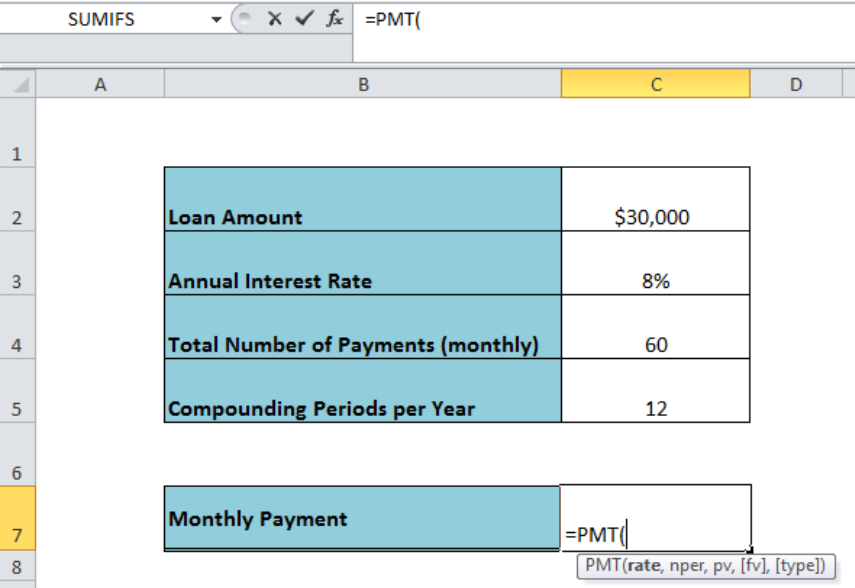
PMT Function: The
PMTfunction is Excel’s equivalent of the loan payment formula. It takes the rate, number of periods, and present value (principal) as arguments.-
Syntax:
=PMT(rate, nper, pv, [fv], [type])-
rate: The interest rate per period (e.g., annual rate/12). -
nper: The total number of payments for the loan (e.g., years*12). -
pv: The present value, or the total amount that a series of future payments is worth now; also known as the principal. -
fv: [optional] The future value, or a cash balance you want to attain after the last payment is made. If omitted,fvis assumed to be 0 (the typical case for loan amortization). -
type: [optional] The number 0 or 1 and indicates when payments are due. 0 = at the end of the period (default), 1 = at the beginning of the period.
-
-
Example: For our $10,000 loan at 7% over 5 years (monthly payments), the formula would be:
=PMT(0.07/12, 60, 10000). Note that the result will typically be negative in Excel to signify an outflow of cash. The result would be approximately -$205.72.
-
-
Building an Amortization Schedule: Spreadsheets allow you to create a detailed amortization schedule where you can track each payment, calculate the interest paid, principal paid, and remaining balance for every period. This level of detail is invaluable for understanding the long-term cost of your loan and the impact of early payments.
Financial Apps and Their Benefits
Many personal finance apps now integrate loan calculators and even tracking features. These apps can often pull in your actual loan data (if you link your accounts) and provide real-time updates on your outstanding balance, interest accrued, and payment breakdowns. Some even offer tools to model different repayment strategies, such as making extra payments or refinancing.
Why Understanding Your Loan Payment Matters
Knowing how to calculate and interpret your loan payments extends far beyond simply knowing what you owe each month. It’s a critical skill for financial empowerment.
Budgeting and Financial Planning
Accurate knowledge of your loan payments is foundational for effective budgeting. When you know precisely how much is committed to debt repayment each month, you can allocate the remainder of your income appropriately, save for other goals, and avoid overspending. This predictability helps prevent financial stress and ensures you live within your means.
Evaluating Loan Offers and Terms
When comparing loan offers from different lenders, the ability to calculate payments manually or with tools allows you to truly understand and compare the total cost of borrowing. A slightly lower interest rate or a longer term can drastically alter your monthly payment and the overall interest you pay. By running these calculations yourself, you can identify the most favorable terms, negotiate more effectively, and avoid costly mistakes.
Identifying Opportunities for Early Repayment
Understanding the amortization schedule reveals how much interest you’re paying, especially in the early years of a long-term loan. This insight can motivate you to make extra principal payments whenever possible. Even small additional contributions can significantly reduce the total interest paid and shorten the loan term, leading to substantial savings. Knowing your payment structure helps you visualize the direct financial benefit of such actions.
Making Informed Refinancing Decisions
Refinancing involves taking out a new loan to pay off an existing one, often to secure a lower interest rate or change the loan term. When considering refinancing, calculating the potential new payment is crucial. You’ll want to compare the new monthly payment, the total interest saved, and any refinancing fees against your current loan to determine if it’s truly a beneficial move. The ability to perform these calculations provides clarity and confidence in such a significant financial decision.

Avoiding Financial Stress
Ignorance about your financial obligations is a leading cause of stress. By proactively understanding your loan payments and how they work, you transform ambiguity into clarity. This knowledge empowers you to manage your debts responsibly, plan for unforeseen circumstances, and ultimately achieve greater peace of mind regarding your financial health.
Calculating a loan payment might seem complex at first glance, but by breaking it down into its core variables and understanding the amortization process, it becomes a manageable task. Whether you prefer manual formulas or the convenience of online tools, mastering this skill is an indispensable step towards taking control of your financial well-being and making smarter borrowing decisions throughout your life.
aViewFromTheCave is a participant in the Amazon Services LLC Associates Program, an affiliate advertising program designed to provide a means for sites to earn advertising fees by advertising and linking to Amazon.com. Amazon, the Amazon logo, AmazonSupply, and the AmazonSupply logo are trademarks of Amazon.com, Inc. or its affiliates. As an Amazon Associate we earn affiliate commissions from qualifying purchases.