
NVIDIA Corporation (NVDA) stands as a titan in the technology sector, renowned for its graphics processing units (GPUs) that power everything from high-end gaming and professional visualization to artificial intelligence and data centers. For investors, the company’s meteoric growth and innovative prowess are often the primary draw. However, a common question among current and prospective shareholders, particularly those with an income-focused investment strategy, revolves around NVIDIA’s dividend policy: “How often does NVIDIA pay dividends?”
While NVIDIA is undeniably a growth stock, it does indeed pay a dividend. Understanding the frequency, history, and strategic implications of this payout is crucial for a complete financial picture. This article delves into NVIDIA’s approach to shareholder returns, demystifying its dividend schedule and explaining why its strategy differs from traditional dividend-paying companies, all within the lens of prudent financial management and investment insights.

NVIDIA’s Dividend Policy: A Historical Perspective
NVIDIA’s journey as a public company has been marked by periods of rapid expansion, technological breakthroughs, and significant shifts in its capital allocation strategy. Its dividend policy reflects this dynamic evolution, prioritizing strategic reinvestment during periods of intense growth while maintaining a consistent, albeit modest, payout to shareholders.
The Early Years of Dividend Payments
NVIDIA first initiated a quarterly cash dividend in 2012, a significant milestone for a company that had previously focused almost exclusively on reinvesting its earnings back into the business for research and development (R&D) and market expansion. At the time, the decision was seen by some as a sign of the company’s growing maturity and financial stability, signaling a commitment to return capital directly to shareholders. The initial quarterly payout per share was relatively small, reflecting a cautious approach, but it established NVIDIA as a company that recognized the value of direct shareholder distributions. This move demonstrated confidence in its future cash flow generation while still reserving ample capital for strategic investments. The rationale behind starting dividends typically involves appealing to a broader base of investors, including those seeking income, and signaling financial health and confidence to the market.
The Shift in Dividend Strategy: Prioritizing Growth
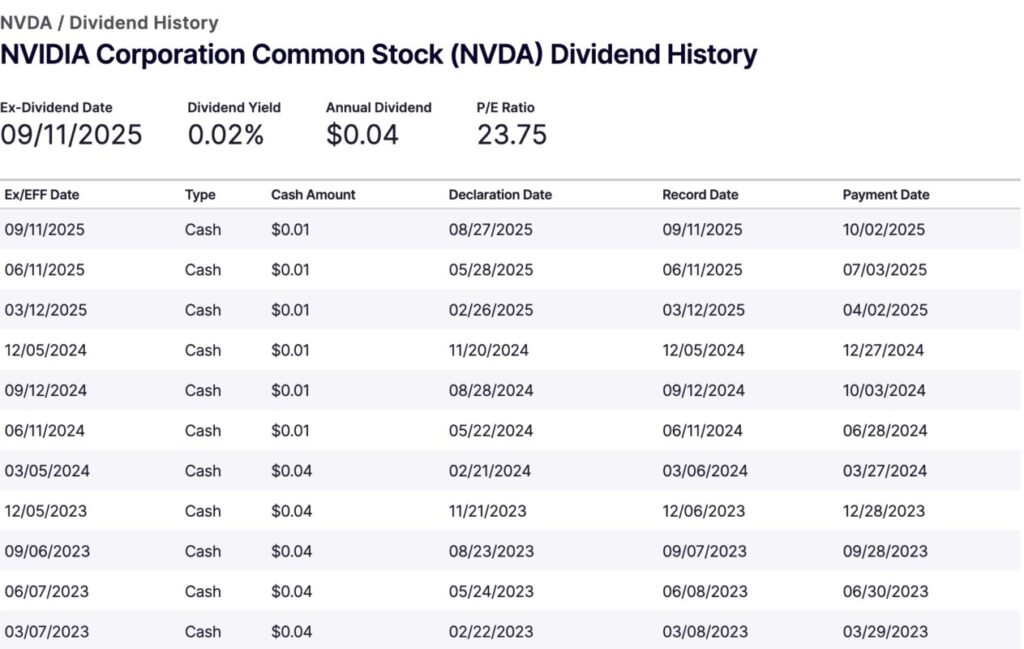
Following the initial period of dividend payments, NVIDIA’s strategy subtly shifted. While it continued to pay a quarterly dividend, the growth in the dividend per share largely stalled. For many years, the quarterly dividend remained constant at a modest amount, even as the company’s revenue and profits skyrocketed, driven by the burgeoning demand for GPUs in new markets like AI, cryptocurrency mining (at one point), and data centers.
This strategic choice was deliberate and fundamental to NVIDIA’s success. Instead of increasing dividend payouts significantly, the company chose to reinvest a substantial portion of its free cash flow back into the business. This reinvestment fueled an aggressive R&D pipeline, allowing NVIDIA to maintain its technological leadership, acquire strategic assets, and expand its market reach. For a company operating at the cutting edge of technology, where innovation cycles are rapid and competition is fierce, prioritizing reinvestment over larger dividend hikes was a financially sound decision. It allowed NVIDIA to sustain its competitive advantage, ensuring long-term growth and ultimately, greater capital appreciation for its shareholders. The decision effectively communicated to the market that NVIDIA’s primary focus was on maximizing future growth potential rather than providing substantial immediate income.
Current Dividend Status and Frequency
As of recent financial disclosures, NVIDIA consistently pays a quarterly cash dividend. This means shareholders receive a dividend payment four times a year, typically distributed a few weeks after the end of each fiscal quarter. While the dollar amount per share is notably low compared to the company’s high stock price, resulting in a very modest dividend yield, the frequency of payment is standard for most dividend-paying U.S. corporations.
For investors, this means that while NVIDIA offers the regularity of quarterly payments, it is not structured to be a primary source of income. Instead, the dividend acts more as a token gesture of shareholder return, with the vast majority of investor value derived from capital appreciation as the company’s stock price continues to climb on the back of its technological advancements and market dominance. The consistency of the quarterly payment, despite its size, underscores NVIDIA’s stable financial position and its commitment, however small, to return a portion of its earnings to shareholders directly.
The Mechanics of NVIDIA’s Dividend Payouts
Understanding how dividends are processed is fundamental for any income-focused investor. For NVIDIA, like most public companies, specific dates and metrics govern the distribution of its quarterly payments. These mechanics are critical for investors to know in order to qualify for and receive their dividends effectively.
Key Dates for Dividend Investors
There are four crucial dates associated with any dividend payment, and NVIDIA’s quarterly payouts adhere to this standard framework:
- Declaration Date: This is the date when NVIDIA’s board of directors officially announces their intention to pay a dividend. The announcement typically includes the amount of the dividend per share, the record date, and the payment date. This is the official statement of the company’s commitment.
- Ex-Dividend Date: This is perhaps the most critical date for investors looking to receive a dividend. To be eligible for NVIDIA’s upcoming dividend payment, an investor must purchase the stock before the ex-dividend date. If you buy the stock on or after the ex-dividend date, you will not receive the upcoming dividend payment; instead, the seller of the stock (who owned it before this date) will receive it. The stock price typically drops by the dividend amount on the ex-dividend date, reflecting the cash leaving the company.
- Record Date: This date usually falls one business day after the ex-dividend date. On the record date, NVIDIA’s transfer agent reviews its records to determine which shareholders officially own the stock. Only shareholders recorded on this date are eligible to receive the dividend payment. You must be an official “owner of record” by this date.
- Payment Date: This is the date when the declared dividend is actually paid out to eligible shareholders. On this date, the cash dividend is distributed to the brokerage accounts of the shareholders who met the requirements of the ex-dividend and record dates. NVIDIA typically provides a payment date a few weeks after the record date, allowing time for administrative processing.
Understanding Dividend Yield
Dividend yield is a key financial metric for income investors, representing the annual dividend income per share relative to the stock’s current market price. It is calculated as (Annual Dividend Per Share / Current Stock Price) * 100%. For NVIDIA, its dividend yield is historically very low, often a fraction of a percent.
A low dividend yield for NVIDIA is a direct consequence of its strategy: a small, largely stagnant dividend payment combined with a rapidly appreciating stock price. For instance, if NVIDIA pays $0.04 per share quarterly, that’s $0.16 annually. If the stock price is $900, the dividend yield would be ($0.16 / $900) * 100% ≈ 0.018%. This stands in stark contrast to mature, income-focused companies, which might offer yields of 2%, 3%, or even higher. For NVIDIA, the dividend yield is not a primary attraction; instead, it highlights the company’s robust growth premium that overshadows its income component.
Dividend Growth and Sustainability
The concept of dividend growth focuses on how often and by how much a company increases its dividend payouts over time. For NVIDIA, significant dividend growth has not been a hallmark of its recent financial strategy. The quarterly dividend has remained stable for an extended period, reflecting the company’s preference for internal reinvestment and other forms of shareholder return like share buybacks.
The sustainability of NVIDIA’s dividend, despite its lack of growth, is exceptionally high. Given its immense profitability, strong cash flow generation, and relatively small dividend payout (payout ratio is extremely low), NVIDIA has no difficulty covering its dividend payments. The question for investors is not whether NVIDIA can sustain its dividend, but whether it chooses to increase it. Currently, the company’s financial choices prioritize allocating capital towards growth opportunities that promise higher future returns, suggesting that substantial dividend increases are unlikely in the near term, barring a major strategic shift.
Why NVIDIA’s Dividend Strategy Differs from Traditional Dividend Stocks
NVIDIA’s position at the vanguard of technological innovation inherently shapes its financial strategy, particularly concerning shareholder returns. Its dividend policy is a clear manifestation of a growth-first mindset, diverging significantly from companies traditionally favored by income investors.
Growth vs. Income: NVIDIA’s Core Focus
At its heart, NVIDIA is and has always been a growth stock. Its valuation reflects the market’s expectation of future earnings growth, driven by its leadership in critical, expanding markets such as artificial intelligence, high-performance computing, and enterprise solutions. For investors, the primary appeal of NVIDIA lies in its potential for significant capital appreciation, rather than the steady income stream provided by dividends.
Companies that are categorized as “dividend stocks” typically operate in more mature, stable industries with predictable cash flows, where growth opportunities are fewer, and returning a large portion of earnings to shareholders via dividends is a primary way to deliver value. Think of utilities, consumer staples, or real estate investment trusts (REITs). NVIDIA, in contrast, operates in a highly dynamic sector, where the “next big thing” can redefine market leadership. This environment demands continuous, substantial investment to maintain a competitive edge.
Reinvestment for Future Innovation
NVIDIA’s strategic decision to maintain a modest dividend and forgo aggressive dividend growth is fundamentally linked to its commitment to reinvestment. The company funnels billions into research and development annually, far exceeding the scale of its dividend payments. This capital is deployed to:
- Advance GPU Architecture: Continuously improving the performance and efficiency of its core products.
- Develop New Platforms: Expanding into new areas like autonomous vehicles, robotics, and Omniverse (their metaverse platform).
- Acquire Strategic Assets: Making targeted acquisitions that complement its technological stack or expand its market reach.
- Build Ecosystems: Investing in software development tools, developer communities, and partnerships that enhance the value and utility of its hardware.
This heavy reinvestment strategy is not merely a preference; it’s a necessity for a company whose valuation is largely predicated on its ability to innovate and stay ahead of the curve. Every dollar reinvested into R&D is seen as having the potential to generate many more dollars in future revenue and profit, ultimately leading to greater shareholder wealth through stock price appreciation. This prioritizes long-term value creation over immediate income distribution.
Share Buybacks as an Alternative Shareholder Return
While dividends are a direct form of cash payout, share buybacks (or share repurchases) represent another significant method for companies to return value to shareholders. NVIDIA has historically engaged in substantial share buyback programs, often prioritizing them over significant dividend increases.
When a company buys back its own shares, it reduces the total number of outstanding shares. This action has several financial benefits:
- Increases Earnings Per Share (EPS): With fewer shares outstanding, the company’s net income is divided among a smaller pool of shares, thereby boosting EPS.
- Supports Stock Price: Reduced supply of shares in the market can create upward pressure on the stock price.
- Signals Confidence: A company buying back its shares signals management’s belief that the stock is undervalued, or that it’s a good use of capital.
For NVIDIA, buybacks are often seen as a more flexible and tax-efficient way to return capital compared to dividends, especially for growth-oriented shareholders. Buybacks allow the company to capitalize on market dips and effectively manage its share count without committing to a permanent increase in fixed dividend payments, which can be challenging to reverse without negative market reactions. This flexibility aligns better with a company that experiences cyclical demand and rapid technological shifts.
Implications for Investors: Is NVIDIA a Dividend Stock?
Given NVIDIA’s specific financial strategy, it’s essential for investors to accurately categorize the company within their portfolio and understand what kind of return to expect.
Attracting Different Investor Profiles
NVIDIA’s investment profile primarily appeals to growth investors – individuals or institutions whose main objective is capital appreciation. These investors are willing to forgo immediate income in exchange for the potential for substantial long-term gains through stock price increases. They are less concerned with dividend yield and more focused on revenue growth, profit margins, innovation cycles, and market expansion.
Conversely, NVIDIA is generally not considered a suitable investment for income investors. These investors prioritize a consistent and growing stream of dividend income to meet their financial needs, such as retirement expenses. Traditional dividend stocks typically offer higher yields and a history of regular dividend increases, which is not NVIDIA’s primary characteristic. While NVIDIA does pay a dividend, its minimal yield means it contributes negligibly to an income-focused portfolio.
Analyzing Total Shareholder Return
For any stock, particularly growth stocks like NVIDIA, evaluating total shareholder return (TSR) provides a more comprehensive picture than focusing solely on dividends or stock price appreciation in isolation. TSR includes both capital gains (from stock price appreciation) and dividends paid over a period.
For NVIDIA, the vast majority of its TSR has come from capital appreciation. The stock has experienced phenomenal growth over the past decade, far outstripping any income generated from its modest dividends. Therefore, investors considering NVIDIA should evaluate its historical performance and future potential predominantly through the lens of its market value appreciation, recognizing dividends as a small, supplementary component of their overall return. Analyzing TSR allows investors to weigh the impact of share buybacks, which indirectly boost capital appreciation by reducing share count, against direct dividend payouts.
The Future of NVIDIA’s Dividends
Predicting the future of any company’s dividend policy is speculative, but for NVIDIA, certain factors could influence changes. As a company matures and its growth rate potentially normalizes, it might find itself generating excess cash flow beyond what can be efficiently reinvested in high-return opportunities. At such a point, increasing dividend payouts could become a more attractive option for returning capital to shareholders.
However, given NVIDIA’s current position at the forefront of AI and other rapidly expanding technological frontiers, the need for aggressive reinvestment is unlikely to diminish significantly in the immediate future. The company is continually finding new markets and applications for its technology, demanding ongoing capital allocation for R&D, infrastructure, and strategic partnerships. Therefore, while a substantial dividend hike is always a possibility down the line, investors should not expect NVIDIA to transform into a high-yield dividend stock anytime soon. Its financial stewardship will likely continue to prioritize strategic growth initiatives and flexible share buybacks over a dramatically increased dividend.

Conclusion: Balancing Growth and Shareholder Returns
NVIDIA pays dividends quarterly, adhering to a standard four-times-a-year schedule. However, for investors primarily focused on income, it’s crucial to understand that NVIDIA is not a traditional dividend stock. Its dividend yield is exceptionally low, and the company has historically prioritized reinvestment into its core business and share buybacks over significant dividend increases.
This strategy is a deliberate financial choice, reflecting NVIDIA’s identity as a cutting-edge growth company operating in highly dynamic and capital-intensive markets. By funneling its robust cash flows into research, development, and strategic expansion, NVIDIA aims to sustain its technological leadership and generate substantial long-term capital appreciation for its shareholders. For those investing in NVIDIA, the primary financial reward comes from the impressive growth in its stock price, with the consistent but modest quarterly dividend serving as a secondary, albeit reliable, component of its overall shareholder return strategy. Understanding this balance is key to aligning investment expectations with NVIDIA’s unique financial blueprint.
aViewFromTheCave is a participant in the Amazon Services LLC Associates Program, an affiliate advertising program designed to provide a means for sites to earn advertising fees by advertising and linking to Amazon.com. Amazon, the Amazon logo, AmazonSupply, and the AmazonSupply logo are trademarks of Amazon.com, Inc. or its affiliates. As an Amazon Associate we earn affiliate commissions from qualifying purchases.