
The Dow Jones Industrial Average (DJIA), often simply called “the Dow,” stands as one of the most iconic and frequently cited barometers of the U.S. stock market and, by extension, the broader economy. For over a century, its daily movements have captured the attention of investors, analysts, and the general public alike, serving as a quick snapshot of market sentiment and corporate health. When conversations turn to market performance, the question inevitably arises: what was the highest Dow Jones average ever recorded? Pinpointing this precise peak requires an understanding of how the index works, the different ways “highest” can be defined, and the historical context of its journey. Beyond just a number, the Dow’s peaks represent moments of significant economic confidence, technological advancement, and shifts in investor psychology, offering valuable insights into the forces that shape financial markets.
The Dow Jones Industrial Average: A Century of Benchmarking
At its core, the Dow is a price-weighted average of 30 significant companies listed on U.S. stock exchanges. While it’s not a true average in the mathematical sense (due to the “Dow divisor” which adjusts for stock splits and other changes), its purpose remains clear: to offer a representative snapshot of the industrial sector’s performance within the broader economy.
A Brief History and Purpose
Conceived by Charles Dow in 1896, the DJIA initially comprised just 12 industrial companies, a reflection of America’s manufacturing-centric economy at the turn of the 20th century. Over the decades, its composition has evolved dramatically, shedding companies like U.S. Leather and American Cotton Oil for modern titans such as Apple, Microsoft, and UnitedHealth Group. This dynamic adjustment ensures that the index remains relevant, reflecting the dominant industries and economic drivers of its time. Its primary purpose is to provide a readily understandable indicator of the stock market’s direction, offering a pulse on investor sentiment and the financial health of leading American corporations. For many, a rising Dow signals economic prosperity and corporate profitability, while a declining Dow can portend economic headwinds.
More Than Just a Number
While the S&P 500 is often considered a more comprehensive gauge of the broader market due to its larger number of constituents and market-capitalization weighting, the Dow’s historical significance and simpler structure make it a compelling narrative device. It’s often the first number cited in news reports about market performance, serving as an easily digestible shorthand for complex market dynamics. Its movements are scrutinized not only by professional investors making multi-million-dollar decisions but also by individual savers checking their retirement portfolios. The psychological impact of the Dow crossing major milestones – whether 10,000, 20,000, 30,000, or even 40,000 – often fuels market rallies and shapes public perception of economic well-being, demonstrating its enduring power as a symbol of American capitalism.
Charting the Peaks: Pinpointing the Highest Average
Determining “the highest Dow Jones average” isn’t as straightforward as it might seem. Markets are dynamic, constantly fluctuating throughout the trading day. This leads to a distinction that is crucial for accuracy.
Defining “Highest”: Closing High vs. Intraday High
When financial journalists or market analysts refer to a “record high” for the Dow, they are typically referring to its all-time closing high. This is the highest value the index reached at the end of a trading day, which is the official figure recorded and widely reported. However, during the trading day, the Dow can often spike higher, briefly touching an intraday high that surpasses its ultimate closing value before retreating. For example, the Dow might hit 40,100 points during the day but then close at 39,950. In this scenario, 39,950 would be the official closing high for that day, even though it traded higher temporarily. When asking for “the highest Dow Jones average,” most are interested in the official, widely recognized closing record.
The Current All-Time High
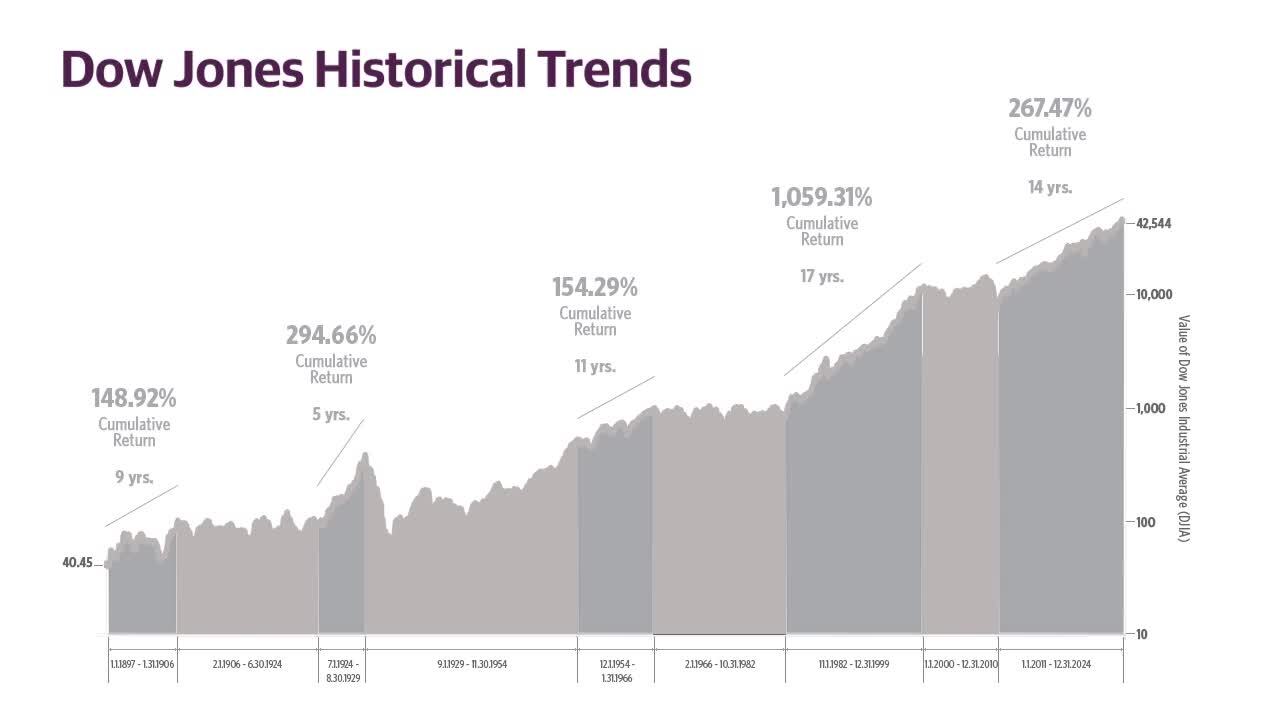
As of late 2023 and early 2024, the Dow Jones Industrial Average has been navigating unprecedented territory, repeatedly breaking its own records. The index surpassed the significant psychological milestone of 40,000 points in May 2024, marking a historic achievement. This latest surge built upon a strong rebound from earlier volatility, propelled by factors such as robust corporate earnings, easing inflation concerns, and optimism regarding potential interest rate adjustments by the Federal Reserve.
Prior to reaching the 40,000 mark, the Dow had established significant closing highs in late 2021 and early 2022, pushing past 36,000 points. After a period of correction and consolidation through much of 2022, the index regained momentum in 2023 and 2024, reflecting a resilient U.S. economy and strong performance from its constituent companies. It is important to note that the “highest average” is a continually moving target in an upward-trending market, with new records being set as economic and corporate fundamentals evolve.
Key Milestones on the Upward Trajectory
The journey to these record highs has been punctuated by numerous significant milestones, each reflecting broader economic shifts and investor confidence:
- 1,000 points: First crossed in 1972, after decades of more gradual growth, symbolizing the post-World War II economic boom.
- 10,000 points: Achieved in 1999 during the height of the dot-com bubble, representing a decade of significant technological advancement and robust market returns.
- 20,000 points: Reached in January 2017, just after the U.S. presidential election, amidst optimism about deregulation and tax cuts. This milestone was achieved relatively quickly after 19,000 points, signaling accelerating market momentum.
- 30,000 points: Surpassed in November 2020, amidst the initial rollout of COVID-19 vaccines and massive fiscal and monetary stimulus packages, showcasing a remarkable rebound from the pandemic-induced crash earlier that year.
- 40,000 points: The most recent significant milestone, crossed in May 2024, reflecting sustained economic growth and corporate profitability despite persistent inflation and geopolitical uncertainties.
Each of these milestones not only marked a new high but also reflected a period of substantial wealth creation and evolving economic landscapes.
Unpacking the Drivers: What Propels the Dow Upward?
The ascent of the Dow Jones Industrial Average to record highs is rarely the result of a single factor. Instead, it is typically a confluence of economic, corporate, and psychological forces working in concert. Understanding these drivers is key to interpreting market movements and making informed financial decisions.
Economic Growth and Corporate Earnings
The most fundamental driver of stock market appreciation is robust economic growth. When the economy is expanding, businesses typically experience higher sales, increased revenues, and, crucially, stronger corporate earnings. The Dow’s 30 components are among the largest and most influential companies in the U.S., meaning their financial performance is often a bellwether for the overall economy. Strong earnings translate into higher stock prices as investors anticipate greater future profits and dividend payouts. Conversely, periods of economic contraction or recession often see a decline in corporate earnings and, consequently, lower stock valuations.

Monetary Policy and Interest Rates
Central bank actions, particularly those of the U.S. Federal Reserve, exert a powerful influence on the stock market. When the Fed implements an accommodative monetary policy—such as lowering interest rates or engaging in quantitative easing—it makes borrowing cheaper for businesses and consumers. This can stimulate economic activity, encourage investment, and make stocks more attractive compared to fixed-income assets (like bonds) which offer lower yields. Conversely, raising interest rates to combat inflation can make borrowing more expensive, cool down economic growth, and often leads to a reevaluation of stock valuations as future earnings are discounted at a higher rate. The anticipation and reaction to these policy shifts are critical market movers.
Technological Advancements and Innovation
Throughout history, technological innovation has been a consistent engine of economic growth and market appreciation. From the industrial revolution to the advent of the internet and, more recently, artificial intelligence, new technologies create entirely new industries, improve productivity, and open up new markets. Companies at the forefront of these innovations often experience rapid growth and become dominant players, driving up their market capitalization and, by extension, the value of indices like the Dow where they are represented. The current bull market, for instance, has seen significant contributions from tech giants whose innovations have transformed global economies.
Geopolitical Stability and Investor Confidence
While less quantifiable, geopolitical stability and investor confidence play a significant psychological role in driving market performance. Periods of peace, predictable political landscapes, and strong international relations tend to foster an environment of certainty, encouraging long-term investment. Conversely, geopolitical tensions, trade wars, or domestic political instability can introduce uncertainty, leading to investor caution, capital flight, and market downturns. Confidence, or the lack thereof, can become a self-fulfilling prophecy, influencing whether investors are willing to pay a premium for future earnings or retreat to safer assets.
The Investor’s Perspective: Interpreting Market Highs
For individual investors, record-breaking Dow averages can evoke a range of emotions, from excitement and satisfaction to anxiety about a potential market correction. It’s crucial to view these highs through a long-term, strategic lens rather than getting swept up in daily headlines.
Beyond the Headlines: Diversification and Long-Term Investing
While a rising Dow is generally good news, a focus solely on its headline number can be misleading. A well-diversified investment portfolio should extend beyond the 30 companies of the DJIA, encompassing a broader range of industries, market capitalizations, and even international equities. A single index’s performance, even one as prominent as the Dow, doesn’t tell the whole story of an individual investor’s portfolio. The most successful investors often prioritize a long-term strategy, understanding that market cycles are inevitable and that consistent contributions and diversification are key to weathering volatility and capturing overall market growth. This approach mitigates the risk of putting all eggs in one basket, even if that basket is the prestigious Dow.
Volatility and Market Corrections
History has repeatedly shown that market highs are often followed by periods of increased volatility or even corrections (a decline of 10% or more from a recent peak). While a record high signals strong market momentum, it can also lead to concerns about overvaluation, where stock prices may have outpaced fundamental earnings growth. Prudent investors acknowledge that pullbacks are a normal, healthy part of market cycles, offering opportunities to buy assets at lower prices. Rather than reacting emotionally to every dip, a disciplined investor uses a predetermined strategy, such as dollar-cost averaging, to navigate these fluctuations.
Investing in a High-Market Environment
When indices are at record levels, it can feel daunting to invest new capital, fearing that one might be buying at the top. However, “time in the market” generally trumps “timing the market.” Strategies for prudent investing in a high-market environment include:
- Dollar-Cost Averaging: Regularly investing a fixed amount of money regardless of market levels. This strategy automatically buys more shares when prices are low and fewer when prices are high, smoothing out the average purchase price over time.
- Rebalancing: Periodically adjusting your portfolio back to your target asset allocation. If stocks have performed exceptionally well, you might sell some high-performing equity to reinvest in other asset classes that have lagged, maintaining your desired risk profile.
- Focus on Fundamentals: Instead of chasing hot stocks, concentrate on companies with strong balance sheets, consistent earnings growth, competitive advantages, and reasonable valuations relative to their growth prospects.
- Maintain an Emergency Fund: Ensure you have adequate cash reserves outside of your investment portfolio to avoid being forced to sell investments during a market downturn to cover unexpected expenses.
Looking Ahead: The Future of the Dow and Your Portfolio
The Dow Jones Industrial Average, with its rich history and prominent position, will undoubtedly continue to be a focal point for economic discussions and investment strategies. Its future, like the market it represents, will be shaped by an interplay of innovation, policy, and investor behavior.
Enduring Relevance in a Changing Landscape
Despite the emergence of more diversified indices and the increasing globalization of financial markets, the Dow maintains its enduring relevance. Its simplicity and historical depth make it an accessible indicator for gauging the health of America’s corporate giants. While its composition will continue to evolve, reflecting shifts in the economic landscape and the rise of new industries, its role as a key benchmark and a narrative centerpiece for market performance is unlikely to diminish. Its journey past 40,000 points is a testament to the long-term upward bias of well-managed economies and innovative businesses.
Navigating Economic Cycles
The future of the Dow, like all market indices, will involve navigating inevitable economic cycles. Periods of expansion and record highs will eventually give way to contractions and corrections, only to be followed by new periods of growth. Understanding this cyclical nature is fundamental for long-term investing. Rather than attempting to predict the next peak or trough, investors are better served by focusing on diversification, maintaining a long-term perspective, and sticking to an investment plan tailored to their individual financial goals and risk tolerance.

Continuous Learning and Adaptation
The world of finance is in constant flux. Technological advancements, evolving regulatory environments, global economic shifts, and changing corporate landscapes mean that what worked yesterday may not be optimal tomorrow. For any investor, continuous learning and adaptation are paramount. Staying informed about economic trends, understanding the drivers behind market movements, and regularly reviewing and adjusting personal financial strategies are essential for not just surviving, but thriving in a dynamic investment environment, ensuring that individual portfolios are well-positioned for whatever highs and lows the Dow Jones Industrial Average—and the broader market—may bring.
aViewFromTheCave is a participant in the Amazon Services LLC Associates Program, an affiliate advertising program designed to provide a means for sites to earn advertising fees by advertising and linking to Amazon.com. Amazon, the Amazon logo, AmazonSupply, and the AmazonSupply logo are trademarks of Amazon.com, Inc. or its affiliates. As an Amazon Associate we earn affiliate commissions from qualifying purchases.