
Deciding when to claim Social Security benefits is one of the most significant financial choices you’ll make as you approach retirement. While age 62 offers the earliest possible claiming age, it comes with a trade-off: a permanently reduced monthly benefit compared to waiting until your Full Retirement Age (FRA) or even later. Understanding the mechanics of this reduction, your personal financial situation, and the long-term implications is crucial for making an informed decision.
Understanding Early Claiming: The Basics
Claiming Social Security benefits at 62 means you are opting for the earliest possible distribution. However, this is not without consequence. The Social Security Administration (SSA) designed the system to incentivize delaying benefits, and starting at 62 triggers the maximum possible reduction to your monthly payment.

The Full Retirement Age (FRA) Conundrum
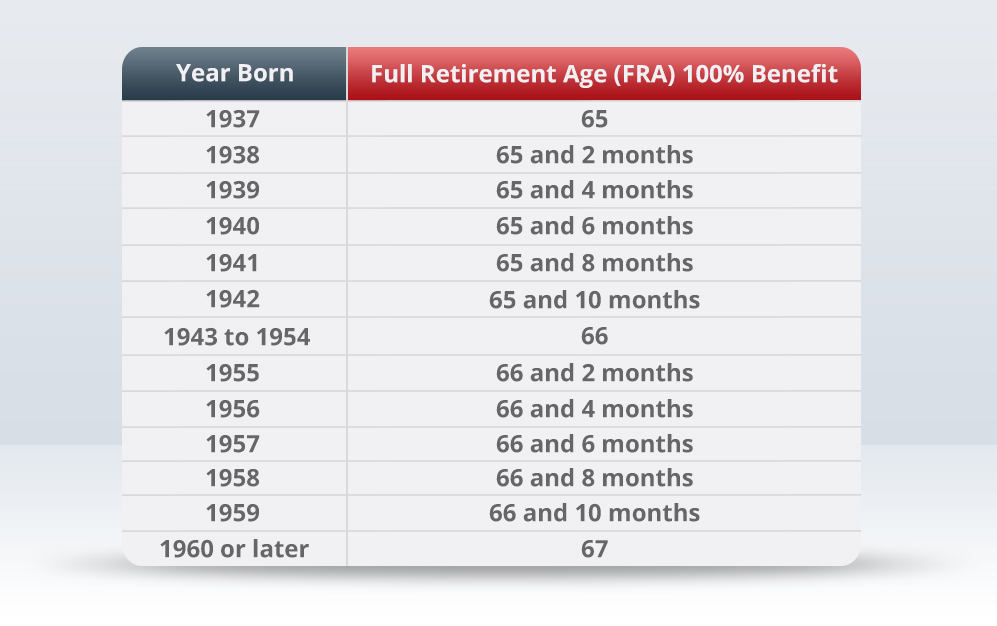
Your Full Retirement Age (FRA) is the age at which you are entitled to receive 100% of your Primary Insurance Amount (PIA). The FRA isn’t a fixed age for everyone; it depends on your birth year. For those born in 1943 through 1954, FRA is 66. It then gradually increases by a few months for each subsequent birth year until it reaches 67 for those born in 1960 or later.
Claiming before your FRA results in a reduced benefit, while claiming after your FRA (up to age 70) results in an increased benefit due to Delayed Retirement Credits. The closer you are to your FRA when you claim, the smaller the reduction. Conversely, starting at 62—the furthest point from your FRA for most individuals—incurs the largest reduction.
The Permanent Reduction Penalty
When you claim Social Security at age 62, your monthly benefit is permanently reduced. This reduction is calculated based on the number of months you claim benefits before your FRA.
For every month you claim benefits before your FRA, your monthly payment is reduced. The reduction rate is structured in two tiers:
-
For the first 36 months early: Your benefit is reduced by 5/9 of 1% per month.
-
For any additional months beyond 36 (up to 60 months, for those with an FRA of 67): Your benefit is reduced by 5/12 of 1% per month.
Let’s illustrate with an example: If your FRA is 67 and you claim at 62, you are claiming 60 months early.
-
The first 36 months reduce your benefit by 36 * (5/9 * 1%) = 20%.
-
The remaining 24 months (60 – 36) reduce your benefit by 24 * (5/12 * 1%) = 10%.
-
Total reduction: 20% + 10% = 30%.
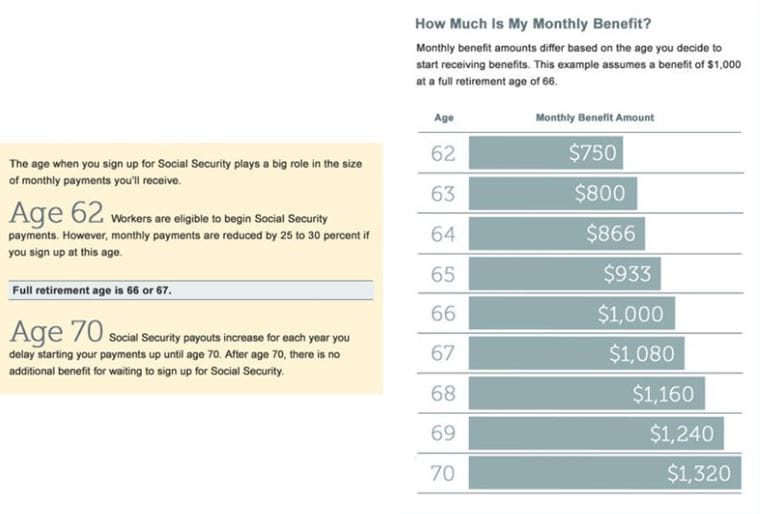
This means if your PIA (the amount you’d receive at FRA) was, say, $2,000, claiming at 62 would reduce your monthly payment to $1,400 ($2,000 * (1 – 0.30)). This reduction is permanent for the rest of your life, though your benefit will still be subject to cost-of-living adjustments (COLAs).
Calculating Your Potential Benefit at 62
To understand how much you might receive, you first need to know your Primary Insurance Amount (PIA) and then apply the appropriate reduction factor.
Your Primary Insurance Amount (PIA)
Your PIA is the monthly benefit you would receive if you started claiming at your Full Retirement Age. The SSA calculates your PIA based on your average indexed monthly earnings (AIME) over your 35 highest-earning years. The more you earned (and paid Social Security taxes on) over your career, and the longer you worked, the higher your PIA will likely be. If you have fewer than 35 years of earnings, zero-earning years will be averaged in, lowering your PIA.
You can find an estimate of your PIA by creating an account and logging into your personal “My Social Security” account on the SSA website. This online portal provides personalized estimates of your future benefits at different claiming ages, including 62, your FRA, and 70.
Applying the Reduction Factors
Once you know your PIA and your FRA, you can calculate the estimated reduction:
-
Determine your FRA: Based on your birth year.
-
Calculate months early: Subtract 62 from your FRA in years, then multiply by 12.
-
Apply the reduction percentages:
-
If your FRA is 66 (e.g., born 1954), you are claiming 48 months early.
-
36 months * 5/9% = 20%
-
12 months * 5/12% = 5%
-
Total reduction = 25%. Your benefit at 62 would be 75% of your PIA.
-
-
If your FRA is 66 and 2 months (e.g., born 1956), you are claiming 50 months early.
-
36 months * 5/9% = 20%
-
14 months * 5/12% = 5.83%
-
Total reduction = 25.83%. Your benefit at 62 would be 74.17% of your PIA.
-
-
If your FRA is 67 (e.g., born 1960 or later), you are claiming 60 months early.
-
36 months * 5/9% = 20%
-
24 months * 5/12% = 10%
-
Total reduction = 30%. Your benefit at 62 would be 70% of your PIA.
-
-
Factors Influencing Your PIA
Several elements play a role in determining your PIA:
-
Lifetime Earnings: Your highest 35 years of earnings, adjusted for inflation, are used. Higher earnings generally mean a higher PIA.
-
Work History Length: Working for at least 35 years ensures no zero-earning years are averaged in.
-
Social Security Tax Contributions: Your PIA is based on earnings up to the annual Social Security wage base limit.
-
Age of Claiming: This directly impacts the final monthly amount you receive, as explained with the reduction factors.
Pros and Cons of Claiming Social Security Early
The decision to claim at 62 is complex, with both potential advantages and significant drawbacks.
Advantages of Starting at 62
-
Immediate Income: For some, an immediate income stream at 62 is necessary due to job loss, health issues, or a desire for early retirement. This income can bridge a gap until other retirement savings become accessible or simply provide much-needed financial relief.
-
Opportunity to Invest Early Benefits: If you don’t immediately need the income, you could theoretically claim benefits at 62 and invest them, hoping for a return that offsets the permanent reduction. However, this strategy carries investment risk and requires careful financial planning.
-
Uncertainty of Life Expectancy: If you have health concerns or a family history of shorter lifespans, taking benefits earlier might mean receiving more money over your lifetime compared to waiting. The break-even point (when the cumulative higher payments from delaying catch up to the cumulative payments from early claiming) can be in your late 70s or early 80s.
-
Spousal Flexibility (in some cases): If your spouse has a significantly higher PIA, you might claim your own reduced benefit at 62, allowing your spouse’s benefit to continue growing until age 70. Then, you might be able to switch to a higher spousal benefit if that amount exceeds your own. This is a complex strategy that requires careful calculation.
Disadvantages and Long-Term Impact
-
Permanently Reduced Monthly Income: This is the most significant drawback. A 25-30% reduction means less income for the rest of your retirement, which can be critical if you live a long life.
-
Reduced Survivor Benefits for Spouse: If you pass away, your surviving spouse may be eligible for a survivor benefit based on your work record. If you claimed early, your reduced benefit amount will determine the maximum your spouse can receive, potentially leaving them with less income.
-
Impact on Lifetime Earnings Cap (if working): If you claim benefits at 62 and continue to work, you may be subject to the Social Security Earnings Test until you reach your FRA. The SSA will deduct $1 from your benefits for every $2 you earn above an annual limit (which is $22,320 in 2024, but check current figures). This can lead to your benefits being partially or fully withheld.
-
Inflation Erosion: A lower starting benefit means a lower base for future Cost-of-Living Adjustments (COLAs), meaning your purchasing power may erode more quickly over time compared to a higher initial benefit.
-
Loss of Growth Potential: Forgoing Delayed Retirement Credits (DRCs) means missing out on an 8% annual increase in benefits for each year you delay past your FRA, up to age 70. This effectively means you are forgoing a guaranteed 8% return on your future benefits, which is a powerful incentive to delay.
Strategic Considerations for Early Claimers
Before making a definitive choice, consider these personal and financial factors.
Health and Life Expectancy
This is perhaps the most personal and critical factor. If you anticipate a shorter life expectancy due to health conditions, claiming early might maximize your total lifetime benefits. Conversely, if you expect to live well into your 80s or 90s (which is increasingly common), delaying benefits often results in a higher cumulative payout due to the increased monthly amounts over a longer period.
Other Income Sources and Retirement Savings
Do you have sufficient retirement savings (401(k), IRA, pensions, taxable investments) to cover your expenses if you don’t claim Social Security? Or, do you need Social Security to supplement these accounts? If your other retirement funds are robust, you might be able to delay Social Security and allow it to grow. If your savings are limited, claiming early might be a necessity. Evaluate your budget and projected expenses carefully.
Spousal and Survivor Benefits
Social Security offers benefits for spouses and survivors, which can be significant. If you are married, your decision impacts not just your own financial future but also your spouse’s, especially if you are the higher earner. A spouse can claim a benefit based on their own work record or up to 50% of the higher-earning spouse’s Full Retirement Age benefit, whichever is greater. If the higher earner dies, the surviving spouse typically receives 100% of the deceased’s benefit (or their own, whichever is higher). Claiming early can reduce the survivor benefit your spouse would receive. Coordination between spouses is key to maximizing household benefits.
The Earnings Test Explained
As mentioned, if you claim Social Security before your Full Retirement Age and continue to work, your benefits may be reduced if your earnings exceed a certain limit. For 2024, the annual exempt amount is $22,320. If you earn more than this, $1 in benefits will be withheld for every $2 you earn above the limit. In the year you reach FRA, the limit is higher ($59,520 in 2024), and $1 is withheld for every $3 earned above the limit. Once you reach your FRA, the earnings test no longer applies, and you can earn as much as you want without affecting your Social Security benefits.
It’s important to note that any benefits withheld due to the earnings test are not lost forever. Your future monthly benefits will be slightly increased at your FRA to account for the withheld amounts, effectively crediting you for the months you didn’t receive full benefits. However, this adjustment does not fully negate the impact of the initial early claiming reduction.
Tools and Resources for Informed Decisions
Making the right choice requires accurate information and personalized analysis.
The Social Security Administration’s Online Tools
The “My Social Security” account is your most valuable resource. By creating an account, you can:
-
View your complete earnings record.
-
Get personalized benefit estimates at various claiming ages (62, FRA, 70).
-
Review your Social Security statement.
-
Apply for benefits online.
These tools provide the foundational data needed for your decision-making.
Seeking Professional Financial Advice
Given the complexity and long-term implications of this decision, consulting a qualified financial advisor can be highly beneficial. A financial planner specializing in retirement can:
-
Analyze your entire financial picture, including all assets, liabilities, and income sources.
-
Project your future cash flow and expenses.
-
Help you understand the impact of various claiming strategies on your overall retirement plan.
-
Advise on coordinated claiming strategies for married couples.
-
Provide insight into tax implications and other pertinent financial considerations.
The decision to claim Social Security benefits at 62 is deeply personal and depends on a confluence of financial, health, and lifestyle factors. While it offers immediate income, it comes with a significant and permanent reduction in your monthly benefit. A thorough understanding of how your benefits are calculated, the trade-offs involved, and how it integrates with your broader retirement plan is essential for making a choice that best supports your financial well-being throughout your retirement years.
aViewFromTheCave is a participant in the Amazon Services LLC Associates Program, an affiliate advertising program designed to provide a means for sites to earn advertising fees by advertising and linking to Amazon.com. Amazon, the Amazon logo, AmazonSupply, and the AmazonSupply logo are trademarks of Amazon.com, Inc. or its affiliates. As an Amazon Associate we earn affiliate commissions from qualifying purchases.