
The promise of harnessing the sun’s abundant energy has driven decades of innovation, making solar power an increasingly viable and critical component of global electricity grids. Understanding precisely how much electricity solar power produces is not a simple fixed number; rather, it’s a dynamic calculation influenced by a sophisticated interplay of technological factors, environmental conditions, and system design. At its core, solar power production hinges on the photovoltaic (PV) effect, a marvel of semiconductor physics that directly converts sunlight into electricity.
Understanding the Fundamentals of Solar Electricity Production
Solar electricity generation begins at the microscopic level within photovoltaic cells, the building blocks of solar panels. These cells, typically made from silicon, are engineered to exploit the photoelectric effect.
The Photovoltaic Effect: Core Technology
When photons from sunlight strike the surface of a PV cell, they impart energy to electrons within the semiconductor material. If the photon has sufficient energy (exceeding the material’s band gap), it can knock an electron loose from its atomic orbit, creating a free electron and a “hole” (the absence of an electron). The specially designed internal electric field within the PV cell then guides these liberated electrons to one side and the holes to the other, establishing a potential difference—a voltage. When an external circuit is connected, these electrons flow, generating a direct current (DC) electricity. Modern silicon PV cells achieve efficiencies upwards of 20%, meaning more than one-fifth of the incident solar energy is converted into usable electricity. Further research into materials like perovskites and multi-junction cells aims to push these efficiencies even higher, leveraging advancements in material science and quantum mechanics.
Key Components of a Solar Energy System
A complete solar power system is more than just a collection of panels. It’s an integrated technological solution designed to capture, convert, and manage electricity.
-
Solar Panels (PV Modules): These house multiple PV cells connected in series and parallel to achieve desired voltage and current outputs. The construction involves a tempered glass front, an encapsulant material (like EVA) to protect cells, and a durable backsheet, all framed for structural integrity.
-
Mounting System: Engineered to securely hold panels at optimal angles and orientations, these systems range from fixed racks to advanced solar trackers that pivot panels to follow the sun’s path throughout the day, maximizing exposure and thus energy capture.
-
Inverter: This is a crucial piece of electronics that converts the DC electricity produced by the panels into alternating current (AC) electricity, which is the standard used by homes, businesses, and the electrical grid.
-
Balance of System (BOS) Components: This umbrella term includes wiring, conduits, junction boxes, disconnect switches, and monitoring equipment, all designed to ensure safe, efficient, and reliable operation.
-
Optional Components: Battery storage systems (e.g., lithium-ion) can store excess electricity for use during periods of low sunlight or power outages. Energy management systems (EMS) provide real-time data, allowing users to monitor production and consumption, often integrating with smart home technologies.
DC vs. AC Output: Inverters at Work
The raw output from solar panels is DC power. However, almost all residential and commercial appliances, as well as the utility grid, operate on AC power. This is where the inverter technology becomes indispensable. String inverters manage an array of panels, converting DC from multiple strings. Microinverters, a more recent technological advancement, are installed directly on each solar panel, converting DC to AC at the panel level. This allows for panel-level optimization, mitigating the impact of shading on individual panels and providing granular monitoring data. Power optimizers, another technology, are DC-to-DC converters placed on each panel to condition the DC power before it reaches a central inverter, combining some benefits of microinverters with the cost-effectiveness of string inverters. The efficiency of these inverters, typically ranging from 95% to 98%, directly affects the final AC output of a solar system.
Factors Influencing Solar Power Output
The amount of electricity a solar system produces is highly variable, a function of both the inherent technology and external environmental factors.
Solar Panel Efficiency: The Technology Race
Panel efficiency refers to the percentage of sunlight energy that a panel can convert into electricity under standard test conditions (STC). Mainstream monocrystalline silicon panels typically have efficiencies between 18% and 23%. Polycrystalline panels are slightly less efficient (15-17%) but often more cost-effective. Research continues to push the boundaries, with experimental cells achieving efficiencies over 40% in laboratory settings through multi-junction designs or novel materials. Higher efficiency panels require less space to produce the same amount of electricity, making them ideal for installations with limited roof area. Manufacturers use advanced cell architectures, anti-reflective coatings, and improved contact designs to maximize photon capture and minimize electrical resistance, driving continuous incremental gains in real-world performance.
Irradiance and Sunlight Hours: Geographical Impact
The primary driver of solar production is solar irradiance—the amount of solar power incident on a given surface area. This is measured in watts per square meter (W/m²). Locations closer to the equator and those with fewer cloudy days receive higher levels of irradiance throughout the year. The duration of sunlight hours also plays a critical role; a panel exposed to strong sunlight for 8 hours will produce significantly more electricity than one exposed for only 4 hours. Meteorological data and solar mapping tools are used by system designers to accurately predict annual energy yield for specific locations.
Temperature and Panel Degradation
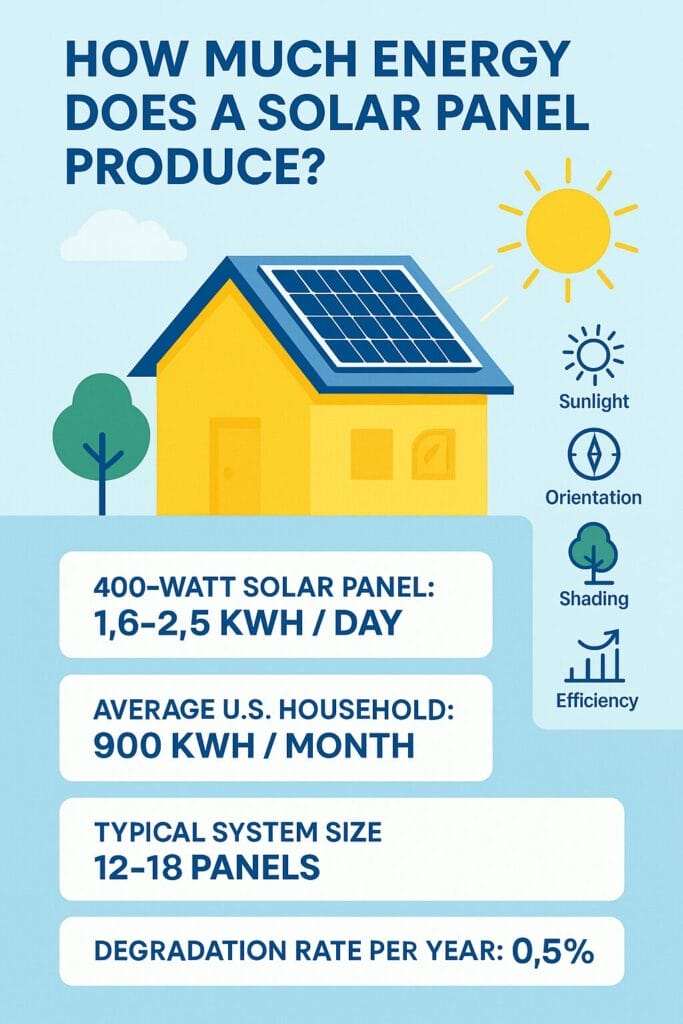
While solar panels need sunlight, excessive heat can actually reduce their efficiency. PV cells convert sunlight more efficiently at cooler temperatures. For every degree Celsius above 25°C (STC temperature), a typical silicon panel’s power output decreases by about 0.3% to 0.5%. This is a material property of semiconductors. Furthermore, solar panels experience a gradual decline in power output over their operational lifespan, known as degradation. Most manufacturers guarantee that their panels will still produce 80-90% of their nameplate power after 25-30 years, thanks to robust material selection and manufacturing processes designed for longevity and resistance to environmental stressors.
Shading and System Orientation
Even partial shading on a single solar panel can disproportionately reduce the output of an entire string of panels in a traditional setup, due to the series connection. Advanced technologies like microinverters and power optimizers mitigate this “Christmas light effect” by allowing each panel to operate independently at its maximum power point. Optimal panel orientation and tilt angle are also critical. In the Northern Hemisphere, panels typically face true south, while in the Southern Hemisphere, they face true north, to maximize exposure to the sun throughout the day and year. The tilt angle is often chosen to maximize annual energy production or to optimize for summer or winter production, depending on specific energy needs.
Maintenance and Cleaning Technologies
Dust, dirt, pollen, and other debris accumulating on the surface of solar panels can block sunlight, reducing output. Regular cleaning, while often minimal, can maintain optimal performance. Technologies like robotic cleaning systems for large arrays, and hydrophobic coatings that repel dirt and water, are emerging to simplify maintenance and ensure sustained efficiency. Monitoring systems also play a crucial role by alerting owners to performance drops that might indicate a need for cleaning or maintenance.
Quantifying Solar Output: Metrics and Expectations
To understand the tangible output of a solar system, specific metrics are used, allowing for comparisons and performance tracking.
Kilowatt-Hours (kWh) and Peak Power (kWp)
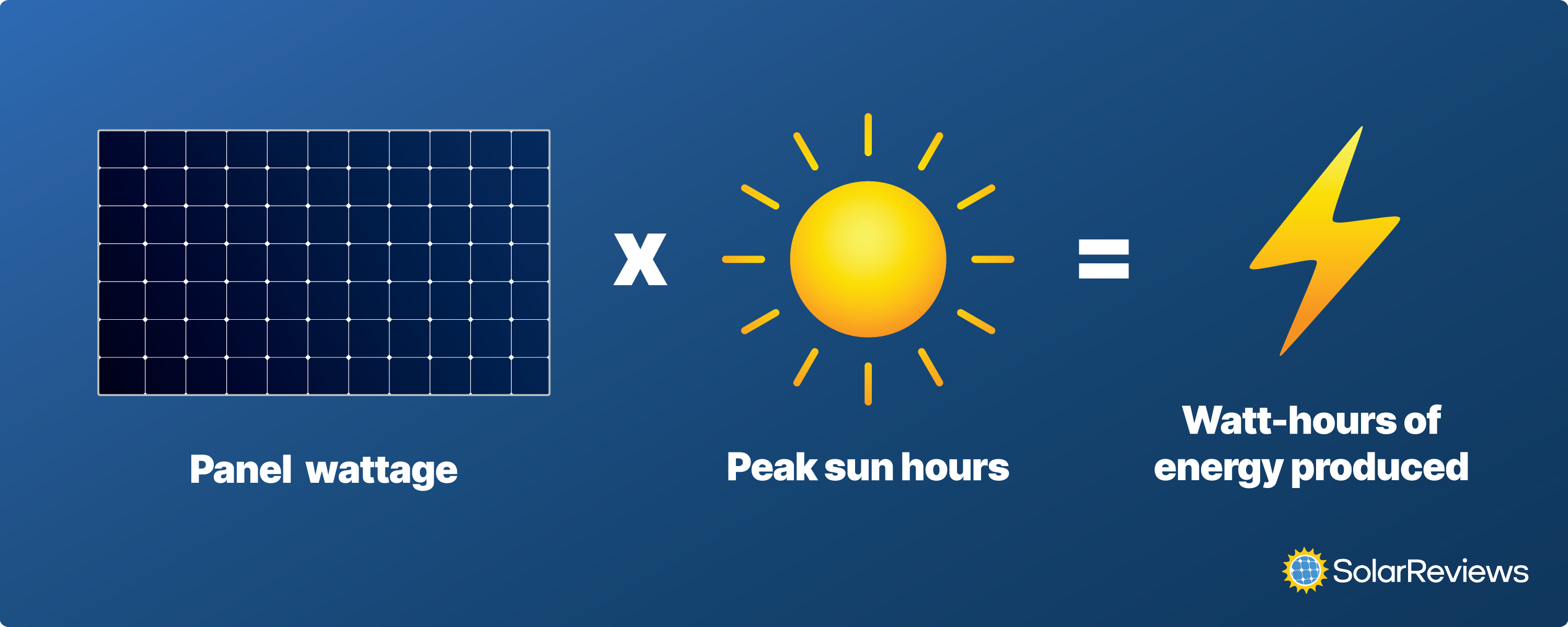
The capacity of a solar panel or system is typically rated in kilowatts peak (kWp), which is the maximum power it can produce under standard test conditions (STC: 1000 W/m² irradiance, 25°C cell temperature, AM1.5 spectrum). This is a theoretical maximum. The actual electricity produced over time is measured in kilowatt-hours (kWh). For example, a 1 kWp system operating at its peak for one hour produces 1 kWh. A typical residential solar panel might have a peak power rating of 350-400 Watts. A 6 kWp residential system (about 15-18 panels) in a sunny location might produce anywhere from 7,000 to 9,000 kWh per year, enough to offset a significant portion of an average home’s electricity consumption. Commercial and utility-scale solar farms can span hundreds or thousands of acres, producing megawatts (MW) or even gigawatts (GW) of power, corresponding to millions or billions of kWh annually.
Typical Residential vs. Commercial System Outputs
Residential solar systems range widely, from small 2 kWp systems offsetting basic consumption to large 15 kWp systems designed for homes with high energy demands or electric vehicle charging. Their annual production can vary from 2,000 kWh to over 20,000 kWh. Commercial systems, such as those on business rooftops or parking lot canopies, are often in the tens or hundreds of kWp range, producing hundreds of thousands of kWh annually. Utility-scale solar farms, on the other hand, are designed to feed directly into the grid, with capacities reaching hundreds of MWp, producing gigawatt-hours of electricity per year. These large installations employ advanced tracking systems, sophisticated inverters, and often have dedicated grid interconnection infrastructure.
Storage Solutions: Enhancing Usable Output
Solar panels produce electricity primarily during daylight hours. To provide power around the clock or during peak evening demand, battery energy storage systems (BESS) are increasingly integrated. These systems typically use lithium-ion battery technology, with capacities measured in kWh. A residential battery might store 10-20 kWh, while utility-scale batteries can store hundreds of MWh. Advanced battery management systems (BMS) optimize charging and discharging cycles, prolonging battery life and enhancing the overall efficiency and reliability of the solar energy system. These technologies are crucial for grid stability and for maximizing the self-consumption of solar power, reducing reliance on the grid.
Advancements and Future of Solar Production Technology
The solar industry is a hotbed of innovation, continually pushing the boundaries of material science, engineering, and digital technology to improve efficiency, reduce costs, and expand applicability.
Perovskite Solar Cells and Next-Gen Materials
While silicon dominates the market, perovskite solar cells are emerging as a highly promising alternative due to their high efficiency potential (already surpassing 25% in labs), flexibility, and lower manufacturing costs. Research is focused on improving their stability and lifespan to make them commercially viable. Other advanced materials include CIGS (copper indium gallium selenide) and cadmium telluride (CdTe) thin-film technologies, which offer advantages in flexibility, transparency, and ease of manufacturing for certain niche applications. Tandem cells, combining different materials (e.g., silicon and perovskite) to absorb different parts of the solar spectrum, are also showing remarkable efficiencies.
Bifacial and Transparent Solar Panels
Bifacial solar panels are designed to capture sunlight from both their front and rear sides. By absorbing light reflected from the ground or other surfaces, these panels can significantly increase electricity production, particularly when installed on light-colored roofs, elevated structures, or ground-mounted systems. Transparent or semi-transparent solar cells are another area of research, with potential applications in building integrated photovoltaics (BIPV) for windows or skylights, generating electricity without sacrificing natural light. These technologies are poised to seamlessly integrate solar generation into everyday structures.
Integrated PV (BIPV) and Smart Grids
Building Integrated Photovoltaics (BIPV) is a technology that integrates solar panels directly into the building envelope, replacing conventional building materials like roof tiles, facades, or windows. This approach not only generates electricity but also provides thermal and acoustic insulation, aesthetics, and structural integrity. As solar power becomes more ubiquitous, its integration into smart grids is paramount. Smart grid technologies utilize digital communication and control systems to monitor and manage electricity production and consumption in real-time, enabling more efficient distribution, demand-response capabilities, and seamless integration of distributed renewable energy sources like solar.
Software for Optimization and Predictive Analytics
Sophisticated software platforms are becoming indispensable for solar system design, monitoring, and maintenance. These tools use algorithms to model panel performance under various conditions, predict energy output based on weather forecasts, and identify potential issues or performance degradations. Machine learning and AI are increasingly used to optimize energy flow, manage battery storage, and even predict panel failures, leading to more reliable and efficient solar power generation. These digital tools significantly enhance the “smartness” of solar installations.
Maximizing Your Solar System’s Production Potential
Achieving the maximum electricity production from a solar system requires careful planning, quality components, and ongoing attention to performance.
Smart Monitoring and Energy Management Systems
Modern solar installations often come equipped with robust monitoring systems that provide real-time data on energy production, consumption, and system health. These systems can track individual panel performance, identify shading issues, and alert owners to potential faults. Integrating these monitoring platforms with home energy management systems (HEMS) allows homeowners to optimize their energy usage, automatically prioritize battery charging, or even adjust appliance schedules to align with peak solar production, thereby maximizing self-consumption and economic benefits.
The Role of Professional Installation and Design
The expertise of professional installers and system designers cannot be overstated. They ensure optimal panel placement, tilt, and orientation based on site-specific solar availability and structural considerations. Correct sizing of the system, proper wiring, and adherence to electrical codes are critical for safety, efficiency, and longevity. An improperly installed system will inevitably underperform and may even pose safety risks. Certified installers are also adept at integrating the various components—panels, inverters, mounting systems, and potentially batteries—into a cohesive and high-performing system.
Keeping Pace with Technological Upgrades
The solar industry is characterized by rapid technological advancement. While a solar system is a long-term investment, keeping abreast of new developments can offer opportunities for enhancing existing systems. Upgrading older string inverters to microinverters, adding battery storage, or integrating more sophisticated energy management software can significantly improve performance, resilience, and user experience. Although full panel replacement is usually not cost-effective for an operational system, understanding market trends and new technologies ensures informed decisions for future expansions or new installations. The continuous evolution of solar technology promises even greater efficiency and accessibility in the years to come, further solidifying its role in our energy future.
aViewFromTheCave is a participant in the Amazon Services LLC Associates Program, an affiliate advertising program designed to provide a means for sites to earn advertising fees by advertising and linking to Amazon.com. Amazon, the Amazon logo, AmazonSupply, and the AmazonSupply logo are trademarks of Amazon.com, Inc. or its affiliates. As an Amazon Associate we earn affiliate commissions from qualifying purchases.